





PyGRT: An integrated, efficient C/Python toolkit for theoretical simulation
in layered half-space media
Chinese Document | English Document (no longer maintained)

Features
- Dynamic full-wave solutions (Green's functions, synthetic displacements, strain, stress, rotation, and dynamic Coulomb stress)
- Surface-wave modal solutions (dispersion curves, eigenfunctions, and surface-wave synthesis)
- Static solutions (static Green's functions, synthetic displacements, and Coulomb stress)
- Multiple source types (explosion, single-force, double-couple, tensile, moment-tensor, and finite-fault sources)
- Auxiliary modules (kernels, Lamb problem, Okada solution, format conversions, and ambient noise simulation)
- CLI and Python API (modular
grtcommand-line tool and Python interface) - Actively maintained — see the documentation for modules and tutorials
Quick Install
Pre-built binaries are available for Linux, macOS, and Windows:
pip install pygrt-kit
Then in Python:
import pygrt
PyGRT also provides the grt CLI. Run grt -h to list available modules, and grt <module> -h (e.g., grt greenfn -h) for module-specific usage.
To use the CLI only (without Python), download the pre-built *.tar.gz archive for your platform from GitHub Releases.
(For conda environments, source builds, and troubleshooting, see the installation guide (Chinese)).
Contact
If you have any questions or suggestions, feel free to reach out:
- Email: zhudengda@mail.iggcas.ac.cn
- GitHub Issues: You can also raise an issue directly on GitHub.
Citation
Since PyGRT has been under continuous maintenance and extension during the peer review, its functions have exceeded the scope described in this paper. For detailed usage of each function, please see the documentation.
Zhu, D., Wang, J., Hao, J., Yao, S., Xu, Y., Xu, T., and Yao, Z. (2025). PyGRT: An Efficient and Integrated Python Package for Computing Synthetic Seismograms in a Layered Half‐Space Model. Seismological Research Letters, 97(3), 2138–2153. doi: 10.1785/0220250057
Zhu, D., Xu, T., Hao, J., and Yao, Z. (2025). A Direct Convergence Method for Computing Synthetic Seismograms for a Layered Half‐Space with Sources and Receivers at Close Depths. Bulletin of the Seismological Society of America, 116(2), 576–588. doi: 10.1785/0120250190
Zhu, D., Xu, T., Hao, J., and Yao, Z. (2026). An Adaptive Strategy for Robust and Efficient Computation of Dispersion Curves in a Layered Half-Space, Bulletin of the Seismological Society of America. doi: doi.org/10.1785/0120260071
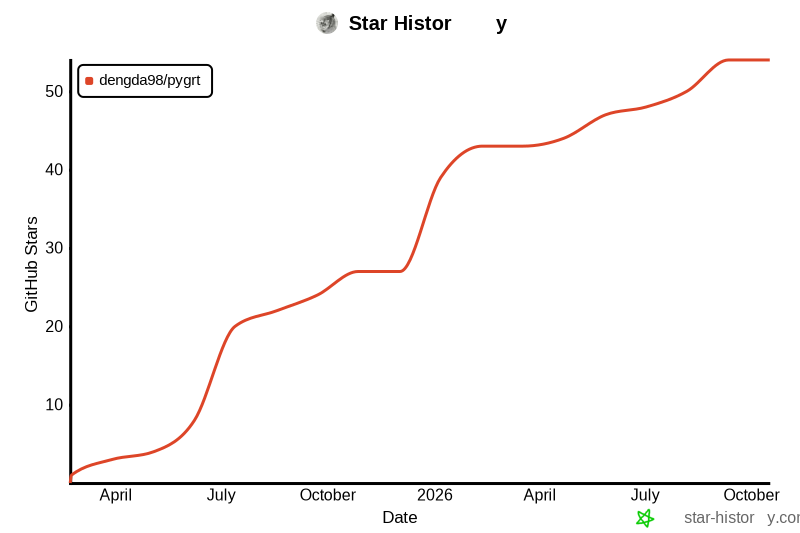
⭐ Like this project? Give it a Star! ⭐
1 maintainer

Metadata
1 maintainer
Release files for pygrt-kit 0.19.0
For a detailed explanation of source distributions (sdists) and built distributions (wheels), please see the package formats documentation.
Built distributions (wheels)
| File | Actions Reset | |||
|---|---|---|---|---|
| pygrt_kit-0.19.0-py3-none-win_amd64.whl | Python 3 | none | Windows x86-64 | Details for pygrt_kit-0.19.0-py3-none-win_amd64.whl |
| pygrt_kit-0.19.0-py3-none-manylinux2014_x86_64.whl | Python 3 | none | Linux glibc 2.17+ x86-64 | Details for pygrt_kit-0.19.0-py3-none-manylinux2014_x86_64.whl |
| pygrt_kit-0.19.0-py3-none-macosx_11_0_arm64.whl | Python 3 | none | macOS 11.0+ ARM64 | Details for pygrt_kit-0.19.0-py3-none-macosx_11_0_arm64.whl |
| pygrt_kit-0.19.0-py3-none-macosx_10_9_x86_64.whl | Python 3 | none | macOS 10.9+ x86-64 | Details for pygrt_kit-0.19.0-py3-none-macosx_10_9_x86_64.whl |
Total release size: 27.5 MB
Release files / pygrt_kit-0.19.0-py3-none-win_amd64.whl
| Download URL | pygrt_kit-0.19.0-py3-none-win_amd64.whl |
|---|---|
| Size | 10.5 MB |
| Tags | Python 3 Windows x86-64 |
|
SHA-256 checksum How to use checksums |
4e45884f2a90b83f84d6fc25d610a3adce531e49dcaee72422ea558273789082
|
|
BLAKE2b-256 checksum How to use checksums |
0d5bef7432ce1da69ff78362492cf48fb1cbb0fccac7c54cd709512fa66c0d6b
|
| Upload date | |
|
Uploaded using Trusted Publishing? What is trusted publishing? |
Yes |
| Uploaded via |
twine/7.0.0 CPython/3.13.16
|
Provenance
Provenance describes where a file came from. On PyPI, provenance is shared via attestations, which provide a verifiable record of the build or publishing details. View details, limitations and caveats.


PyPI Publish Attestation
PyPI verified that this artifact, at this checksum, originated from the publisher listed below.
Signed by GitHub Actions, verified by PyPI on Nov 6, 2026.
Transparency logRelease files / pygrt_kit-0.19.0-py3-none-manylinux2014_x86_64.whl
| Download URL | pygrt_kit-0.19.0-py3-none-manylinux2014_x86_64.whl |
|---|---|
| Size | 4.7 MB |
| Tags | Linux glibc 2.17+ x86-64 Python 3 |
|
SHA-256 checksum How to use checksums |
2700d1d8966e96433af3cb184d0c7a6264d6607847bf27d35cf2aadc7f6cafa1
|
|
BLAKE2b-256 checksum How to use checksums |
47d357d76149ee3b132329e763aeeb6291e457355e51cad0e85a801c92430a0c
|
| Upload date | |
|
Uploaded using Trusted Publishing? What is trusted publishing? |
Yes |
| Uploaded via |
twine/7.0.0 CPython/3.13.16
|
Provenance
Provenance describes where a file came from. On PyPI, provenance is shared via attestations, which provide a verifiable record of the build or publishing details. View details, limitations and caveats.
PyPI Publish Attestation
PyPI verified that this artifact, at this checksum, originated from the publisher listed below.
Signed by GitHub Actions, verified by PyPI on Nov 6, 2026.
Transparency logRelease files / pygrt_kit-0.19.0-py3-none-macosx_11_0_arm64.whl
| Download URL | pygrt_kit-0.19.0-py3-none-macosx_11_0_arm64.whl |
|---|---|
| Size | 4.3 MB |
| Tags | Python 3 macOS 11.0+ ARM64 |
|
SHA-256 checksum How to use checksums |
ffc66866cabcbda5ba8aea021180053147f6e13612a9c4f2b09ac14e47c82953
|
|
BLAKE2b-256 checksum How to use checksums |
ba6ff10de0dc16f37f9522ae7d47c40ceebe0490eac43080002be7c4981e97c0
|
| Upload date | |
|
Uploaded using Trusted Publishing? What is trusted publishing? |
Yes |
| Uploaded via |
twine/7.0.0 CPython/3.13.16
|
Provenance
Provenance describes where a file came from. On PyPI, provenance is shared via attestations, which provide a verifiable record of the build or publishing details. View details, limitations and caveats.
PyPI Publish Attestation
PyPI verified that this artifact, at this checksum, originated from the publisher listed below.
Signed by GitHub Actions, verified by PyPI on Nov 6, 2026.
Transparency logRelease files / pygrt_kit-0.19.0-py3-none-macosx_10_9_x86_64.whl
| Download URL | pygrt_kit-0.19.0-py3-none-macosx_10_9_x86_64.whl |
|---|---|
| Size | 8.0 MB |
| Tags | Python 3 macOS 10.9+ x86-64 |
|
SHA-256 checksum How to use checksums |
d726faa632f6e3af2e889f3b13a45aa0e3ffe428e95852d8505849ad0098f328
|
|
BLAKE2b-256 checksum How to use checksums |
ab831b44980948f6d5cae8d4f86f42d7c4345111e98b5e0824c49a235fdfb340
|
| Upload date | |
|
Uploaded using Trusted Publishing? What is trusted publishing? |
Yes |
| Uploaded via |
twine/7.0.0 CPython/3.13.16
|
Provenance
Provenance describes where a file came from. On PyPI, provenance is shared via attestations, which provide a verifiable record of the build or publishing details. View details, limitations and caveats.
PyPI Publish Attestation
PyPI verified that this artifact, at this checksum, originated from the publisher listed below.
Signed by GitHub Actions, verified by PyPI on Nov 6, 2026.
Transparency logSecurity for pygrt-kit 0.19.0
Provenance
Provenance describes where a file came from. On PyPI, provenance is shared via attestations, which provide a verifiable record of the build or publishing details. View details, limitations and caveats.
Full provenance
All 4 files in this release have been uploaded with provenance metadata.
Attestation for pygrt_kit-0.19.0-py3-none-win_amd64.whl
PyPI Publish Attestation
PyPI verified that this artifact, at this checksum, originated from the publisher listed below.
Signed by GitHub Actions, verified by PyPI on Nov 6, 2026.
Transparency logA note on package security
PyPI is a repository for distributing packages, not a service for auditing them. While third-party security researchers and our staff do their best to detect and remove malicious packages, PyPI cannot guarantee the quality, security or suitability of any given package.
To learn more about protecting yourself from malicious actors, visit our package security documentation.














