
pyinc





Salsa-style red-green queries, hardened for Python's mutable runtime.
pyinc is a correctness-first incremental query engine for Python. Declare
keyed inputs and pure queries, and it records the dependency graph while your
code runs. On the next request it reuses unaffected work, recomputes affected
queries, and backdates semantically equal results so downstream work stays
valid. It is pure Python and stdlib-only, with zero runtime dependencies.
It is built to replace a hand-rolled caching layer and its cache-invalidation
bugs, such as the editor still underlining an error you fixed a minute ago.
Python 3.11 to 3.14 and the free-threaded 3.14t build are supported and tested on Linux, macOS, and Windows. Python 3.15 and later are not supported, because query identity reads bytecode and module metadata, and both change with every CPython minor release.
python -m pip install pyinc
Status
pyinc is feature-complete. No new features are planned. Bug fixes and soundness fixes are welcome as pull requests. CONTRIBUTING.md has the setup and the checks. No response time is promised. The supported Python versions are 3.11 to 3.14, plus the free-threaded 3.14t build.
Semantic versioning covers only what pyinc and pyinc.integrations export.
pyinc_tools and pyinc_codegen are feature-frozen: their behavior changes
only to fix a defect.
Quick start
from __future__ import annotations

from pyinc import Database, Input, query

NAMES = Input[tuple[str, ...]]("example.names")


@query
def normalized_names(db: Database) -> tuple[str, ...]:
    return tuple(sorted({name.strip() for name in NAMES.read(db)}))


db = Database(mode="strict")
db.set(NAMES, (" Grace ", "Ada", "Ada"))
assert db.get(normalized_names) == ("Ada", "Grace")

db.set(NAMES, ("Grace", "Ada"))
assert db.get(normalized_names) == ("Ada", "Grace")
assert db.inspect(normalized_names).last_decision == "backdated"
The first request computes the result. The second input is different, so the
query runs again, but its result is semantically equal. pyinc backdates that
node, so everything downstream stays valid.
See it on a real workspace
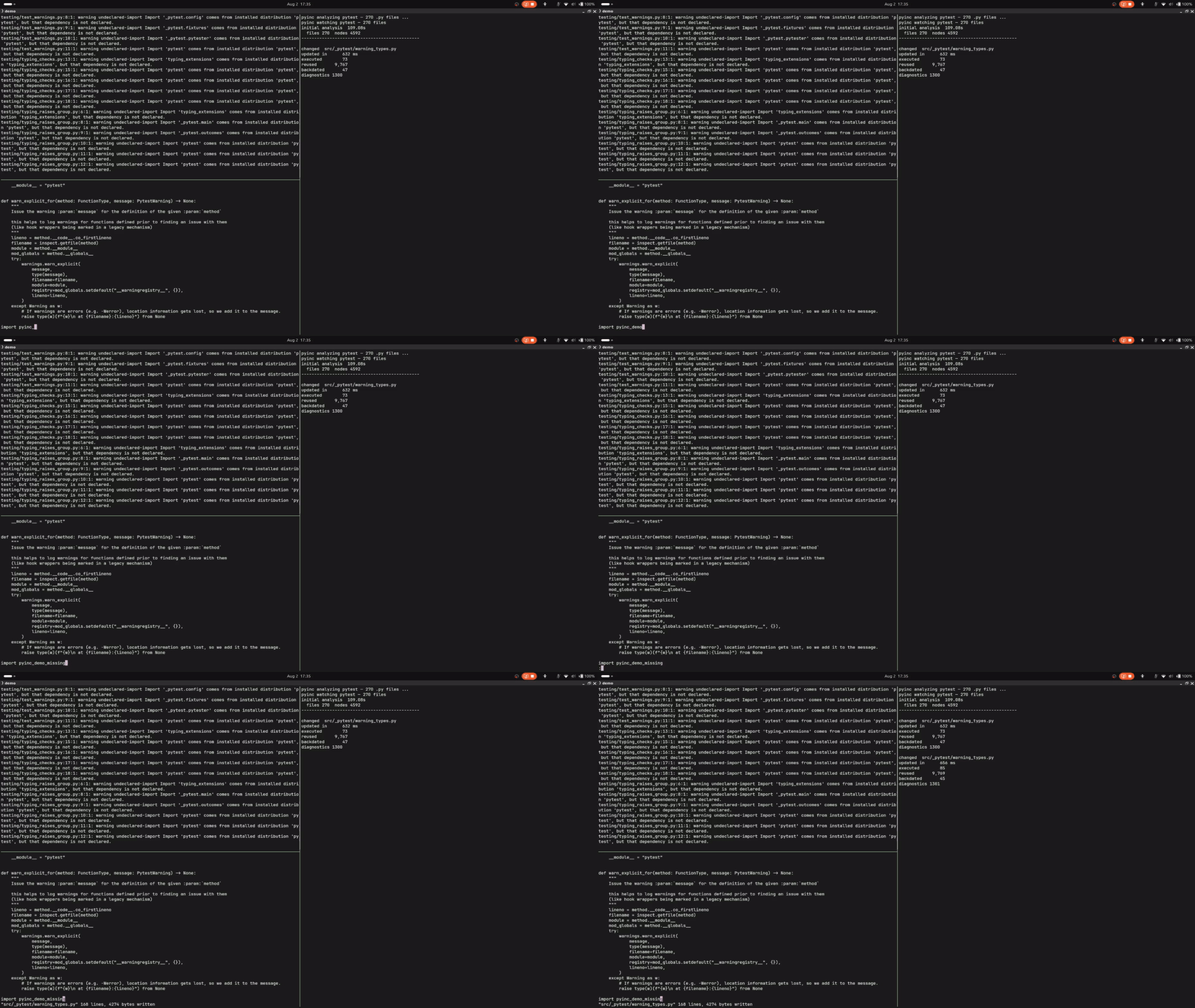
pyinc-tools was pointed at a pinned checkout of pytest, with nothing in it
adapted for pyinc, and watched while single files were edited. The recording
was made with a development build of pyinc 3.1.
The demo page has
the clips and their provenance. For numbers from your own machine, run
python -m bench.overhead from the repository root. It prints cost ratios
measured in one run. The
benchmark README
describes the harness.
Documentation
- Getting started: build a small graph, add a tracked file, choose a mode, inspect work, and write a first action.
- Examples: small runnable scripts, including the
calcworked example. - FAQ: how this relates to Salsa, why not
lru_cache, threading, scope, and when not to use it. - Kernel contract: the from-scratch consistency guarantee, its three conditions, modes, checkpoints, and limitations. The action contract covers declared-output reconciliation.
- Integration contract: stable entrypoints, result types, supported shapes, and limits.
pyinc-toolsguide and LSP reference: CLI, editor setup, overlays, protocol methods, and user-visible limitations.- Documentation index: every document, the package map, and the authoring and codegen guides.
- Releases and verification: what the release workflow checks, trusted publishing, and checking a download.
One distribution ships three top-level typed packages: pyinc, pyinc_tools,
and pyinc_codegen. The stable integration surface, pyinc.integrations, is a
subpackage of pyinc.
pyinc: the stable query kernel, resources, snapshots, artifact stores, and declared-output actionspyinc.integrations: stable analysis results and entrypoints for Python source, configuration, dependencies, symbols, and notebookspyinc_tools(feature-frozen):pyinc-tools analyze, a polling watcher,WorkspaceSession, and a stdio LSP serverpyinc_codegen(feature-frozen): JSON Schema to typed Python generation
Development
git clone https://github.com/Brumbelow/pyinc.git
cd pyinc
python3 -m venv .venv
. .venv/bin/activate
python3 -m pip install -e '.[dev]' -c constraints.txt
python3 scripts/check_docs.py
pytest -n auto -m 'not process' --ignore tests/test_properties.py --tb=short
python3 -m mypy src tests bench scripts examples
python3 -m mypy --platform win32 src tests bench scripts examples
python3 -m ruff check src tests bench scripts examples
1 maintainer

Metadata
1 maintainer
Release files for pyinc 6.0.0
For a detailed explanation of source distributions (sdists) and built distributions (wheels), please see the package formats documentation.
Source distribution (sdist)
| File | Size | Uploaded | Provenance | Actions |
|---|---|---|---|---|
| pyinc-6.0.0.tar.gz | 2.8 MB | With provenance | Details for pyinc-6.0.0.tar.gz |
Built distribution (wheel)
| File | Interpreter | ABI | Platform | Actions Reset |
|---|---|---|---|---|
| pyinc-6.0.0-py3-none-any.whl | Python 3 | none | any | Details for pyinc-6.0.0-py3-none-any.whl |
Total release size: 3.2 MB
Release files / pyinc-6.0.0.tar.gz
| Download URL | pyinc-6.0.0.tar.gz |
|---|---|
| Size | 2.8 MB |
| Tags | Source |
|
SHA-256 checksum How to use checksums |
a54413efa0ede03c9248f0d3382d5e5cfe54cbb6974f58a8bebf6b1cc470e65a
|
|
BLAKE2b-256 checksum How to use checksums |
76bf10276b2833121bf01d87461bd9fa3f55e72e7525ac81edd2c30f03b2d4db
|
| Upload date | |
|
Uploaded using Trusted Publishing? What is trusted publishing? |
Yes |
| Uploaded via |
twine/7.0.0 CPython/3.13.16
|
Provenance
Provenance describes where a file came from. On PyPI, provenance is shared via attestations, which provide a verifiable record of the build or publishing details. View details, limitations and caveats.


PyPI Publish Attestation
PyPI verified that this artifact, at this checksum, originated from the publisher listed below.
Signed by GitHub Actions, verified by PyPI on Nov 14, 2026.
Transparency logRelease files / pyinc-6.0.0-py3-none-any.whl
| Download URL | pyinc-6.0.0-py3-none-any.whl |
|---|---|
| Size | 386.0 kB |
| Tags | Python 3 |
|
SHA-256 checksum How to use checksums |
151e91e20c4d70ef5ca2cb17a023a9078e0d7e418658e92f8044989617702956
|
|
BLAKE2b-256 checksum How to use checksums |
3f3fd88b262bb4dc3bdc2da232026121b8b5b02b78f4b50d010c4c75cef2737f
|
| Upload date | |
|
Uploaded using Trusted Publishing? What is trusted publishing? |
Yes |
| Uploaded via |
twine/7.0.0 CPython/3.13.16
|
Provenance
Provenance describes where a file came from. On PyPI, provenance is shared via attestations, which provide a verifiable record of the build or publishing details. View details, limitations and caveats.
PyPI Publish Attestation
PyPI verified that this artifact, at this checksum, originated from the publisher listed below.
Signed by GitHub Actions, verified by PyPI on Nov 14, 2026.
Transparency logSecurity for pyinc 6.0.0
Provenance
Provenance describes where a file came from. On PyPI, provenance is shared via attestations, which provide a verifiable record of the build or publishing details. View details, limitations and caveats.
Full provenance
Both files in this release have been uploaded with provenance metadata.
Attestation for pyinc-6.0.0.tar.gz
PyPI Publish Attestation
PyPI verified that this artifact, at this checksum, originated from the publisher listed below.
Signed by GitHub Actions, verified by PyPI on Nov 14, 2026.
Transparency logA note on package security
PyPI is a repository for distributing packages, not a service for auditing them. While third-party security researchers and our staff do their best to detect and remove malicious packages, PyPI cannot guarantee the quality, security or suitability of any given package.
To learn more about protecting yourself from malicious actors, visit our package security documentation.














