
A Comprehensive and Scalable Python Library for Outlier Detection (Anomaly Detection)

Project description
Deployment & Documentation & Stats & License










Read Me First
Welcome to PyOD, a well-developed and easy-to-use Python library for detecting anomalies in multivariate data. Whether you are working with a small-scale project or large datasets, PyOD provides a range of algorithms to fit your needs.
PyOD Version 2 is now available (Paper) [12], featuring:
Expanded Deep Learning Support: Integrates 12 modern neural models into a single PyTorch-based framework, bringing the total number of outlier detection methods to 45.
Enhanced Performance and Ease of Use: Models are optimized for efficiency and consistent performance across different datasets.
LLM-based Model Selection: Automated model selection guided by a large language model reduces manual tuning and assists users who may have limited experience with outlier detection.
Multi-Modal Detection via EmbeddingOD: Chain foundation model encoders (sentence-transformers, OpenAI, HuggingFace) with any PyOD detector for text and image anomaly detection. See EmbeddingOD example.
PyOD Ecosystem & Resources: NLP-ADBench (NLP anomaly detection) | TODS (time-series) | PyGOD (graph) | ADBench (benchmark) | AD-LLM (LLM-based AD) [50] | Resources
About PyOD
PyOD, established in 2017, has become a go-to Python library for detecting anomalous/outlying objects in multivariate data. This exciting yet challenging field is commonly referred to as Outlier Detection or Anomaly Detection.
PyOD includes more than 50 detection algorithms, from classical LOF (SIGMOD 2000) to the cutting-edge ECOD and DIF (TKDE 2022 and 2023). Since 2017, PyOD has been successfully used in numerous academic research projects and commercial products with more than 26 million downloads. It is also well acknowledged by the machine learning community with various dedicated posts/tutorials, including Analytics Vidhya, KDnuggets, and Towards Data Science.
PyOD is featured for:
Unified, User-Friendly Interface across various algorithms.
Wide Range of Models, from classic techniques to the latest deep learning methods in PyTorch.
High Performance & Efficiency, leveraging numba and joblib for JIT compilation and parallel processing.
Fast Training & Prediction, achieved through the SUOD framework [55].
Outlier Detection with 5 Lines of Code:
# Example: Training an ECOD detector
from pyod.models.ecod import ECOD
clf = ECOD()
clf.fit(X_train)
y_train_scores = clf.decision_scores_  # Outlier scores for training data
y_test_scores = clf.decision_function(X_test)  # Outlier scores for test data
Text Anomaly Detection with EmbeddingOD (pip install pyod sentence-transformers):
from pyod.models.embedding import EmbeddingOD
clf = EmbeddingOD(encoder='all-MiniLM-L6-v2', detector='KNN')
clf.fit(train_texts)                          # list of strings
scores = clf.decision_function(test_texts)    # anomaly scores
labels = clf.predict(test_texts)              # binary labels

# Or use a preset:
clf = EmbeddingOD.for_text(quality='fast')    # MiniLM + KNN
Image detection requires additional packages (pip install transformers torch). See EmbeddingOD example for details.
Selecting the Right Algorithm: Start with ECOD or Isolation Forest for tabular data, EmbeddingOD for text/image, or MetaOD for data-driven selection.
Citing PyOD:
If you use PyOD in a scientific publication, we would appreciate citations to the following paper(s):
PyOD 2: A Python Library for Outlier Detection with LLM-powered Model Selection is available as a preprint. If you use PyOD in a scientific publication, we would appreciate citations to the following paper:
@inproceedings{chen2025pyod,
  title={Pyod 2: A python library for outlier detection with llm-powered model selection},
  author={Chen, Sihan and Qian, Zhuangzhuang and Siu, Wingchun and Hu, Xingcan and Li, Jiaqi and Li, Shawn and Qin, Yuehan and Yang, Tiankai and Xiao, Zhuo and Ye, Wanghao and others},
  booktitle={Companion Proceedings of the ACM on Web Conference 2025},
  pages={2807--2810},
  year={2025}
}
PyOD paper is published in Journal of Machine Learning Research (JMLR) (MLOSS track).:
@article{zhao2019pyod,
    author  = {Zhao, Yue and Nasrullah, Zain and Li, Zheng},
    title   = {PyOD: A Python Toolbox for Scalable Outlier Detection},
    journal = {Journal of Machine Learning Research},
    year    = {2019},
    volume  = {20},
    number  = {96},
    pages   = {1-7},
    url     = {http://jmlr.org/papers/v20/19-011.html}
}
or:
Zhao, Y., Nasrullah, Z. and Li, Z., 2019. PyOD: A Python Toolbox for Scalable Outlier Detection. Journal of machine learning research (JMLR), 20(96), pp.1-7.
For a broader perspective on anomaly detection, see our NeurIPS papers on ADBench [17] and ADGym.
Table of Contents:
Additional Topics (Model Save/Load, SUOD, Thresholding)
Installation
PyOD is designed for easy installation using either pip or conda. We recommend using the latest version of PyOD due to frequent updates and enhancements:
pip install pyod            # normal install
pip install --upgrade pyod  # or update if needed
conda install -c conda-forge pyodAlternatively, you can clone and run the setup.py file:
git clone https://github.com/yzhao062/pyod.git
cd pyod
pip install .
Required Dependencies:
Python 3.8 or higher
joblib
matplotlib
numpy>=1.19
numba>=0.51
scipy>=1.5.1
scikit_learn>=0.22.0
Optional Dependencies (see details below):
combo (optional, required for models/combination.py and FeatureBagging)
pytorch (optional, required for AutoEncoder, and other deep learning models)
suod (optional, required for running SUOD model)
xgboost (optional, required for XGBOD)
pythresh (optional, required for thresholding)
sentence-transformers (optional, required for EmbeddingOD text detection)
openai (optional, required for EmbeddingOD with OpenAI embeddings)
transformers and torch (optional, required for EmbeddingOD image detection and HuggingFace encoder)
API Cheatsheet & Reference
The full API Reference is available at PyOD Documentation. Below is a quick cheatsheet for all detectors:
fit(X): Fit the detector. The parameter y is ignored in unsupervised methods.
decision_function(X): Predict raw anomaly scores for X using the fitted detector.
predict(X): Determine whether a sample is an outlier or not as binary labels using the fitted detector.
predict_proba(X): Estimate the probability of a sample being an outlier using the fitted detector.
predict_confidence(X): Assess the model’s confidence on a per-sample basis (applicable in predict and predict_proba) [38].
predict_with_rejection(X): Allow the detector to reject (i.e., abstain from making) highly uncertain predictions (output = -2) [39].
Key Attributes of a fitted model:
decision_scores_: Outlier scores of the training data. Higher scores typically indicate more abnormal behavior. Outliers usually have higher scores.
labels_: Binary labels of the training data, where 0 indicates inliers and 1 indicates outliers/anomalies.
ADBench Benchmark and Datasets
We just released a 45-page, the most comprehensive ADBench: Anomaly Detection Benchmark [17]. The fully open-sourced ADBench compares 30 anomaly detection algorithms on 57 benchmark datasets.
The organization of ADBench is provided below:

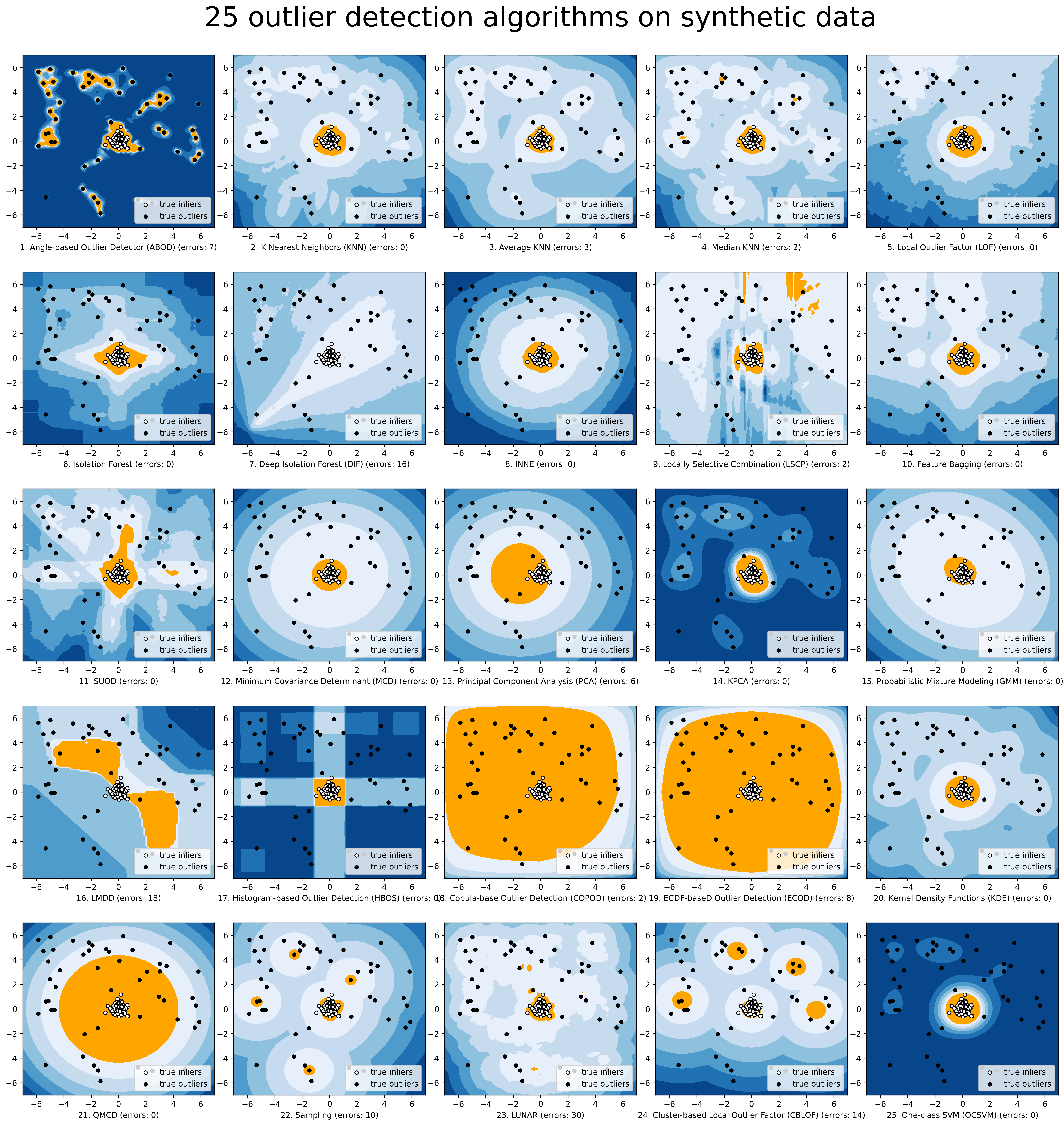
For a simpler visualization, we make the comparison of selected models via compare_all_models.py.
Additional Topics
Model Save & Load: Use joblib or pickle for saving and loading PyOD models. See example.
Fast Train with SUOD: Accelerate training and prediction with the SUOD framework [55]. See example.
Thresholding Outlier Scores: Data-driven approaches for setting contamination levels via PyThresh.
Implemented Algorithms
PyOD toolkit consists of four major functional groups:
(i) Individual Detection Algorithms :
Type |
Abbr |
Algorithm |
Year |
Ref |
|---|---|---|---|---|
Probabilistic |
ECOD |
Unsupervised Outlier Detection Using Empirical Cumulative Distribution Functions |
2022 |
|
Probabilistic |
ABOD |
Angle-Based Outlier Detection |
2008 |
|
Probabilistic |
FastABOD |
Fast Angle-Based Outlier Detection using approximation |
2008 |
|
Probabilistic |
COPOD |
COPOD: Copula-Based Outlier Detection |
2020 |
|
Probabilistic |
MAD |
Median Absolute Deviation (MAD) |
1993 |
|
Probabilistic |
SOS |
Stochastic Outlier Selection |
2012 |
|
Probabilistic |
QMCD |
Quasi-Monte Carlo Discrepancy outlier detection |
2001 |
|
Probabilistic |
KDE |
Outlier Detection with Kernel Density Functions |
2007 |
|
Probabilistic |
Sampling |
Rapid distance-based outlier detection via sampling |
2013 |
|
Probabilistic |
GMM |
Probabilistic Mixture Modeling for Outlier Analysis |
[1] [Ch.2] |
|
Linear Model |
PCA |
Principal Component Analysis (the sum of weighted projected distances to the eigenvector hyperplanes) |
2003 |
|
Linear Model |
KPCA |
Kernel Principal Component Analysis |
2007 |
|
Linear Model |
MCD |
Minimum Covariance Determinant (use the mahalanobis distances as the outlier scores) |
1999 |
|
Linear Model |
CD |
Use Cook’s distance for outlier detection |
1977 |
|
Linear Model |
OCSVM |
One-Class Support Vector Machines |
2001 |
|
Linear Model |
LMDD |
Deviation-based Outlier Detection (LMDD) |
1996 |
|
Proximity-Based |
LOF |
Local Outlier Factor |
2000 |
|
Proximity-Based |
COF |
Connectivity-Based Outlier Factor |
2002 |
|
Proximity-Based |
(Incremental) COF |
Memory Efficient Connectivity-Based Outlier Factor (slower but reduce storage complexity) |
2002 |
|
Proximity-Based |
CBLOF |
Clustering-Based Local Outlier Factor |
2003 |
|
Proximity-Based |
LOCI |
LOCI: Fast outlier detection using the local correlation integral |
2003 |
|
Proximity-Based |
HBOS |
Histogram-based Outlier Score |
2012 |
|
Proximity-Based |
HDBSCAN |
Density-based clustering based on hierarchical density estimates |
2013 |
|
Proximity-Based |
kNN |
k Nearest Neighbors (use the distance to the kth nearest neighbor as the outlier score) |
2000 |
|
Proximity-Based |
AvgKNN |
Average kNN (use the average distance to k nearest neighbors as the outlier score) |
2002 |
|
Proximity-Based |
MedKNN |
Median kNN (use the median distance to k nearest neighbors as the outlier score) |
2002 |
|
Proximity-Based |
SOD |
Subspace Outlier Detection |
2009 |
|
Proximity-Based |
ROD |
Rotation-based Outlier Detection |
2020 |
|
Outlier Ensembles |
IForest |
Isolation Forest |
2008 |
|
Outlier Ensembles |
INNE |
Isolation-based Anomaly Detection Using Nearest-Neighbor Ensembles |
2018 |
|
Outlier Ensembles |
DIF |
Deep Isolation Forest for Anomaly Detection |
2023 |
|
Outlier Ensembles |
FB |
Feature Bagging |
2005 |
|
Outlier Ensembles |
LSCP |
LSCP: Locally Selective Combination of Parallel Outlier Ensembles |
2019 |
|
Outlier Ensembles |
XGBOD |
Extreme Boosting Based Outlier Detection (Supervised) |
2018 |
|
Outlier Ensembles |
LODA |
Lightweight On-line Detector of Anomalies |
2016 |
|
Outlier Ensembles |
SUOD |
SUOD: Accelerating Large-scale Unsupervised Heterogeneous Outlier Detection (Acceleration) |
2021 |
|
Neural Networks |
AutoEncoder |
Fully connected AutoEncoder (use reconstruction error as the outlier score) |
[1] [Ch.3] |
|
Neural Networks |
VAE |
Variational AutoEncoder (use reconstruction error as the outlier score) |
2013 |
|
Neural Networks |
Beta-VAE |
Variational AutoEncoder (all customized loss term by varying gamma and capacity) |
2018 |
|
Neural Networks |
SO_GAAL |
Single-Objective Generative Adversarial Active Learning |
2019 |
|
Neural Networks |
MO_GAAL |
Multiple-Objective Generative Adversarial Active Learning |
2019 |
|
Neural Networks |
DeepSVDD |
Deep One-Class Classification |
2018 |
|
Neural Networks |
AnoGAN |
Anomaly Detection with Generative Adversarial Networks |
2017 |
|
Neural Networks |
ALAD |
Adversarially learned anomaly detection |
2018 |
|
Neural Networks |
AE1SVM |
Autoencoder-based One-class Support Vector Machine |
2019 |
|
Neural Networks |
DevNet |
Deep Anomaly Detection with Deviation Networks |
2019 |
|
Graph-based |
R-Graph |
Outlier detection by R-graph |
2017 |
|
Graph-based |
LUNAR |
LUNAR: Unifying Local Outlier Detection Methods via Graph Neural Networks |
2022 |
|
Embedding-based |
EmbeddingOD |
Multi-modal anomaly detection via foundation model embeddings (text, image) |
2025 |
Ensemble methods (IForest, INNE, DIF, FB, LSCP, LODA, SUOD, XGBOD) are included in the table above. Score combination functions (average, maximization, AOM, MOA, median, majority vote) are in pyod.models.combination. See API docs for details.
(ii) Utility Functions:
Type |
Name |
Function |
|---|---|---|
Data |
generate_data |
Synthesized data generation; normal data from multivariate Gaussian, outliers from uniform distribution |
Data |
generate_data_clusters |
Synthesized data generation in clusters for more complex patterns |
Evaluation |
evaluate_print |
Print ROC-AUC and Precision @ Rank n for a detector |
Evaluation |
precision_n_scores |
Calculate Precision @ Rank n |
Utility |
get_label_n |
Turn raw outlier scores into binary labels by assigning 1 to the top n scores |
Stat |
wpearsonr |
Calculate the weighted Pearson correlation of two samples |
Encoding |
resolve_encoder |
Resolve an encoder from a string name, BaseEncoder instance, or callable |
Encoding |
SentenceTransformerEncoder |
Encode text via sentence-transformers models (e.g., MiniLM, mpnet) |
Encoding |
OpenAIEncoder |
Encode text via OpenAI Embeddings API (text-embedding-3-small/large) |
Encoding |
HuggingFaceEncoder |
Encode text or images via HuggingFace transformers (BERT, DINOv2, CLIP) |
Quick Start for Outlier Detection
PyOD has been well acknowledged by the machine learning community with a few featured posts and tutorials.
Analytics Vidhya: An Awesome Tutorial to Learn Outlier Detection in Python using PyOD Library
KDnuggets: Intuitive Visualization of Outlier Detection Methods, An Overview of Outlier Detection Methods from PyOD
Towards Data Science: Anomaly Detection for Dummies
“examples/knn_example.py” demonstrates the basic API of using kNN detector. It is noted that the API across all other algorithms are consistent/similar.
More detailed instructions for running examples can be found in examples directory.
Initialize a kNN detector, fit the model, and make the prediction.
from pyod.models.knn import KNN   # kNN detector

# train kNN detector
clf_name = 'KNN'
clf = KNN()
clf.fit(X_train)

# get the prediction label and outlier scores of the training data
y_train_pred = clf.labels_  # binary labels (0: inliers, 1: outliers)
y_train_scores = clf.decision_scores_  # raw outlier scores

# get the prediction on the test data
y_test_pred = clf.predict(X_test)  # outlier labels (0 or 1)
y_test_scores = clf.decision_function(X_test)  # outlier scores

# it is possible to get the prediction confidence as well
y_test_pred, y_test_pred_confidence = clf.predict(X_test, return_confidence=True)  # outlier labels (0 or 1) and confidence in the range of [0,1]
Evaluate the prediction by ROC and Precision @ Rank n (p@n).
from pyod.utils.data import evaluate_print

# evaluate and print the results
print("\nOn Training Data:")
evaluate_print(clf_name, y_train, y_train_scores)
print("\nOn Test Data:")
evaluate_print(clf_name, y_test, y_test_scores)
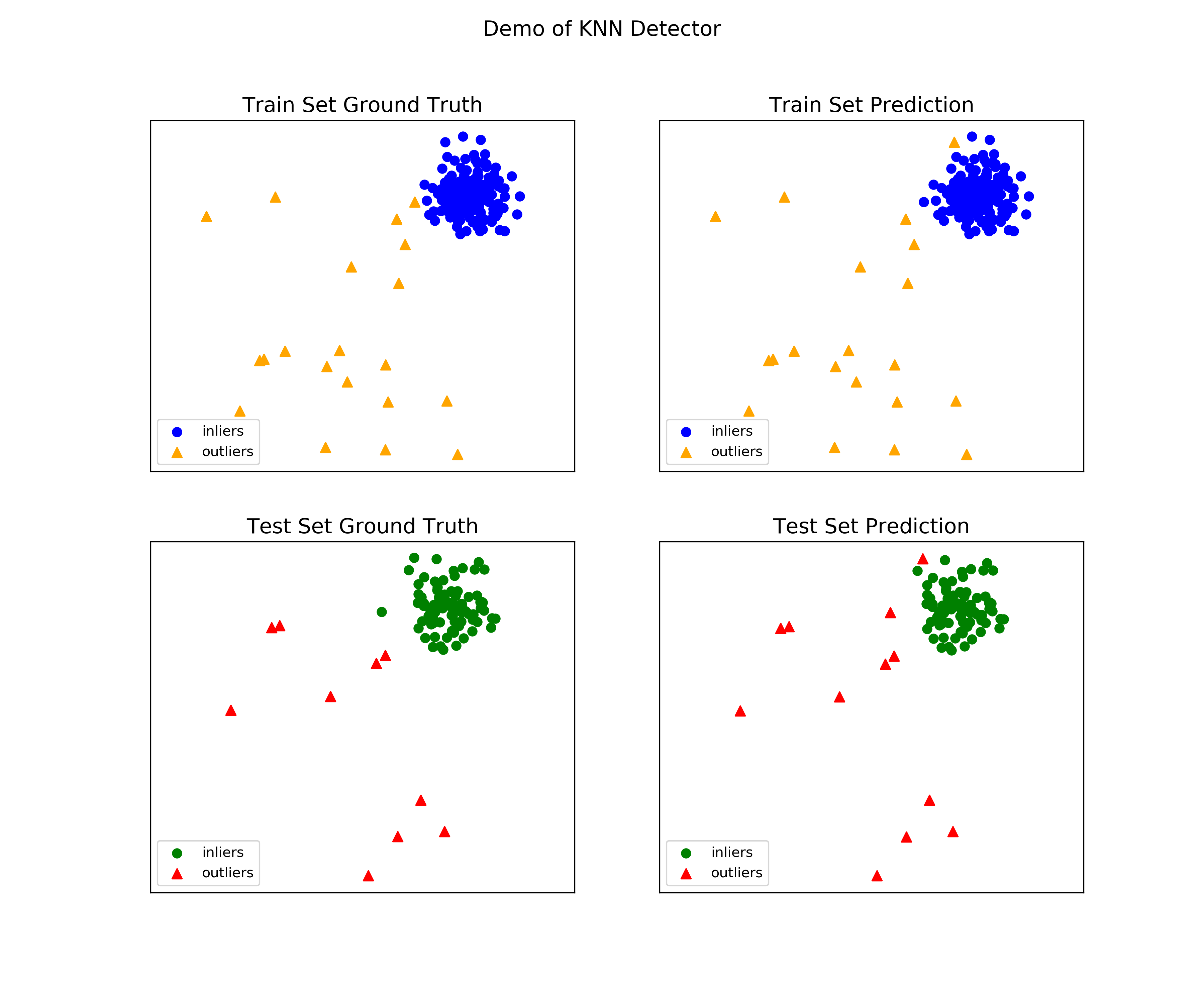
See a sample output & visualization.
On Training Data: KNN ROC:1.0, precision @ rank n:1.0 On Test Data: KNN ROC:0.9989, precision @ rank n:0.9visualize(clf_name, X_train, y_train, X_test, y_test, y_train_pred, y_test_pred, show_figure=True, save_figure=False)
Visualization (knn_figure):
Reference
Release history Release notifications | RSS feed


Download files
Download the file for your platform. If you're not sure which to choose, learn more about installing packages.
Source Distribution
Built Distribution
Filter files by name, interpreter, ABI, and platform.
If you're not sure about the file name format, learn more about wheel file names.
Copy a direct link to the current filters
File details
Details for the file pyod-2.1.0.tar.gz.
File metadata
- Download URL: pyod-2.1.0.tar.gz
- Upload date:
- Size: 198.3 kB
- Tags: Source
- Uploaded using Trusted Publishing? No
- Uploaded via: twine/6.2.0 CPython/3.12.12
File hashes
| Algorithm | Hash digest | |
|---|---|---|
| SHA256 |
4f2f255b3f7f800ce542b4be97b2a1e810d2739afea98a0b3fb9588a7fdaf6f3
|
|
| MD5 |
dd0a231a9c4286b035ae2c3f7247b710
|
|
| BLAKE2b-256 |
0d5c109bbf7347b7f2b316629449cae927f9759675f86dd434d640419c032325
|
File details
Details for the file pyod-2.1.0-py3-none-any.whl.
File metadata
- Download URL: pyod-2.1.0-py3-none-any.whl
- Upload date:
- Size: 238.4 kB
- Tags: Python 3
- Uploaded using Trusted Publishing? No
- Uploaded via: twine/6.2.0 CPython/3.12.12
File hashes
| Algorithm | Hash digest | |
|---|---|---|
| SHA256 |
5ebabba5514a6df8863348ada0f33b9c8b4d0f09d04e834079739c15326cfd27
|
|
| MD5 |
6b2ec3116aed37d54f42292b5a7bf0a5
|
|
| BLAKE2b-256 |
b2c495da255d92291e0c979ebd3856901c0dc94f2e1af2e574a695f9925263d4
|






