
PyOrthoANI 
A Python implementation of the OrthoANI algorithm for nucleotide identity measurement.







🗺️ Overview
OrthoANI is a metric proposed by Lee et al.[1] in 2016 to improve computation of Average Nucleotide Identity. It uses BLASTn to find orthologous blocks in a pair of sequences, and then computes the average identity only considering alignments of reciprocal orthologs.
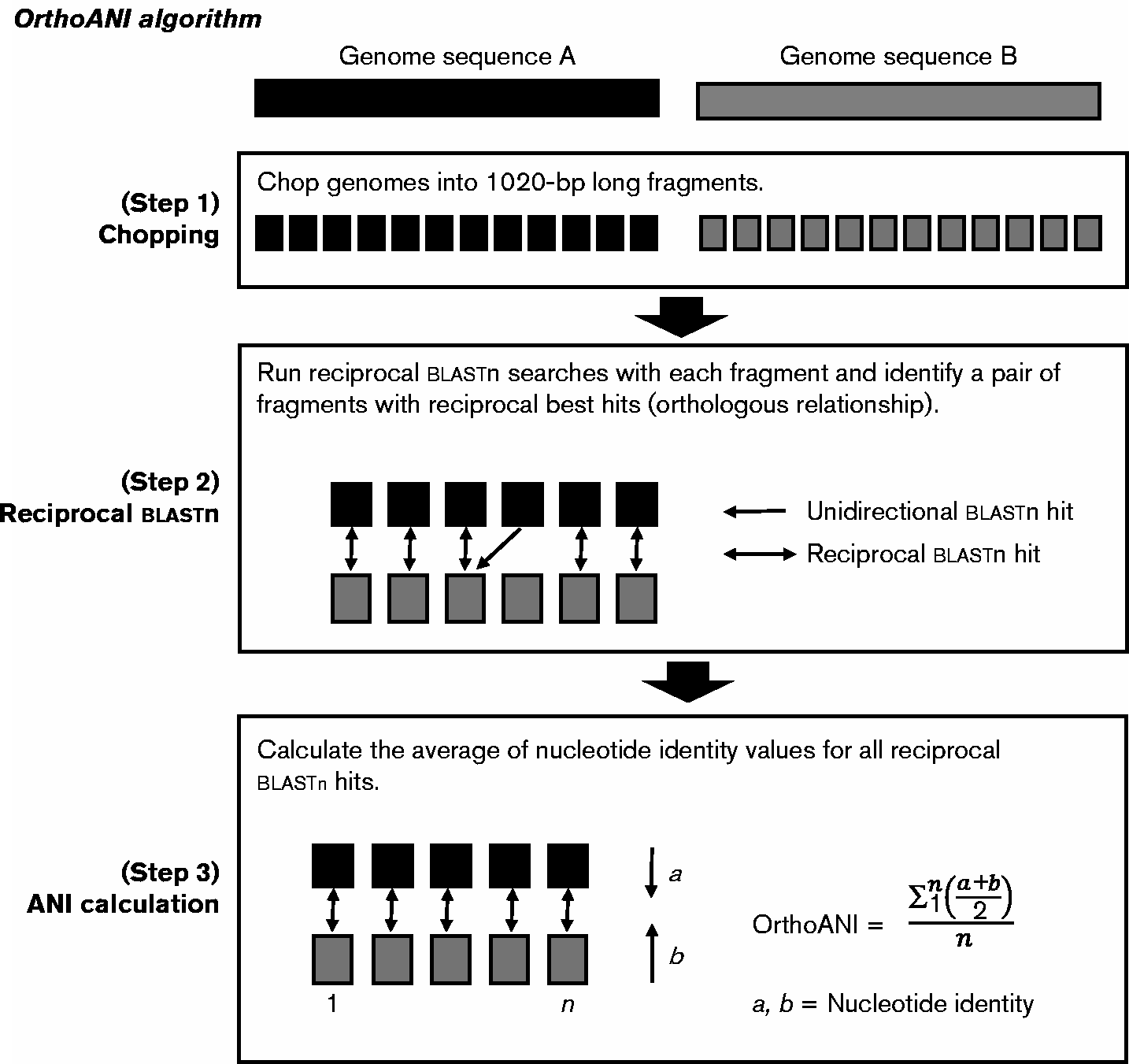
PyOrthoANI is a reimplementation of the closed-source Java implementation
provided by the authors on ezbiocloud.net.
It relies on Biopython to handle the I/O, and calls
the BLAST+ binaries using the subprocess module of the Python standard
library.
🔧 Installing
Installing with pip is the easiest:
$ pip install pyorthoani
PyOrthoANI also requires the BLAST+ binaries to be installed on your machine
and available somewhere in your $PATH.
💡 Example
Use Biopython to load two FASTA files, and then orthoani.orthoani to compute
the OrthoANI metric between them:
import pyorthoani
from Bio.SeqIO import read

genome_1 = read("sequence1.fa", "fasta")
genome_2 = read("sequence2.fa", "fasta")

ani = pyorthoani.orthoani(genome_1, genome_2)
pyorthoani can also be used from the CLI using a very simple command-line
interface mimicking the original Java tool:
$ pyorthoani -q sequence1.fa -r sequence2.fa
57.25
🐏 Memory
orthoani uses the machine temporary folder to handle BLAST+ input and output
files, which is configurable through
tempfile.tempdir.
On some systems (like ArchLinux), this filesystem can reside in memory, which means
that your computer could have trouble processing very large files. If this
happens, try changing the value of the tempfile.tempdir to a directory that
is actually located on physical storage.
📏 Precision
Values computed by this package and the original Java implementation may differ slightly because in Java the authors perform rounding of floating-point values at the sub-percent level, while this library uses the full values.
🔖 Citation
PyOrthoANI is scientific software; it is submitted for publication and is currently available as a pre-print on bioRxiv. Please cite both PyOrthoANI and OrthoANI if you are using it in an academic work, for instance as:
PyOrthoANI (Larralde et al., 2024), a Python implementation of OrthoANI (Lee et al., 2016).
📜 About
This library is provided under the open-source MIT license.
This project is in no way not affiliated, sponsored, or otherwise endorsed by the original OrthoANI authors. It was developed by Martin Larralde during his PhD project at the European Molecular Biology Laboratory in the Zeller team.
📚 References
- [1] Imchang Lee, Yeong Ouk Kim, Sang-Cheol Park and Jongsik Chun. OrthoANI: An improved algorithm and software for calculating average nucleotide identity (2016). International Journal of Systematic and Evolutionary Microbiology. doi:10.1099/ijsem.0.000760. PMID:26585518.
1 maintainer

Release files for pyorthoani 0.7.0
For a detailed explanation of source distributions (sdists) and built distributions (wheels), please see the package formats documentation.
Source distribution (sdist)
| File | Size | Uploaded | |
|---|---|---|---|
| pyorthoani-0.7.0.tar.gz | 14.7 kB | Details |
Built distribution (wheel)
| File | Interpreter | ABI | Platform | Reset |
|---|---|---|---|---|
| pyorthoani-0.7.0-py3-none-any.whl | Python 3 | none | any | Details |
Total release size: 26.7 kB
Release files / pyorthoani-0.7.0.tar.gz
| Download URL | pyorthoani-0.7.0.tar.gz |
|---|---|
| Size | 14.7 kB |
| Tags | Source |
|
SHA-256 checksum How to use checksums |
37a5a22dc54c45740f56bb94e0fefaf9d4adae3a71bda74d2a5deae4775ee908
|
|
BLAKE2b-256 checksum How to use checksums |
947324eb53cc1e24ae2e9e2235ecaa5d42c80ae93f20b8c4c098199761506014
|
| Upload date | |
|
Uploaded using Trusted Publishing? What is trusted publishing? |
Yes |
| Uploaded via |
twine/6.1.0 CPython/3.12.9
|
Provenance
Provenance describes where a file came from. On PyPI, provenance is shared via attestations, which provide a verifiable record of the build or publishing details. View details, limitations and caveats.


PyPI Publish Attestation
PyPI verified that this artifact, at this checksum, originated from the publisher listed below.
Signed by GitHub Actions, verified by PyPI on Feb 21, 2025.
Transparency logRelease files / pyorthoani-0.7.0-py3-none-any.whl
| Download URL | pyorthoani-0.7.0-py3-none-any.whl |
|---|---|
| Size | 12.0 kB |
| Tags | Python 3 |
|
SHA-256 checksum How to use checksums |
e6bead9606e140b0f23874163ffdcc12ffb40260ed20fa002b23acd7ec1b6799
|
|
BLAKE2b-256 checksum How to use checksums |
13229a6f4202d71311a73502a85f491e07591c269457f87eced642c9734f8a60
|
| Upload date | |
|
Uploaded using Trusted Publishing? What is trusted publishing? |
Yes |
| Uploaded via |
twine/6.1.0 CPython/3.12.9
|
Provenance
Provenance describes where a file came from. On PyPI, provenance is shared via attestations, which provide a verifiable record of the build or publishing details. View details, limitations and caveats.
PyPI Publish Attestation
PyPI verified that this artifact, at this checksum, originated from the publisher listed below.
Signed by GitHub Actions, verified by PyPI on Feb 21, 2025.
Transparency log












