

PyPermission - The python RBAC authorization library for projects where SQLAlchemy is a valid option.











PyPermission keeps authorization simple. It avoids framework lock-ins, skips Policy DSL complexity, and gives developers a clean, Python-native way to express Subjects, Roles, Resources, and Permissions across any application architecture.
If you find the PyPermission library beneficial, please consider supporting the project by starring it on GitHub.

PyPermission - RBAC for Python
Features
- RBAC for Python (Quick Start)
- Subjects, Roles, Hierarchies, Permissions, Policies & Auditing
- Supports NIST Level 2a & some Level 4 review functions (Details)
- Persistency via SQLAlchemy
- SQLite & PostgreSQL (psycopg)
- Integration Guide
- Advanced Auditing
- Export a RBAC DAG as NetworkX DiGraph
- Visualize a RBAC DAG via Plotly
- Lightweight
- High test Coverage
- Online documentation
Installing PyPermission with pip
The PyPermission library can be installed directly from the PyPI repositories with:
pip install PyPermission
If you want to use PostgreSQL, you need to install the postgres dependency group:
pip install 'PyPermission[postgres]'
Usage Example
from sqlalchemy.engine import create_engine
from sqlalchemy.orm import sessionmaker
from sqlalchemy.event import listen

engine = create_engine("sqlite:///:memory:", future=True)
db_factory = sessionmaker(bind=engine, autoflush=False, autocommit=False)

from pypermission import RBAC, Permission, create_rbac_database_table, set_sqlite_pragma

listen(engine, "connect", set_sqlite_pragma) # needed for foreign key constraints (sqlite only)
create_rbac_database_table(engine=engine)

with db_factory() as db:
    # Create an 'admin' Role
    RBAC.role.create(role="admin", db=db)

    # Allow all Members of the 'admin' Role, to edit any user
    RBAC.role.grant_permission(
        role="admin",
        permission=Permission(
            resource_type="user",
            resource_id="*",
            action="edit",
        ),
        db=db,
    )

    # Create a Subject for the user 'Alex'
    RBAC.subject.create(subject="Alex", db=db)

    # Assign Subject 'Alex' to the 'admin' Role
    RBAC.subject.assign_role(
        subject="Alex", role="admin", db=db
    )

    # Test if user 'Alex' can edit user 'Max'
    RBAC.subject.assert_permission(
        subject="Alex",
        permission=Permission(
            resource_type="user",
            resource_id="Max",
            action="edit",
        ),
        db=db,
    )
Auditing
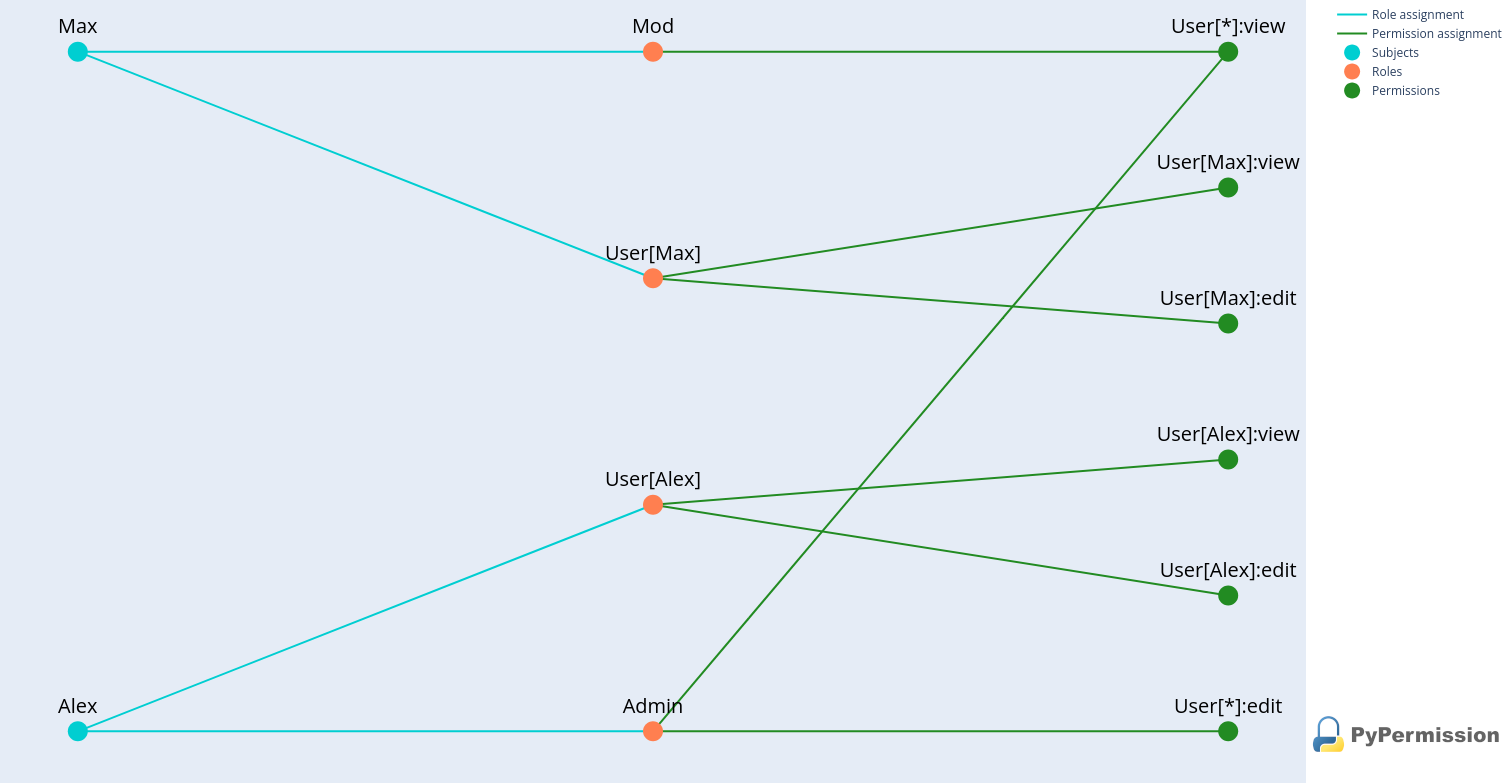
PyPermission supports a variety of review functions for auditing of the RBAC system and even comes with some tooling for visualization out of the box.
The Core API surface on a glance
pypermission.service.role.RoleService
| Methods |
|---|
create(*, role: str, db: Session) -> None |
delete(*, role: str, db: Session) -> None |
list(*, db: Session) -> tuple[str, ...] |
add_hierarchy(*, parent_role: str, child_role: str, db: Session) -> None |
remove_hierarchy(*, parent_role: str, child_role: str, db: Session) -> None |
children(*, role: str, db: Session) -> tuple[str, ...] |
ascendants(*, role: str, db: Session) -> tuple[str, ...] |
descendants(*, role: str, db: Session) -> tuple[str, ...] |
subjects(*, role: str, include_descendant_subjects: bool = False, db: Session) -> tuple[str, ...] |
grant_permission(*, role: str, permission: Permission, db: Session) -> None |
revoke_permission(*, role: str, permission: Permission, db: Session) -> None |
check_permission(*, role: str, permission: Permission, db: Session) -> bool |
assert_permission(*, role: str, permission: Permission, db: Session) -> None |
permissions(*, role: str, inherited: bool = True, db: Session) -> tuple[Permission, ...] |
policies(*, role: str, inherited: bool = True, db: Session) -> tuple[Policy, ...] |
actions_on_resource(*, role: str, resource_type: str, resource_id: str, inherited: bool = True, db: Session) -> tuple[str, ...] |
pypermission.service.role.SubjectService
| Methods |
|---|
create(*, subject: str, db: Session) -> None |
delete(*, subject: str, db: Session) -> None |
list(*, db: Session) -> tuple[str, ...] |
assign_role(*, subject: str, role: str, db: Session) -> None |
deassign_role(*, subject: str, role: str, db: Session) -> None |
roles(*, subject: str, include_ascendant_roles: bool = False, db: Session) -> tuple[str, ...] |
check_permission(*, subject: str, permission: Permission, db: Session) -> bool |
assert_permission(*, subject: str, permission: Permission, db: Session) -> None |
permissions(*, subject: str, db: Session) -> tuple[Permission, ...] |
policies(*, subject: str, db: Session) -> tuple[Policy, ...] |
actions_on_resource(*, subject: str, resource_type: str, resource_id: str, inherited: bool = True, db: Session) -> tuple[str, ...] |
Resources
Sponsor

Fine-Tuned AI services for developers.
Digon.IO provides end-to-end consulting and development for SMEs and software companies building data-driven solutions - with a focus on supply chain optimization and text processing. (Website) (Technical Blog)
The sponsor logo is the property of Digon.IO GmbH. Standard trademark and copyright restrictions apply to any use outside this repository.
License
- Library source code: Licensed under LGPLv3.
- Library logo: The library logo is a trademark of the project (unregistered). You are permitted to use the logo only in contexts that directly reference, document, or promote this library. For example, in a dependent project or in a blog post discussing this library. Any other use is prohibited.
1 maintainer

Metadata
1 maintainer
Release files for PyPermission 0.4.0
For a detailed explanation of source distributions (sdists) and built distributions (wheels), please see the package formats documentation.
Source distribution (sdist)
| File | Size | Uploaded | |
|---|---|---|---|
| pypermission-0.4.0.tar.gz | 16.3 kB | Details |
Built distribution (wheel)
| File | Interpreter | ABI | Platform | Reset |
|---|---|---|---|---|
| pypermission-0.4.0-py3-none-any.whl | Python 3 | none | any | Details |
Total release size: 37.6 kB
Release files / pypermission-0.4.0.tar.gz
| Download URL | pypermission-0.4.0.tar.gz |
|---|---|
| Size | 16.3 kB |
| Tags | Source |
|
SHA-256 checksum How to use checksums |
20996d82f83ee368aa9a88a0b662f6733d3f7a7e036a50ed5b55b5a560a986fb
|
|
BLAKE2b-256 checksum How to use checksums |
8051837ec81d474d34b75e1f4d501bd74e65a1f1119f879e38599e3d67571459
|
| Upload date | |
|
Uploaded using Trusted Publishing? What is trusted publishing? |
No |
| Uploaded via |
uv/0.9.8
|
Release files / pypermission-0.4.0-py3-none-any.whl
| Download URL | pypermission-0.4.0-py3-none-any.whl |
|---|---|
| Size | 21.3 kB |
| Tags | Python 3 |
|
SHA-256 checksum How to use checksums |
2359ca2237f00caff9599e3c7f69b0ea649fd503d4ae8c1a215defdc98b41f0b
|
|
BLAKE2b-256 checksum How to use checksums |
f39b0ba3485ae766b1639d1fdcb5851dc28c645f94a14a25d7e08eae61abd651
|
| Upload date | |
|
Uploaded using Trusted Publishing? What is trusted publishing? |
No |
| Uploaded via |
uv/0.9.8
|














