
PyPSF
This project provides a python implementation of the Pattern Sequence Based Forecasting (PSF) algorithm. For a detailed description of the PSF algorithm and some of the practical issues I encountered when using it, see this PDF file.
Installation
pip install pypsf
Dependencies
- scikit-learn
- numpy
Example Usage
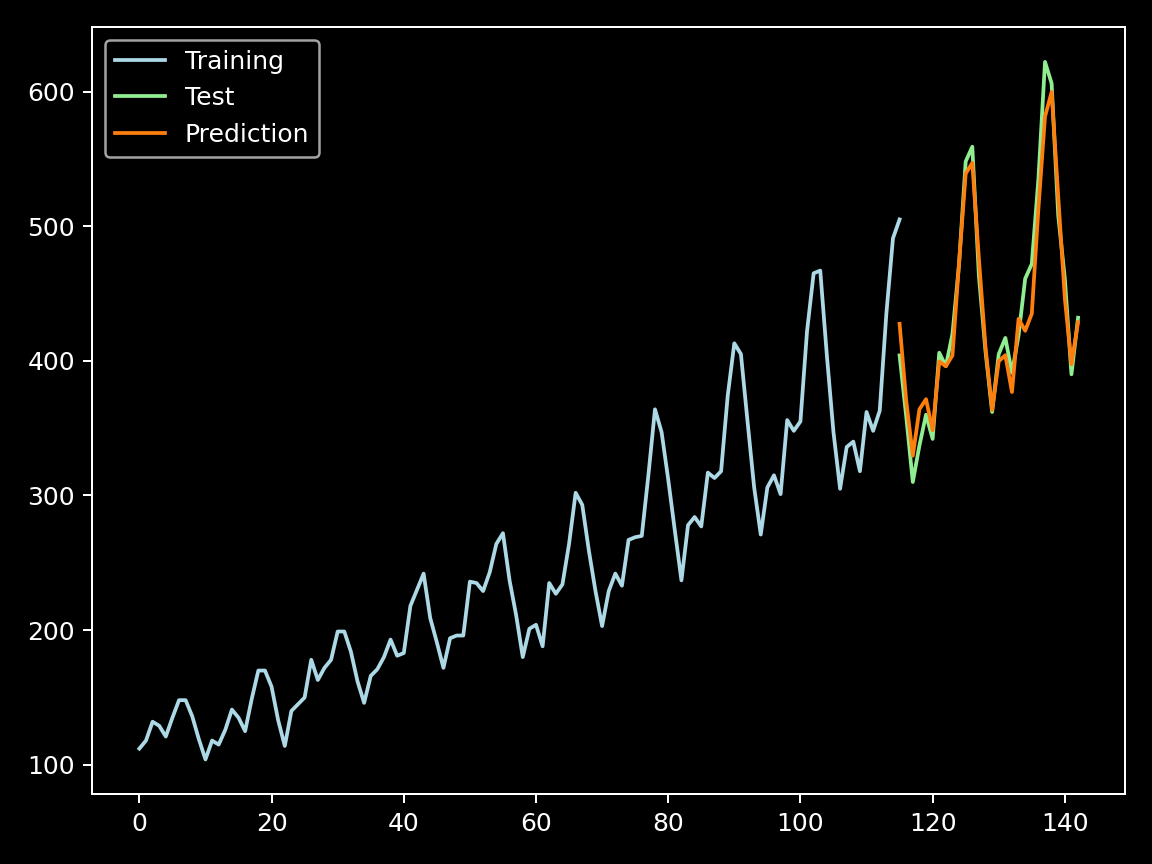
Applying PSF to the classic R "AirPassenger" dataset, which provides monthly totals of a US airline passengers, from 1949 to 1960.
import numpy as np
import matplotlib.pyplot as plt
from pypsf import Psf

plt.style.use("dark_background")

t_series = np.array([112, 118, 132, 129, 121, 135, 148, 148, 136, 119, 104, 118,
                     115, 126, 141, 135, 125, 149, 170, 170, 158, 133, 114, 140,
                     145, 150, 178, 163, 172, 178, 199, 199, 184, 162, 146, 166,
                     171, 180, 193, 181, 183, 218, 230, 242, 209, 191, 172, 194,
                     196, 196, 236, 235, 229, 243, 264, 272, 237, 211, 180, 201,
                     204, 188, 235, 227, 234, 264, 302, 293, 259, 229, 203, 229,
                     242, 233, 267, 269, 270, 315, 364, 347, 312, 274, 237, 278,
                     284, 277, 317, 313, 318, 374, 413, 405, 355, 306, 271, 306,
                     315, 301, 356, 348, 355, 422, 465, 467, 404, 347, 305, 336,
                     340, 318, 362, 348, 363, 435, 491, 505, 404, 359, 310, 337,
                     360, 342, 406, 396, 420, 472, 548, 559, 463, 407, 362, 405,
                     417, 391, 419, 461, 472, 535, 622, 606, 508, 461, 390, 432])
train = t_series[:-28]
test = t_series[-28:]

psf = Psf(cycle_length=12, apply_diff=True, diff_periods=12)
psf.fit(train)

pred = psf.predict(len(test))

fig, ax = plt.subplots()
x_train = np.array(range(len(train)))
x_test_pred = np.array(range(len(test))) + x_train[-1]
ax.plot(x_train, train, c="lightblue")
ax.plot(x_test_pred, test, c="lightgreen")
ax.plot(x_test_pred, pred, c="tab:orange")
plt.legend(["Training", "Test", "Prediction"])
plt.tight_layout()
plt.show()
Parameters
class Psf
- cycle_length: int
The cycle length c - k: int (optional), default None
The user-defined number of desired clusters when running K-means on the cycles - w: int (optional), default None
The user-defined window size - suppress_warnings: bool (optional), default False
Suppress all warnings - apply_diff: bool (optional), default False
Apply first order differencing to the time series before applying PSF - diff_periods: int (optional), default 1
Periods to shift for calculating difference, to allow for either ordinary or seasonal differencing. Ignore if apply_diff=False - detrend: bool (optional), default False
Remove a linear trend from the series prior to applying PSF by fitting a simple linear regression model. The trend is subsequently re-added to the predictions.
Psf.fit
- data:
The input time series - k_values: iterable[int] (optional), default tuple(range(3, 12))
The set of candidate values of k to test when finding the "best" k number of clusters based on the training data - w_values: iterable[int] (optional), default tuple(range(1, 20))
The set of candidate values of w to test when finding the "best" window size w based on the training data
Psf.predict
- n_ahead: int
The number of values to predict
1 maintainer

Release files for pypsf 1.0.9
For a detailed explanation of source distributions (sdists) and built distributions (wheels), please see the package formats documentation.
Source distribution (sdist)
| File | Size | Uploaded | |
|---|---|---|---|
| pypsf-1.0.9.tar.gz | 215.9 kB | Details |
Built distribution (wheel)
| File | Interpreter | ABI | Platform | Reset |
|---|---|---|---|---|
| pypsf-1.0.9-py3-none-any.whl | Python 3 | none | any | Details |
Total release size: 227.7 kB
Release files / pypsf-1.0.9.tar.gz
| Download URL | pypsf-1.0.9.tar.gz |
|---|---|
| Size | 215.9 kB |
| Tags | Source |
|
SHA-256 checksum How to use checksums |
fa9fc8784c43a035e73a4197ec9ed923594b03ac2e3189abdecfcff3f1363198
|
|
BLAKE2b-256 checksum How to use checksums |
ca203bc389090d7d2664aa2c638f1b7f195a560c8cf1509195e1deafbd6d7b71
|
| Upload date | |
|
Uploaded using Trusted Publishing? What is trusted publishing? |
No |
| Uploaded via |
twine/6.0.1 CPython/3.12.8
|
Release files / pypsf-1.0.9-py3-none-any.whl
| Download URL | pypsf-1.0.9-py3-none-any.whl |
|---|---|
| Size | 11.7 kB |
| Tags | Python 3 |
|
SHA-256 checksum How to use checksums |
02ab503a3f6734a0b9313b1fc60bde78c5d8eb877c8d805b51086514388db8c4
|
|
BLAKE2b-256 checksum How to use checksums |
5604ebadfa69e10689ffa2ced140adb3523c144e1a15ecdcaa668637c76a8181
|
| Upload date | |
|
Uploaded using Trusted Publishing? What is trusted publishing? |
No |
| Uploaded via |
twine/6.0.1 CPython/3.12.8
|














