










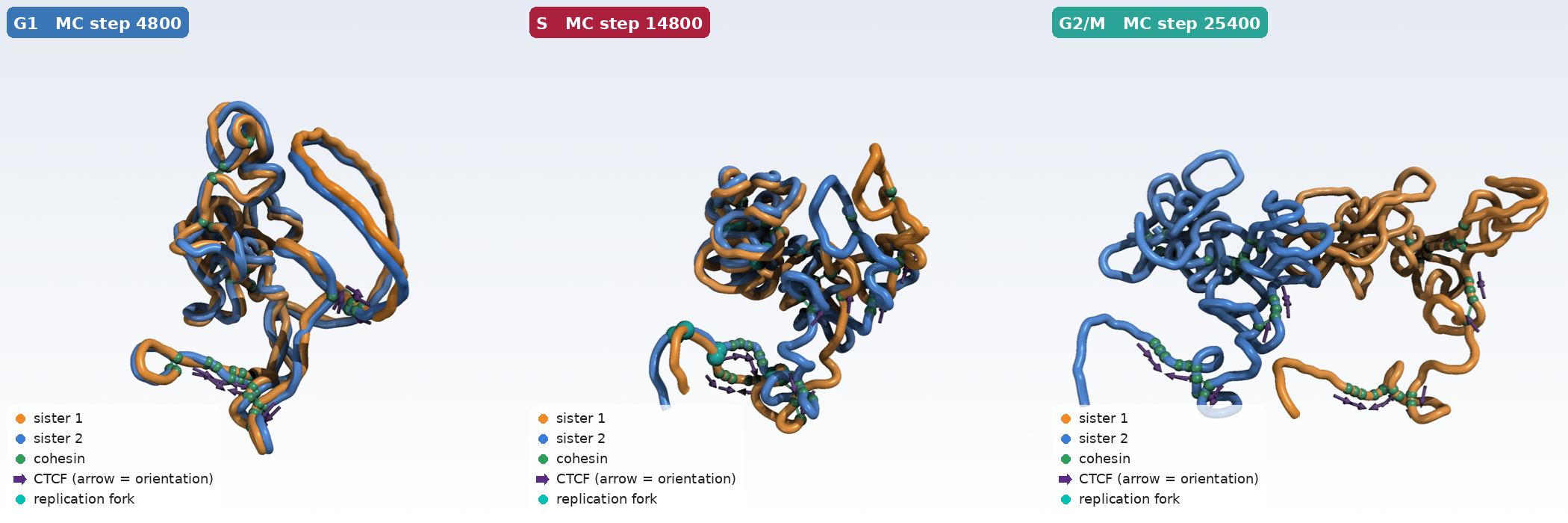
One simulated cell cycle: G1, S (replication forks, sisters appear) and G2/M. Sister chromatids in orange and blue, cohesin in green, CTCF orientation as purple arrows, forks in turquoise.
RepliSage simulates how loop extrusion, epigenetic state and DNA replication shape chromatin in 3D, from G1 through S phase to G2/M. It runs a replication simulation, a Monte Carlo of loop-extruding factors (LEFs) and Potts spins (A/B compartments), and optionally 3D structures with OpenMM. Every run ends with a single report.html.
Install
Python 3.10 or newer.
git clone https://github.com/SFGLab/RepliSage && cd RepliSage
pip install -r requirements.txt      # or: pip install .   (gives the `replisage` command)
The 3D part (OpenMM) is faster on a GPU; the Monte Carlo runs on CPU. A Docker image is provided (Dockerfile).
Run
The everyday choices are command-line flags (-h lists them all):
# loop extrusion only
python src/run.py --bedpe-file loops.bedpe --region chr14:80835000-98674700

# add replication timing (bigWig, txt, parquet, or `builtin`), then decide about 3D
python src/run.py --bedpe-file loops.bedpe --region chr14:80835000-98674700 --rt-file timing.bigWig --run-md true

# replication stress, several replicas
python src/run.py -c my_config.ini --with-stress --n-replicas 4 --threads 4
| Flag | Meaning |
|---|---|
-c FILE |
Read a config file |
--bedpe-file FILE |
CTCF input: loops (BEDPE) or peaks (BED, narrowPeak) |
--smooth-sigma BEADS, --no-smooth |
Width of the Gaussian smoothing of the CTCF input, or switch it off |
--motif-genome FASTA |
Read CTCF orientation from motifs when the input has none |
--hic FILE |
Validate the model against a Hi-C map (.hic; pip install "pyRepliSage[hic]") |
--rt-file FILE |
Replication timing. No file: no replication simulation, no forks |
--region CHR:START-END |
Region to model |
--run-md true/false |
Build 3D structures (needs replication data or not, both work) |
--with-stress |
Replication stress (off by default) |
--n-replicas, --seed, --out, --name, --platform, --threads |
Run control |
Everything else (Monte Carlo, replication and MD energies, force field, plots) is set only in the config file: copy src/config.ini or one of the annotated files in examples/ and run it with -c. Flags win over the file; the file wins over the defaults.
More in the documentation: command line, pipeline, replication, Monte Carlo and 3D models, config, analysis.
Output
Each run creates a folder results/<run_name>/ (one replica_XX/ per replica) containing:
| File | What |
|---|---|
report.html |
Start here: model, figures, diagnostics, command and all parameters |
viewer_3d.html |
Interactive 3D viewer: trajectory bar, cell-cycle phase, colour modes (sister chromatids, compartments, rainbow, replication) and a moving-window contact map with LEFs and forks marked |
movie_3d.mp4, movie_3d.gif |
Interpolated PyVista movie |
ensemble/*.cif |
One mmCIF per structure (chains A and B = sister chromatids); open in ChimeraX with view.cxc |
plots/, metadata/ |
Figures (png + svg) and raw arrays / CSV statistics |
config_used.ini |
Exact configuration, re-run with -c |
Switch parts off with --no-report and --no-viewer. The 3D movies take minutes to render: add --skip-movies for quick runs.
Configuration
src/config.ini documents every parameter. Precedence: defaults < config file < command-line flags.
Tests
pip install -e ".[test]" && pytest # add -m "not slow" to skip OpenMM / full-pipeline tests
Citation
- Korsak, S. et al. "RepliSage: a stochastic graph-based framework for 3D chromatin modeling across the cell cycle." Nucleic Acids Research 54.12 (2026): gkag618.
- Buka, K. et al. "Improved cohesin HiChIP protocol and bioinformatic analysis for robust detection of chromatin loops and stripes." Communications Biology 8.1 (2025): 437.
- Massey, D. J. and Koren, A. "High-throughput analysis of single human cells reveals the complex nature of DNA replication timing control." Nature Communications 13 (2022): 2402.
1 maintainer

Metadata
1 maintainer
Release files for pyRepliSage 1.0.2
For a detailed explanation of source distributions (sdists) and built distributions (wheels), please see the package formats documentation.
Source distribution (sdist)
| File | Size | Uploaded | Provenance | Actions |
|---|---|---|---|---|
| pyreplisage-1.0.2.tar.gz | 7.7 MB | Without provenance | Details for pyreplisage-1.0.2.tar.gz |
Built distribution (wheel)
| File | Interpreter | ABI | Platform | Actions Reset |
|---|---|---|---|---|
| pyreplisage-1.0.2-py3-none-any.whl | Python 3 | none | any | Details for pyreplisage-1.0.2-py3-none-any.whl |
Total release size: 15.4 MB
Release files / pyreplisage-1.0.2.tar.gz
| Download URL | pyreplisage-1.0.2.tar.gz |
|---|---|
| Size | 7.7 MB |
| Tags | Source |
|
SHA-256 checksum How to use checksums |
58225bdeb27bb04202783c6e10d34eff89453b7a814df58dda0ec757d636cb69
|
|
BLAKE2b-256 checksum How to use checksums |
708cb0953540947411766871ef815aa457755f52b05a59f2bdc4f993c5dbdb24
|
| Upload date | |
|
Uploaded using Trusted Publishing? What is trusted publishing? |
No |
| Uploaded via |
twine/6.1.0 CPython/3.8.20
|
Release files / pyreplisage-1.0.2-py3-none-any.whl
| Download URL | pyreplisage-1.0.2-py3-none-any.whl |
|---|---|
| Size | 7.7 MB |
| Tags | Python 3 |
|
SHA-256 checksum How to use checksums |
96c5386f34251bd722c6c774a42f4d04d1edc1680fe1d8c00c35fc25bc225515
|
|
BLAKE2b-256 checksum How to use checksums |
eda8f3cc13c296f781a340304d548454205ef3d22a85d5707f9cbb4a40608664
|
| Upload date | |
|
Uploaded using Trusted Publishing? What is trusted publishing? |
No |
| Uploaded via |
twine/6.1.0 CPython/3.8.20
|
Security for pyRepliSage 1.0.2
Provenance
Provenance describes where a file came from. On PyPI, provenance is shared via attestations, which provide a verifiable record of the build or publishing details. View details, limitations and caveats.
No provenance found
None of the files in this release were uploaded with provenance metadata.
A note on package security
PyPI is a repository for distributing packages, not a service for auditing them. While third-party security researchers and our staff do their best to detect and remove malicious packages, PyPI cannot guarantee the quality, security or suitability of any given package.
To learn more about protecting yourself from malicious actors, visit our package security documentation.














