
A Python package for working with Lucide icons
Verified details
These details have been verified by PyPIProject links
GitHub Statistics
Maintainers

Project description
python-lucide







A Python package that provides easy access to all Lucide icons as SVG strings. Just import and use any Lucide icon in your Python projects, with no javascript in sight.
Features
- 🎨 Access 1600+ Lucide icons directly from Python
- 🔍 Semantic search - find icons by meaning, in the terminal or in the browser
- 🛠 Customize icons with classes, sizes, colors, and other SVG attributes
- 🚀 Framework-friendly with examples for FastHTML, Flask, Django, and more
- 📦 Lightweight with minimal dependencies
- 🔧 Customizable icon sets - include only the icons you need
Installation
pip install python-lucide
This installs the package with a pre-built database of all Lucide icons, ready to use immediately.
Quick Start
from lucide import lucide_icon

# Get an icon
svg = lucide_icon("house")

# Add CSS classes
svg = lucide_icon("settings", cls="icon icon-settings")

# Customize size
svg = lucide_icon("arrow-up", width="32", height="32")

# Customize colors (stroke for outline, fill for interior)
svg = lucide_icon("heart", stroke="red", fill="pink")

# Customize stroke properties
svg = lucide_icon("chart-line", stroke_width="3", stroke_linecap="round")
Icon Customization
All Lucide icons use stroke for their outline color and fill for their interior color:
# Looking for how to change colors? Use stroke and fill:
lucide_icon("user", stroke="blue")        # Blue outline
lucide_icon("user", fill="currentColor")  # Inherit color from CSS
lucide_icon("user", stroke="#ff6b6b")     # Hex colors work too
Semantic Search
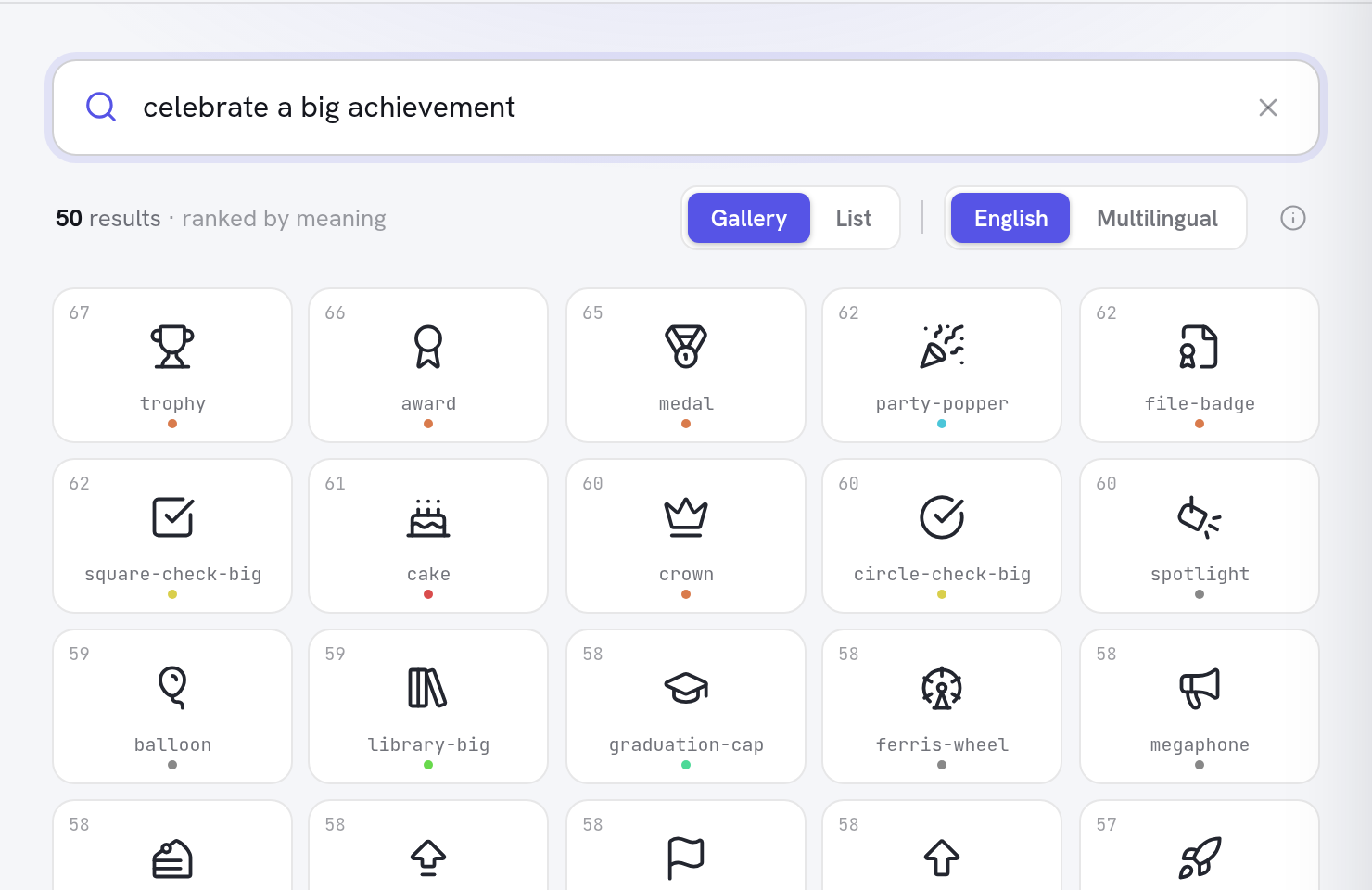
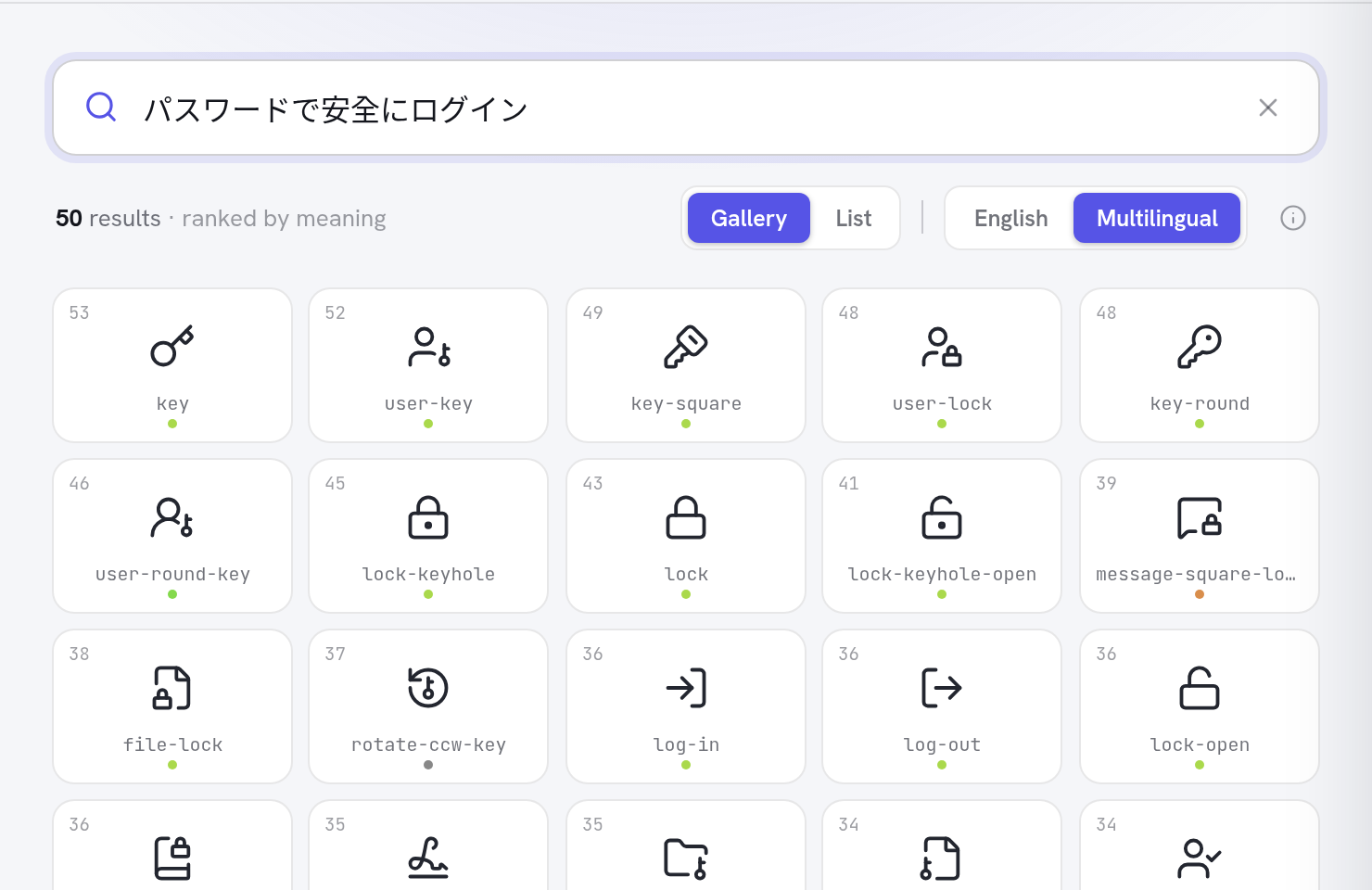
Find icons by describing what you mean, not what they're called — in English or 50+ languages:
# One-off, no install (requires uv)
uvx --from "python-lucide[search]" lucide search "waiting for a download"

# Or install the search extra
pip install "python-lucide[search]"
lucide search "celebrate a big achievement"
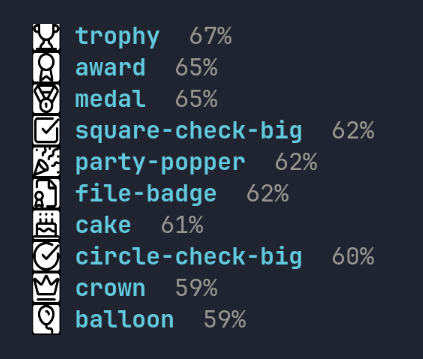
In terminals supporting the Kitty graphics protocol (kitty, Ghostty,
WezTerm), the icons render inline as above — inside tmux too, with
tmux set -g allow-passthrough on. Elsewhere you get the plain text
list. (Rendering uses the cairo system library; if it's missing, the
CLI prints a hint.)
Icons are matched against AI-generated descriptions using the same embedding model the web app uses, so descriptive phrases ("an idea just occurred to me") work better than keywords. Options:
--model multilingual— search in 50+ languages (defaultbge-smallranks best for English)--limit N— number of results;--verbose— include each icon's description
The first search downloads the embedding model (~67 MB) and the pre-built search index (11 MB); both are cached, and every search after that runs locally in well under a second.
The same search is available as a Python API:
from lucide.search import search_icons

for r in search_icons("secure login", limit=5):
    print(r.name, r.score)
Prefer not to install anything? The browser version runs the whole pipeline client-side.
Framework Integration Examples
Starlette
from starlette.applications import Starlette
from starlette.responses import Response
from starlette.routing import Route
from lucide import lucide_icon

def icon(request):
    icon_name = request.path_params["icon_name"]
    svg = lucide_icon(icon_name, cls="icon", stroke="currentColor")
    return Response(svg, media_type="image/svg+xml")

app = Starlette(routes=[Route("/icons/{icon_name}", icon)])
FastAPI
from fastapi import FastAPI
from fastapi.responses import Response
from lucide import lucide_icon

app = FastAPI()

@app.get("/icons/{icon_name}")
def get_icon(icon_name: str, size: int = 24, color: str = "currentColor"):
    svg = lucide_icon(icon_name, width=size, height=size, stroke=color)
    return Response(content=svg, media_type="image/svg+xml")
FastHTML
from fasthtml.common import *
from lucide import lucide_icon

app, rt = fast_app()

@rt('/')
def get():
    return Titled("Hello Icons",
        H1("Welcome"),
        # Wrap icon output in NotStr to prevent HTML escaping
        NotStr(lucide_icon("house", cls="icon")),
        P("This is a simple FastHTML app with Lucide icons.")
    )

serve()
Flask
from flask import Flask
from lucide import lucide_icon

app = Flask(__name__)

@app.route('/icons/<icon_name>')
def serve_icon(icon_name):
    svg = lucide_icon(icon_name, cls="icon", stroke="currentColor")
    return svg, 200, {'Content-Type': 'image/svg+xml'}
Django
# In your views.py
from django.http import HttpResponse
from lucide import lucide_icon

def icon_view(request, icon_name):
    svg = lucide_icon(icon_name, cls="icon-lg", width="32", height="32")
    return HttpResponse(svg, content_type='image/svg+xml')

# In your templates (as a template tag)
from django import template
from django.utils.safestring import mark_safe
from lucide import lucide_icon

register = template.Library()

@register.simple_tag
def icon(name, **kwargs):
    return mark_safe(lucide_icon(name, **kwargs))
API Reference
lucide_icon()
Retrieves and customizes a Lucide icon.
lucide_icon(
    icon_name: str,
    cls: str = "",
    fallback_text: str | None = None,
    width: str | int | None = None,
    height: str | int | None = None,
    fill: str | None = None,
    stroke: str | None = None,
    stroke_width: str | int | None = None,
    stroke_linecap: str | None = None,
    stroke_linejoin: str | None = None,
) -> str
Parameters:
icon_name: Name of the Lucide icon to retrievecls: CSS classes to add to the SVG element (space-separated)fallback_text: Text to display if the icon is not foundwidth: Width of the SVG elementheight: Height of the SVG elementfill: Fill color for the iconstroke: Stroke color for the icon (outline color)stroke_width: Width of the strokestroke_linecap: How the ends of strokes are rendered ("round", "butt", "square")stroke_linejoin: How corners are rendered ("round", "miter", "bevel")
Returns: SVG string
Example:
# Full customization example
icon = lucide_icon(
    "activity",
    cls="icon icon-activity animated",
    width=48,
    height=48,
    stroke="rgb(59, 130, 246)",
    stroke_width=2.5,
    stroke_linecap="round",
    stroke_linejoin="round"
)
get_icon_list()
Returns a list of all available icon names.
from lucide import get_icon_list

icons = get_icon_list()
print(f"Available icons: {len(icons)}")
print(icons[:5])  # ['activity', 'airplay', 'alarm-check', ...]
Advanced Usage
Building a Custom Icon Set
If you want to include only specific icons or use a different version of Lucide:
# Build with specific icons only
lucide-db -i home,settings,user,heart,star -o custom-icons.db

# Use a specific Lucide version
lucide-db -t 0.350.0 -o lucide-v0.350.0.db

# Build from a file listing icon names
echo -e "home\nsettings\nuser" > my-icons.txt
lucide-db -f my-icons.txt -o my-icons.db
Using a Custom Database
Set the LUCIDE_DB_PATH environment variable:
export LUCIDE_DB_PATH=/path/to/custom-icons.db
python your-app.py
Or configure it in your Python code:
import os
os.environ['LUCIDE_DB_PATH'] = '/path/to/custom-icons.db'

from lucide import lucide_icon
# Will now use your custom database
Development
This project uses uv for fast dependency management and pre-commit for code quality.
Setup
# Clone the repository
git clone https://github.com/mmacpherson/python-lucide.git
cd python-lucide

# Create a virtual environment and install dependencies
make env
source .venv/bin/activate  # On Windows: .venv\Scripts\activate

# Install pre-commit hooks
make install-hooks

# Run tests
make test
Rebuilding the Icon Database
# Rebuild with latest Lucide icons
make lucide-db

# Rebuild with specific version
make lucide-db TAG=0.350.0

# Check if version updates are available
make check-lucide-version
Version Checking and Automation
The project includes automated version checking and update capabilities:
# Check for Lucide version updates and artifact status
make check-lucide-version

# Alternative: Use the CLI command directly
uv run check-lucide-version
Weekly Automation: The repository automatically checks for new Lucide releases every Monday and creates update PRs when new versions are available.
Release Process
This project follows a manual release process:
-
Update version in
pyproject.toml:# Create release branch git checkout -b release/v0.2.0 # Edit pyproject.toml to bump version # version = "0.2.0" # Commit and push git add pyproject.toml git commit -m "Bump version to 0.2.0" git push -u origin release/v0.2.0
-
Create and merge PR for the version bump
-
Trigger publishing workflow:
- Go to Actions
- Click "Run workflow"
- Select the main branch
- Click "Run workflow"
-
Automatic publishing: The
publish.ymlworkflow builds and publishes the package to PyPI using trusted publishing.
How It Works
The package comes with a pre-built SQLite database containing all Lucide icons. When you call lucide_icon(), it fetches the icon's SVG from the database and applies your customizations. This approach means:
- Fast: Icons are loaded from an efficient SQLite database
- Offline: No internet connection required at runtime
- Customizable: Build your own database with just the icons you need
- Maintainable: Update to newer Lucide versions by rebuilding the database
License
This project is licensed under the MIT License - see the LICENSE file for details. The Lucide icons themselves are also MIT licensed - see Lucide's license.
Project details
Verified details
These details have been verified by PyPIProject links
GitHub Statistics
Maintainers
Release history Release notifications | RSS feed


Download files
Download the file for your platform. If you're not sure which to choose, learn more about installing packages.
Source Distribution
Built Distribution
Filter files by name, interpreter, ABI, and platform.
If you're not sure about the file name format, learn more about wheel file names.
Copy a direct link to the current filters
File details
Details for the file python_lucide-0.5.0.tar.gz.
File metadata
- Download URL: python_lucide-0.5.0.tar.gz
- Upload date:
- Size: 877.9 kB
- Tags: Source
- Uploaded using Trusted Publishing? Yes
- Uploaded via: uv/0.11.21 {"installer":{"name":"uv","version":"0.11.21","subcommand":["publish"]},"python":null,"implementation":{"name":null,"version":null},"distro":{"name":"Ubuntu","version":"24.04","id":"noble","libc":null},"system":{"name":null,"release":null},"cpu":null,"openssl_version":null,"setuptools_version":null,"rustc_version":null,"ci":true}
File hashes
| Algorithm | Hash digest | |
|---|---|---|
| SHA256 |
91ce46bc5e8f3e8a83faa8cfc677d6cf521ba2d6cc3381fa492ed36461e967bf
|
|
| MD5 |
94ae8024830a430c56f75656f835f732
|
|
| BLAKE2b-256 |
51032999bff05ed17732cf15bdc07391754b547af8047df071b97b7ceb7dfa31
|
File details
Details for the file python_lucide-0.5.0-py3-none-any.whl.
File metadata
- Download URL: python_lucide-0.5.0-py3-none-any.whl
- Upload date:
- Size: 645.5 kB
- Tags: Python 3
- Uploaded using Trusted Publishing? Yes
- Uploaded via: uv/0.11.21 {"installer":{"name":"uv","version":"0.11.21","subcommand":["publish"]},"python":null,"implementation":{"name":null,"version":null},"distro":{"name":"Ubuntu","version":"24.04","id":"noble","libc":null},"system":{"name":null,"release":null},"cpu":null,"openssl_version":null,"setuptools_version":null,"rustc_version":null,"ci":true}
File hashes
| Algorithm | Hash digest | |
|---|---|---|
| SHA256 |
72e30d26bfd009bafbc6ccc023b9934f29798b42588ac8e7a390d689f7786966
|
|
| MD5 |
b9b388e1134336923e1e7ff2a63dd009
|
|
| BLAKE2b-256 |
85e86304aa3caf868761217949e35764da0396e0acf7673a3294ea6324910c1b
|






