
Vault


Vault is a simple Python password manager. It allows you to securely save secrets with a simple CLI interface.
Features
- Secrets are stored in an encrypted SQLite database with SQLCipher
- Within the database, each password and notes are encrypted with a unique salt using AES-256 encryption with pycryptodome
- Master key is hashed with a unique salt
- Possibility to create an unlimited number of vaults
- Clipboard cleared automatically
- Automatic vault locking after inactivity
- Password suggestions with password-generator-py
- Import / Export in Json
Basic usage
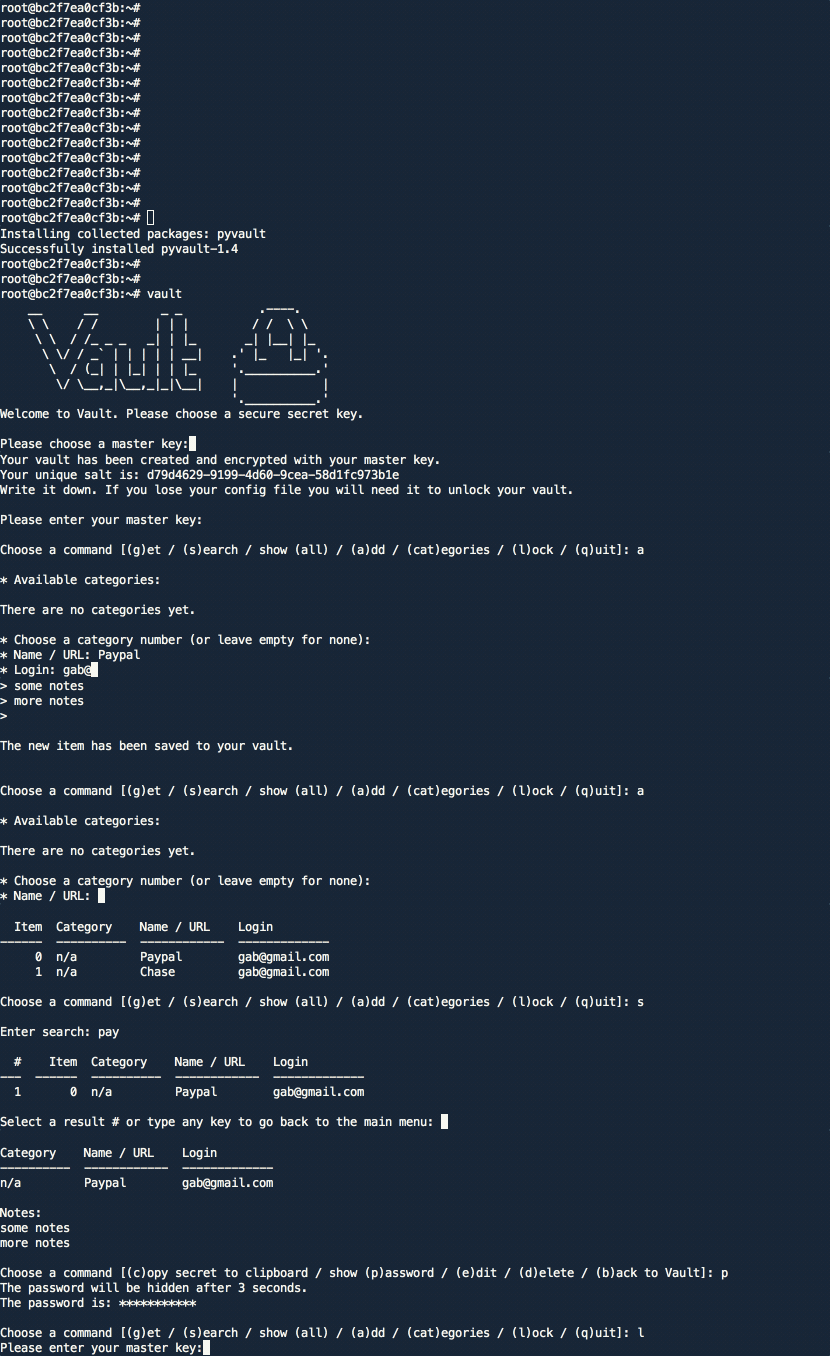
Installation and setup
Vault is tested on Python 3.11 to 3.15. SQLCipher is bundled with the sqlcipher3 package on macOS, Linux and Windows, so you do not need to install it separately.
pip3 install pyvault

# Run setup
vault
On Linux, copying secrets to the clipboard requires xclip (or xsel):
sudo apt install -y xclip
Upgrading from 2.4.5 or earlier
Earlier versions used the SQLCipher library installed on your system. Vault now uses the bundled SQLCipher 4, which opens any vault created with SQLCipher 4.x (the version shipped by Homebrew and by Ubuntu 20.04 and later). If your vault was created with SQLCipher 3.x, export it with your current version before upgrading and import it again afterwards (see import):
vault --export vault_backup.json        # before upgrading
pip3 install -U pyvault
vault --import_items vault_backup.json  # after upgrading, then delete vault_backup.json
If no prebuilt package exists for your platform, pip builds sqlcipher3 from source. You then need the SQLCipher headers (brew install sqlcipher on macOS, sudo apt install -y gcc python3-dev libsqlcipher-dev on Ubuntu/Debian).
Using Docker
# Pull the image
docker pull gabfl/vault

# Create local directory
mkdir ~/.vault

# Launch image
docker run -v ~/.vault:/root/.vault -ti gabfl/vault
Cloning the project
# Clone project
git clone https://github.com/gabfl/vault && cd vault

# Installation
pip3 install .

# Run setup
vault
Advanced settings:
usage: vault [-h] [-t [CLIPBOARD_TTL]] [-p [HIDE_SECRET_TTL]]
             [-a [AUTO_LOCK_TTL]] [-v VAULT_LOCATION] [-c CONFIG_LOCATION]
             [-k] [-i IMPORT_ITEMS] [-x EXPORT] [-f [{json}]] [-e]

optional arguments:
  -h, --help            show this help message and exit
  -t [CLIPBOARD_TTL], --clipboard_TTL [CLIPBOARD_TTL]
                        Set clipboard TTL (in seconds, default: 15)
  -p [HIDE_SECRET_TTL], --hide_secret_TTL [HIDE_SECRET_TTL]
                        Set delay before hiding a printed password (in
                        seconds, default: 15)
  -a [AUTO_LOCK_TTL], --auto_lock_TTL [AUTO_LOCK_TTL]
                        Set auto lock TTL (in seconds, default: 900)
  -v VAULT_LOCATION, --vault_location VAULT_LOCATION
                        Set vault path
  -c CONFIG_LOCATION, --config_location CONFIG_LOCATION
                        Set config path
  -k, --change_key      Change master key
  -i IMPORT_ITEMS, --import_items IMPORT_ITEMS
                        File to import credentials from
  -x EXPORT, --export EXPORT
                        File to export credentials to
  -f [{json}], --file_format [{json}]
                        Import/export file format (default: 'json')
  -e, --erase_vault     Erase the vault and config file
1 maintainer

Metadata
1 maintainer
Release files for pyvault 2.4.6
For a detailed explanation of source distributions (sdists) and built distributions (wheels), please see the package formats documentation.
Source distribution (sdist)
| File | Size | Uploaded | Provenance | Actions |
|---|---|---|---|---|
| pyvault-2.4.6.tar.gz | 22.8 kB | Without provenance | Details for pyvault-2.4.6.tar.gz |
Built distribution (wheel)
| File | Interpreter | ABI | Platform | Actions Reset |
|---|---|---|---|---|
| pyvault-2.4.6-py3-none-any.whl | Python 3 | none | any | Details for pyvault-2.4.6-py3-none-any.whl |
Total release size: 52.0 kB
Release files / pyvault-2.4.6.tar.gz
| Download URL | pyvault-2.4.6.tar.gz |
|---|---|
| Size | 22.8 kB |
| Tags | Source |
|
SHA-256 checksum How to use checksums |
d4ced3cdb2bc59fea9ef49591f8f75b3bce707414f3e03a794105cba8f1de136
|
|
BLAKE2b-256 checksum How to use checksums |
2427a21975f47c2237f48489162d0df9b8356c86afbf8dac4d7da68bf5af9476
|
| Upload date | |
|
Uploaded using Trusted Publishing? What is trusted publishing? |
No |
| Uploaded via |
twine/7.0.0 CPython/3.15.0
|
Release files / pyvault-2.4.6-py3-none-any.whl
| Download URL | pyvault-2.4.6-py3-none-any.whl |
|---|---|
| Size | 29.2 kB |
| Tags | Python 3 |
|
SHA-256 checksum How to use checksums |
a8f8fe3175548c2f3afe48edab5ce92bb6ffb4a0f272d9b1e6db58cf7afb7aa2
|
|
BLAKE2b-256 checksum How to use checksums |
820d6203ebeaabc60acb490e663551e65377f1b53d2f3ae31553c0c1b93b7f1b
|
| Upload date | |
|
Uploaded using Trusted Publishing? What is trusted publishing? |
No |
| Uploaded via |
twine/7.0.0 CPython/3.15.0
|
Security for pyvault 2.4.6
Provenance
Provenance describes where a file came from. On PyPI, provenance is shared via attestations, which provide a verifiable record of the build or publishing details. View details, limitations and caveats.
No provenance found
None of the files in this release were uploaded with provenance metadata.
A note on package security
PyPI is a repository for distributing packages, not a service for auditing them. While third-party security researchers and our staff do their best to detect and remove malicious packages, PyPI cannot guarantee the quality, security or suitability of any given package.
To learn more about protecting yourself from malicious actors, visit our package security documentation.














