
Exact mesh booleans, intersection curves, self-intersection repair,
isocontours and isobands, and N-ary CSG on PyVista
meshes — plus signed distance fields, field CSG and isosurfacing on
PyVista volumes. PyVista in, PyVista out, through one .trueform
accessor on pyvista.PolyData and on pyvista.ImageData.
Getting Started
pip install pyvista-trueform
The accessor registers itself on import and answers through
.trueform on any pyvista.PolyData — and, for scalar fields, on any
pyvista.ImageData:
import pyvista as pv
import pyvista_trueform as tfpv  # registers the accessors

pv.Cube().trueform.volume()
tfpv.sphere_sdf((32,) * 3, (0.1,) * 3, (-1.6,) * 3, (0, 0, 0), 1.0) \
    .trueform.isosurface()
The cache is whole-value, keyed by the dataset's VTK modification time — the held instance is what lets trueform's spatial tree, face membership, and edge link build lazily once:
import numpy as np

a = pv.Cube()
mesh = a.trueform.to_mesh()
assert a.trueform.to_mesh() is mesh  # same cached instance, MTime unchanged

np.asarray(a.points)[0] += 1.0       # raw mutation: MTime NOT bumped
a.Modified()                         # tell VTK, so the cache rebuilds
assert a.trueform.to_mesh() is not mesh
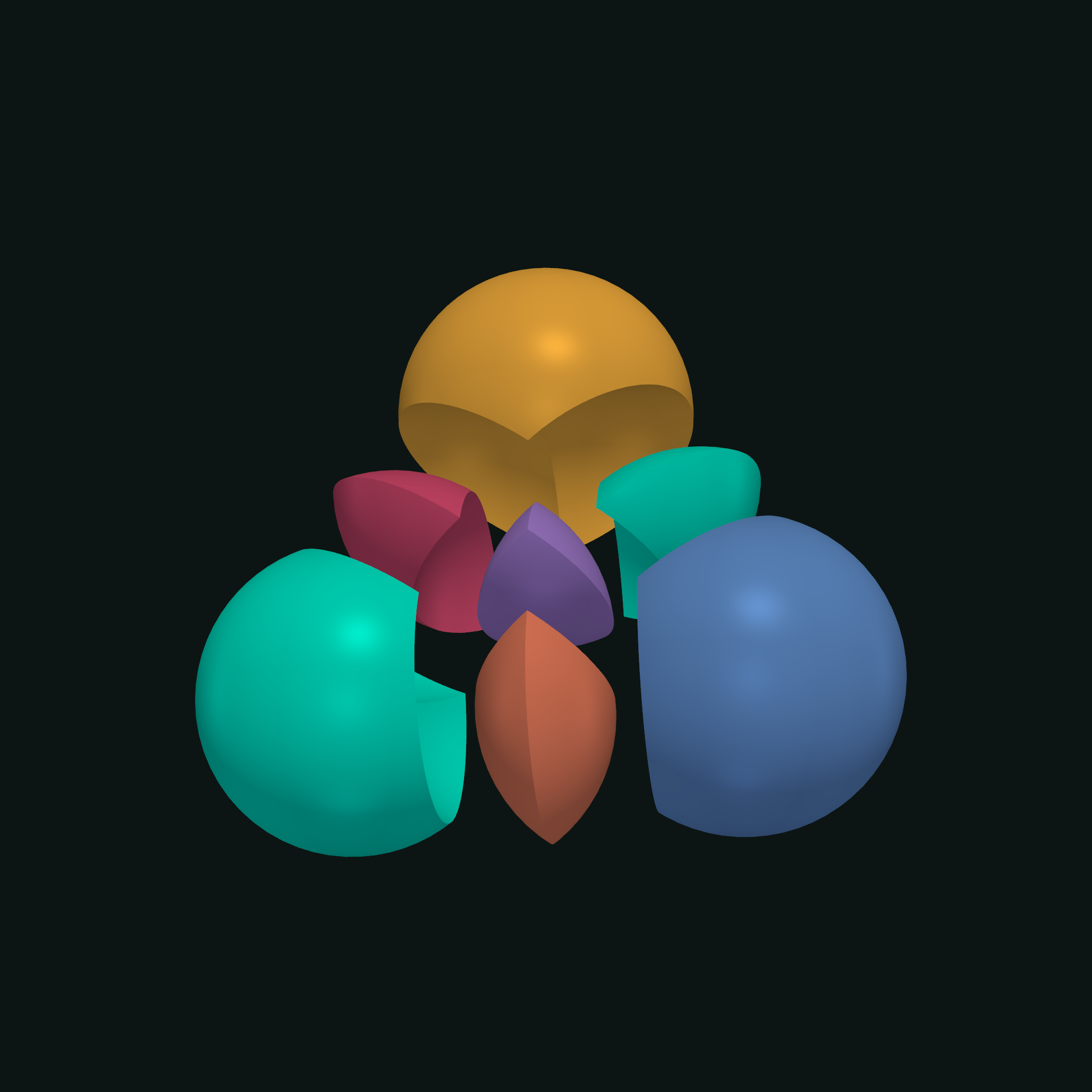
A worked example — a boolean carves the shape, domains reads the
pieces the arrangement made, and pick names the one a ray struck:
import numpy as np
import pyvista as pv
import pyvista_trueform as tfpv
import trueform as tf

a = pv.Cube()
b = pv.Cube(center=(0.5, 0.5, 0.5))

carved = a.trueform.difference(b)
carved.cell_data["trueform_labels"]  # per-face source: 0 (a) or 1 (b)
blocks = tfpv.domains([a, b])        # every overlap pocket, its own block
ray = tf.Ray(origin=np.array([-2, 0, 0], dtype=np.float32),
            direction=np.array([1, 0, 0], dtype=np.float32))
hit = tfpv.pick(blocks, ray)
hit.block_index                      # which block the ray struck
The contract the package holds itself to — dialect laws, the full surface, the gotchas — is one call away:
print(tfpv.agents()) # the package contract, for agents and humans alike
The sections below cover the rest of the surface these three lean on.
N-ary CSG
Build one arrangement of N operands and answer arbitrarily many boolean expressions against it:
from pyvista_trueform import csg_graph

c = pv.Cube(center=(0.25, 0.5, 0.0))  # quads, mixed ngons: normalized losslessly
graph = csg_graph([a, b, c])
graph.mesh(tf.op(0) - (tf.op(1) | tf.op(2)))

graph.domains()                       # every watertight piece, as a MultiBlock
graph.intersection_curves()           # the seams, as line PolyData
graph.outer_shell()                   # boundary of everything the operands enclose
graph.native                          # escape hatch: the raw trueform.CsgGraph

csg_graph([a])                        # one operand is legal: its own self arrangement
Conversions
to_trueform and to_pyvista cross the boundary; only to_trueform
copies:
from pyvista_trueform import (to_trueform, to_pyvista, curves_to_pyvista,
                             volume_to_trueform, volume_to_pyvista)

mesh = to_trueform(a)                        # detached trueform.Mesh, copies the geometry
to_pyvista(mesh)                             # zero-copy: shares mesh's own NumPy buffers
curves_to_pyvista(tf.boundary_curves(mesh))  # any (paths, points) pair, zero-copy
volume_to_pyvista(tf.sphere_sdf((16,) * 3, (0.25,) * 3, (-2.0,) * 3,
                                (0, 0, 0), 1.0))  # a field as ImageData, zero-copy
IO
from pyvista_trueform import read, write

write("cube.obj", a)                          # dispatched on suffix; .obj keeps a's own quad faces
read("cube.obj")                              # zero-copy conversion back to PolyData

write("cube.stl", a.trueform.triangulated())  # STL: triangles only
read("cube.stl")                              # STL welds duplicate vertices on the way in

ball = tfpv.sphere_sdf((16,) * 3, (0.25,) * 3, (-2.0,) * 3, (0, 0, 0), 1.0)
write("ball.nii.gz", ball)                    # NIfTI-1: the volume's active point scalars
read("ball.nii.gz")                           # ImageData back, in the file's own dtype
Domains and N-ary arrangements
from pyvista_trueform import domains, mesh_arrangements, split_into_domains

domains([a, b, c])            # every watertight domain, named by id, as a MultiBlock
mesh_arrangements([a, b, c])  # the whole arrangement instead, as one labeled PolyData
a.trueform.domains()          # one mesh's own overlap pockets, from its self arrangement

arranged = mesh_arrangements([a, b, c])
split_into_domains(arranged, exclude_outer_shell=True)  # already cut: labeled and
                                                        # split, no second arrangement
Picking
pick and closest answer over any MultiBlock (nested ones flatten; a
plain PolyData works too, as block 0):
from pyvista_trueform import pick, closest

blocks = domains(csg_graph([a, b]))
ray = tf.Ray(origin=np.array([-2, 0, 0], dtype=np.float32),
            direction=np.array([1, 0, 0], dtype=np.float32))
pick(blocks, ray)                 # hit.block_index, hit.point: first block struck
closest(blocks, [0.0, 0.0, 0.0])  # same shape, by proximity instead of a ray
Volumes
A scalar field is a pyvista.ImageData under the same .trueform
accessor: the samples are its active point data, the grid is its own
placement. A scan carries the file's affine, so its isosurface lands in
patient space with nothing further to do:
scan = tfpv.read("ct.nii.gz")           # NIfTI in, ImageData out, samples still int16
bone = scan.trueform.isosurface(300.0)  # the Hounsfield level set, in patient space
bone.plot()
A mesh states its own field, and a field states a mesh back:
field = a.trueform.signed_distance_field((33,) * 3, (0.05,) * 3, (-0.8,) * 3)
field.active_scalars.min()              # -0.5: negative inside a, zero on its surface

field.trueform.isosurface()                          # back to a surface
field.trueform.isosurface(0.1)                       # offset outward by 0.1
field.trueform.isosurface(method="dual_contouring")  # creases and corners survive

a.trueform.signed_distance_field((33,) * 3, (0.05,) * 3, (-0.8,) * 3,
                                 mode="banded", band=3)  # ~10x faster
Fields carve like solids, regrid, and slice:
ball = tfpv.sphere_sdf((33,) * 3, (0.05,) * 3, (-0.8,) * 3, (0, 0, 0), 0.6)

carved = field.trueform.difference(ball)   # .union() and .intersection() too
carved.trueform.isosurface()               # exactly the boolean of the two solids

field.trueform.resampled((17,) * 3, (0.1,) * 3, (-0.8,) * 3)
field.trueform.slice_contours((-0.8, -0.8, 0.0), (1, 0, 0), (0, 1, 0),
                             (128, 128), (0.0125, 0.0125), 0.0)
Field CSG is bound by the grid's resolution where the mesh booleans above are exact everywhere — reach for fields when the input already is one, when the shapes are offsets or blends, and for meshes when you want the operands back unchanged.
Remesh
tri = a.trueform.triangulated()

tri.trueform.remeshed(0.1)             # isotropic, target edge length
tri.trueform.decimated(0.5)            # quadric-error, target face proportion
tri.trueform.simplified()              # quadric-error, to an error budget instead

labels = np.zeros(tri.n_cells, dtype=np.int32)
remeshed = tri.trueform.remeshed(0.1, preserve_regions=labels)
remeshed.cell_data["trueform_labels"]  # preserve_regions rides back as cell data
Queries
a.trueform.volume()                  # .area(), .signed_volume(), .mean_edge_length() too
a.trueform.is_closed()               # .is_open(), .is_manifold(), .is_non_manifold(),
                                     # .euler_characteristic() too
a.trueform.has_self_intersections()  # does the mesh meet itself; the first contact stops it
a.trueform.distance(b)               # euclidean; .intersects(b) too
a.trueform.signed_distance(b)        # negative inside b; batched over a's own points
a.plot(scalars=a.trueform.signed_distance(b), cmap="polydera_div")  # packaged map, registered on import
a.trueform.winding_number([0, 0, 0])  # ~1 inside, ~0 outside; a tf.Point batches it
a.trueform.closest_point([0, 0, 0])  # (face_id, distance, point)
a.trueform.closest_points([2, 0, 0], k=3)  # the k nearest, closest first
a.trueform.closest_point_pair(b)     # witness pair between a and b
a.trueform.principal_curvatures()    # (k0, k1); .shape_index() too

a.trueform.face_quality()            # (quality, min angle, max angle, aspect ratio) per face
a.trueform.dihedral_angles()         # (edges, angles) for every edge two faces share
a.cell_data["quality"] = a.trueform.face_quality()[0]  # measures come back raw: attach them

seg = tf.Segment(np.array([[2, 0, 0], [3, 0, 0]], dtype=np.float32))
a.trueform.distance(seg)             # queries take trueform primitives; .closest_point(seg) too

n, labels = a.trueform.connected_components()  # (n, per-face component labels)
a.trueform.split_components()        # one block per component, as a MultiBlock
a.trueform.boundary_curves()         # open edges, as line PolyData
a.trueform.boundary_edges()          # the dataset's own point ids instead; .boundary_paths(),
                                     # .non_manifold_edges(), .non_manifold_paths() too
a.trueform.boundary_rims()           # (vertices, faces, closed) per rim, same point ids
a.trueform.non_manifold_vertices()   # the vertices whose faces are not one fan
a.trueform.split_non_manifold_vertices()  # one vertex per fan; + the point map

ray = tf.Ray(origin=np.array([-2, 0, 0], dtype=np.float32),
            direction=np.array([1, 0, 0], dtype=np.float32))
a.trueform.ray_cast(ray)             # (face_id, t); config=(min_t, max_t) bounds it
All of these answer against the cached mesh, so the spatial tree amortizes across calls.
Registration
from pyvista_trueform import (align_rigid, align_similarity, align_icp,
                             align_obb, align_knn, chamfer_distance)

align_rigid(a, b)       # Kabsch: rotation + translation, correspondence required
align_similarity(a, b)  # + uniform scale, same correspondence requirement
align_icp(a, b)         # iterative closest point, no correspondence needed
align_obb(a, b)         # oriented-bounding-box alignment, no correspondence
align_knn(a, b)         # one soft-correspondence step
chamfer_distance(a, b)  # one-way chamfer measure

matrix = align_rigid(a, b)                    # 4x4 delta: maps a's current points onto b
aligned = a.transform(matrix, inplace=False)  # apply to a itself to align it with b
Lines and tubes
from pyvista_trueform import connect_lines, tube

line = pv.Line((0, 0, 0), (1, 0, 0))
tube(line, radius=0.1)  # triangle tube; unordered 2-point segments connect first
connect_lines(line)     # just the assembly: segments in, polylines out, same point ids
Generators
tfpv.box(2.0, 1.0, 3.0)                                   # ticks subdivide each axis
tfpv.sphere(1.0, stacks=20, segments=20)
tfpv.cylinder(1.0, 2.0, segments=20)
tfpv.plane(10.0, 5.0)                                     # ticks subdivide each axis
tfpv.sphere(1.0, dtype=np.float64, index_dtype=np.int64)  # trueform's defaults apply when omitted
Examples
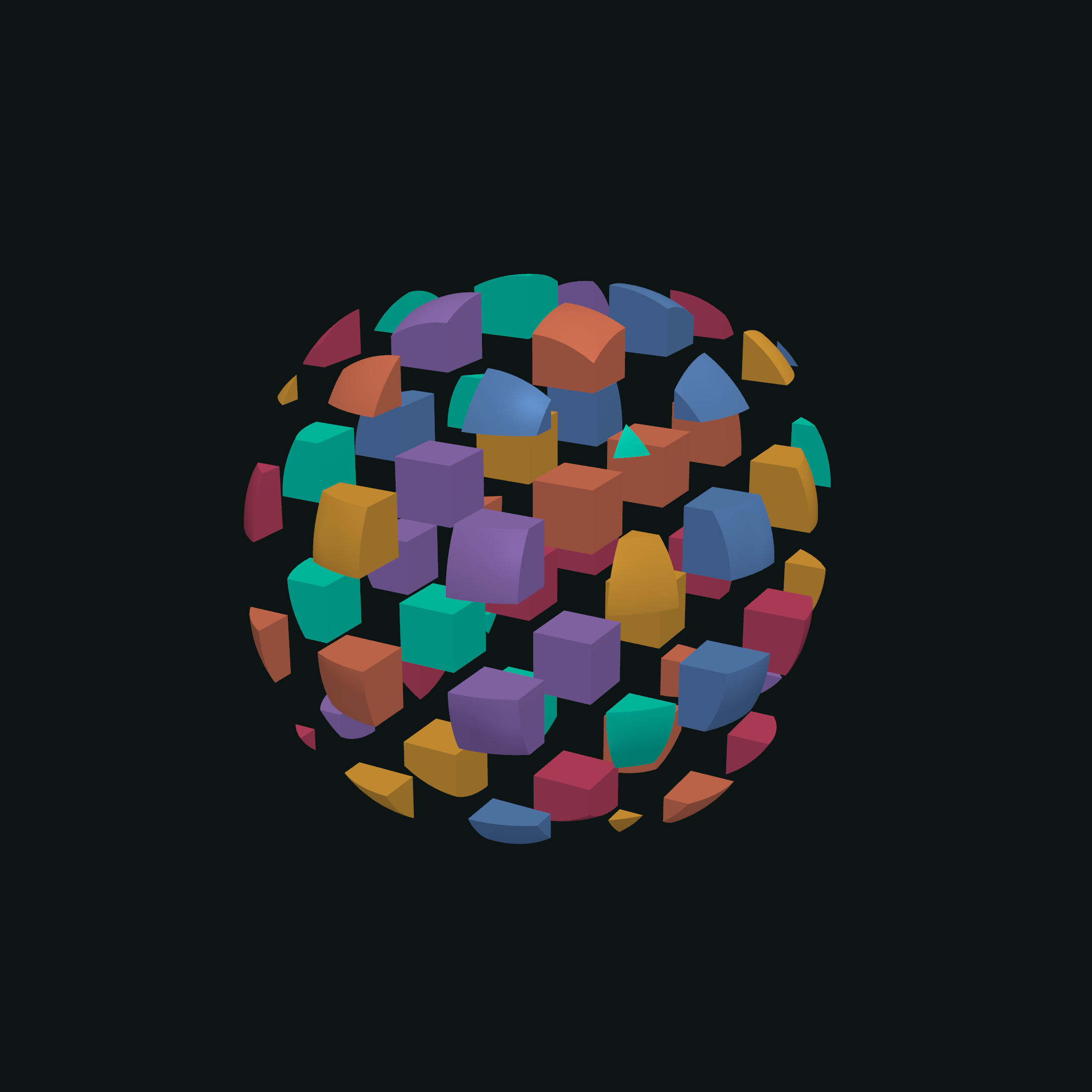
Eleven standalone scripts in examples/, each with an importable
compute() and a plotting main() (python examples/<name>.py); the
gallery ships in the Polydera color scheme through the shared
examples/_theme.py:
boolean.py— a boolean difference recut live under a dragged sphere widget, the result labeled by source.csg_fracture.py— a sphere minus a grid of cutters through one csg_graph expression, read back as volumetric chunks; clicking a chunk names it throughclosest.isobands.py— height isobands and isocontours overlaid on a surface, recut live from a band-count slider.volume_scan.py— a NIfTI study read in patient space and surfaced at a Hounsfield threshold; pass a scan path, or let it synthesize, write and read back a posed int16 one.volume_csg.py— a box's signed distance field minus a sphere's, surfaced by flying edges and by dual contouring side by side, the isovalue on a slider.volume_offset.py— a torus's own banded distance field read at three offsets, the last one closing the hole.volume_slice.py— a field's level sets on one plane, drawn as curves beside the isosurface they cut.signed_distance.py— a hills surface recolored live by signed distance to a dragged torus probe, diverging about the zero seam.curvature.py— Gaussian curvature across a torus and mean curvature across a hills surface, from oneprincipal_curvaturescall each.remesh_and_simplify.py— remeshed, decimated, and simplified side by side.raycast_depth.py— an orthographic depth image from one batchedtf.Raycast.
Coming with trueform 0.11
Orientation verdicts (orient_faces_consistently,
ensure_positive_orientation) — the Python binding still returns only the
repaired faces array, no verdict yet.
License
Dual-licensed:
- Noncommercial: PolyForm Noncommercial License 1.0.0
- Commercial: Contact info@polydera.com
1 maintainer

Metadata
1 maintainer
Release files for pyvista-trueform 0.5.0
For a detailed explanation of source distributions (sdists) and built distributions (wheels), please see the package formats documentation.
Source distribution (sdist)
| File | Size | Uploaded | |
|---|---|---|---|
| pyvista_trueform-0.5.0.tar.gz | 76.2 kB | Details |
Built distribution (wheel)
| File | Interpreter | ABI | Platform | Reset |
|---|---|---|---|---|
| pyvista_trueform-0.5.0-py3-none-any.whl | Python 3 | none | any | Details |
Total release size: 140.6 kB
Release files / pyvista_trueform-0.5.0.tar.gz
| Download URL | pyvista_trueform-0.5.0.tar.gz |
|---|---|
| Size | 76.2 kB |
| Tags | Source |
|
SHA-256 checksum How to use checksums |
d6f52885b85a6fc88b0f8536a0a006f620cb02c5592be4acbaddbaab1121595a
|
|
BLAKE2b-256 checksum How to use checksums |
cb95a5982cb0d9fbe468484faad1d07706e51b44500d42173f59ed356df8f04f
|
| Upload date | |
|
Uploaded using Trusted Publishing? What is trusted publishing? |
No |
| Uploaded via |
twine/7.0.0 CPython/3.13.14
|
Release files / pyvista_trueform-0.5.0-py3-none-any.whl
| Download URL | pyvista_trueform-0.5.0-py3-none-any.whl |
|---|---|
| Size | 64.4 kB |
| Tags | Python 3 |
|
SHA-256 checksum How to use checksums |
fbc0caa4ce3fc65bbd52360be9caf9787ae6a69decd1d2987efb26b7aaa6b4d2
|
|
BLAKE2b-256 checksum How to use checksums |
3b38521fe4685ec2f4c55cf33fd95c1d1e477ea9f0503ee81cf6cb902995527e
|
| Upload date | |
|
Uploaded using Trusted Publishing? What is trusted publishing? |
No |
| Uploaded via |
twine/7.0.0 CPython/3.13.14
|














