

QAlprit
Mobile QA. Bugs caught with proof.
Record a test by clicking through your app. Replay it on Android and iOS. Get a report with a screenshot of every step.




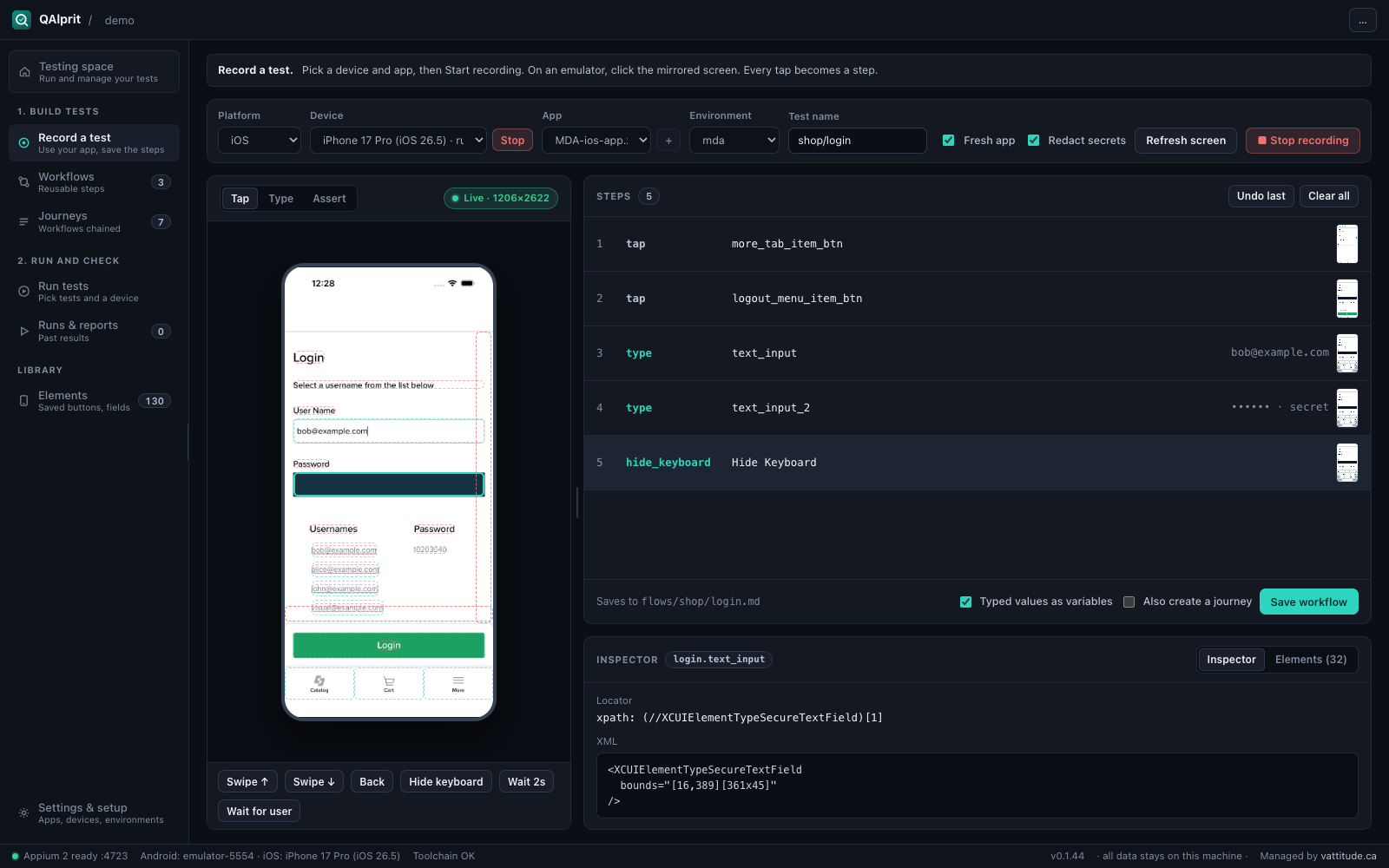
QAlprit is a desktop app for testing Android and iOS apps. You do not write test scripts. You open your app on an emulator or simulator inside the Workbench, click through it once, and QAlprit saves those clicks as a test you can run again whenever the app changes.
- Click to record. The Workbench mirrors the device screen. Click a button to record a tap, click a field to record typing, click a label to record a check.
- One test, many inputs. Text you type becomes a variable. Add rows to a table and the same test runs once per row.
- Secrets stay hidden. Password and card fields are blacked out in screenshots and masked in logs and reports.
- Same steps every run. Nothing is guessed at run time, so a failure means the app changed.
- Runs on your machine. Your app, test data and screenshots never leave it.
Get started in five minutes
1. Install the desktop app
Download the installer from the latest release:
| Your computer | File | Tests |
|---|---|---|
| macOS (Apple silicon) | QAlprit-<version>-macos-arm64.dmg |
Android and iOS |
| Windows 10 or 11 | QAlprit-Setup-<version>-win64.exe |
Android |
The app bundles Appium 2, Node and Java, so there is nothing else to install for Android. iOS testing needs Xcode with an iOS Simulator, which is why it is macOS only.
On first launch a welcome guide asks three things: Android or iPhone, which app file, and which device. Then it opens the recorder. If you have tests already, click Skip to Testing space. Settings & setup checks your toolchain and can create an Android emulator for you with one click.
2. Record a test
Click Record a new test (or go to Record a test), pick the platform, the device and your app file (.apk for Android, .app or .zip for the iOS Simulator), and click Start recording. QAlprit boots the device if it is off, installs the app and shows it live.
Now use the app the way a customer would:
- Tap mode records a tap on whatever you click.
- Type mode asks for text and enters it. Tick Secret for passwords.
- Assert mode records a check that the element you click is on screen.
- The buttons under the phone add swipes, back, hide keyboard and a short wait.
Every click shows up as a step on the right. You can reorder, duplicate, edit or delete steps before you save. If iOS shows a "Save Password" sheet, the recorder dismisses it for you.
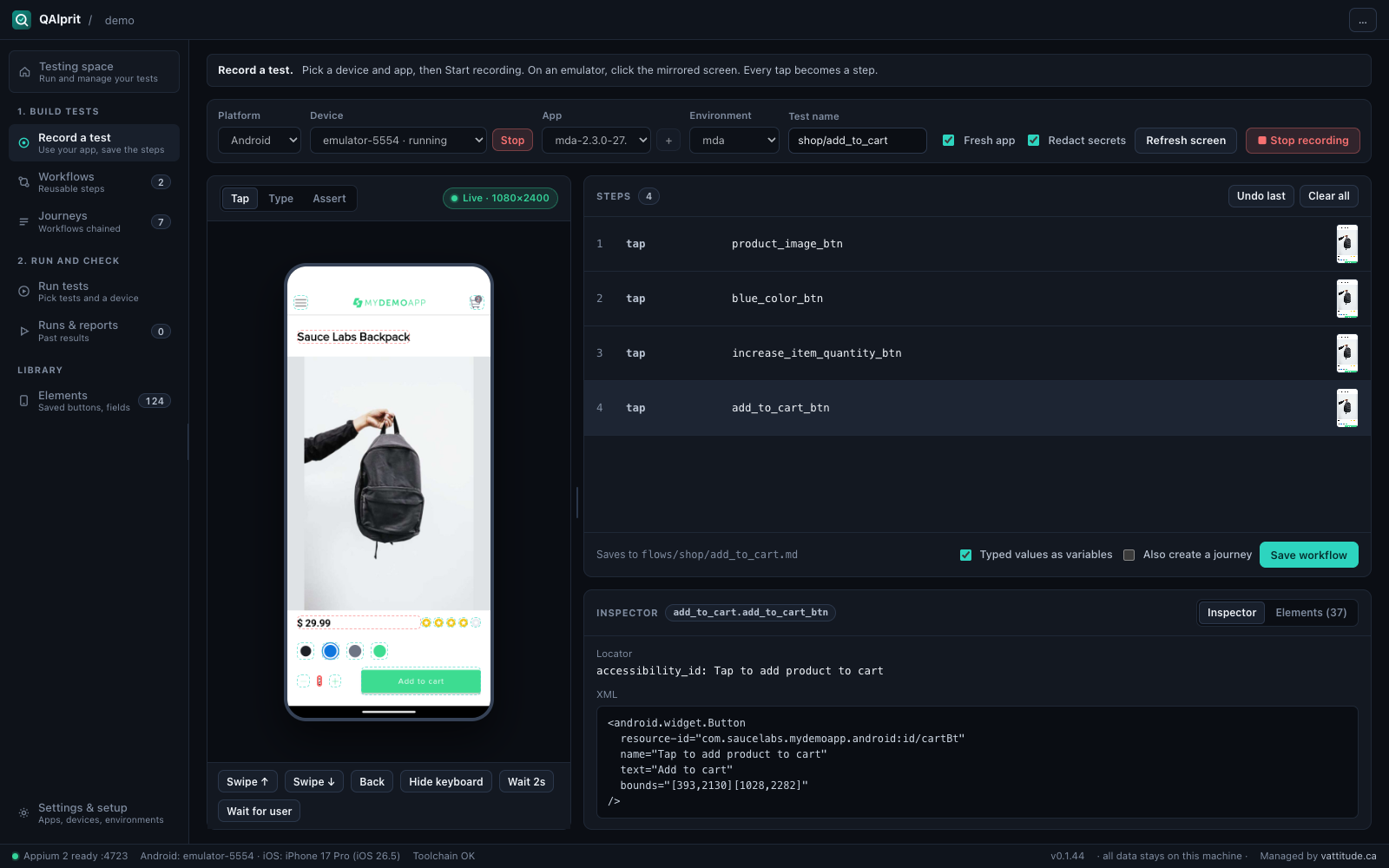
3. Save it as a workflow
Click Save workflow. QAlprit names the elements you touched, stores how to find them, and turns everything you typed into variables such as ${username} and ${password}.
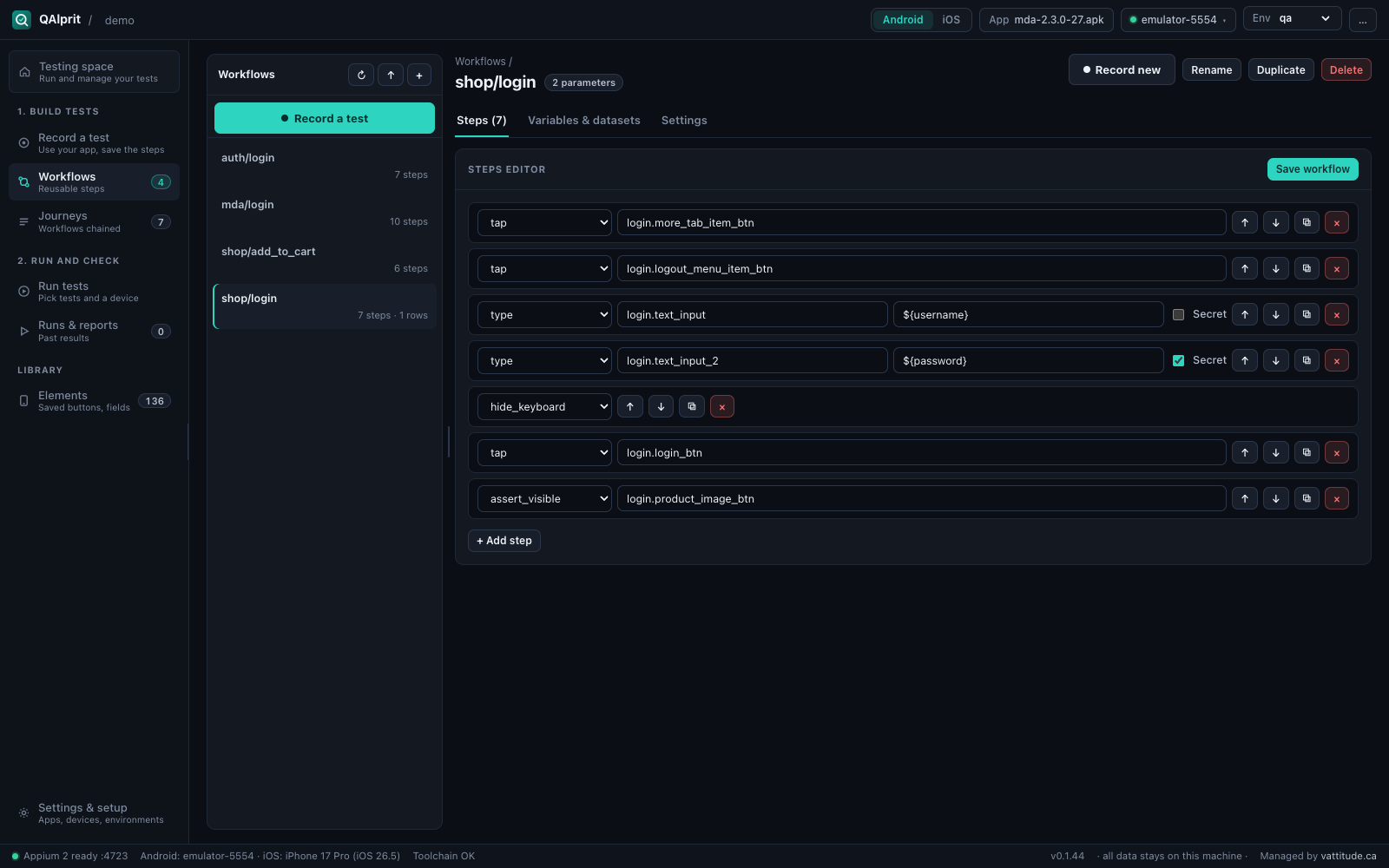
4. Add test data
Open the workflow and go to Variables & datasets. The values you typed while recording are already there as the first row. Click Add row for more cases, or Import CSV to bring in a spreadsheet. Secret columns show as dots.
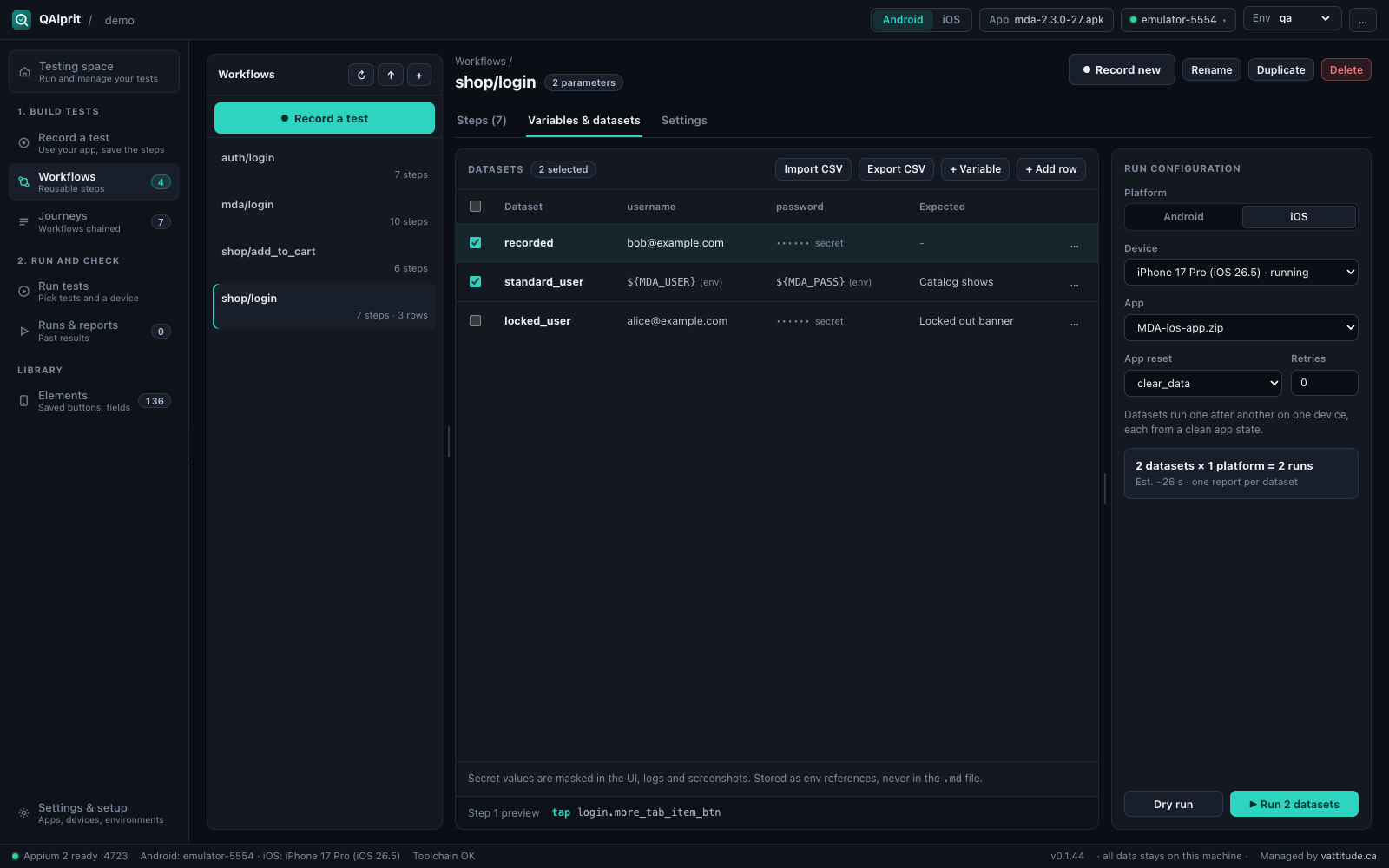
5. Run and read the report
Tick the rows you want, choose Android or iOS, and click Run. Each row runs from a clean app state. Runs & reports shows a result per row with the final screen, and links to the full HTML report, a Markdown summary and JUnit XML for CI.
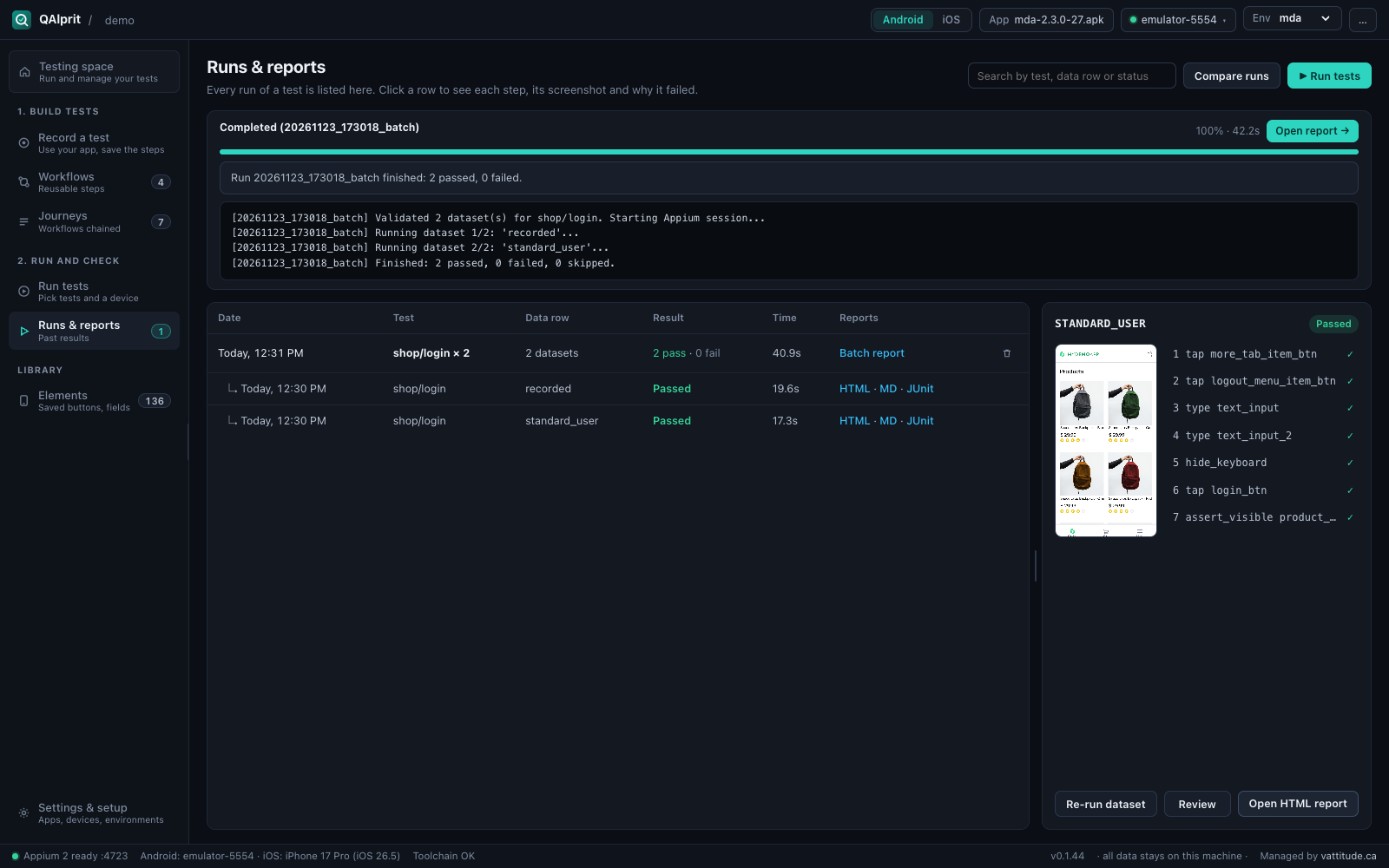
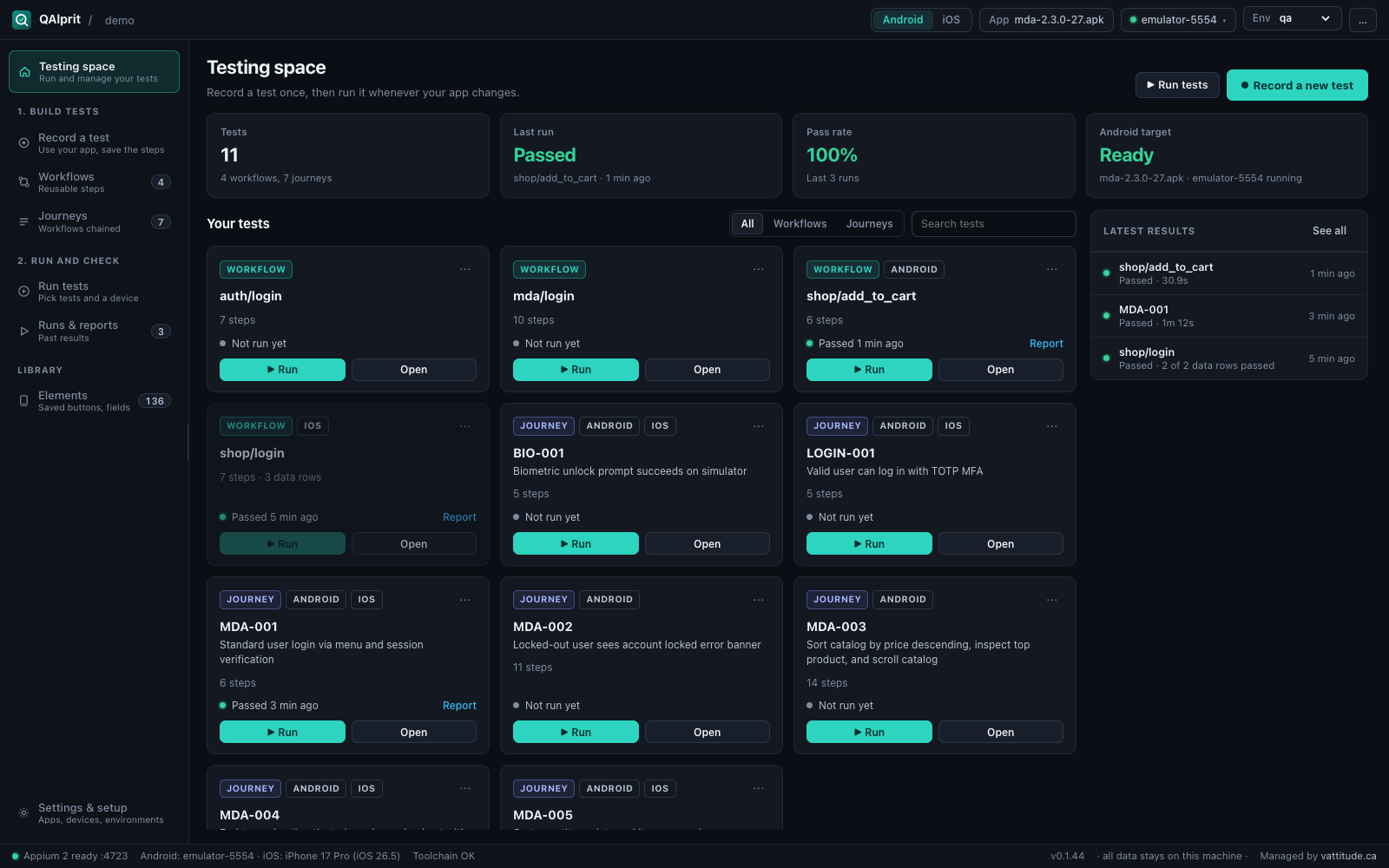
What the Workbench gives you
| View | What you do there |
|---|---|
| Testing space | See every test as a card, run it in one click, rename, duplicate or delete it, and check the latest results |
| Record a test | Mirror a live emulator, simulator or USB phone and capture steps by clicking |
| Workflows | Edit recorded steps, manage variables and CSV datasets, run one or many rows |
| Journeys | Chain workflows into end-to-end tests and tag them into suites |
| Runs & reports | Watch a run live, open reports, compare two runs, delete old runs |
| Elements | Search every saved button and field, see how it is found on Android and iOS, delete unused ones |
| Settings & setup | Check the toolchain, create emulators, manage environments and app files |
What comes out
Every run creates a folder under results/<run-id>/ with your proof:
report.html: Open in any browser to see pass/fail results, failure categories, and step screenshots.summary.md&junit.xml: Markdown results table for pull requests plus JUnit XML for CI pipelines.screenshots/: Step screenshots with passwords and sensitive boxes blacked out in memory before saving.results.json&appium.log: Structured test data (schema_version: 1.1) and scrubbed Appium logs.
Real sample output (Sauce Labs My Demo App)
See all 5 passing Android tests in the Live Sample Report or examples/mda-sample-run:
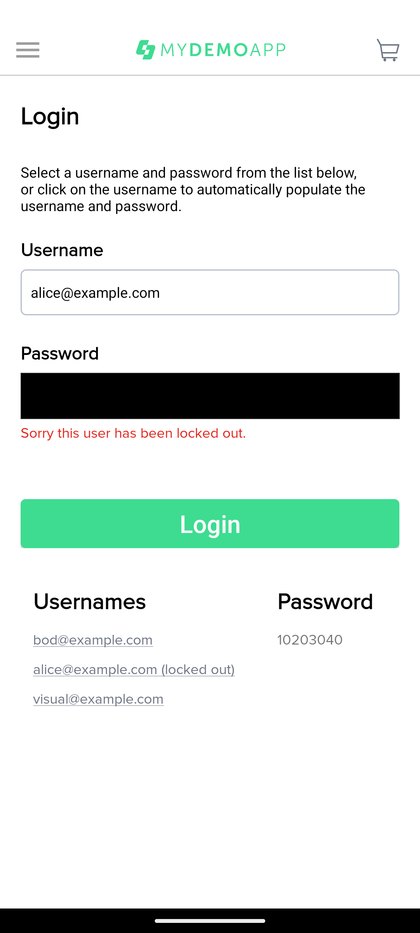 MDA-002: Password blacked out; error message verified. |
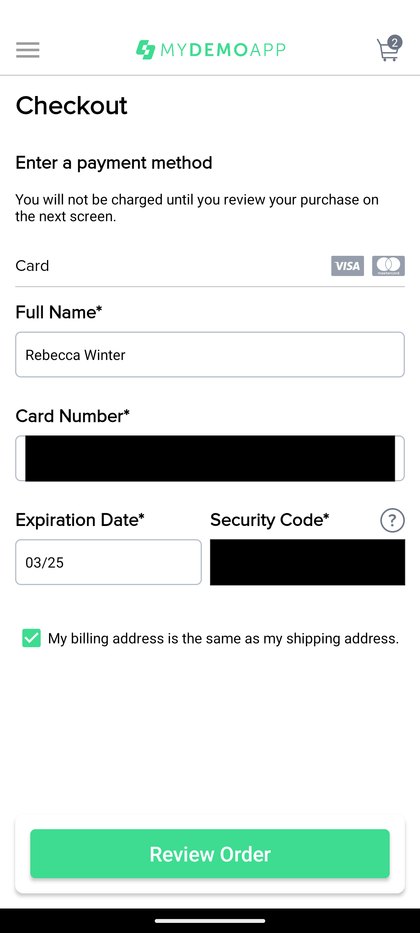 MDA-004: Card number and CVV blacked out in memory. |
For engineers: CLI, CI and plain-text tests
Everything the Workbench saves is a plain text file in your project folder, so tests live in git and run in CI without the desktop app.
| File | Holds |
|---|---|
flows/<name>.md |
A recorded workflow, with platforms: set to where you recorded it |
screens/screens.yaml |
Element locators, with separate android: and ios: entries |
datasets/flows/<name>.csv |
One row per test case. A cell can hold ${QA_PASS} to read a real credential from .env |
specs/<suite>/*.md |
Journeys that call workflows |
Install the Python package to run the same tests from a terminal or pipeline:
pip install qalprit
npm install -g appium
appium driver install uiautomator2   # Android
appium driver install xcuitest       # iOS, macOS only

qalprit ui                           # the same Workbench, in your browser
qalprit doctor                       # check Python, Node, Appium and device tools
qalprit validate --suite mda --env mda
qalprit run --platform android --device android_emulator --app apps/mda-2.3.0-27.apk --env mda --suite mda
The CLI needs Python 3.10+, Node.js, and either Android Studio (ADB plus an emulator or USB phone) or Xcode with an iOS Simulator.
To try the bundled sample suite, copy config/env.example to .env and download mda-2.3.0-27.apk from Sauce Labs My Demo App into apps/.
You can also hand the work to an AI coding agent (Claude Code, Codex, Cursor, Copilot, Antigravity). Paste:
Follow Agent Instructions to run QAlprit against
apps/<your-app.apk-or-.app>on<android|ios>. Fix any broken locators or keyboard issues without hiding real app bugs, and open my finalreport.html.
To work on QAlprit itself:
git clone https://github.com/vattitude-me/QAlprit.git
cd QAlprit
python3 -m venv .venv && source .venv/bin/activate
pip install -e ".[dev]"
pytest -v
Technical documentation
Event flow
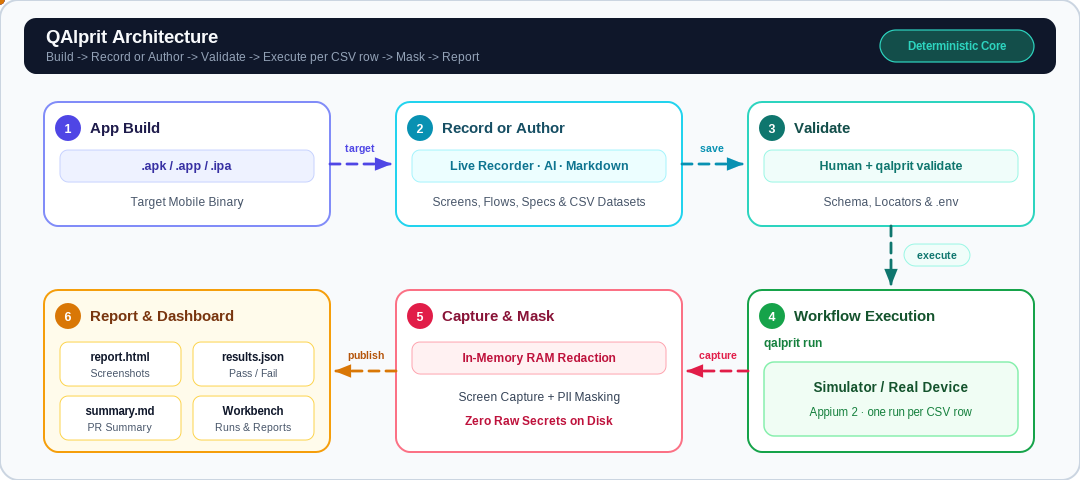
- App Build: Package the target mobile binary (
.apk,.app, or.ipa). - Record: Click through the app on a live emulator in the Workbench. QAlprit saves screen locators (
screens/screens.yaml), reusable flows (flows/*.md), test specs (specs/*.md), and CSV datasets (datasets/). - Validate: Review with human +
qalprit validateto catch schema, locator, and.envissues before execution. - Workflow Execution: Run each workflow deterministically via Appium 2 on a simulator/emulator or real USB device, once per selected CSV row.
- Capture & Mask: Capture screen frames and mask sensitive fields/PII in memory before saving (
secure_evidence: true). - Report & Dashboard: Generate
report.html,summary.md,junit.xml,results.json, and explore or compare runs inqalprit ui.
CLI reference
| Command | What it does |
|---|---|
qalprit doctor |
Checks Python, Node, Appium 2, and Android/iOS tools |
qalprit devices |
Lists connected phones, emulators, and simulators |
qalprit list [--suite <name>] |
Lists test specs, reusable flows, and screen locators (--json-output supported) |
qalprit inspect --platform android|ios |
Reads the current app screen and ranks suggested locators (--export-json supported) |
qalprit validate --suite <name> --env <name> |
Checks specs, flows, locators, and .env without a phone (--app optional) |
qalprit run --platform android|ios --device <name> --app <path> |
Runs tests (--id, --exclude-tags, --rerun-failed, --dry-run, --update-baselines) |
qalprit report <results-dir> |
Rebuilds report.html, summary.md, and junit.xml from results.json |
qalprit ui |
Opens the Workbench in your browser: record flows, edit datasets, run, and compare reports |
More docs
- AI Agent Instructions: Prompt and runbook so an AI coding agent can run & maintain QAlprit for you
- Authoring Guide: Step vocabulary, reusable flows, CSV datasets, and iOS reset tips
- Editable Diagram (Draw.io)
- Contributing · Security · MIT License
QAlprit (qalprit.vattitude.ca). Managed by vattitude.ca
1 maintainer

Metadata
1 maintainer
Release files for qalprit 0.1.34
For a detailed explanation of source distributions (sdists) and built distributions (wheels), please see the package formats documentation.
Source distribution (sdist)
| File | Size | Uploaded | Provenance | Actions |
|---|---|---|---|---|
| qalprit-0.1.34.tar.gz | 277.6 kB | With provenance | Details for qalprit-0.1.34.tar.gz |
Built distribution (wheel)
| File | Interpreter | ABI | Platform | Actions Reset |
|---|---|---|---|---|
| qalprit-0.1.34-py3-none-any.whl | Python 3 | none | any | Details for qalprit-0.1.34-py3-none-any.whl |
Total release size: 518.3 kB
Release files / qalprit-0.1.34.tar.gz
| Download URL | qalprit-0.1.34.tar.gz |
|---|---|
| Size | 277.6 kB |
| Tags | Source |
|
SHA-256 checksum How to use checksums |
aff473baff9a5a1c79d95a69e36fc8796f35939a6422a87d0d1c1ee6235c17bf
|
|
BLAKE2b-256 checksum How to use checksums |
3ccd1557a55ae5998b805fee1f5483180d316154eff8f46dc0a9d9f11c105e1f
|
| Upload date | |
|
Uploaded using Trusted Publishing? What is trusted publishing? |
Yes |
| Uploaded via |
twine/7.0.0 CPython/3.13.16
|
Provenance
Provenance describes where a file came from. On PyPI, provenance is shared via attestations, which provide a verifiable record of the build or publishing details. View details, limitations and caveats.


PyPI Publish Attestation
PyPI verified that this artifact, at this checksum, originated from the publisher listed below.
Signed by GitHub Actions, verified by PyPI on Nov 17, 2026.
Transparency logRelease files / qalprit-0.1.34-py3-none-any.whl
| Download URL | qalprit-0.1.34-py3-none-any.whl |
|---|---|
| Size | 240.6 kB |
| Tags | Python 3 |
|
SHA-256 checksum How to use checksums |
5ee667265713bf46befdb9a8fbd7f214cf54759f1ecf4f449e16bc95637f6d62
|
|
BLAKE2b-256 checksum How to use checksums |
d7073732dd85b250715cbee136ba272fac0bc45e7b115f5bf39a0672f3f90e9f
|
| Upload date | |
|
Uploaded using Trusted Publishing? What is trusted publishing? |
Yes |
| Uploaded via |
twine/7.0.0 CPython/3.13.16
|
Provenance
Provenance describes where a file came from. On PyPI, provenance is shared via attestations, which provide a verifiable record of the build or publishing details. View details, limitations and caveats.
PyPI Publish Attestation
PyPI verified that this artifact, at this checksum, originated from the publisher listed below.
Signed by GitHub Actions, verified by PyPI on Nov 17, 2026.
Transparency logSecurity for qalprit 0.1.34
Provenance
Provenance describes where a file came from. On PyPI, provenance is shared via attestations, which provide a verifiable record of the build or publishing details. View details, limitations and caveats.
Full provenance
Both files in this release have been uploaded with provenance metadata.
Attestation for qalprit-0.1.34.tar.gz
PyPI Publish Attestation
PyPI verified that this artifact, at this checksum, originated from the publisher listed below.
Signed by GitHub Actions, verified by PyPI on Nov 17, 2026.
Transparency logA note on package security
PyPI is a repository for distributing packages, not a service for auditing them. While third-party security researchers and our staff do their best to detect and remove malicious packages, PyPI cannot guarantee the quality, security or suitability of any given package.
To learn more about protecting yourself from malicious actors, visit our package security documentation.














