
Information-theoretic reconstruction of quantum wavefunctions from discrete bitstrings

Project description
QBitwave: Emergent Information-Theoretic Wavefunctions
QBitwave models quantum-like dynamics as the deterministic evolution of compressibility in finite bitstrings. The wavefunction ψ is interpreted not as a physical field but as the minimal compression algorithm that reproduces a given informational state. Existence corresponds to compressibility — most compressible configurations dominate. Through Fourier-domain transformations and entropy measures, QBitwave unifies bitstrings, complex amplitudes, and probabilistic behavior into a single information-centric framework.
Core Concept
QBitwave
QBitwave treats the wavefunction as an emergent, information-theoretic object.
A finite bitstring encodes a discretized wavefunction, which can be reconstructed as normalized complex amplitudes — the minimal program
reproducing the bitstring (Kolmogorov complexity perspective).
Fundamental principles:
- Compression = quantum probability amplitude = predictability
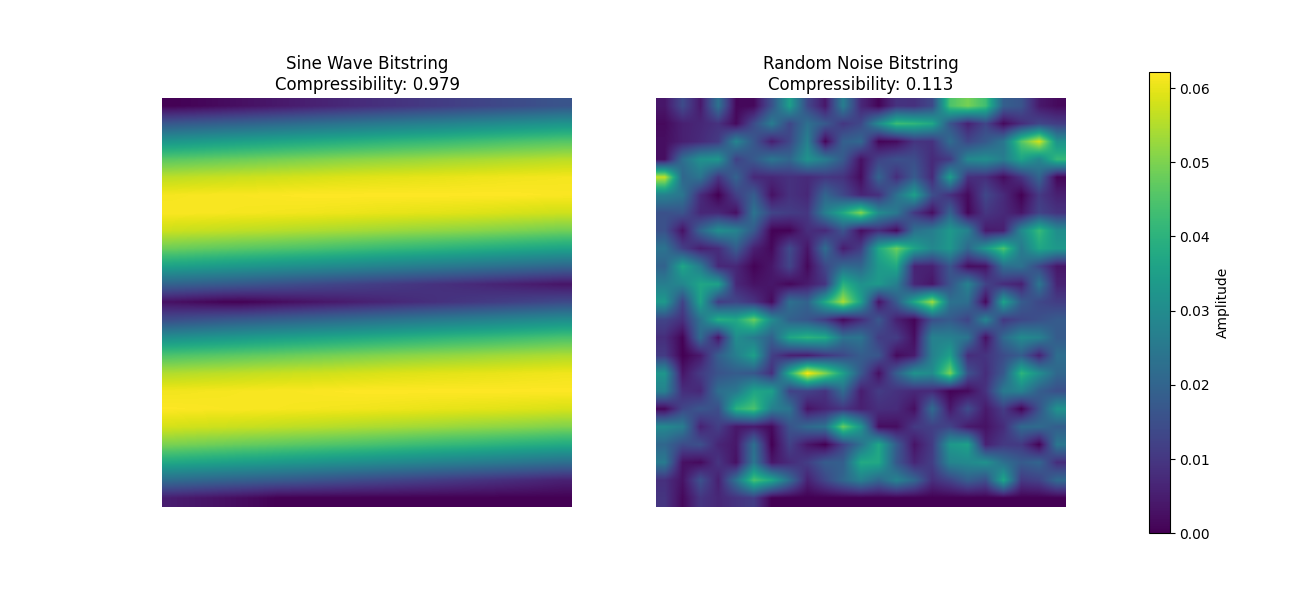
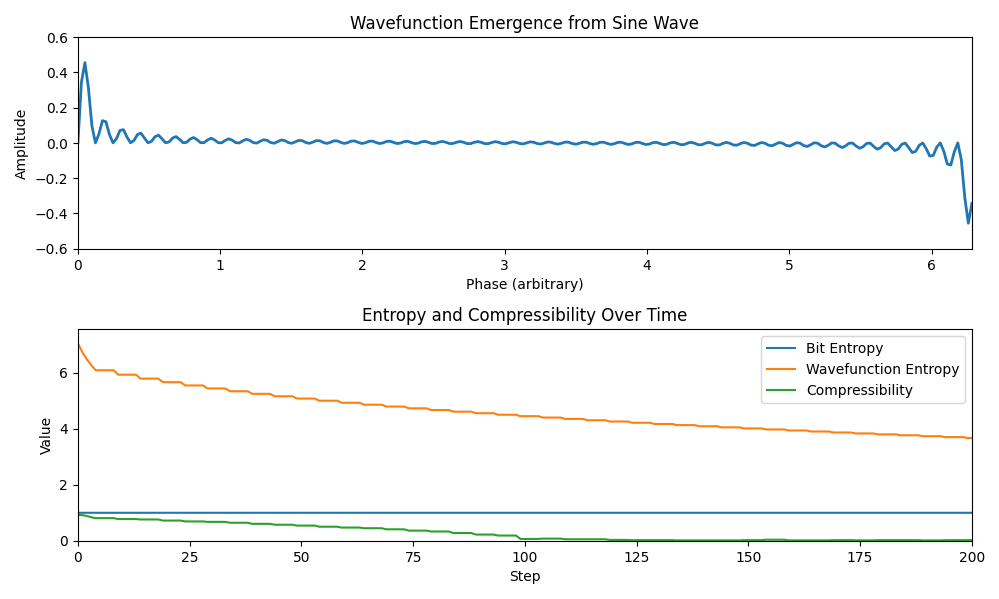
- Smooth, regular data compresses well → high amplitude in few Fourier components (low entropy)
- Random/noisy data is incompressible → low amplitude concentration
- Wavefunction = minimal program reproducing the bitstring
Features:
- Forward mapping: wavefunction → bitstring
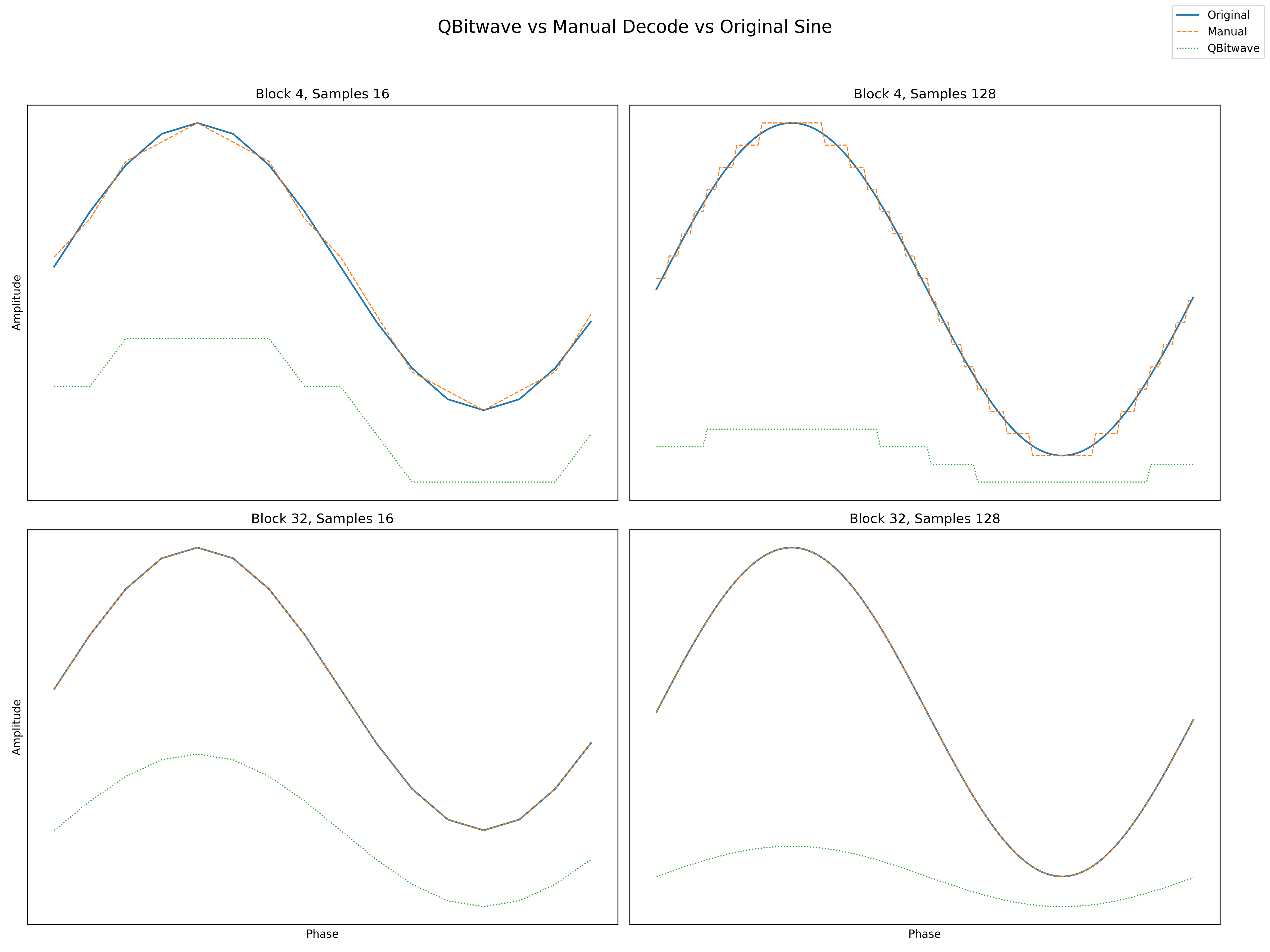
- Reverse mapping: bitstring → minimal wavefunction
- Block-size selection via entropy maximization
- Shannon entropy computation
- Fourier-based compressibility measure reflecting structure
QBitwaveND
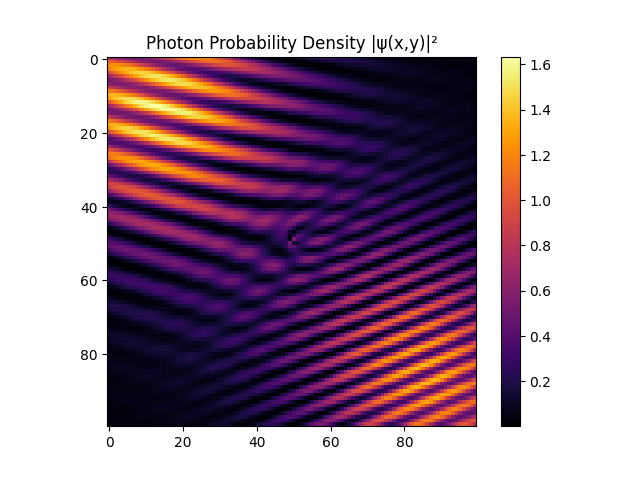
QBitwaveND generalizes QBitwave to N-dimensional continuous fields and allows dynamical evolution in time.
| Conceptual Relation |
|---|
QBitwave → Emergence: bitstring → ψ(x) |
QBitwaveND → Evolution: ψ(x) → ψ(x, t) |
QBitwaveND applies unitary, physically motivated evolution consistent with the Schrödinger free-particle dispersion relation, but framed entirely informationally:
- Take N-dimensional complex amplitude array ψ(x₁, x₂, …, xₙ)
- Compute Fourier transform:
ψ̃(k) = FFT[ψ(x)] / ∏ shape - Apply time evolution in frequency space:
ψ̃(k, t) = ψ̃(k) · exp(-i·ω(k)·t), where ω(k) = (ħ |k|²) / 2m - Inverse transform to get ψ(x, t)
Interpretation:
- Time is an informational parameter — the phase evolution of encoded structure
- Bridges algorithmic information (Kolmogorov domain) and spacetime dynamics (Fourier domain)
- Provides unitary time evolution over emergent informational geometry, extending static ψ(x) of
QBitwaveto ψ(x, t)
Attributes:
amplitudes: N-dimensional complex array ψ(x) at t=0shape: spatial dimensions of the arrayndim: number of spatial dimensionsfft_coeffs: normalized Fourier coefficients ψ̃(k)freqs: per-axis frequency arraysmass: effective mass parameter (ħk² / 2m)c: speed of light (for optional relativistic corrections)hbar: reduced Planck constant
Key Methods:
from_array(data_array): construct from existing N-D arrayfrom_qbitwave(qb: QBitwave): create N-D field from a 1D informational wavefunctiontime_evolve_coeffs(t): return Fourier coefficients after time evolutionevaluate(*coords, t=0.0): compute ψ(x, t) at arbitrary coordinatesprobability(*coords, t=0.0): return |ψ(x, t)|² (Born-rule analog)
Why It Matters
- Information as primary ontology: All physical phenomena are encoded by minimal informational descriptions; spacetime, fields, and quantum dynamics are derived, not assumed.
- Compressibility replaces renormalization: High-frequency modes that contribute divergences in conventional QFT are interpreted as incompressible configurations with vanishing physical measure, providing a natural regularization.
- Singularities as structureless limits: Zero execution-trace entropy indicates collapse of all distinguishable geometric degrees of freedom, eliminating the need to treat singularities as breakdowns of physics.
Source code
Example Usage
from qbitwave import QBitwave, QBitwaveND

# Create a 1D informational wavefunction
qb = QBitwave("010110110001")

# Lift it to N-dimensional dynamic field
qn = QBitwaveND.from_qbitwave(qb)

# Evaluate amplitude at x=0.2, t=0.5
psi_t = qn.evaluate(0.2, t=0.5)

# Compute probability (Born rule analog)
P = qn.probability(0.2, t=0.5)
Images
Release history Release notifications | RSS feed


Download files
Download the file for your platform. If you're not sure which to choose, learn more about installing packages.
Source Distribution
Built Distribution
Filter files by name, interpreter, ABI, and platform.
If you're not sure about the file name format, learn more about wheel file names.
Copy a direct link to the current filters
File details
Details for the file qbitwave-0.2.5.tar.gz.
File metadata
- Download URL: qbitwave-0.2.5.tar.gz
- Upload date:
- Size: 16.3 kB
- Tags: Source
- Uploaded using Trusted Publishing? No
- Uploaded via: twine/6.1.0 CPython/3.12.3
File hashes
| Algorithm | Hash digest | |
|---|---|---|
| SHA256 |
a4a4c2f99207a5808d99f792a72b15bf971677707de6ea36090fc1180ca14298
|
|
| MD5 |
0644a95fc0c6150c6b15335d19b6b955
|
|
| BLAKE2b-256 |
745d0569be1578623ceafc514ddd585d5affd38bcaeac8cd5bafae5a1e5d35f6
|
File details
Details for the file qbitwave-0.2.5-py3-none-any.whl.
File metadata
- Download URL: qbitwave-0.2.5-py3-none-any.whl
- Upload date:
- Size: 13.2 kB
- Tags: Python 3
- Uploaded using Trusted Publishing? No
- Uploaded via: twine/6.1.0 CPython/3.12.3
File hashes
| Algorithm | Hash digest | |
|---|---|---|
| SHA256 |
459e33f71f863d282edc2648cc55e07b2e71ed6373157c99816e18f833736ff0
|
|
| MD5 |
cb6ad81081e838f0d10e604e9877574d
|
|
| BLAKE2b-256 |
2626b338a1e2cfd273f0246712de2e4440f7704bb185cbb7ca98e02cd60c8071
|






