
Tsallis statistics for artificial intelligence, built on JAX.
Verified details
These details have been verified by PyPIProject links
GitHub Statistics
Maintainers

Project description





What is qjax?
Tsallis (non-extensive) statistics generalizes Boltzmann–Gibbs–Shannon statistics through a single entropic index $q$. As $q \to 1$ every construction collapses back to its classical counterpart — Shannon entropy, the Gaussian, softmax, the Kullback–Leibler divergence — while $q \neq 1$ opens up heavy tails, sparse attention, and tunable exploration.
qjax exposes these $q$-deformed primitives as pure, differentiable, jit/vmap-friendly JAX functions. Because $q$ is just another argument, you can hold it fixed or learn it end-to-end by gradient descent.
import jax, jax.numpy as jnp
import qjax

# q-deformed functions (recover log / exp as q -> 1)
qjax.q_log(2.0, q=1.5)
qjax.q_exp(1.0, q=1.5)

# Tsallis information measures
p = jnp.array([0.5, 0.3, 0.2])
qjax.tsallis_entropy(p, q=2.0)         # -> Shannon entropy as q -> 1
qjax.tsallis_divergence(p, p, q=2.0)   # -> KL divergence as q -> 1

# q-Gaussian distribution (heavy-tailed for 1 < q < 3)
x = jnp.linspace(-4, 4, 100)
qjax.q_gaussian_pdf(x, q=1.5, beta=1.0)
samples = qjax.sample(jax.random.PRNGKey(0), q=1.5, beta=1.0, shape=(1000,))

# Sparse softmax: q=1 -> softmax, q=2 -> sparsemax (exact zeros)
qjax.tsallis_entmax(jnp.array([2.0, 1.0, -1.0]), q=2.0)
Contents
Building blocks
qjax is organized as a small set of composable, fully differentiable primitives. Each is a pure function of $(x, q)$. Every primitive is a single closed form in the entropic index $q$, and each recovers its Boltzmann–Gibbs–Shannon counterpart in the $q \to 1$ limit:
qjax |
Definition | Limit $q \to 1$ |
|---|---|---|
q_log |
$\ln_q x = \dfrac{x^{1-q} - 1}{1 - q}$ | $\ln x$ |
q_exp |
$\exp_q x = \big[1 + (1-q),x\big]_+^{\frac{1}{1-q}}$ | $e^{x}$ |
tsallis_entropy |
$S_q(p) = \dfrac{1 - \sum_i p_i^{,q}}{q - 1}$ | $-\sum_i p_i \ln p_i$ |
tsallis_cross_entropy |
$H_q(y, p) = -\sum_i y_i \ln_q p_i$ | $-\sum_i y_i \ln p_i$ |
tsallis_divergence |
$D_q(p ,\Vert, r) = \dfrac{\sum_i p_i^{,q}, r_i^{,1-q} - 1}{q - 1}$ | $\mathrm{KL}(p ,\Vert, r)$ |
q_gaussian_pdf |
$\mathcal{G}_q(x) = \dfrac{\sqrt{\beta}}{C_q},\exp_q(-\beta x^2)$ | $\sqrt{\tfrac{\beta}{\pi}},e^{-\beta x^2}$ |
tsallis_entmax |
$entmax_q(z) = \arg\max_{p \in \Delta},\langle p, z\rangle + S_q(p)$ | $softmax(z)$ |
where $[,\cdot,]_+ = \max(\cdot, 0)$ is the Tsallis cut-off, $C_q$ the $q$-Gaussian normalization, and $\Delta$ the probability simplex
(tsallis_entmax is exactly sparsemax at $q = 2$).
qjaxis a research library. The numerics are tested across the $q \to 1$ limit, gradients, andjit/vmap, but the API may still evolve.
Deformed functions and $q$-algebra
q_log and q_exp are inverse deformations of log/exp; the accompanying $q$-algebra turns them into homomorphisms (q_log(a·b) = q_add(q_log a, q_log b)).
qjax.q_log(x, q=1.5)                                   # (x**(1-q) - 1) / (1-q)
qjax.q_add(qjax.q_log(2.0, 1.4), qjax.q_log(3.0, 1.4), 1.4)   # == q_log(6.0, 1.4)
Information measures
p = jnp.array([0.5, 0.3, 0.2])
r = jnp.array([0.25, 0.25, 0.5])

qjax.tsallis_entropy(p, q=2.0)           # -> Shannon entropy as q -> 1
qjax.tsallis_cross_entropy(p, r, q=2.0)  # q-deformed cross-entropy loss
qjax.tsallis_divergence(p, r, q=2.0)     # -> KL(p || r) as q -> 1
The $q$-Gaussian
A maximum-Tsallis-entropy distribution: heavy-tailed (Student-$t$) for $1 < q < 3$, compactly supported for $q < 1$, Gaussian at $q = 1$.
x = jnp.linspace(-4, 4, 100)
qjax.q_gaussian_pdf(x, q=1.5, beta=1.0)
qjax.q_gaussian_logpdf(x, q=1.5, beta=1.0)
qjax.sample(jax.random.PRNGKey(0), q=1.5, beta=1.0, shape=(1000,))
Sparse activations
tsallis_entmax spans the whole family: $q = 1$ is softmax, $q = 2$ is sparsemax
(exact zeros), larger $q$ is sparser still, and $q < 1$ is denser than softmax.
A drop-in for sparse attention, with exact gradients w.r.t. both $z$ and $q$.
z = jnp.array([2.0, 1.0, 0.1, -1.0])
qjax.tsallis_entmax(z, q=0.5)   # denser than softmax
qjax.tsallis_entmax(z, q=1.0)   # softmax
qjax.tsallis_entmax(z, q=2.0)   # sparsemax (exact zeros)
A learnable $q$
Because $q$ is an ordinary differentiable argument, it is finite everywhere — including the $q = 1$ limit — so it can be optimized like any other parameter:
import jax

x = jnp.linspace(-3, 3, 200)
nll = lambda q: -jnp.mean(qjax.q_gaussian_logpdf(x, q, 1.0))
grad_q = jax.grad(nll)(1.5)     # well-defined gradient w.r.t. the entropic index
This is what makes $q$ more than a hyperparameter: the right amount of non-extensivity can be discovered from data.
Label-noise robustness
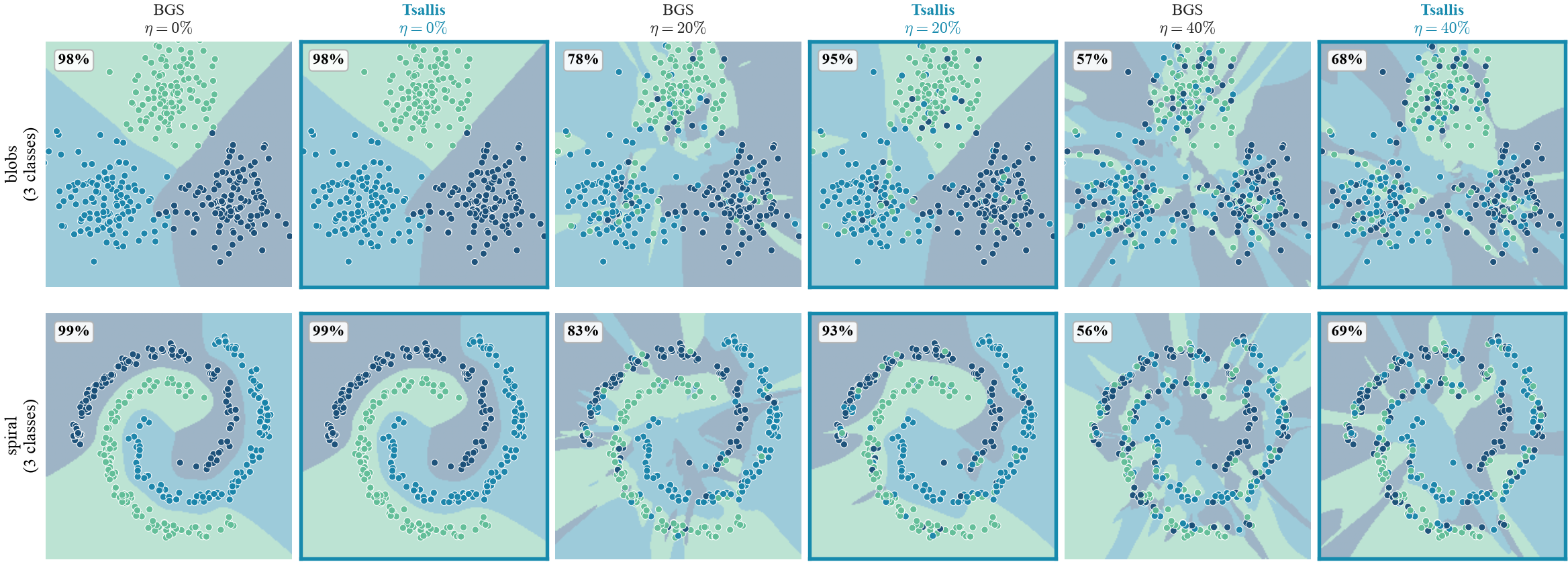
When training labels are noisy, ordinary softmax cross-entropy is unbounded — a confidently mislabeled example incurs an arbitrarily large loss, so an over-parameterized network ends up memorizing the noise. Replacing the logarithm with the deformed $q$-logarithm gives the Tsallis cross-entropy, which is bounded for $q < 1$: its gradient saturates on unfittable points, so the model ignores label noise instead of fitting it.
For a one-hot target with true class $c$ and softmax probabilities $p$,
$$\mathcal{L}_q(p, c) = -\ln_q p_c = \frac{1 - p_c^{,1-q}}{1 - q}, \qquad \ln_q x = \frac{x^{1-q} - 1}{1 - q}.$$
As $q \to 1$ this is exactly the standard cross-entropy $-\log p_c$; for $q < 1$ the per-example loss is bounded above by $1/(1-q)$, so mislabeled points cannot dominate the gradient.
The figure trains a small 3-class classifier on two shapes (blobs, spiral) from clean data up to 40% label noise, comparing the Boltzmann–Gibbs–Shannon baseline ($q = 1$) with Tsallis ($q = 0.3$). The comparison is fair — both share the same initialization, data, noisy labels and optimizer; only $q$ differs. Without noise the two match (≈98–99%); as noise grows the baseline carves spurious wrong-class islands while Tsallis keeps clean regions and higher accuracy.
See the classification example for the full setup.
Neural-network building blocks
qjax.nn holds the pieces that every Tsallis model ends up needing. It is
framework-agnostic — plain arrays and pytrees — so it composes with Flax,
Equinox, Haiku, or hand-rolled JAX without pulling in any of them.
from qjax.nn import bounded_q, entmax_attention, tsallis_cross_entropy_loss

# Keep a learnable q inside its valid range, whatever the optimizer does.
q = bounded_q(params["q_raw"], 1.0, 3.0)

# Attention normalized by entmax instead of softmax.
context, attn = entmax_attention(queries, keys, values, q=q)

# A q-deformed classification loss; q < 1 bounds the penalty on bad labels.
loss = tsallis_cross_entropy_loss(logits, targets, q=0.5, normalizer_q=1.0)
Installation
qjax requires Python 3.10+ and depends only on jax. Plotting is optional. It is managed with uv.
| Use case | Command |
|---|---|
| As a dependency | uv add qjax |
| With plotting | uv add "qjax[plots]" (adds matplotlib) |
| Development | uv sync --extra dev (tests + linter + mypy) |
| Building the docs | uv sync --extra docs (Material for MkDocs) |
For GPU/TPU acceleration, install the matching JAX build by following the JAX installation guide.
Contributing
Contributions are welcome — new $q$-deformed primitives, examples, docs, and fixes. See CONTRIBUTING.md for the development setup, design principles (purity, the $q \to 1$ limit, finite gradients), and the checks CI runs.
License
Released under the MIT License.
Project details
Verified details
These details have been verified by PyPIProject links
GitHub Statistics
Maintainers
Release history Release notifications | RSS feed


Download files
Download the file for your platform. If you're not sure which to choose, learn more about installing packages.
Source Distribution
Built Distribution
Filter files by name, interpreter, ABI, and platform.
If you're not sure about the file name format, learn more about wheel file names.
Copy a direct link to the current filters
File details
Details for the file qjax-0.1.2.tar.gz.
File metadata
- Download URL: qjax-0.1.2.tar.gz
- Upload date:
- Size: 12.6 MB
- Tags: Source
- Uploaded using Trusted Publishing? Yes
- Uploaded via: twine/6.1.0 CPython/3.13.14
File hashes
| Algorithm | Hash digest | |
|---|---|---|
| SHA256 |
7de4990735e672105766567f8786470c4c23f527919acdea5e16cfcad656c21a
|
|
| MD5 |
6dec74aa2585c67db02fae8f6f08dee7
|
|
| BLAKE2b-256 |
ee1adc2d73e5592c95cf604a410ed168c28baff998b99cae063e015faf469118
|
Provenance
The following attestation bundles were made for qjax-0.1.2.tar.gz:
Publisher:
release.yaml on kleyt0n/qjax
-
Statement:
-
Statement type:
https://in-toto.io/Statement/v1 -
Predicate type:
https://docs.pypi.org/attestations/publish/v1 -
Subject name:
qjax-0.1.2.tar.gz -
Subject digest:
7de4990735e672105766567f8786470c4c23f527919acdea5e16cfcad656c21a - Sigstore transparency entry: 2262408671
- Sigstore integration time:
-
Permalink:
kleyt0n/qjax@44f3fea1420b91839c1ec1a95d80b6bac821add8 -
Branch / Tag:
refs/tags/v0.1.2 - Owner: https://github.com/kleyt0n
-
Access:
public
-
Token Issuer:
https://token.actions.githubusercontent.com -
Runner Environment:
github-hosted -
Publication workflow:
release.yaml@44f3fea1420b91839c1ec1a95d80b6bac821add8 -
Trigger Event:
push
-
Statement type:
File details
Details for the file qjax-0.1.2-py3-none-any.whl.
File metadata
- Download URL: qjax-0.1.2-py3-none-any.whl
- Upload date:
- Size: 34.1 kB
- Tags: Python 3
- Uploaded using Trusted Publishing? Yes
- Uploaded via: twine/6.1.0 CPython/3.13.14
File hashes
| Algorithm | Hash digest | |
|---|---|---|
| SHA256 |
1064d307360aa019c5b5491e4ef28dad47d000bbacc154e93d52f1869c851535
|
|
| MD5 |
c5b23738d7e8e19adaf4053e53129e19
|
|
| BLAKE2b-256 |
79662b73cb155e236a398959d1ec2b5711b0b2785a32d3cad8231b436eea7b8c
|
Provenance
The following attestation bundles were made for qjax-0.1.2-py3-none-any.whl:
Publisher:
release.yaml on kleyt0n/qjax
-
Statement:
-
Statement type:
https://in-toto.io/Statement/v1 -
Predicate type:
https://docs.pypi.org/attestations/publish/v1 -
Subject name:
qjax-0.1.2-py3-none-any.whl -
Subject digest:
1064d307360aa019c5b5491e4ef28dad47d000bbacc154e93d52f1869c851535 - Sigstore transparency entry: 2262408903
- Sigstore integration time:
-
Permalink:
kleyt0n/qjax@44f3fea1420b91839c1ec1a95d80b6bac821add8 -
Branch / Tag:
refs/tags/v0.1.2 - Owner: https://github.com/kleyt0n
-
Access:
public
-
Token Issuer:
https://token.actions.githubusercontent.com -
Runner Environment:
github-hosted -
Publication workflow:
release.yaml@44f3fea1420b91839c1ec1a95d80b6bac821add8 -
Trigger Event:
push
-
Statement type:






