
qthermo
Heat, work and efficiency for quantum machines, with the physics checked for you.
Tiny machines built from a few qubits can act as engines and refrigerators. Working out how much heat they move, and whether the model you used is even allowed by the laws of thermodynamics, usually means hand-writing hundreds of lines of simulation code for every paper. qthermo does that part. You describe the machine; it gives you the heat flows, the efficiency, and a warning when the model breaks physics.


pip install "qthermo[plot]" # Python 3.10 or newer
Try it: reproduce a published result
Pick a paper and run it. Each one rebuilds the paper's setup from scratch and prints qthermo's numbers next to the paper's.
python -m qthermo                  # list the papers
python -m qthermo fridge           # run one
python -m qthermo all              # run all five (~15 s)
| name | paper | what it shows |
|---|---|---|
fridge |
Linden, Popescu & Skrzypczyk, PRL 105, 130401 (2010) | The smallest possible refrigerator: three qubits, cooled by heat alone. Its efficiency is exactly ω_c/ω_h. |
maser |
Scovil & Schulz-DuBois, PRL 2, 262 (1959) | The first quantum heat engine. Its efficiency is exactly 1 − ω_c/ω_h. |
szilard |
Sagawa & Ueda, PRL 100, 080403 (2008) | Work from information: a measurement worth I bits of information yields at most T·I of work, even when the measurement makes errors. |
cold-to-hot |
Levy & Kosloff, EPL 107, 20004 (2014) | A standard shortcut (the "local master equation") can make heat flow from cold to hot, breaking the second law. qthermo catches it. |
local-vs-global |
Hofer et al., NJP 19, 123037 (2017) | Which of the standard models gives the right heat current? Each one is graded against the exact answer. |
What "reproduced" means here: the first four papers state their result as a formula, and qthermo matches it to machine precision. For the last one, qthermo computes the exact answer independently and reproduces the paper's finding (which approximation fails, and where), not its plotted figure.
The same thing from Python, with a figure:
import qthermo as qt

r = qt.papers.local_vs_global(detuning=0.1)
print(r.report())
r.plot()
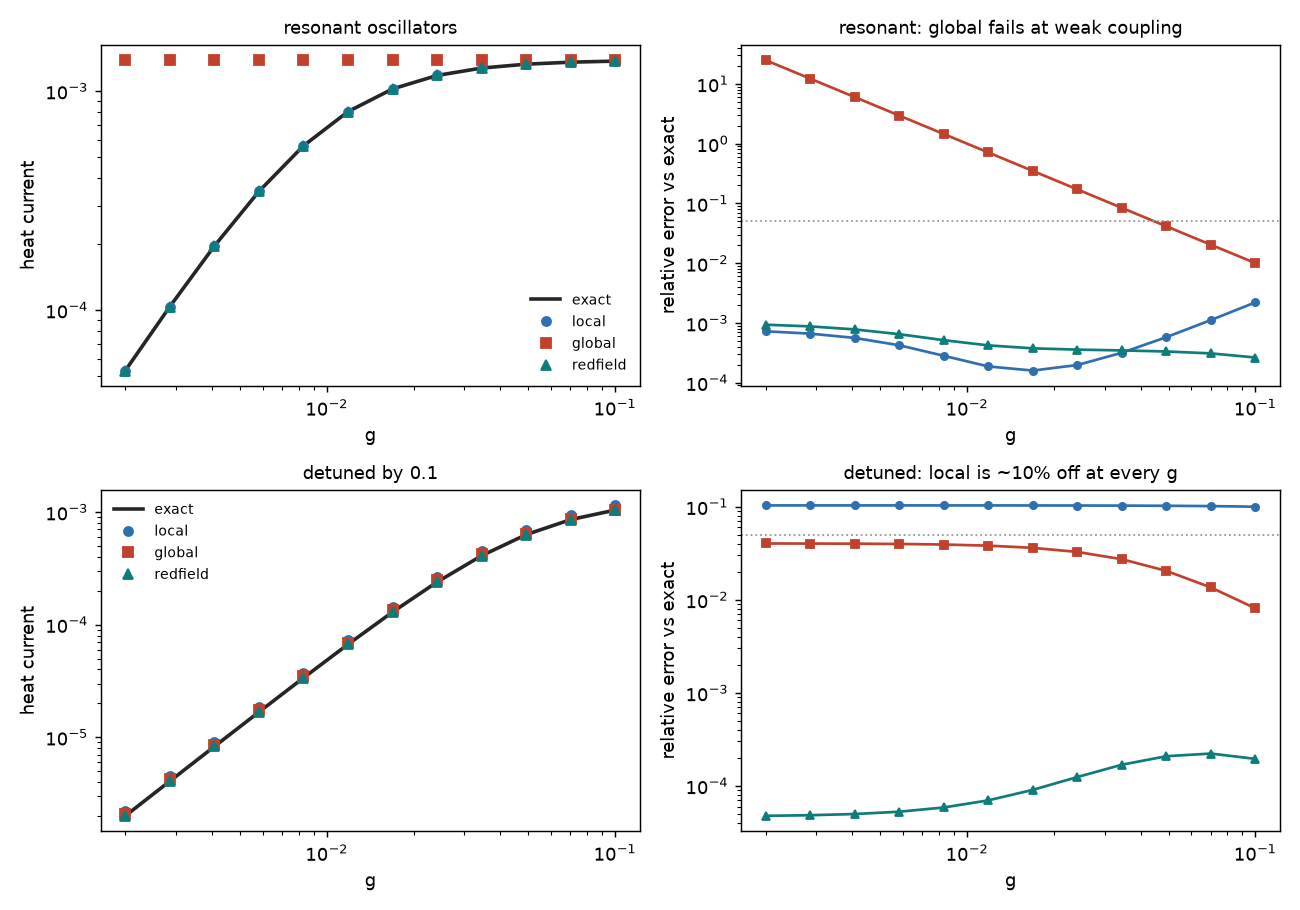
Each of the two textbook approximations fails somewhere: the global one for resonant oscillators at weak coupling (top, off by up to 25×), the local one for detuned oscillators (bottom, 10% off). The Redfield model is within 0.1% of exact in both.
Build your own machine
Describe the parts, how they are coupled, and which heat bath touches which part:
machine = qt.build_model(
    local_H=[qt.qubit_hamiltonian(1.0), qt.qubit_hamiltonian(0.6)],   # two qubits
    interactions={(0, 1): (0.3 * qt.sigma_x, qt.sigma_x)},            # coupled
    baths=[dict(name="hot", site=0, coupling=qt.sigma_x, T=2.0, gamma=0.1),
           dict(name="cold", site=1, coupling=qt.sigma_x, T=1.0, gamma=0.1)])

steady = machine.analyze()        # heat flow from every bath, efficiency, entropy
print(steady.report())
print(qt.audit(machine))          # does the model break any law of thermodynamics?
qt.plot_machine(steady)           # where the heat goes
Then, depending on what you need:
| to... | use |
|---|---|
| compare the standard models on your machine | machine.compare(), machine.rebuild("redfield") |
| scan a parameter and find the best setting | qt.sweep, qt.scan_2d |
| send someone the result and the checks | qt.report(machine, "machine.html") |
| make an interactive page with a slider | qt.explorer(build, values, path="page.html") |
| engines that run in cycles, like a car engine | qt.Cycle, qt.otto_cycle |
| how noisy the heat flow is | qt.current_statistics(machine, "hot") |
| the cost of erasing a bit, and the cheapest way to do it | qt.landauer_erasure, qt.geodesic_schedule |
| strong coupling to the environment | qt.reaction_coordinate_model |
| storing energy in qubits (quantum batteries) | qt.batteries |
| real lab units (GHz, mK, µs) | qt.LabUnits |
Every function is listed in the API reference, the guide walks through all of them with figures, and the tutorial notebook takes one research question from a Hamiltonian to publishable numbers.
Proof that it works
python -m qthermo.benchmarks # 44 checks against published results, ~40 s
- 44 benchmarks, each comparing a computed number with a published or exact result, with the source named next to it.
- About 270 automated tests, run on every change, including randomised checks that the laws of thermodynamics hold for random machines.
- Agrees with QuTiP, the standard quantum simulation library, to 1e-16 for steady states and 1e-10 for time evolution.
- Every code example in this README and the guide is run automatically, so none of them can silently go stale.
The exact definitions behind every number are in docs/physics.md.
Limits
- Weak coupling to the environment by default (Markovian master equations); strong coupling only through the reaction-coordinate mapping.
- Up to about 8 qubits (a few hundred energy levels) on a laptop.
- The Redfield model gives steady states only, and is not guaranteed to stay physical at strong bath coupling.
- Simulation only: nothing here has been compared with experimental data yet.
Feedback and where this could go
qthermo is new and built by one person, and the most useful thing you can do is tell me where it falls short: a result it gets wrong, a paper it should reproduce, or a feature that would make it useful in your work. Please open an issue.
Directions under consideration:
- more reproduced papers, each graded against an exact or published result
- a multi-parameter optimiser ("find the settings that maximise cooling")
- stronger coupling to the environment (HEOM or TEMPO backends)
- presets for specific hardware (superconducting qubits, trapped ions)
Citing and license
If you use qthermo in research, please cite it using CITATION.cff. MIT license. Changes are listed in the changelog.
1 maintainer

Metadata
1 maintainer
Release files for qthermo 0.7.0
For a detailed explanation of source distributions (sdists) and built distributions (wheels), please see the package formats documentation.
Source distribution (sdist)
| File | Size | Uploaded | Provenance | Actions |
|---|---|---|---|---|
| qthermo-0.7.0.tar.gz | 157.3 kB | With provenance | Details for qthermo-0.7.0.tar.gz |
Built distribution (wheel)
| File | Interpreter | ABI | Platform | Actions Reset |
|---|---|---|---|---|
| qthermo-0.7.0-py3-none-any.whl | Python 3 | none | any | Details for qthermo-0.7.0-py3-none-any.whl |
Total release size: 302.6 kB
Release files / qthermo-0.7.0.tar.gz
| Download URL | qthermo-0.7.0.tar.gz |
|---|---|
| Size | 157.3 kB |
| Tags | Source |
|
SHA-256 checksum How to use checksums |
9d0657666463daee489b0ac2037c6319b4cee2afe5866053a7039c8cac5cdf76
|
|
BLAKE2b-256 checksum How to use checksums |
9a9da18a73ba81a6607401720b4b46efdf4af7fc7850e0eee429662893d50f67
|
| Upload date | |
|
Uploaded using Trusted Publishing? What is trusted publishing? |
Yes |
| Uploaded via |
twine/7.0.0 CPython/3.13.14
|
Provenance
Provenance describes where a file came from. On PyPI, provenance is shared via attestations, which provide a verifiable record of the build or publishing details. View details, limitations and caveats.


PyPI Publish Attestation
PyPI verified that this artifact, at this checksum, originated from the publisher listed below.
Signed by GitHub Actions, verified by PyPI on Sep 26, 2026.
Transparency logRelease files / qthermo-0.7.0-py3-none-any.whl
| Download URL | qthermo-0.7.0-py3-none-any.whl |
|---|---|
| Size | 145.3 kB |
| Tags | Python 3 |
|
SHA-256 checksum How to use checksums |
f708b9a0b6b88c8c13407fbac421cb300580dacf30dacb269803e833d4e6fed0
|
|
BLAKE2b-256 checksum How to use checksums |
54a0cbba7a41a43ec949eca23cbfb1a8f2ad2647c764426ff39d8fd00bc38631
|
| Upload date | |
|
Uploaded using Trusted Publishing? What is trusted publishing? |
Yes |
| Uploaded via |
twine/7.0.0 CPython/3.13.14
|
Provenance
Provenance describes where a file came from. On PyPI, provenance is shared via attestations, which provide a verifiable record of the build or publishing details. View details, limitations and caveats.
PyPI Publish Attestation
PyPI verified that this artifact, at this checksum, originated from the publisher listed below.
Signed by GitHub Actions, verified by PyPI on Sep 26, 2026.
Transparency logSecurity for qthermo 0.7.0
Provenance
Provenance describes where a file came from. On PyPI, provenance is shared via attestations, which provide a verifiable record of the build or publishing details. View details, limitations and caveats.
Full provenance
All 2 files in this release have been uploaded with provenance metadata.
Attestation for qthermo-0.7.0.tar.gz
PyPI Publish Attestation
PyPI verified that this artifact, at this checksum, originated from the publisher listed below.
Signed by GitHub Actions, verified by PyPI on Sep 26, 2026.
Transparency logA note on package security
PyPI is a repository for distributing packages, not a service for auditing them. While third-party security researchers and our staff do their best to detect and remove malicious packages, PyPI cannot guarantee the quality, security or suitability of any given package.
To learn more about protecting yourself from malicious actors, visit our package security documentation.














