




Quasigraph is an open-source toolkit designed for generating chemical and geometric descriptors to be used in machine learning models.
Installation
The easiest method to install quasigraph is by utilizing pip:
$ pip install quasigraph
Getting started
from ase.build import molecule
from quasigraph import QuasiGraph

# Initialize an Atoms object for methanol (CH3OH) using ASE's molecule function
atoms = molecule('CH3OH')

# Instantiate a QuasiGraph object containing chemical and coordination numbers
qgr = QuasiGraph(atoms)

# Convert the QuasiGraph object into a pandas DataFrame
df = qgr.get_dataframe()

# Convert the QuasiGraph object into a vector
vector = qgr.get_vector()
Descriptor
The descriptor can be separated into two parts, a chemical part and a geometric part.
Chemical part
The chemical part of the descriptor employs the Mendeleev library, incorporating atomic details like the valence electron concentration, covalent radius, atomic radius, Pauling electronegativity and electron affinitity for every element within the object.
For example, for methanol (CH3OH) we have the table:
| VEC | covalent_radius | en_pauling | |
|---|---|---|---|
| 0 | 4 | 0.75 | 2.55 |
| 1 | 6 | 0.63 | 3.44 |
| 2 | 1 | 0.32 | 2.2 |
| 3 | 1 | 0.32 | 2.2 |
| 4 | 1 | 0.32 | 2.2 |
| 5 | 1 | 0.32 | 2.2 |
Geometric part
The geometric part involves identifying all bonds and computing the coordination numbers for each atom, indicated as CN. Additionally, the generalized coordination number (GCN)1 is determined by summing the coordination numbers of the neighboring ligands for each atom and normalizing this sum by the highest coordination number found in the molecule.
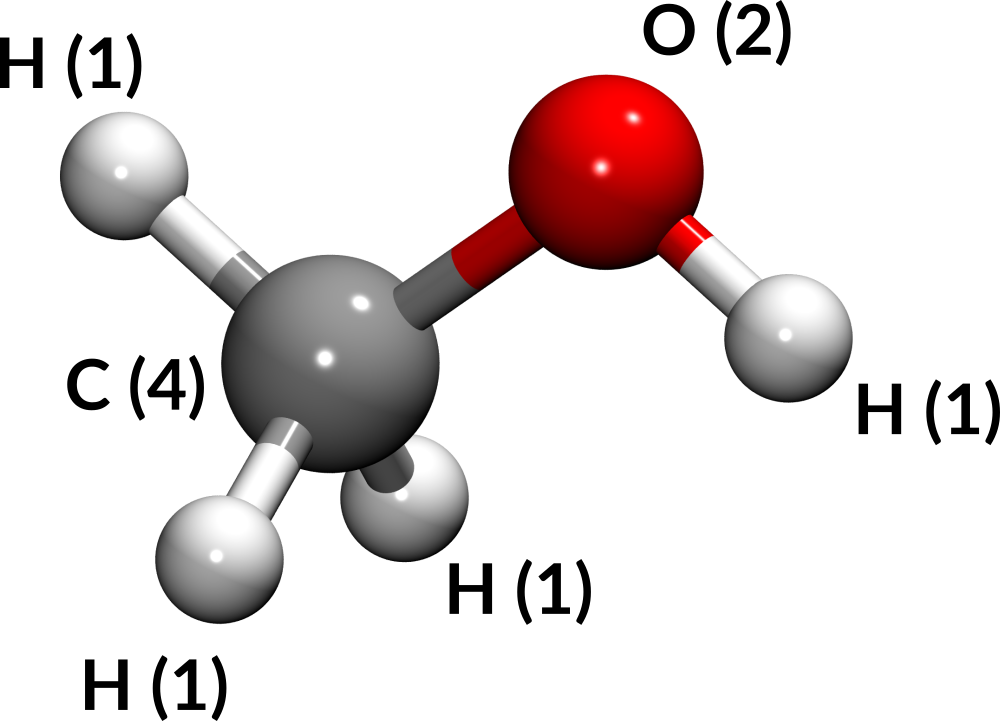
Figure 1 - Schematic representation of the methanol molecule, indicating the chemical symbol and coordination number (CN) for every atom.
For example, for methanol (CH3OH) we have the geometric data, as shown in Fig. 1.
| CN | GCN |
|---|---|
| 4 | 1.25 |
| 2 | 1.25 |
| 1 | 1.00 |
| 1 | 0.50 |
| 1 | 1.00 |
| 1 | 1.00 |
Continuous bond information (optional)
By default the geometric part is CN and GCN. The geometric_features argument selects any of the per-atom features below; the chemical columns come first, then the geometric ones in the order given.
from quasigraph import QuasiGraph, GEOMETRIC_FEATURES

qgr = QuasiGraph(atoms, geometric_features=GEOMETRIC_FEATURES)
qgr.get_dataframe()   # ... CN, GCN, CN_smooth, bond_mean, bond_min, bond_max, bond_std, bond_strain
| Feature | Meaning |
|---|---|
CN |
number of bonded atoms (a pair is bonded when its distance is at most (1 + tolerance) times the sum of covalent radii) |
GCN |
generalized coordination number |
CN_smooth |
continuous CN: every pair contributes a sigmoid weight 1 / (1 + exp((d − rc) / T)) centred on the bond threshold rc = (1 + tolerance)(ri + rj), with temperature T in Å (default 0.1). T → 0 gives a step function and CN_smooth = CN |
bond_mean, bond_min, bond_max, bond_std |
statistics of the atom's bond lengths (0 for an atom without bonds) |
bond_strain |
mean of (bond length / sum of covalent radii) − 1: positive for stretched bonds |
Covalent radii are the Pyykkö values from Mendeleev. Metallic bonds are typically 10–20 % longer than the sum of these radii, so in a perfect fcc metal bond_strain ≈ 0.15; the useful information is the variation between sites. With the default temperature of 0.1 Å a bond 0.3 Å inside the threshold has weight 0.95 and one 0.3 Å outside it 0.05, so CN_smooth stays close to CN while varying continuously with bond length; a larger temperature smooths more.
Adsorption-site environment
For a target that depends on one atom, such as the adsorption free energy of a hydrogen atom, get_site_environment aggregates the descriptor over the neighbour shells of that atom on the bond graph and returns a fixed-length, named vector that does not depend on the number of atoms or their order:
qgr = QuasiGraph(atoms, geometric_features=GEOMETRIC_FEATURES)
env = qgr.get_site_environment("H", shells=2, elements=["Ag", "Au", "Cu", "Pd", "Pt"])  # pandas Series
vector = qgr.get_site_vector("H", shells=2, elements=["Ag", "Au", "Cu", "Pd", "Pt"])   # numpy array
site is an atom index or a chemical symbol that occurs once in the structure. The Series contains site_<feature> for the site atom itself and, for each shell k (atoms k bonds away from the site): shell<k>_n, shell<k>_n_<El> (counts per element in elements), shell<k>_dist_mean/min/max (distance from the site), shell<k>_<feature>_mean for chemical features and shell<k>_<feature>_mean/min/max for geometric features. Pass the same elements list for every structure of a dataset so all vectors have the same length; an empty shell contributes zeros.
Package structure
quasigraph.quasigraph.QuasiGraph– user-facing class; wraps an ASEAtomsobject and exposesget_dataframe()/get_vector()plus the attributescn,gcn,bonded_atoms,bonds,adjacency,distances(non-periodic) anddistances_tensor(periodic).quasigraph.geometry– pure NumPy functions for distances, bonds, CN and GCN (distance_matrix,distance_tensor,bonds_from_distance_matrix,coordination_numbers,generalized_coordination_numbers, ...). They take plain arrays and can be reused without ASE.quasigraph.elements– chemical features taken from the Mendeleev library. Database lookups are cached per element symbol (get_element,get_feature), so the cost of a Mendeleev query is paid once per element per process instead of once per atom.quasigraph.ptable– hand-curated tables (VEC,CONFIG) not available in Mendeleev.
License
This is an open source code under MIT License.
Acknowledgements
We thank financial support from FAPESP (Grant No. 2022/14549-3), INCT Materials Informatics (Grant No. 406447/2022-5), and CNPq (Grant No. 311324/2020-7).
-
Calle-Vallejo, F., Martínez, J. I., García-Lastra, J. M., Sautet, P. & Loffreda, D. Fast Prediction of Adsorption Properties for Platinum Nanocatalysts with Generalized Coordination Numbers, Angew. Chem. Int. Ed. 53, 8316-8319 (2014). ↩
1 maintainer

Metadata
1 maintainer
Release files for quasigraph 26.9.3
For a detailed explanation of source distributions (sdists) and built distributions (wheels), please see the package formats documentation.
Source distribution (sdist)
| File | Size | Uploaded | |
|---|---|---|---|
| quasigraph-26.9.3.tar.gz | 166.5 kB | Details |
Built distribution (wheel)
| File | Interpreter | ABI | Platform | Reset |
|---|---|---|---|---|
| quasigraph-26.9.3-py3-none-any.whl | Python 3 | none | any | Details |
Total release size: 181.5 kB
Release files / quasigraph-26.9.3.tar.gz
| Download URL | quasigraph-26.9.3.tar.gz |
|---|---|
| Size | 166.5 kB |
| Tags | Source |
|
SHA-256 checksum How to use checksums |
5c6ba92587af21ab840dc31445153c82c0cea693d0a2689256f69701fc974dbf
|
|
BLAKE2b-256 checksum How to use checksums |
42f9dc154c3b43d95d497bc48b48a45ff3dec78551400eb989edb52ae04ecabc
|
| Upload date | |
|
Uploaded using Trusted Publishing? What is trusted publishing? |
No |
| Uploaded via |
twine/7.0.0 CPython/3.12.7
|
Release files / quasigraph-26.9.3-py3-none-any.whl
| Download URL | quasigraph-26.9.3-py3-none-any.whl |
|---|---|
| Size | 15.0 kB |
| Tags | Python 3 |
|
SHA-256 checksum How to use checksums |
6aef6281b7774d977b5e4b1b592251a91380bff736ca5cbd5b677b460d7cd079
|
|
BLAKE2b-256 checksum How to use checksums |
2b8fa2bae31c365cc18e6263511481b7904d0e322c5235aa6e06a9c66261c2f2
|
| Upload date | |
|
Uploaded using Trusted Publishing? What is trusted publishing? |
No |
| Uploaded via |
twine/7.0.0 CPython/3.12.7
|














