
A Python package for radioactive decay modelling that supports 1252 radionuclides, decay chains, branching, and metastable states.

Project description





radioactivedecay is a Python package for radioactive decay calculations.
It supports decay chains of radionuclides, metastable states and branching
decays. By default it uses the decay data from ICRP Publication 107, which
contains 1252 radionuclides of 97 elements.
It solves the radioactive decay differential equations analytically using NumPy and SciPy linear algebra routines. There is also a high numerical precision decay mode using SymPy routines, useful for when there are orders of magnitude differences between half-lives of radionuclides in the same decay chain.
- Full Documentation: https://alexmalins.com/radioactivedecay
Installation
radioactivedecay requires Python 3.6+. Install radioactivedecay from
the Python Package Index using
pip:
$ pip install radioactivedecay
This command will also install the dependencies (Matplotlib, NetworkX, NumPy, SciPy & SymPy) if they are not already present in the environment.
Usage
Decay calculations
Create an Inventory of radionuclides and decay it as follows:
>>> import radioactivedecay as rd
>>> inv_t0 = rd.Inventory({'Mo-99': 2.0})
>>> inv_t1 = inv_t0.decay(20.0, 'h')
>>> inv_t1.contents
{'Mo-99': 1.6207863893776937,
'Tc-99': 9.05304236308454e-09,
'Tc-99m': 1.3719829376710406}
An Inventory of 2.0 Bq of Mo-99 was decayed for 20 hours, producing the
radioactive progeny Tc-99m and Tc-99.
Note we did not have to specify the units of the initial Mo-99 activity. This is because the output activity units are the same as the input units. So the above calculation could have represented the decay of 2.0 Ci of Mo-99, or of 2.0 dpm, 2.0 kBq, etc.
We supplied 'h' as an argument to decay() to specify the decay time
period had units of hours. Supported time units include 'μs', 'ms',
's', 'm', 'h', 'd', 'y' etc. Note seconds ('s') is the
default if no unit is supplied to decay().
Radionuclides can be specified in three equivalent ways in
radioactivedecay. The strings
'Rn-222','Rn222'or'222Rn','Ir-192n','Ir192n'or'192nIr'
are all equivalent ways of specifying 222Rn or 192nIr.
Plotting decay graphs
Use the plot() method to graph of the decay of an Inventory over time:
>>> inv_t0.plot(20, 'd')
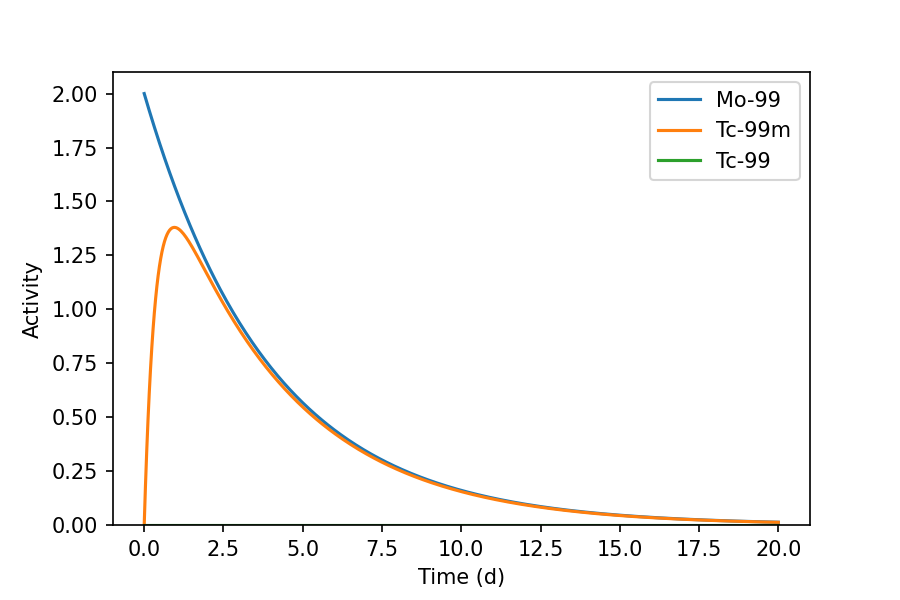
The graph shows the decay of Mo-99 over 20 days, leading to the ingrowth of Tc-99m and a trace quantity of Tc-99. Graphs are drawn using Matplotlib.
Fetching decay data
The Radionuclide class can be used to fetch decay information for
individual radionuclides, e.g. for Rn-222:
>>> nuc = rd.Radionuclide('Rn-222')
>>> nuc.half_life('d')
3.8235
>>> nuc.progeny()
['Po-218']
>>> nuc.branching_fractions()
[1.0]
>>> nuc.decay_modes()
['α']
Likewise similar methods exist for Inventory instances:
>>> inv_t1.half_lives('readable')
{'Mo-99': '65.94 h', 'Tc-99': '0.2111 My', 'Tc-99m': '6.015 h'}
>>> inv_t1.progeny()
{'Mo-99': ['Tc-99m', 'Tc-99'], 'Tc-99': ['Ru-99'], 'Tc-99m': ['Tc-99', 'Ru-99']}
>>> inv_t1.branching_fractions()
{'Mo-99': [0.8773, 0.1227], 'Tc-99': [1.0], 'Tc-99m': [0.99996, 3.7e-05]}
>>> inv_t1.decay_modes()
{'Mo-99': ['β-', 'β-'], 'Tc-99': ['β-'], 'Tc-99m': ['IT', 'β-']}
Decay chain diagrams
The Radionuclide class includes a plot() method for drawing decay chain
diagrams:
>>> nuc = rd.Radionuclide('Mo-99')
>>> nuc.plot()
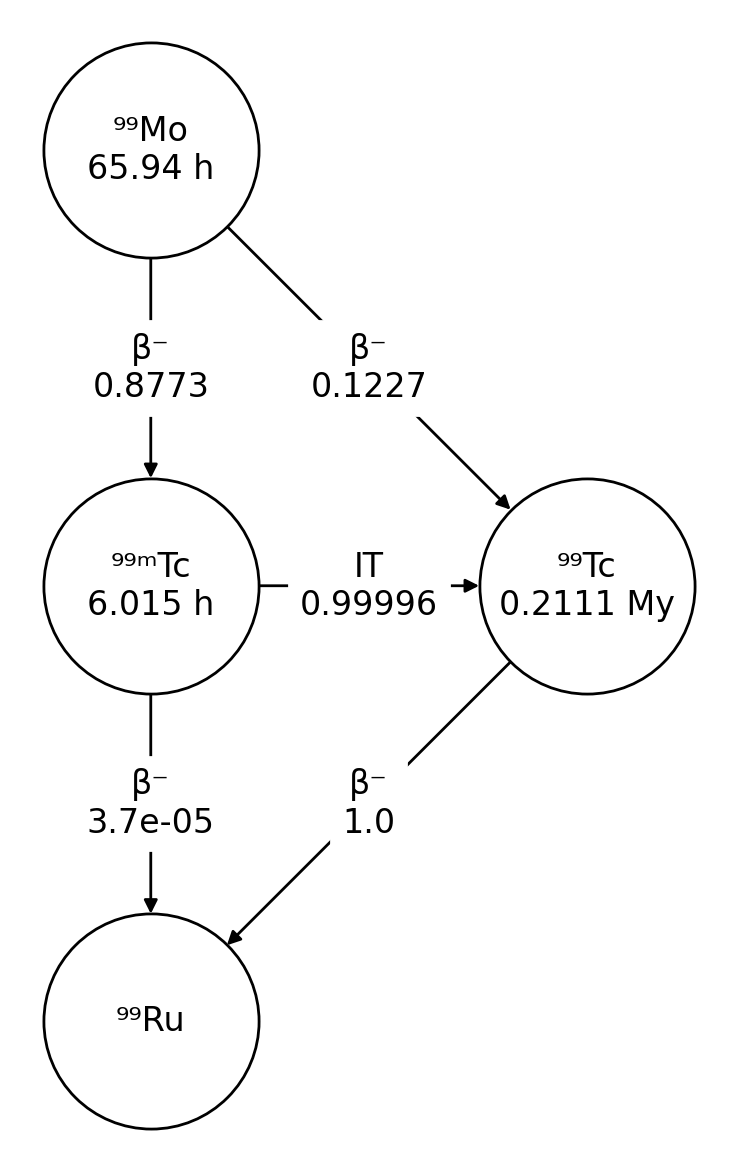
These diagrams are drawn using NetworkX and Matplotlib.
High numerical precision decay calculations
radioactivedecay includes a high numerical precision decay mode. This can
give more reliable results for decay chains containing both long- and
short-lived radionuclides:
>>> inv_t0 = rd.Inventory({'U-238': 1.0})
>>> inv_t1 = inv_t0.decay_high_precision(10.0, 'd')
>>> inv_t1.contents
{'At-218': 1.4511675857141352e-25,
'Bi-210': 1.8093327888942224e-26,
'Bi-214': 7.09819414496093e-22,
'Hg-206': 1.9873081129046843e-33,
'Pa-234': 0.00038581180879502017,
'Pa-234m': 0.24992285949158477,
'Pb-210': 1.0508864357335218e-25,
'Pb-214': 7.163682655782086e-22,
'Po-210': 1.171277829871092e-28,
'Po-214': 7.096704966148592e-22,
'Po-218': 7.255923469955255e-22,
'Ra-226': 2.6127168262000313e-21,
'Rn-218': 1.4511671865210924e-28,
'Rn-222': 7.266530698712501e-22,
'Th-230': 8.690585458641225e-16,
'Th-234': 0.2499481473619856,
'Tl-206': 2.579902288672889e-32,
'Tl-210': 1.4897029111914831e-25,
'U-234': 1.0119788393651999e-08,
'U-238': 0.9999999999957525}
How radioactivedecay works
radioactivedecay calculates an analytical solution to the radioactive decay
differential equations using linear algebra operations. It implements the
method described in this paper:
M Amaku, PR Pascholati & VR Vanin, Comp. Phys. Comm. 181, 21-23
(2010). See the
theory docpage for more
details.
It uses NumPy and SciPy routines for standard decay calculations (double-precision floating-point operations), and SymPy for arbitrary numerical precision calculations.
By default radioactivedecay uses decay data from
ICRP Publication 107
(2008).
The notebooks
folder
in the GitHub repository contains Jupyter Notebooks for creating the decay
datasets that are read in by radioactivedecay, e.g.
ICRP
107.
It also contains some comparisons against decay calculations made with
PyNE
and
Radiological
Toolbox.
Tests
From the base directory run:
$ python -m unittest discover
License
radioactivedecay is open source software released under the MIT License. The
ICRP-107 decay data is copyright 2008 A. Endo and K.F. Eckerman. See
LICENSE for
details.
Contributing
Contributors are welcome to fix bugs, add new features or make feature requests. Please open a pull request or a new issue on the GitHub repository.
Release history Release notifications | RSS feed


Download files
Download the file for your platform. If you're not sure which to choose, learn more about installing packages.
Source Distribution
Built Distribution
Filter files by name, interpreter, ABI, and platform.
If you're not sure about the file name format, learn more about wheel file names.
Copy a direct link to the current filters
File details
Details for the file radioactivedecay-0.3.3.tar.gz.
File metadata
- Download URL: radioactivedecay-0.3.3.tar.gz
- Upload date:
- Size: 584.5 kB
- Tags: Source
- Uploaded using Trusted Publishing? No
- Uploaded via: twine/3.1.1 pkginfo/1.4.2 requests/2.22.0 setuptools/45.2.0 requests-toolbelt/0.8.0 tqdm/4.30.0 CPython/3.8.5
File hashes
| Algorithm | Hash digest | |
|---|---|---|
| SHA256 |
ddb0a1054cf659db465a7355be3f8ac203e81206aa90b07798ac0eeafb65d99a
|
|
| MD5 |
29f71e31ae23755babf4cd358c8ba288
|
|
| BLAKE2b-256 |
800595b7ec770811d4f762e1f7a365ac9defe9d738aa1317c0e5f154dc677951
|
File details
Details for the file radioactivedecay-0.3.3-py3-none-any.whl.
File metadata
- Download URL: radioactivedecay-0.3.3-py3-none-any.whl
- Upload date:
- Size: 575.5 kB
- Tags: Python 3
- Uploaded using Trusted Publishing? No
- Uploaded via: twine/3.1.1 pkginfo/1.4.2 requests/2.22.0 setuptools/45.2.0 requests-toolbelt/0.8.0 tqdm/4.30.0 CPython/3.8.5
File hashes
| Algorithm | Hash digest | |
|---|---|---|
| SHA256 |
f2cdc3a0acdd96cdbc85df85d32c9526dd412400b3eb618d4029e5077d17501d
|
|
| MD5 |
715a38becfb1632d1b9e97e079ca22ae
|
|
| BLAKE2b-256 |
2c9da1a2e1d0ce9135174577f246585b57622f4a8631eda08cf198b1c4826c83
|






