
rag-playbook
Stop guessing which RAG pattern to use. Compare them with real numbers.


Quick Start · Patterns · Decision Guide · Architecture · CLI Reference
Every RAG tutorial teaches you how to build patterns. None of them tell you which one to actually use.
rag-playbook runs the same query against 8 production-tested RAG patterns and shows you which one wins — with real numbers for quality, latency, and cost.
Quick Start
pip install rag-playbook[openai]
export OPENAI_API_KEY=sk-...

# Compare all patterns on your documents
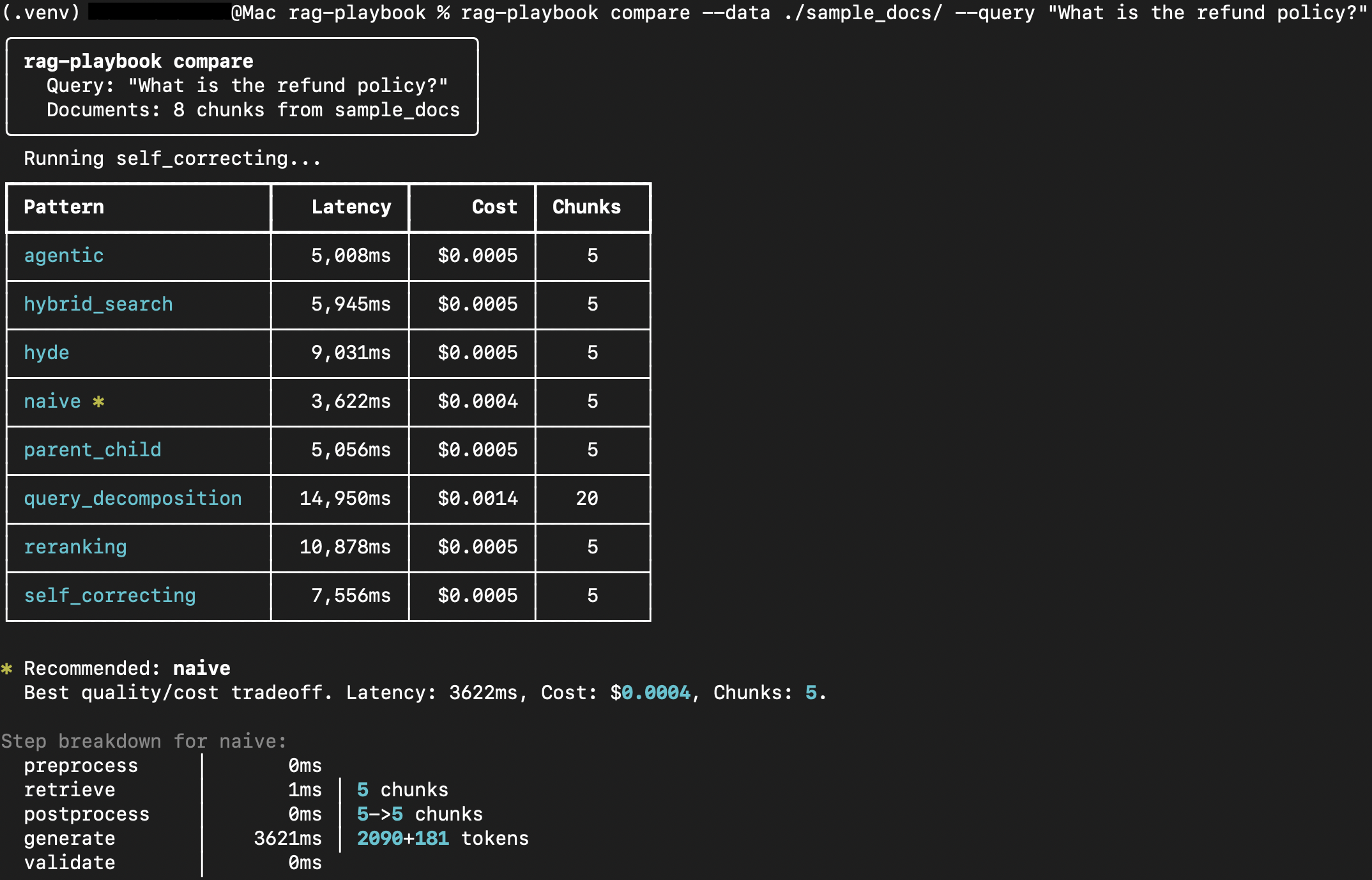
rag-playbook compare --data ./my_docs/ --query "What is the refund policy?"
Patterns
| # | Pattern | Best For | Latency | Cost |
|---|---|---|---|---|
| 01 | Naive | Simple factual queries | ~1s | $ |
| 02 | Hybrid Search | Queries with codes, IDs, exact terms | ~1.1s | $ |
| 03 | Re-ranking | When top-K retrieval isn't precise enough | ~1.4s | $$ |
| 04 | Parent-Child | Long documents with clear sections | ~1s | $ |
| 05 | Query Decomposition | Complex multi-part questions | ~2.1s | $$$ |
| 06 | HyDE | Short or ambiguous queries | ~1.5s | $$ |
| 07 | Self-Correcting | When hallucination risk is high | ~2.8s | $$$ |
| 08 | Agentic | When query intent is unclear | ~3.2s | $$$$ |
Which pattern should I use? (decision guide)
How is this different from [X]?
| NirDiamant/RAG_Techniques | FlashRAG | Ragas | rag-playbook | |
|---|---|---|---|---|
| Format | Jupyter notebooks | Academic library | Eval metrics | Library + CLI |
pip install |
No | Complex | Yes | Yes (simple) |
| Benchmarks | None | Academic | N/A | Practical comparison |
| "Which to use?" | No | No | No | YES |
| License | Non-commercial | MIT | Apache-2.0 | MIT |
Use as a Library
import asyncio
from rag_playbook import create_pattern, Settings
from rag_playbook.core.embedder import create_embedder
from rag_playbook.core.llm import create_llm
from rag_playbook.core.vector_store import create_vector_store

async def main():
    settings = Settings()  # Reads from .env / environment
    llm = create_llm(settings)
    embedder = create_embedder(settings)
    store = create_vector_store("memory")

    pattern = create_pattern("reranking", llm=llm, embedder=embedder, store=store)

    # Index your documents first (or use the CLI: rag-playbook ingest)
    result = await pattern.query("What is the refund policy?")

    print(result.answer)
    print(f"Cost: ${result.metadata.cost_usd:.4f}")
    print(f"Latency: {result.metadata.latency_ms:.0f}ms")

asyncio.run(main())
See examples/ for more usage patterns.
Installation
# Minimal (in-memory store, OpenAI)
pip install rag-playbook[openai]

# Everything (includes planned vector store backends)
pip install rag-playbook[all]
From Source
git clone https://github.com/Aamirofficiall/rag-playbook.git
cd rag-playbook
uv venv --python 3.11 .venv
source .venv/bin/activate
uv pip install -e ".[dev,chromadb,openai]"
CLI Commands
| Command | Description |
|---|---|
rag-playbook compare |
Compare patterns side-by-side on your documents |
rag-playbook run |
Run a single pattern |
rag-playbook recommend |
Get an LLM-powered pattern recommendation |
rag-playbook ingest |
Load, chunk, embed, and index documents |
rag-playbook bench |
Run full benchmark suite |
rag-playbook patterns |
List all available patterns |
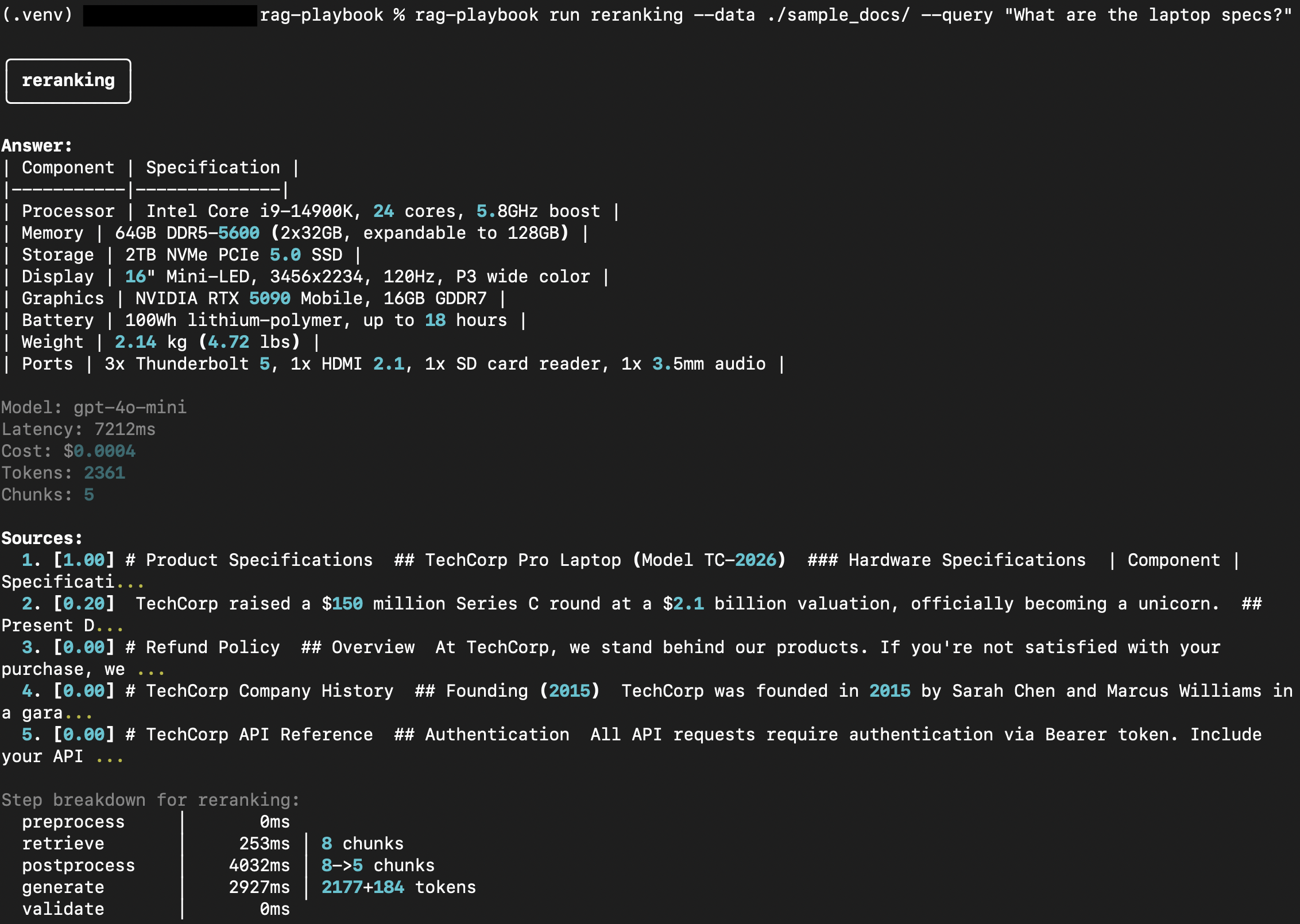
Run a single pattern
rag-playbook run reranking --data ./docs/ --query "What are the laptop specs?"
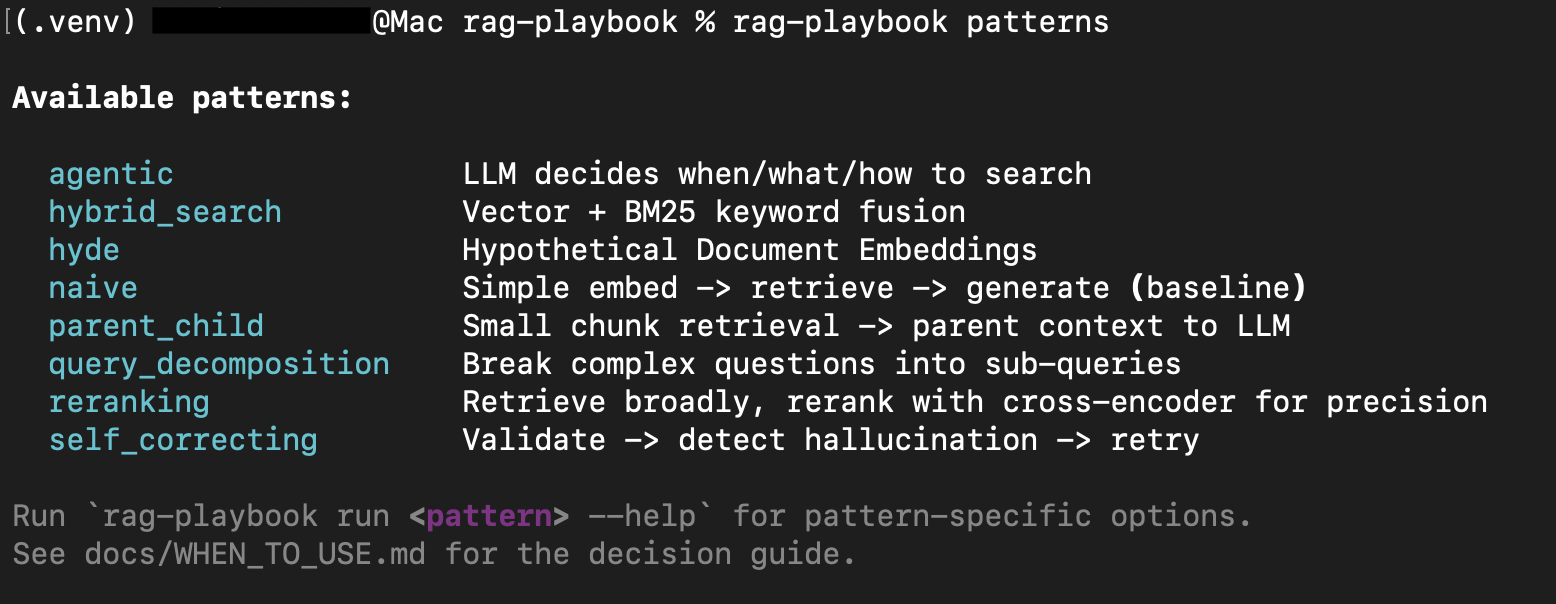
List available patterns
rag-playbook patterns
Get a pattern recommendation
rag-playbook recommend --query "What is the refund policy?"

Ingest documents
rag-playbook ingest --data ./sample_docs/

See CLI Reference for full usage.
Configuration
Environment variables map directly to settings — no prefix needed:
# .env — Core settings
OPENAI_API_KEY=sk-...                  # Required for OpenAI provider
DEFAULT_LLM_PROVIDER=openai            # openai | anthropic
DEFAULT_LLM_MODEL=gpt-4o-mini         # Any model your provider supports
EMBEDDING_MODEL=text-embedding-3-small
EMBEDDING_DIMENSION=1536
DEFAULT_TOP_K=5
DEFAULT_CHUNK_SIZE=512
DEFAULT_CHUNK_OVERLAP=50
Using OpenRouter (or any OpenAI-compatible API)
Works with any OpenAI-compatible endpoint — OpenRouter, Azure OpenAI, Ollama, vLLM, etc:
OPENAI_API_KEY=sk-or-v1-...                     # Your OpenRouter key
OPENAI_BASE_URL=https://openrouter.ai/api/v1    # Custom base URL
DEFAULT_LLM_MODEL=openai/gpt-4o-mini            # OpenRouter model format
Vector store backends
The default in-memory store works out of the box but re-embeds every session. ChromaDB, pgvector, and Qdrant are planned as persistent backends — the optional dependencies are installable but the store implementations are not yet wired up. Contributions welcome.
Or pass a Settings object directly in code. See .env.example for all options.
Architecture
Document → Chunk → EmbeddedChunk → RetrievedChunk → RAGResult
              │         │                │               │
          Chunker    Embedder       VectorStore        LLM
LLM providers, embedders, and vector stores are all swappable. Each RAG pattern extends a base class and overrides only the steps it needs. Embeddings are cached automatically so running compare across all 8 patterns doesn't re-embed your docs 8 times.
See Architecture Guide for details.
Development
make install    # Install with dev dependencies
make test       # Run unit tests
make lint       # Lint with ruff
make format     # Auto-format with ruff
make type-check # Type check with mypy
make check      # Run all checks
See CONTRIBUTING.md for the full guide.
Author
Built by Aamir Shahzad — backend engineer building data systems and AI infrastructure.
License
1 maintainer

Metadata
1 maintainer
Release files for rag-playbook 0.2.2
For a detailed explanation of source distributions (sdists) and built distributions (wheels), please see the package formats documentation.
Source distribution (sdist)
| File | Size | Uploaded | |
|---|---|---|---|
| rag_playbook-0.2.2.tar.gz | 2.7 MB | Details |
Built distribution (wheel)
| File | Interpreter | ABI | Platform | Reset |
|---|---|---|---|---|
| rag_playbook-0.2.2-py3-none-any.whl | Python 3 | none | any | Details |
Total release size: 2.7 MB
Release files / rag_playbook-0.2.2.tar.gz
| Download URL | rag_playbook-0.2.2.tar.gz |
|---|---|
| Size | 2.7 MB |
| Tags | Source |
|
SHA-256 checksum How to use checksums |
c69de1ca44279a2a7dd5c2a1a27d929456d0906f6274bd75602951ca62bd75de
|
|
BLAKE2b-256 checksum How to use checksums |
4b6ad1ed61fdeb2f466247dbcd90eff9feedd68bde073d352c7357959819257d
|
| Upload date | |
|
Uploaded using Trusted Publishing? What is trusted publishing? |
No |
| Uploaded via |
twine/6.2.0 CPython/3.11.6
|
Release files / rag_playbook-0.2.2-py3-none-any.whl
| Download URL | rag_playbook-0.2.2-py3-none-any.whl |
|---|---|
| Size | 47.8 kB |
| Tags | Python 3 |
|
SHA-256 checksum How to use checksums |
9110922ed05253a3f5a68f7ccf44c9aa6278874c5a67ede09508097f4a72cdba
|
|
BLAKE2b-256 checksum How to use checksums |
5cd9ed65eaf6a60730c55eb5843e49d4d7f1522f509bad8432511d7455f3c9f9
|
| Upload date | |
|
Uploaded using Trusted Publishing? What is trusted publishing? |
No |
| Uploaded via |
twine/6.2.0 CPython/3.11.6
|














