
Compare RAG patterns with real benchmarks. Run one command, see which pattern wins.

Project description
rag-playbook
Stop guessing which RAG pattern to use. Compare them with real numbers.


Quick Start · Patterns · Decision Guide · Architecture · CLI Reference
Every RAG tutorial teaches you how to build patterns. None of them tell you which one to actually use.
rag-playbook runs the same query against 8 production-tested RAG patterns and shows you which one wins — with real numbers for quality, latency, and cost.
Quick Start
pip install rag-playbook[openai]
export OPENAI_API_KEY=sk-...

# Compare all patterns on your documents
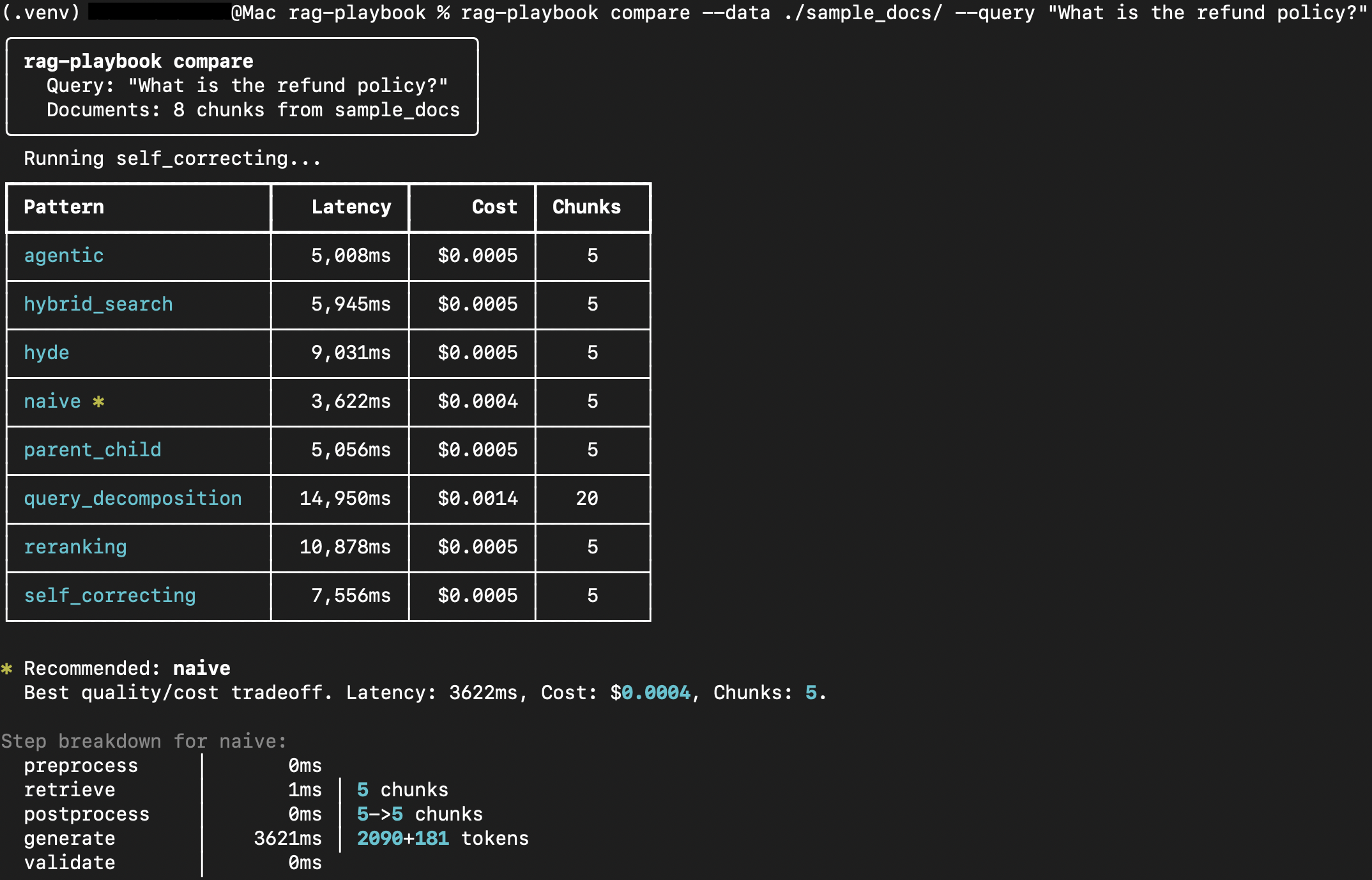
rag-playbook compare --data ./my_docs/ --query "What is the refund policy?"
Patterns
| # | Pattern | Best For | Latency | Cost |
|---|---|---|---|---|
| 01 | Naive | Simple factual queries | ~1s | $ |
| 02 | Hybrid Search | Queries with codes, IDs, exact terms | ~1.1s | $ |
| 03 | Re-ranking | When top-K retrieval isn't precise enough | ~1.4s | $$ |
| 04 | Parent-Child | Long documents with clear sections | ~1s | $ |
| 05 | Query Decomposition | Complex multi-part questions | ~2.1s | $$$ |
| 06 | HyDE | Short or ambiguous queries | ~1.5s | $$ |
| 07 | Self-Correcting | When hallucination risk is high | ~2.8s | $$$ |
| 08 | Agentic | When query intent is unclear | ~3.2s | $$$$ |
Which pattern should I use? (decision guide)
How is this different from [X]?
| NirDiamant/RAG_Techniques | FlashRAG | Ragas | rag-playbook | |
|---|---|---|---|---|
| Format | Jupyter notebooks | Academic library | Eval metrics | Library + CLI |
pip install |
No | Complex | Yes | Yes (simple) |
| Benchmarks | None | Academic | N/A | Practical comparison |
| "Which to use?" | No | No | No | YES |
| License | Non-commercial | MIT | Apache-2.0 | MIT |
Use as a Library
import asyncio
from rag_playbook import create_pattern, Settings
from rag_playbook.core.embedder import create_embedder
from rag_playbook.core.llm import create_llm
from rag_playbook.core.vector_store import create_vector_store

async def main():
    settings = Settings()  # Reads from .env / environment
    llm = create_llm(settings)
    embedder = create_embedder(settings)
    store = create_vector_store("memory")

    pattern = create_pattern("reranking", llm=llm, embedder=embedder, store=store)

    # Index your documents first (or use the CLI: rag-playbook ingest)
    result = await pattern.query("What is the refund policy?")

    print(result.answer)
    print(f"Cost: ${result.metadata.cost_usd:.4f}")
    print(f"Latency: {result.metadata.latency_ms:.0f}ms")

asyncio.run(main())
See examples/ for more usage patterns.
Installation
# Minimal (in-memory store, OpenAI)
pip install rag-playbook[openai]

# Everything (includes planned vector store backends)
pip install rag-playbook[all]
From Source
git clone https://github.com/Aamirofficiall/rag-playbook.git
cd rag-playbook
uv venv --python 3.11 .venv
source .venv/bin/activate
uv pip install -e ".[dev,chromadb,openai]"
CLI Commands
| Command | Description |
|---|---|
rag-playbook compare |
Compare patterns side-by-side on your documents |
rag-playbook run |
Run a single pattern |
rag-playbook recommend |
Get an LLM-powered pattern recommendation |
rag-playbook ingest |
Load, chunk, embed, and index documents |
rag-playbook bench |
Run full benchmark suite |
rag-playbook patterns |
List all available patterns |
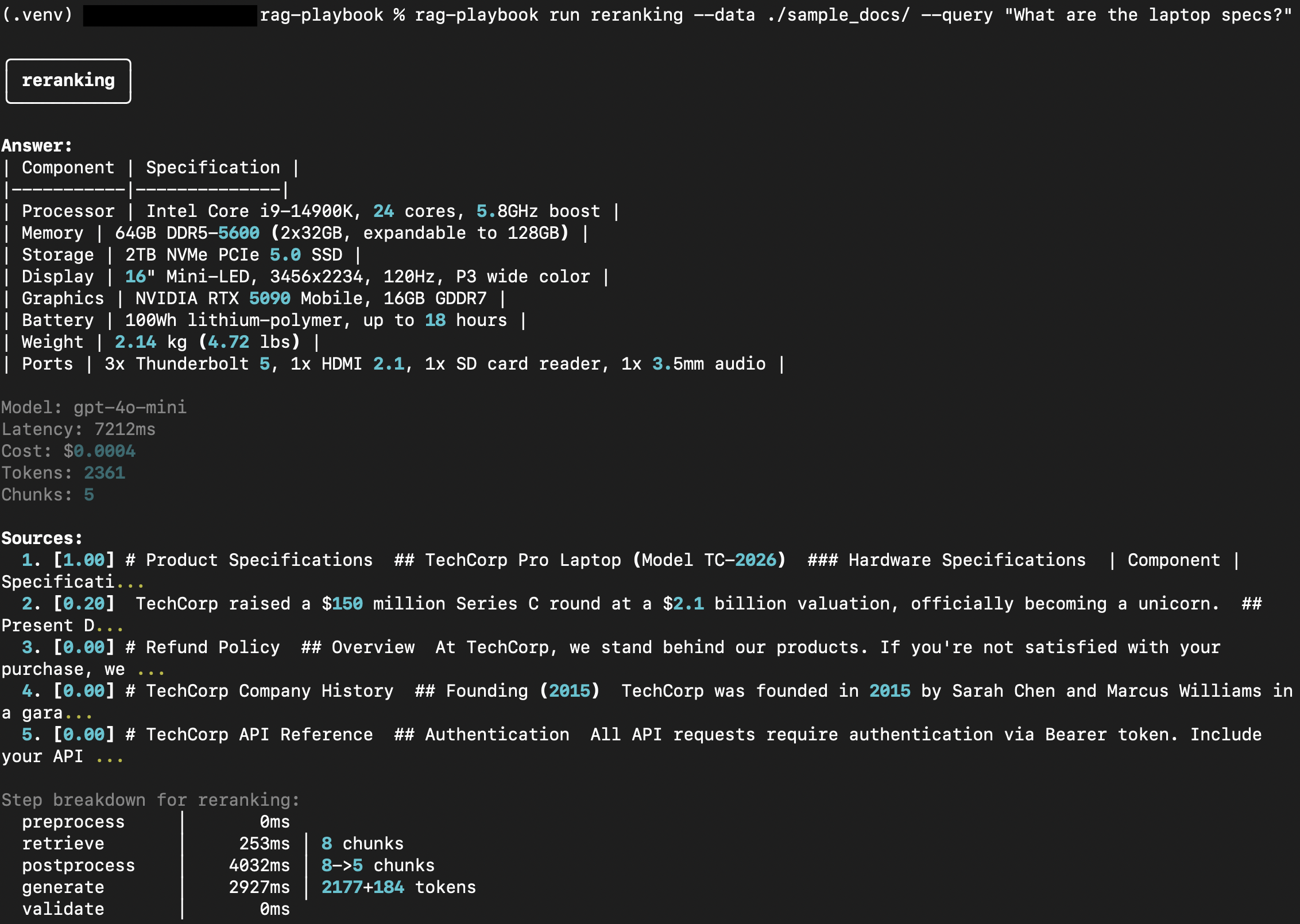
Run a single pattern
rag-playbook run reranking --data ./docs/ --query "What are the laptop specs?"
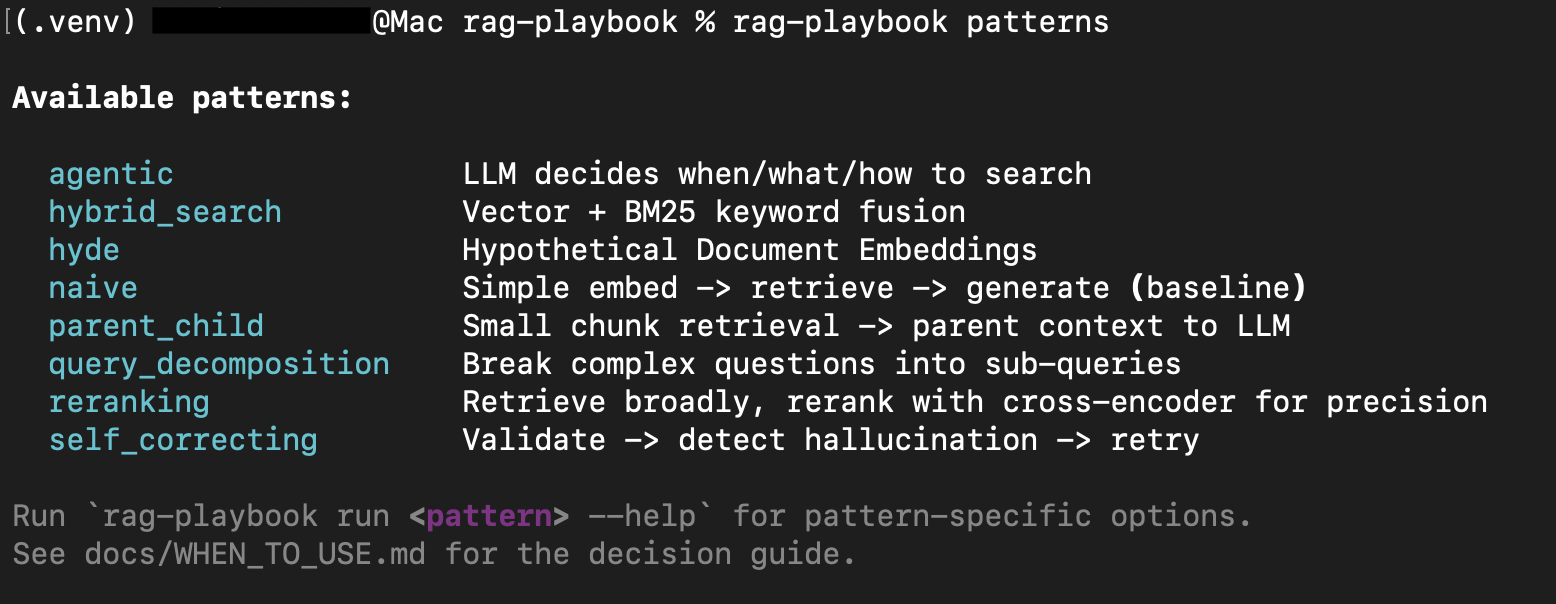
List available patterns
rag-playbook patterns
Get a pattern recommendation
rag-playbook recommend --query "What is the refund policy?"

Ingest documents
rag-playbook ingest --data ./sample_docs/

See CLI Reference for full usage.
Configuration
Environment variables map directly to settings — no prefix needed:
# .env — Core settings
OPENAI_API_KEY=sk-...                  # Required for OpenAI provider
DEFAULT_LLM_PROVIDER=openai            # openai | anthropic
DEFAULT_LLM_MODEL=gpt-4o-mini         # Any model your provider supports
EMBEDDING_MODEL=text-embedding-3-small
EMBEDDING_DIMENSION=1536
DEFAULT_TOP_K=5
DEFAULT_CHUNK_SIZE=512
DEFAULT_CHUNK_OVERLAP=50
Using OpenRouter (or any OpenAI-compatible API)
Works with any OpenAI-compatible endpoint — OpenRouter, Azure OpenAI, Ollama, vLLM, etc:
OPENAI_API_KEY=sk-or-v1-...                     # Your OpenRouter key
OPENAI_BASE_URL=https://openrouter.ai/api/v1    # Custom base URL
DEFAULT_LLM_MODEL=openai/gpt-4o-mini            # OpenRouter model format
Vector store backends
The default in-memory store works out of the box but re-embeds every session. ChromaDB, pgvector, and Qdrant are planned as persistent backends — the optional dependencies are installable but the store implementations are not yet wired up. Contributions welcome.
Or pass a Settings object directly in code. See .env.example for all options.
Architecture
Document → Chunk → EmbeddedChunk → RetrievedChunk → RAGResult
              │         │                │               │
          Chunker    Embedder       VectorStore        LLM
LLM providers, embedders, and vector stores are all swappable. Each RAG pattern extends a base class and overrides only the steps it needs. Embeddings are cached automatically so running compare across all 8 patterns doesn't re-embed your docs 8 times.
See Architecture Guide for details.
Development
make install    # Install with dev dependencies
make test       # Run unit tests
make lint       # Lint with ruff
make format     # Auto-format with ruff
make type-check # Type check with mypy
make check      # Run all checks
See CONTRIBUTING.md for the full guide.
Author
Built by Aamir Shahzad — backend engineer building data systems and AI infrastructure.
License


Download files
Download the file for your platform. If you're not sure which to choose, learn more about installing packages.
Source Distribution
Built Distribution
Filter files by name, interpreter, ABI, and platform.
If you're not sure about the file name format, learn more about wheel file names.
Copy a direct link to the current filters
File details
Details for the file rag_playbook-0.2.2.tar.gz.
File metadata
- Download URL: rag_playbook-0.2.2.tar.gz
- Upload date:
- Size: 2.7 MB
- Tags: Source
- Uploaded using Trusted Publishing? No
- Uploaded via: twine/6.2.0 CPython/3.11.6
File hashes
| Algorithm | Hash digest | |
|---|---|---|
| SHA256 |
c69de1ca44279a2a7dd5c2a1a27d929456d0906f6274bd75602951ca62bd75de
|
|
| MD5 |
35c345f9d74e9ecf483e168b3eed7732
|
|
| BLAKE2b-256 |
4b6ad1ed61fdeb2f466247dbcd90eff9feedd68bde073d352c7357959819257d
|
File details
Details for the file rag_playbook-0.2.2-py3-none-any.whl.
File metadata
- Download URL: rag_playbook-0.2.2-py3-none-any.whl
- Upload date:
- Size: 47.8 kB
- Tags: Python 3
- Uploaded using Trusted Publishing? No
- Uploaded via: twine/6.2.0 CPython/3.11.6
File hashes
| Algorithm | Hash digest | |
|---|---|---|
| SHA256 |
9110922ed05253a3f5a68f7ccf44c9aa6278874c5a67ede09508097f4a72cdba
|
|
| MD5 |
65150dc3e42517b0239094929e7f4840
|
|
| BLAKE2b-256 |
5cd9ed65eaf6a60730c55eb5843e49d4d7f1522f509bad8432511d7455f3c9f9
|






