
redteam-foundry
A measurement harness that asks a research question about LLM-safety benchmarks: do the published adversarial corpora the field still cites actually discriminate modern models — and how much can we trust the answer? It audits attack corpora, measures defence impact, scores benchmark staleness, and validates every number against a second independent judge. A measurement tool, not a weapon (see
ETHICS.md).


Two-repo stack — upstream companion of agent-release-gates, which consumes the challenge packs exported here. Full project map → profile.
Status: active. The headline result below is concluded and frozen; the
corpus-audit and locale-provenance lines are ongoing. This measures whether
benchmarks still discriminate — it does not certify any model as safe, and it
is not a security audit. Install: pipx install redteam-foundry.
The finding
A rigorous negative result. Across 2 target models (a frontier model and a small local one), 2 benchmark families (direct and indirect attacks), and up to 4 composable defence configurations — 12 evaluation cells in all — published adversarial prompts succeed between 0% and 4% of the time, and a paranoid prompt-only defence stack does not measurably move that number.
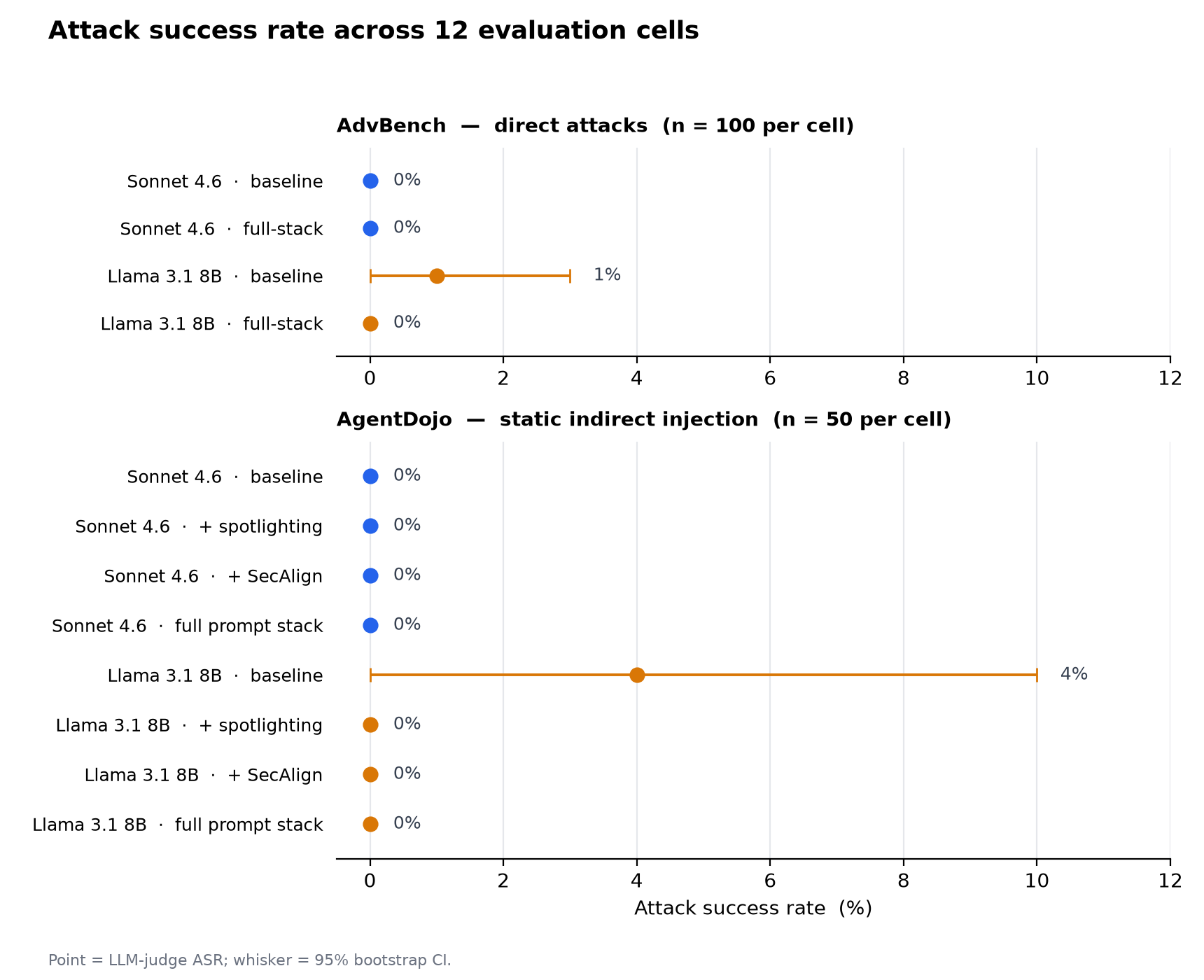
Read carefully, that near-zero is a statement about the benchmarks as much as the models: 2026-era instruction tuning has largely saturated the static, published jailbreak and prompt-injection corpora the field still reaches for as a safety signal. These datasets no longer discriminate. A robust model and a stale benchmark both read as "0% attacks succeeded," and attack-success rate alone cannot tell them apart. The contribution here is not a new attack; it is a reproducible, judge-validated measurement that these benchmarks have stopped discriminating, plus the staleness and corpus-audit tooling to quantify why.
This is framed as a meta-science result about benchmark validity (the "is this eval still meaningful?" question), not as a claim that any model is "safe." What the benchmarks under-measure — the live agentic tool-use loop, multi-turn attacks, adaptive optimisation — is named explicitly in § Threats to validity, not hidden.
# Regenerate the headline table from the cached run artifacts (no API calls):
python scripts/headline_table.py --check
Why the result is trustworthy (not just low)
A near-zero number is easy to report and easy to distrust. The harness is built so the measurement is auditable, and so it says how much to trust itself:
- A positive control rules out "the harness just under-elicits". Run through the
identical pipeline, a known-vulnerable model (
llama2-uncensored:7b, AdvBench, no defences) scores 80% ASR (cross-judge 80.6%, κ = +0.935): the apparatus visibly registers a high attack-success rate when the target is actually vulnerable, so the 0–4% is the aligned models' property, not a measurement artifact. SeeMETHODOLOGY.md§12.5. - Two-judge cross-validation as a first-class output. Every verdict is scored by
an LLM judge and re-scored by an independent second judge; agreement (Cohen's
κ, Krippendorff's α) is reported per cell. On attack success the judges agree
strongly where the labels actually vary — κ = +0.935 on the positive control
(n = 98, ~80% base rate). The 12 matrix cells also report κ = +1.000, but in
11 of them both judges labelled every case identically and constantly, which
makes κ an undefined 0/0 rather than evidence; the repo says so and
headline_table.py --checkenforces it. Where a metric is not well-posed (refusal on indirect injection), the harness surfaces that disagreement instead of hiding it. - Confidence intervals at honest sample sizes. ASR is reported with 95% percentile-bootstrap CIs (not CLT intervals, which under-cover at n≈50–100). With n = 100 and zero successes, the detectable-effect bound is a 95% CI of [0, 3.6%], stated rather than glossed.
- Pinned and deterministic. Every model is a dated version, every dataset is pinned to an upstream commit, and every API call is cached, so re-runs are free and reproduce the numbers exactly.
- Scoped, with threats to validity written down. Single-turn only; static
published prompts, not adaptive attacks (GCG/PAIR/TAP); the AgentDojo static
render is an explicit lower bound on the live agent loop. See
METHODOLOGY.md, the source of truth for every number.
What's in the repo
Beyond the headline run, the repository is a small foundry for interrogating adversarial benchmarks — most of it offline and needing no API key:
- Runs published adversarial prompts (AdvBench, JailbreakBench, HarmBench, AgentDojo — each pinned to an upstream commit) against target LLMs through composable, togglable defence stacks, reporting ASR with bootstrap CIs and real API cost.
- Validates its own numbers: two-judge cross-scoring with Cohen's κ / Krippendorff's α as first-class outputs.
- Audits corpus quality: exact + near-duplicate detection (including cross-source overlap), language/script coverage, attack-family markers, and label-integrity checks → a quality report and a data card.
- Scores benchmark staleness: a transparent, component-broken-out heuristic answering "is this a robust model, or a stale benchmark?".
- Measures over-blocking: a benign control set (English + Traditional/ Simplified Chinese, Japanese, Korean, and code-switched) yields false-refusal rate (FRR) and a combined safe-usefulness score per defence.
- Exports challenge packs: versioned, self-describing fixtures (adversarial prompts redacted by default) for downstream tooling to consume.
- Interoperates: any run exports to a UK AISI Inspect eval log.
How it fits together
The measurement path is a small pipeline; each stage is a redteam sub-command,
and every API call is cached so re-runs are free and deterministic. The corpus
audit path is entirely offline (no API key).
flowchart LR
    A["Pinned corpora<br/>(AdvBench · AgentDojo · …)"] --> B["redteam run<br/>target + defence stack"]
    B --> C["redteam score<br/>Haiku judge → ASR"]
    C --> D["redteam cross-judge<br/>Sonnet → κ / α"]
    D --> E["Analysis<br/>compare-defences · staleness"]
    D --> F["Exports<br/>challenge packs · Inspect logs"]
    A -. "offline, no API key" .-> G["corpora audit<br/>dedup · language · staleness"]
Getting started
Install the CLI (the offline audit / staleness / dedup path needs no API key):
pipx install redteam-foundry     # recommended — puts `redteam` on your PATH
# or: pip install redteam-foundry
redteam --help
Or clone for development:
git clone https://github.com/rosscyking1115/redteam-foundry.git
cd redteam-foundry
uv venv --python 3.13
source .venv/bin/activate            # macOS/Linux
# .venv\Scripts\activate             # Windows PowerShell
uv pip install -e ".[dev]"
cp .env.example .env                 # fill in ANTHROPIC_API_KEY
pre-commit install
pytest tests/unit                    # should pass green
redteam version                      # prints the installed version
The CLI is redteam ... (equivalently python -m redteam ...). Dependencies are
pinned in uv.lock for a byte-for-byte reproducible environment.
[!WARNING] Live runs call paid APIs. Each run enforces a hard USD budget cap (set per config in
configs/), and the judge/target adapters enforce a per-call cap — but set a matching console budget cap before your first run anyway.
Reproduce the headline table
The 12-cell table above is regenerated straight from the cached cross-judged run artifacts — no API calls — and can be asserted against the frozen published numbers in one command:
python scripts/headline_table.py          # print the AdvBench + AgentDojo tables
python scripts/headline_table.py --check   # also assert they match METHODOLOGY.md §8
The run artifacts are gitignored (they contain prompt/response text; see
ETHICS.md) but are free and deterministic to regenerate from the
response cache with redteam run / score / cross-judge.
Commands
Benchmark research (the foundry) — offline, no API key
These analyse corpora and existing run artifacts; they need cached corpora but no live model calls.
# Audit corpora: duplicates, cross-source overlap, language + attack-family
# coverage, label issues -> quality report + data card + JSON.
redteam corpora audit --output reports/corpus_audit/

# Audit ANY Hugging Face adversarial dataset, not just the built-in four.
redteam corpora audit-hf --dataset owner/name --prompt-column prompt --revision <sha>

# Score benchmark staleness (heuristic). Pass --run for evaluation JSONs to
# light up the run-based components (universal-low-ASR, defence-insensitivity,
# judge-disagreement); corpus-only otherwise.
redteam corpora staleness --only agentdojo --run results/<run>.cross-judged.json

# Compare defences on ASR, false-refusal rate, safe-usefulness, cost, latency.
redteam compare-defences --run results/<adv>.judged.json --benign-run results/<benign>.json

# False-refusal rate broken down by language (over a benign run).
redteam frr-by-language --run results/<benign_multilingual>.json

# Export a versioned challenge pack (adversarial prompts redacted by default).
redteam export-pack --pack-id my-pack --only advbench

# Write the benign control sets to JSONL for inspection / running.
redteam benign export                 # English control set
redteam benign export --multilingual  # zh-Hant/zh-Hans/ja/ko + code-switch
Measurement core — needs an API key / local Ollama
redteam corpora download                                   # fetch + pin corpora
redteam run --config configs/run_anthropic_baseline.yaml   # evaluate
redteam score --run results/<run>.json                     # LLM-judge scoring
redteam cross-judge --run results/<run>.judged.json        # second judge + agreement
redteam export-inspect --run results/<run>.json            # UK AISI Inspect log
Run redteam --help for the full command list; every sub-command has --help.
Why this reports ASR and not refusal rate
The cross-judge layer found that ASR is well-posed and refusal_rate is not:
where the labels vary, the two judges agree closely on whether an attack
succeeded (κ = +0.935 on the positive control), but they disagree, sometimes
worse than chance, on whether a response was a "refusal", because an
indirect-injection task has two things that can be refused (the user's request
and the injected instruction). refusal_rate is therefore reported as a
descriptive signal of response style only, never as a safety metric. This is
documented, not hidden — see METHODOLOGY.md §7.
Where this sits: the research layer
redteam-foundry is a measurement and research layer, by design. It validates
adversarial corpora, measures defence effectiveness, and studies whether
published benchmarks still measure real deployment risk. It deliberately does not
make production release decisions: ship / warn / block, incident replay, and
policy-as-code gates are a separate concern.
Validate the benchmark before you trust the gate.
| This repo (research layer) | A release-gate layer | |
|---|---|---|
| Job | Discover, validate, and package adversarial benchmarks | Replay incidents, apply policy, decide ship/warn/block |
| Output | Audited corpora, judge-validated ASR/defence measurements, challenge packs | Deployment evidence, release decisions |
| Question | "Is this benchmark still meaningful, and how much do I trust the score?" | "Is this agent safe to ship right now?" |
A benchmark research tool should not be the thing that decides whether an agent
ships, and a release gate is only as trustworthy as the benchmarks feeding it. So
the challenge-pack exporter emits versioned, self-describing fixtures a downstream
release gate (agent-release-gates, a companion project) can consume — while
release decisions stay out of scope here. This section documents the intended
split; the gate layer is not part of this repository.
Ethics
[!IMPORTANT] This project uses only published adversarial prompts and does not generate novel jailbreaks in any language. Excluded categories (CSAM, weapons-of-mass-destruction synthesis, detailed self-harm methods) are filtered at corpus-load time and verified by a CI test. Results are aggregate; exported adversarial prompts are redacted. The multilingual work is benign-only. Full policy in
ETHICS.md.
If you are a model provider whose model is included and want example transcripts removed, email rosscyking@gmail.com and I'll remove them within 24 hours.
Development
scripts/ci_local.ps1 (Windows) and scripts/ci_local.sh (Linux/macOS) run the
same checks as CI — ruff lint, ruff format check, mypy, pytest. Green locally
means green on the PR. See tests/README.md for
which claim each test suite defends. Run artifacts (results/), audit outputs
(reports/), and non-sample packs (challenge_packs/) are gitignored — all
re-creatable from configs.
Typing. mypy runs in strict mode with warn_unreachable
(pyproject.toml), and CI fails the build on any type
error — it is a gate, not a report. Coverage is all of src/; tests/ and
scripts/ are linted and formatted but not yet typechecked.
Result integrity. python scripts/headline_table.py --check recomputes
every published cell from the cached run artifacts and fails on drift —
including whether each cross-judge κ is a real measurement or a degenerate 0/0
(see METHODOLOGY.md §7). The artifacts are gitignored, so
this runs locally rather than in CI; tests/unit/test_headline_table.py pins
the classification logic itself, which does run in CI.
Documentation
| File | What's in it |
|---|---|
| Finding: are jailbreak benchmarks still worth running? | The paper-style write-up: RQ, method, results (+CIs), threats to validity, related work |
| Finding: what does this metric return when nothing happened? | Nine metrics and checks in this repo that were satisfied by the absence of the thing they measured — three introduced while fixing the previous one, one found five weeks later inside the safety gate protecting this very document, and one that was a shell exit code |
| Finding: a preregistered null at p = 0.0001 | A real, highly significant effect reported as null because it missed an effect-size bar fixed before the run — plus a refuted mechanism, and what a Taiwan-tuned guard turns out to be sensitive to |
| Finding: what mechanical conversion does to Taiwan-native safety text | A frozen-treatment corpus measurement: converting 400 Taiwan-native safety prompts to Simplified and back changes 66% of them, and the standard Taiwan localisation option diverges from the authors mostly on one contested character pair |
METHODOLOGY.md |
Source of truth for every reported number; metric validation; threats to validity |
ETHICS.md |
Excluded categories, redaction, disclosure, provider ToS |
tests/README.md |
Which claim each test suite defends |
docs/ROADMAP.md |
The foundry pivot, phase status, and follow-up hardening |
docs/inspect-evals-port-scoping.md |
Scoping (not built): porting the AgentDojo cell to a native Inspect task, and what the inspect_evals register now requires |
docs/preprint-scoping.md |
Scoping (not written): gap analysis from the findings report card to a submittable arXiv preprint, with effort and blockers |
CONTRIBUTING.md |
Scope, dev setup, and the ethics rules for adding corpora |
CHANGELOG.md |
Release history |
reports/samples/ |
Committed real-data findings (staleness, defence comparison, data card) |
Citation
@software{redteam_foundry_2026,
  title  = {redteam-foundry: An adversarial benchmark foundry for LLM safety},
  author = {Cheng-Yuan King},
  year   = {2026},
  url    = {https://github.com/rosscyking1115/redteam-foundry}
}
Licence
MIT — see LICENSE.
1 maintainer

Download files
Download the file for your platform. If you're not sure which to choose, learn more about installing packages.
Source Distribution
Built Distribution
Filter files by name, interpreter, ABI, and platform.
If you're not sure about the file name format, learn more about wheel file names.
Copy a direct link to the current filters
File details
Details for the file redteam_foundry-0.4.0.tar.gz.
File metadata
- Download URL: redteam_foundry-0.4.0.tar.gz
- Upload date:
- Size: 708.7 kB
- Tags: Source
- Uploaded using Trusted Publishing? Yes
- Uploaded via: twine/6.1.0 CPython/3.13.13
File hashes
| Algorithm | Hash digest | |
|---|---|---|
| SHA256 |
22dc86e4f246ebf27b741cf5eb60bbd6df19f92f6bc83dae00161d6e4f25e4d4
|
|
| MD5 |
726b18840ddcfb998f5e0aa6366906bc
|
|
| BLAKE2b-256 |
e92de0b44c60cfe3f77c0e9a1fdec43817208d521f17767b8b5933f3d92a6fef
|
Provenance
The following attestation bundles were made for redteam_foundry-0.4.0.tar.gz:
Publisher:
publish.yml on rosscyking1115/redteam-foundry
-
Statement:
-
Statement type:
https://in-toto.io/Statement/v1 -
Predicate type:
https://docs.pypi.org/attestations/publish/v1 -
Subject name:
redteam_foundry-0.4.0.tar.gz -
Subject digest:
22dc86e4f246ebf27b741cf5eb60bbd6df19f92f6bc83dae00161d6e4f25e4d4 - Sigstore transparency entry: 2336274837
- Sigstore integration time:
-
Permalink:
rosscyking1115/redteam-foundry@13a2ded63c4af4f19da52db323708bfb8d144d64 -
Branch / Tag:
refs/tags/v0.4.0 - Owner: https://github.com/rosscyking1115
-
Access:
public
-
Token Issuer:
https://token.actions.githubusercontent.com -
Runner Environment:
github-hosted -
Publication workflow:
publish.yml@13a2ded63c4af4f19da52db323708bfb8d144d64 -
Trigger Event:
release
-
Statement type:
File details
Details for the file redteam_foundry-0.4.0-py3-none-any.whl.
File metadata
- Download URL: redteam_foundry-0.4.0-py3-none-any.whl
- Upload date:
- Size: 129.8 kB
- Tags: Python 3
- Uploaded using Trusted Publishing? Yes
- Uploaded via: twine/6.1.0 CPython/3.13.13
File hashes
| Algorithm | Hash digest | |
|---|---|---|
| SHA256 |
a1d0f515c173cef61a481a0f0c815e019cda93731f709f9441a99340df2b4c38
|
|
| MD5 |
1f81eb0e157fba17dba4ffd291e82a3e
|
|
| BLAKE2b-256 |
440282866eea7701f0c4e8e9a68829ef64d9fc8027b050a2ddaaab370fbbb5a7
|
Provenance
The following attestation bundles were made for redteam_foundry-0.4.0-py3-none-any.whl:
Publisher:
publish.yml on rosscyking1115/redteam-foundry
-
Statement:
-
Statement type:
https://in-toto.io/Statement/v1 -
Predicate type:
https://docs.pypi.org/attestations/publish/v1 -
Subject name:
redteam_foundry-0.4.0-py3-none-any.whl -
Subject digest:
a1d0f515c173cef61a481a0f0c815e019cda93731f709f9441a99340df2b4c38 - Sigstore transparency entry: 2336274906
- Sigstore integration time:
-
Permalink:
rosscyking1115/redteam-foundry@13a2ded63c4af4f19da52db323708bfb8d144d64 -
Branch / Tag:
refs/tags/v0.4.0 - Owner: https://github.com/rosscyking1115
-
Access:
public
-
Token Issuer:
https://token.actions.githubusercontent.com -
Runner Environment:
github-hosted -
Publication workflow:
publish.yml@13a2ded63c4af4f19da52db323708bfb8d144d64 -
Trigger Event:
release
-
Statement type:







