
Reconstruct (ancient) pedigrees from pairwise kinship relations.

Project description
🌲 repare is a Python package for (ancient) pedigree reconstruction.
Installation
Recommended
curl -O https://raw.githubusercontent.com/ehuangc/repare/main/repare-environment.yml
conda env create -f repare-environment.yml
conda activate repare
repare uses PyGraphviz to plot reconstructed pedigrees. Since PyGraphviz relies on Graphviz which cannot be installed using pip, we recommend installing repare and its dependencies in a fresh conda environment, as shown above. This conda-based installation method automatically installs Graphviz and ensures PyGraphviz is linked to it.
To install conda, see this page.
Other
If you don't need to plot reconstructed pedigrees, you can install repare directly with pip install repare. If you need to plot reconstructed pedigrees but have your own Graphviz installation, you can install repare and Pygraphviz (and not Graphviz) with pip install repare[plot].
To install PyGraphviz and Graphviz (yourself), see this page.
Usage
We recommend running repare through its command-line interface.
repare -n NODES -r RELATIONS [-o OUTPUT] [-m MAX_CANDIDATE_PEDIGREES] [-e EPSILON] [-s SEED] [-d] [-w] [-v]
[!NOTE] Minimal command:
repare -n nodes.csv -r relations.csvFor example data inputs, see examples/nodes.csv and examples/relations.csv.
Inputs
Nodes (-n) (required): Path to a CSV file that contains information about the individuals to be analyzed by repare.
-
Nodes CSV file columns
- id (required): ID of individual. Cannot be fully numeric, as numeric IDs are reserved for placeholder nodes.
- sex (required): Genetic sex of individual. Value must be "M" or "F".
- y_haplogroup (required): Y chromosome haplogroup of individual. Can include "*" as a wildcard expansion character at the end if haplogroup is not fully inferred.
- mt_haplogroup (required): Mitochondrial haplogroup of individual. Can include "*" as a wildcard expansion character at the end if haplogroup is not fully inferred.
- can_have_children (optional): Whether the individual can have offspring (e.g., as indicated by age of death). If provided, value must be "True" or "False". Defaults to "True".
- can_be_inbred (optional): Whether the individual can have parents related at the 3rd-degree or closer (e.g., as indicated by ROH). If provided, value must be "True" or "False". Defaults to "True".
- years_before_present (optional): (Approximate) date of birth of individual, in years before present. If provided, will be used to prune temporally invalid pedigrees. This column should only be used when backed by strong dating evidence.
Relations (-r) (required): Path to a CSV file that contains information about inferred pairwise kinship relations. Methods to infer these kinship relations include KIN and READv2. All individuals included in this file must be specified in the nodes CSV.
-
Relations CSV file columns
- id1 (required): ID of individual 1.
- id2 (required): ID of individual 2.
- degree (required): Degree of (inferred) kinship relation between individual 1 and individual 2. Value must be "1", "2", or "3". Higher-degree relatives are considered unrelated.
- constraints (optional): Semicolon-delimited list of possible configurations of kinship relation. For example, a parental 1st-degree relation can be constrained with "parent-child;child-parent". Many kinship inference methods will classify 1st-degree relation types, which can be used as relation constraints. Valid constraints: "parent-child", "child-parent", "siblings", "maternal aunt/uncle-nephew/niece", "maternal nephew/niece-aunt/uncle", "paternal aunt/uncle-nephew/niece", "paternal nephew/niece-aunt/uncle", "maternal grandparent-grandchild", "maternal grandchild-grandparent", "paternal grandparent-grandchild", "paternal grandchild-grandparent" "maternal half-siblings", "paternal half-siblings", "double cousins".
- force_constraints (optional): Whether the corresponding constraint should be forced. If provided, value must be "True" or "False". If "True", the constraint must be followed. If "False", breaking the constraint counts as one inconsistency. Defaults to "False".
Output (-o) (optional): Path to directory for saving repare outputs. Defaults to the current working directory.
Max Candidate Pedigrees (-m) (optional): Maximum number of candidate pedigrees to keep after each algorithm iteration. Defaults to 1000.
Epsilon (-e) (optional): Parameter for adapted epsilon-greedy sampling at the end of each algorithm iteration. Defaults to 0.2.
Seed (-s) (optional): Random seed for reproducibility. Defaults to 42.
Do Not Plot (-d) (flag): If set, do not plot reconstructed pedigree(s).
Write Alternate Pedigrees (-w) (flag): If set, write outputs for alternate reconstructed pedigrees. These pedigrees share the same number of inconsistencies and 3rd-degree "tiebreaker" inconsistencies as the primary output pedigree. Also write the kinship relations that are constant across the primary and all alternate pedigrees.
Verbose (-v) (flag): If set, enable verbose output (INFO-level logging).
[!TIP] Run
repare --print-allowed-constraintsto print a list of allowed relation constraint strings directly from the CLI.
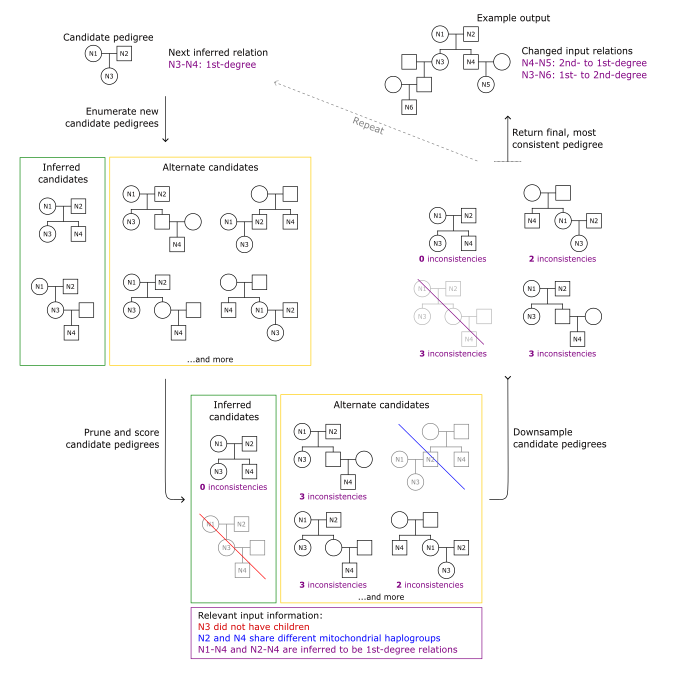
Diagram of repare's pedigree reconstruction process
Reproducibility
We recommend using Pixi to reproduce the results in this repo.
git clone https://github.com/ehuangc/repare.git
cd repare
pixi shell
Once in the Pixi shell, you can run the script(s) corresponding to the results you'd like to reproduce. For example:
python benchmarks/published/run_parameter_experiment.py
exit
To install Pixi, see this page.
Citation
If you use repare in your work, please cite our preprint:
Huang, E. C., Li, K. A., & Narasimhan, V. M. (2025). Fault-tolerant pedigree reconstruction from pairwise kinship relations. bioRxiv. https://doi.org/10.1101/2025.08.21.671608
@article{repare_preprint2025,
  doi     = {10.1101/2025.08.21.671608},
  author  = {Huang, Edward C. and Li, Kevin A. and Narasimhan, Vagheesh M.},
  title   = {Fault-tolerant pedigree reconstruction from pairwise kinship relations},
  journal = {bioRxiv},
  month   = {aug},
  year    = {2025},
  url     = {https://doi.org/10.1101/2025.08.21.671608},
}
Release history Release notifications | RSS feed


Download files
Download the file for your platform. If you're not sure which to choose, learn more about installing packages.
Source Distribution
Built Distribution
Filter files by name, interpreter, ABI, and platform.
If you're not sure about the file name format, learn more about wheel file names.
Copy a direct link to the current filters
File details
Details for the file repare-0.1.8.tar.gz.
File metadata
- Download URL: repare-0.1.8.tar.gz
- Upload date:
- Size: 5.8 MB
- Tags: Source
- Uploaded using Trusted Publishing? No
- Uploaded via: twine/6.1.0 CPython/3.13.1
File hashes
| Algorithm | Hash digest | |
|---|---|---|
| SHA256 |
5a7d76fc2a3c5d3870f912e503897adaa38b8321b68eeea5bb3e89a1c20f295a
|
|
| MD5 |
4740d3943d482056ca0a295ed9a0cf1d
|
|
| BLAKE2b-256 |
67e10e8b8ea81f9acb31a7fb59829487f53b7727d2aec82efd13a5d06c608d96
|
File details
Details for the file repare-0.1.8-py3-none-any.whl.
File metadata
- Download URL: repare-0.1.8-py3-none-any.whl
- Upload date:
- Size: 28.0 kB
- Tags: Python 3
- Uploaded using Trusted Publishing? No
- Uploaded via: twine/6.1.0 CPython/3.13.1
File hashes
| Algorithm | Hash digest | |
|---|---|---|
| SHA256 |
826eaaad0b4c920872c7255ae0249a5272508a38a5f404ddc87320afa70387da
|
|
| MD5 |
c2b1634166daaad4d874d338d632b72e
|
|
| BLAKE2b-256 |
1d57116744b5dbc2ddfb69eb90e1454a7c18b95ad471bea777c5baa32c851cbe
|






