
retex for Python
Compile LaTeX documents from Python, to PDF, SVG, ODT, ODP, HTML and Markdown, with retex, a TeX engine written in Rust whose output is pixel-identical to LuaLaTeX's. retex runs in the Python process and starts no TeX program.
- Source code, issues and releases: https://gitlab.com/severin-lemaignan/retex
- The manual (PDF): https://severin-lemaignan.gitlab.io/retex/retex-manual.pdf ("retex in programs")
- Try retex in your browser: https://severin-lemaignan.gitlab.io/retex
import retex

tex = retex.Retex()
doc = tex(r"""
\documentclass{article}
\begin{document}
Hello, \LaTeX{} from Python! $e^{i\pi} + 1 = 0$
\end{document}
""")

pdf = doc.to_pdf()        # bytes
svg = doc.to_svg()        # str: every page, stacked
odt = doc.to_odt()        # bytes
html = doc.to_html()      # str: one file, fonts and pictures in it
md = doc.to_markdown()    # str
doc.save("hello.pdf")     # or .svg, .odt, .odp, .html, .md
A build runs every pass the document needs, BibTeX, biber and makeindex
included. What it reported is in doc.diagnostics, doc.errors and
doc.warnings. A build that writes no output raises retex.RetexError,
whose diagnostics and log say why. In Jupyter, a document shows as
its pages (an SVG image; front ends that take PNG images show the first
page at 96 dpi).
Pages as images, drawn in the process (from the page's SVG, with resvg):
png = doc.to_png()                 # bytes: the first page at 150 dpi
a = doc.to_numpy(page=0, dpi=300)  # numpy array, uint8, (height, width, 3)
a = doc.to_numpy(alpha=True)       # (height, width, 4), transparent background
pages = doc.to_numpy(page=None)    # a list, one array per page
im = doc.to_pil(crop=True)         # a PIL image, cut down to the ink
Pages are numbered from 0 (negative numbers count from the end).
crop=True keeps what the page paints, with a margin of 2 points. For
a formula, use \pagestyle{empty} or the standalone class so that
the page number is not part of it. numpy and Pillow are needed only by
to_numpy and to_pil.
Options, all keyword arguments of Retex:
| option | meaning |
|---|---|
passes |
at most this many passes (default 5; 1 runs TeX once) |
shell_escape |
let \write18 run programs (default False) |
accessible |
tagged PDF, checked for accessibility (PDF/UA-2) |
working_dir |
where the document's own files (pictures, .bib) are |
job_name |
the job name (default document) |
files |
{name: str or bytes}: files the document reads |
keep_files |
keep the build's files (log, .aux) in this directory |
Retex.compile_file(path) compiles a .tex file, its directory being
the working directory.
retex needs a TeX Live installation (2025 or 2026) for the LaTeX packages and fonts. Builds release the GIL. They run one at a time in a process, and change the current directory while they run.
Build the wheel with maturin: maturin build --release in this directory. cargo xtask python builds it and runs
tests/. For PyPI, build a manylinux wheel with maturin build --release --zig --compatibility manylinux_2_28 (with zig on
PATH).
Examples
The scripts are in examples/.
A formula in a matplotlib figure, typeset by LaTeX (amsmath, any package) rather than by mathtext:
formula = retex.compile(r"""\documentclass{standalone}
\begin{document}$\displaystyle \varphi(x) = \frac{1}{\sqrt{2\pi}}\, e^{-x^2/2}$
\end{document}""").to_numpy(dpi=300, alpha=True, crop=True)
ax.add_artist(AnnotationBbox(OffsetImage(formula, zoom=fig.dpi / 300),
                             (-2.6, 0.3), frameon=False))
One PDF per person: a template filled in and compiled in a loop
(certificates, letters, badges). A Retex keeps its options from one
build to the next:
tex = retex.Retex(passes=2)
for name in ["Ada Lovelace", "Alan Turing", "Grace Hopper"]:
    tex(TEMPLATE.replace("@NAME@", name)).save(f"certificate-{name.split()[-1]}.pdf")
A contact sheet: every page of a document as a thumbnail, in one image:
pages = retex.Retex().compile_file("thesis.tex").to_pil(page=None, dpi=24)
w, h = pages[0].size
sheet = Image.new("RGB", (8 * w, rows * h), "white")
for i, page in enumerate(pages):
    sheet.paste(page, ((i % 8) * w, (i // 8) * h))
A check for continuous integration: build every document and print
its errors, with their file and line, as the retex program does:
tex = retex.Retex()
for path in pathlib.Path("docs").rglob("*.tex"):
    try:
        problems = tex.compile_file(path).errors
    except retex.RetexError as e:
        problems = e.diagnostics
    for d in problems:
        print(d)   # docs/intro.tex:12: error: undefined command \sectoin
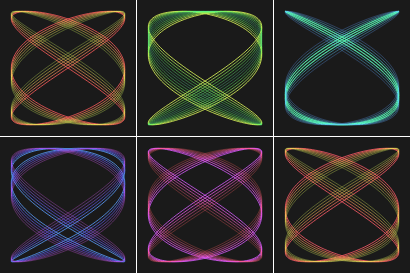
An animated GIF: numpy computes the curves, TikZ draws them, one
tikzpicture a frame. With the standalone class's tikz option each
picture is a page, and page=None gives every page as an image:
a = np.linspace(0, 2 * np.pi, 300)
pictures = []
for degrees in range(0, 360, 5):
    t = np.radians(degrees)
    x, y = 2 * np.sin(3 * a + t), 2 * np.sin(2 * a)
    path = " -- ".join(f"({u:.3f},{v:.3f})" for u, v in zip(x, y))
    pictures.append(rf"\begin{{tikzpicture}} ... \draw {path}; \end{{tikzpicture}}")
doc = retex.compile(r"\documentclass[tikz]{standalone}\begin{document}"
                    + "\n".join(pictures) + r"\end{document}")
frames = doc.to_pil(page=None, dpi=72)
frames[0].save("lissajous.gif", save_all=True, append_images=frames[1:], duration=60, loop=0)
TeX to pixels and back: a glyph drawn as an array, then redrawn as a TikZ picture of dots, one for each cell, as large as the cell is dark (a vector halftone):
ink = 1 - retex.compile(GLYPH).to_numpy(dpi=40).mean(axis=2) / 255
dots = [rf"\fill ({c},{-r}) circle ({0.55 * ink[r, c]**0.5:.3f});" for r, c in cells]
retex.compile(TIKZ_HEAD + "\n".join(dots) + TIKZ_TAIL).save("halftone.pdf")

1 maintainer

Metadata
1 maintainer
Release files for retex 1.7.0
For a detailed explanation of source distributions (sdists) and built distributions (wheels), please see the package formats documentation.
Built distribution (wheel)
| File | Interpreter | ABI | Platform | Actions Reset |
|---|---|---|---|---|
| retex-1.7.0-cp39-abi3-manylinux_2_28_x86_64.whl | CPython 3.9 | abi3 | Linux glibc 2.28+ x86-64 | Details for retex-1.7.0-cp39-abi3-manylinux_2_28_x86_64.whl |
Release files / retex-1.7.0-cp39-abi3-manylinux_2_28_x86_64.whl
| Download URL | retex-1.7.0-cp39-abi3-manylinux_2_28_x86_64.whl |
|---|---|
| Size | 8.3 MB |
| Tags | CPython 3.9 Linux glibc 2.28+ x86-64 abi3 |
|
SHA-256 checksum How to use checksums |
22a0a9951a2259acad7fbffae9589638fed429a04c6e30a0a9cd02009f845d0f
|
|
BLAKE2b-256 checksum How to use checksums |
f54174b5c5eaeb7760fcb5c9b127dac8818cc37ba27e55900cbd4f6938abf450
|
| Upload date | |
|
Uploaded using Trusted Publishing? What is trusted publishing? |
No |
| Uploaded via |
maturin/1.16.0
|
Security for retex 1.7.0
Provenance
Provenance describes where a file came from. On PyPI, provenance is shared via attestations, which provide a verifiable record of the build or publishing details. View details, limitations and caveats.
No provenance found
None of the files in this release were uploaded with provenance metadata.
A note on package security
PyPI is a repository for distributing packages, not a service for auditing them. While third-party security researchers and our staff do their best to detect and remove malicious packages, PyPI cannot guarantee the quality, security or suitability of any given package.
To learn more about protecting yourself from malicious actors, visit our package security documentation.














