
A pretrained model for transfer learning across the MOF adsorption sapce
Verified details
These details have been verified by PyPIProject links
GitHub Statistics
Maintainers

Project description
🤖 About
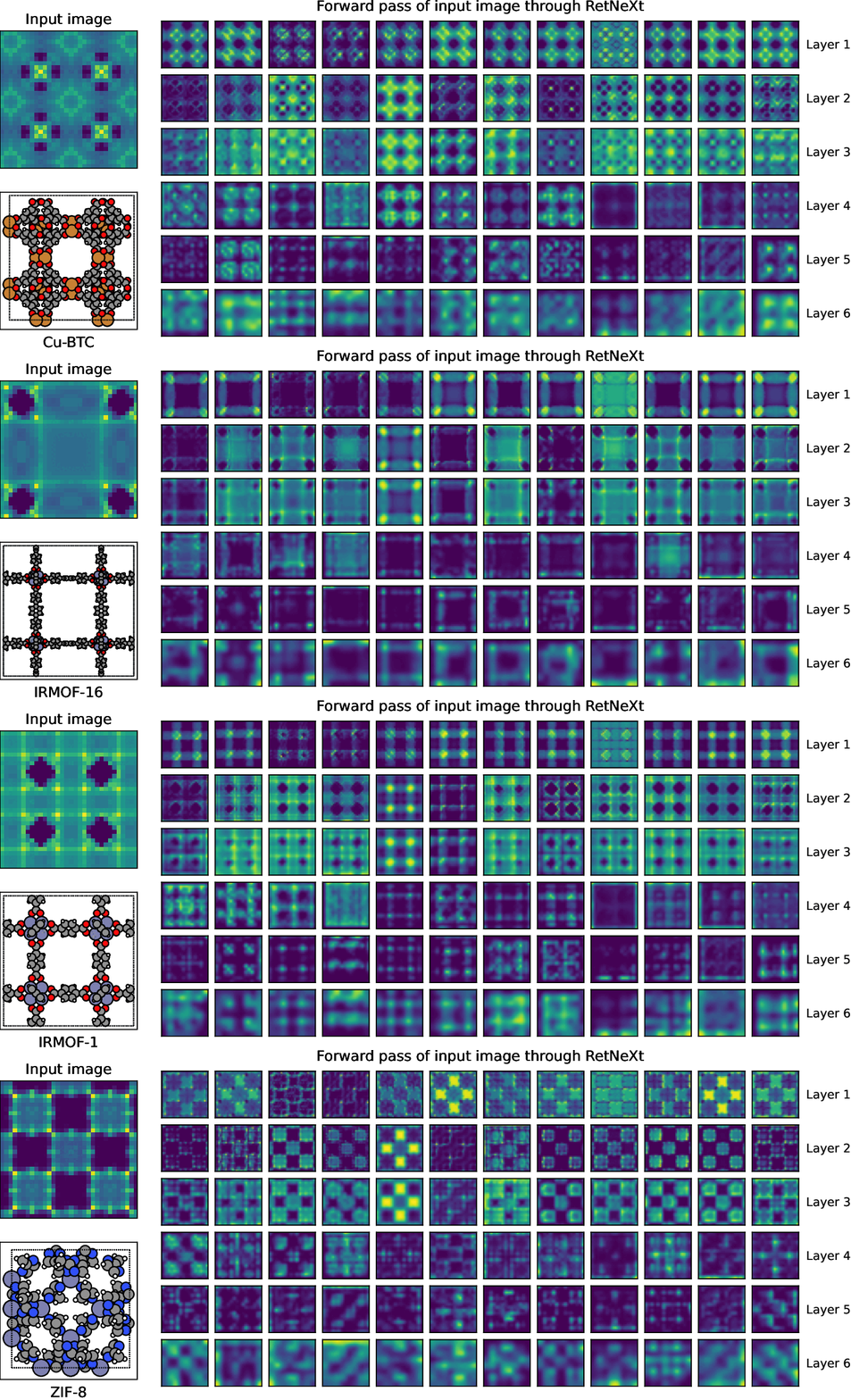
RetNeXt is a pretrained model for transfer learning across the MOF adsorption sapce. This package provides:
-
The model architecture, a 3D convolutional neural network for voxel-based material representations.
-
Pretrained model via multi-task learning, enabling effective feature extraction and transfer learning.
-
Built-in transformations for preprocessing and data augmentation of 3D energy images.
The pretrained model can be used as a feature extractor or fine-tuned for adsorption property prediction.
🚀 Tutorial
Before starting, the following packages must be installed:
pip install retnext          # Model and 3D transformations
pip install torchvision      # For data augmentation
pip install pymoxel>=0.5.0   # For image generation
pip install aidsorb>=2.0.0   # For model training
[!NOTE] All examples below assume the use of the pretrained model. Therefore, the image generation and preprocessing parameters must be configured accordingly.
🎨 Generate the energy images
You can generate the energy images from the CLI as following:
moxel path/to/CIFs path/to/voxels_data/ --grid_size=32 --cubic_box=30
Alternatively, for more fine-grained control over the materials to be processed:
from moxel.utils import voxels_from_files

cifs = ['foo.cif', 'bar.cif', ...]
voxels_from_files(cifs, 'path/to/voxels_data/', grid_size=32, cubic_box=30)
❄️ Use RetNeXt as feature extractor
Energy images are passed through the pretrained model to extract 128-D features, which are then stored in a .csv file.
Show example
from types import NoneType
import os

import numpy as np
import pandas as pd
from tqdm import tqdm
import torch
from torch.utils.data import DataLoader
from torch.utils.data._utils.collate import default_collate_fn_map
from torchvision.transforms.v2 import Compose
from retnext.modules import RetNeXt
from retnext.transforms import AddChannelDim, BoltzmannFactor
from aidsorb.data import PCDDataset as VoxelsDataset


# Required for collating unlabeled samples
def collate_none(batch, *, collate_fn_map):
    return None


# Get the names of the materials
names = [f.removesuffix('.npy') for f in os.listdir('path/to/voxels_data/')]

# Preprocessing transformations
transform_x = Compose([AddChannelDim(), BoltzmannFactor()])

# Create the dataset
dataset = VoxelsDataset(names, path_to_X='path/to/voxels_data/', transform_x=transform_x)

# Create the dataloader (adjust batch_size and num_workers)
dataloader = DataLoader(dataset, shuffle=False, drop_last=False, batch_size=256, num_workers=8)
default_collate_fn_map.update({NoneType: collate_none})

# Load pretrained weights
device = torch.device('cuda' if torch.cuda.is_available() else 'cpu')
model = RetNeXt(pretrained=True).to(device)

# Freeze the model
model.requires_grad_(False)
model.eval()
model.fc = torch.nn.Identity()  # So .forward() returns the embeddings.

# Extract features
Z = torch.cat([
    model(x.to(device))
    for x, _ in tqdm(dataloader, desc='Generating embeddings')
])

# Store features in .csv file
df = pd.DataFrame(Z.cpu().numpy(), index=names)
df.to_csv(f'embeddings.csv', index=True, index_label='name')
[!TIP] You can use these features alone or combine them with others features (e.g. structural descriptors) to train classical machine learning algorithms (e.g. Random Forest or XGBoost) for adsorption property prediction.
🔥 Fine-tune RetNeXt
-
Split the data into train, validation and test:
aidsorb prepare path/to/voxels_data/ --split_ratio='[0.7, 0.15, 0.15]' --seed=42
-
Freeze part of the model and train it:
Show example
import torch
from lightning.pytorch import Trainer, seed_everything
from torchmetrics import R2Score, MeanAbsoluteError, MetricCollection
from aidsorb.datamodules import PCDDataModule as VoxelsDataModule
from aidsorb.litmodules import PCDLit as VoxelsLit
from torchvision.transforms.v2 import Compose, RandomChoice
from retnext.modules import RetNeXt
from retnext.transforms import AddChannelDim, BoltzmannFactor, RandomRotate90, RandomReflect, RandomFlip

# For reproducibility
seed_everything(42, workers=True)

# Load pretrained weights and set the number of outputs
model = RetNeXt(n_outputs=1, pretrained=True)

# Option 1
# Linear evaluation (freeze the backbone and train only the output layer)
#model.backbone.requires_grad_(False)
#model.backbone.eval()

# Option 2
# Fine-tune the last two conv and output layers
model.backbone[:7].requires_grad_(False)
model.backbone[:7].eval()

# Option 3
# Fine-tune all layers (just freeze the first BN which acts as standardizer)
#model.backbone[0].requires_grad_(False)
#model.backbone[0].eval()

# Preprocessing and data augmentation transformations
eval_transform_x = Compose([AddChannelDim(), BoltzmannFactor()])
train_transform_x = Compose([
    AddChannelDim(), BoltzmannFactor(),
    RandomChoice([
        torch.nn.Identity(),
        RandomRotate90(),
        RandomFlip(),
        RandomReflect()
        ])
    ])

# Create the datamodule
datamodule = VoxelsDataModule(
    path_to_X='path/to/voxels_data/',
	path_to_Y='path/to/labels.csv',
    index_col='id',
	labels=['adsorption_property'],
    train_batch_size=32, eval_batch_size=256,
    train_transform_x=train_transform_x,
    eval_transform_x=eval_transform_x,
    shuffle=True, drop_last=True,
    config_dataloaders=dict(num_workers=8),
)
datamodule.setup()

# Configure loss, metrics and optimizer
criterion = torch.nn.MSELoss()
metric = MetricCollection(R2Score(), MeanAbsoluteError())
config_optimizer = dict(name='Adam', hparams=dict(lr=1e-3))  # Adjust the learning rate

# Create the litmodel
litmodel = VoxelsLit(model, criterion, metric=metric, config_optimizer=config_optimizer)

# Create the trainer
trainer = Trainer(max_epochs=5)

# Initialize last bias with target mean (optional but recommended)
train_names = list(datamodule.train_dataset.pcd_names)
y_train_mean = datamodule.train_dataset.Y.loc[train_names].mean().item()
torch.nn.init.constant_(litmodel.model.fc.bias, y_train_mean)

# Train and test the model
trainer.fit(litmodel, datamodule=datamodule)
trainer.test(litmodel, datamodule=datamodule)
Show RetNeXt architecture
RetNeXt(
  (backbone): Sequential(
    (0): BatchNorm3d(1, eps=1e-05, momentum=None, affine=False, track_running_stats=True)
    (1): Sequential(
      (0): Conv3d(1, 32, kernel_size=(3, 3, 3), stride=(1, 1, 1), padding=same, bias=False)
      (1): BatchNorm3d(32, eps=1e-05, momentum=0.1, affine=True, track_running_stats=True)
      (2): ReLU()
    )
    (2): Sequential(
      (0): Conv3d(32, 32, kernel_size=(3, 3, 3), stride=(1, 1, 1), padding=same, bias=False)
      (1): BatchNorm3d(32, eps=1e-05, momentum=0.1, affine=True, track_running_stats=True)
      (2): ReLU()
    )
    (3): MaxPool3d(kernel_size=2, stride=2, padding=0, dilation=1, ceil_mode=False)
    (4): Sequential(
      (0): Conv3d(32, 64, kernel_size=(3, 3, 3), stride=(1, 1, 1), padding=same, bias=False)
      (1): BatchNorm3d(64, eps=1e-05, momentum=0.1, affine=True, track_running_stats=True)
      (2): ReLU()
    )
    (5): Sequential(
      (0): Conv3d(64, 64, kernel_size=(3, 3, 3), stride=(1, 1, 1), padding=same, bias=False)
      (1): BatchNorm3d(64, eps=1e-05, momentum=0.1, affine=True, track_running_stats=True)
      (2): ReLU()
    )
    (6): MaxPool3d(kernel_size=2, stride=2, padding=0, dilation=1, ceil_mode=False)
    (7): Sequential(
      (0): Conv3d(64, 128, kernel_size=(3, 3, 3), stride=(1, 1, 1), bias=False)
      (1): BatchNorm3d(128, eps=1e-05, momentum=0.1, affine=True, track_running_stats=True)
      (2): ReLU()
    )
    (8): Sequential(
      (0): Conv3d(128, 128, kernel_size=(3, 3, 3), stride=(1, 1, 1), bias=False)
      (1): BatchNorm3d(128, eps=1e-05, momentum=0.1, affine=True, track_running_stats=True)
      (2): ReLU()
    )
    (9): AdaptiveAvgPool3d(output_size=1)
    (10): Flatten(start_dim=1, end_dim=-1)
  )
  (fc): Linear(in_features=128, out_features=1, bias=True)
)
Show example
labels.csvid,adsorption_property sample_001,0.123 sample_002,0.456 sample_003,0.789 sample_004,1.234 sample_005,0.987
[!NOTE] The example above shows how to fine-tune the pretrained model for a regression task. For classification, you only need to adjust the final layer (e.g.
model = RetNeXt(n_outputs=10, pretrained=True)for a 10-class classification task), and use the proper loss and metrics.
For more details and customization options, refer to the AIdsorb documentation.
📑 Citing
If you use RetNeXt in your research, please consider citing the following work:
@article{Sarikas2026,
  title = {RetNeXt: A Pretrained Model for Transfer Learning Across the MOF Adsorption Space},
  ISSN = {1549-960X},
  url = {http://dx.doi.org/10.1021/acs.jcim.5c02698},
  DOI = {10.1021/acs.jcim.5c02698},
  journal = {Journal of Chemical Information and Modeling},
  publisher = {American Chemical Society (ACS)},
  author = {Sarikas,  Antonios P. and Gkagkas,  Konstantinos and Froudakis,  George E.},
  year = {2026},
  month = feb
}
⚖️ License
RetNeXt is released under the GNU General Public License v3.0 only.
Project details
Verified details
These details have been verified by PyPIProject links
GitHub Statistics
Maintainers
Release history Release notifications | RSS feed


Download files
Download the file for your platform. If you're not sure which to choose, learn more about installing packages.
Source Distribution
Built Distribution
Filter files by name, interpreter, ABI, and platform.
If you're not sure about the file name format, learn more about wheel file names.
Copy a direct link to the current filters
File details
Details for the file retnext-1.0.0.post0.tar.gz.
File metadata
- Download URL: retnext-1.0.0.post0.tar.gz
- Upload date:
- Size: 2.1 MB
- Tags: Source
- Uploaded using Trusted Publishing? Yes
- Uploaded via: twine/6.1.0 CPython/3.13.12
File hashes
| Algorithm | Hash digest | |
|---|---|---|
| SHA256 |
00b96631ee3634cd42ac8327b97df1565510c2e45fffc62e702b71cab4c14e9f
|
|
| MD5 |
0a72732926c0da35e0b0d5dbe7de0f35
|
|
| BLAKE2b-256 |
3354dc89db42ecd09ee1a370dd1688ed7b2130bbc6753cd7873c08e838fbcea7
|
Provenance
The following attestation bundles were made for retnext-1.0.0.post0.tar.gz:
Publisher:
python-publish.yml on adosar/retnext
-
Statement:
-
Statement type:
https://in-toto.io/Statement/v1 -
Predicate type:
https://docs.pypi.org/attestations/publish/v1 -
Subject name:
retnext-1.0.0.post0.tar.gz -
Subject digest:
00b96631ee3634cd42ac8327b97df1565510c2e45fffc62e702b71cab4c14e9f - Sigstore transparency entry: 1592549496
- Sigstore integration time:
-
Permalink:
adosar/retnext@d8e77f8eff7a13bf3a9f298dbd44676505566cec -
Branch / Tag:
refs/tags/1.0.0.post0 - Owner: https://github.com/adosar
-
Access:
public
-
Token Issuer:
https://token.actions.githubusercontent.com -
Runner Environment:
github-hosted -
Publication workflow:
python-publish.yml@d8e77f8eff7a13bf3a9f298dbd44676505566cec -
Trigger Event:
release
-
Statement type:
File details
Details for the file retnext-1.0.0.post0-py3-none-any.whl.
File metadata
- Download URL: retnext-1.0.0.post0-py3-none-any.whl
- Upload date:
- Size: 19.6 kB
- Tags: Python 3
- Uploaded using Trusted Publishing? Yes
- Uploaded via: twine/6.1.0 CPython/3.13.12
File hashes
| Algorithm | Hash digest | |
|---|---|---|
| SHA256 |
0453fa91c05b9fc3892a2c85b87cc1e20512b4866828ad0cccd419aba3ebb553
|
|
| MD5 |
f1eefbcf98af5ea1997a48eb46e8e27e
|
|
| BLAKE2b-256 |
8786d5d6f86fbe5a11ad0df9c5c420ea4bfe29996f7c0d9fb289465cda7a6897
|
Provenance
The following attestation bundles were made for retnext-1.0.0.post0-py3-none-any.whl:
Publisher:
python-publish.yml on adosar/retnext
-
Statement:
-
Statement type:
https://in-toto.io/Statement/v1 -
Predicate type:
https://docs.pypi.org/attestations/publish/v1 -
Subject name:
retnext-1.0.0.post0-py3-none-any.whl -
Subject digest:
0453fa91c05b9fc3892a2c85b87cc1e20512b4866828ad0cccd419aba3ebb553 - Sigstore transparency entry: 1592549563
- Sigstore integration time:
-
Permalink:
adosar/retnext@d8e77f8eff7a13bf3a9f298dbd44676505566cec -
Branch / Tag:
refs/tags/1.0.0.post0 - Owner: https://github.com/adosar
-
Access:
public
-
Token Issuer:
https://token.actions.githubusercontent.com -
Runner Environment:
github-hosted -
Publication workflow:
python-publish.yml@d8e77f8eff7a13bf3a9f298dbd44676505566cec -
Trigger Event:
release
-
Statement type:






