
rigidax
Differentiable rigid-body kinematics and dynamics in JAX. Its design starts from frax: the dense, loop-free formulation of the dynamics over a DOF ancestor mask. It fills in frax's gaps:
| frax 0.2 | rigidax | |
|---|---|---|
| Model formats | URDF | MJCF and URDF (compiled by MuJoCo) |
| Joint types | revolute, prismatic, free | hinge, slide, ball, free, several joints per body |
| Gravity | hardcoded 9.81 in forward_dynamics |
model parameter, any vector |
| Physical parameters | frozen into the compiled function | pytree leaves: jax.grad / vmap over masses, inertias, offsets, gravity; swap them without recompiling |
| Armature | no | yes (in M and inverse dynamics) |
| External wrenches | per-link | per-body, MuJoCo xfrc_applied layout |
| Ground truth tests | Pinocchio / MuJoCo | every quantity vs MuJoCo on random trees + G1/A2/Panda, plus Pinocchio |
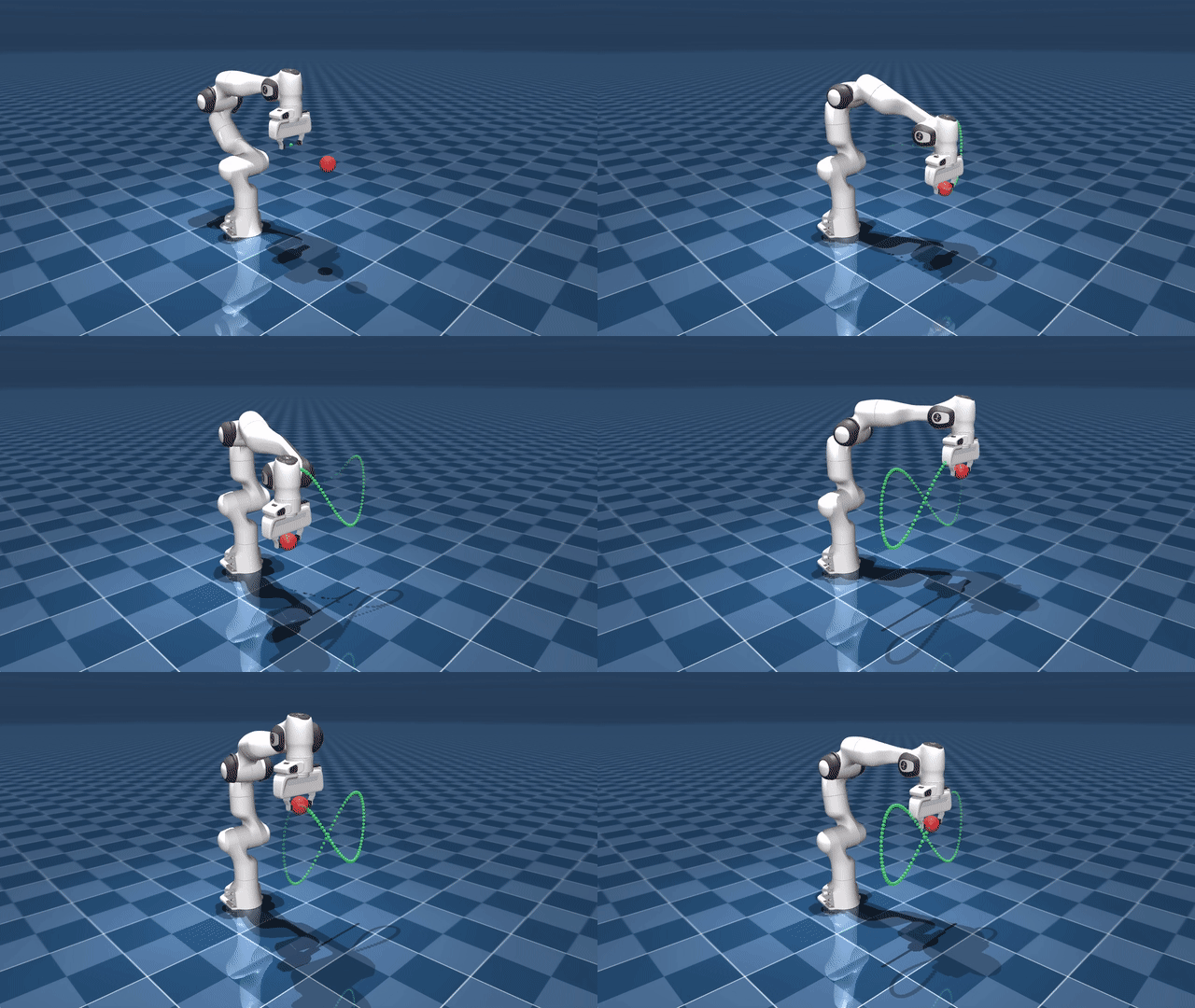
The Panda tracks a figure-eight with operational space control (examples/osc_demo.py).
rigidax computes the kinematics, Jacobian, mass matrix and bias forces in about 54 µs
per step, Python dispatch included. Mean tracking error is 0.9 mm. MuJoCo only
simulates and renders.
env -u PYTHONPATH MUJOCO_GL=egl python examples/osc_demo.py --out osc_demo.mp4

Two output variants are produced from the same solve settings. Speed on the same laptop with self-collision: 22.8k frames/s for the plain G1 and 18.8k for G1 + Dex3. The Dex3 version is slower because the finger envelope adds collision spheres. frax, with self-collision, runs at 18.3k.
| Variant | Command | Output | GIF |
|---|---|---|---|
| G1 + Dex3 hands (default) | retarget_lafan1.py <clips> |
data/g1_lafan1_hands/ (nq 50) |
examples/g1_lafan1.gif |
| Plain G1, rigid hands | retarget_lafan1.py <clips> --no-hands |
data/g1_lafan1_nohands/ (nq 36) |
examples/g1_lafan1_nohands.gif |
Both variants track the forearm twist. Palm floor contact and fingers are Dex3-only.
Render a variant with render_motions.py --data data/g1_lafan1_nohands ....
rigidax.ik: batched IK and retargeting
A dedicated differential IK solver for retargeting whole datasets on CPU:
- Each Gauss-Newton step is a small QP, solved by a purpose-built fixed-iteration
ADMM (
rigidax.ik.solve_qp). It has no branches, so it vectorizes over thousands of frames. It uses:- row equilibration,
- one explicit inverse per solve, then matrix-vector products (batched triangular solves are slow on XLA:CPU),
- warm starts from the previous frame,
- optional polishing.
- Constraints:
- hard joint limits,
- a per-iteration trust region, so a joint can never flip across its range in one frame,
- a hard floor (
FloorPoints), - elastic self-collision, an exact L1 penalty that keeps the problem always feasible,
on an automatic sphere model of any MuJoCo model (
SphereModel.fit).
- Tasks: position, orientation, limb direction (retargets between skeletons with different proportions) and posture.
- Batching:
solve_trajectorysplits clips into segments that run in parallel (vmap within a device, pmap across devices). Each segment is seeded by a multi-start solve, and consecutive segments are crossfaded so seams are smooth.
from rigidax import ik
tasks = [ik.position(model, bodies, w), ik.direction(model, links, bases, w),
         ik.orientation(model, frames, w), ik.PostureTask(posture_w)]
solver = ik.IKSolver(model, tasks, floor=ik.FloorPoints.on(model, feet, sole_points),
                     collision=ik.SphereModel.fit(mj_model, model, pair_filter=...))
qs, costs = solver.solve_trajectory(seed_fn, [clip1_targets, clip2_targets, ...])
vs frax on LAFAN1 → Unitree G1
Both libraries ran frax's own LAFAN1 settings on the same i9-11900H laptop (8 cores, one XLA device per core), on 8 clips (53,621 frames, 30 min of motion). Both outputs are scored with the same metrics:
- Motion kept: robot vs human limb angular speed (1.0 = all of it).
- Lag: in frames.
- Joint acceleration: worst 5% of frames.
- Skating: the robot's toe contact sliding while the human toe is planted.
- Penetration: MuJoCo's own mesh collision check.
bench/bench_frax_ik.py runs frax.
| frames/s | arm / leg dir. error p95 | hand / forearm rot. p95 | arms / legs kept | lag (frames) | >20° jumps | skate median / p95 | touchdown p95 | penetration | through floor | |
|---|---|---|---|---|---|---|---|---|---|---|
| frax, self-collision | 18,327 | 17.4° / 11.6° | 13° / 20° | 0.88 / 0.95 | 0.16 | 1.9% | 4.6 / 32 cm/s | 40 | 0.0% | 0.6 cm max |
| rigidax, self-collision (plain G1) | 22,836 | 14.0° / 11.7° | 12° / 24° | 0.92 / 0.94 | -0.01 | 0.1% | 0.9 / 21 | 35 | 0.0% | 3.8 cm max (lying) |
| frax, no self-collision | 37,490 | 17.1° / 11.3° | 11° / 19° | 0.88 / 0.95 | 0.15 | 1.8% | 4.4 / 31 | 38 | 3.3% | |
| rigidax, no self-collision | 46,808 | 3.9° / 11.7° | 10° / 22° | 0.96 / 0.94 | -0.10 | 0.1% | 0.9 / 21 | 35 | 2.2% |
The rigidax task set covers everything frax tracks: pelvis, the thigh / shin / foot links, torso, and the upper arm / forearm / hand orientations. It adds limb directions and toe contact points on top.
Where frax is still slightly ahead:
- forearm twist (24° vs 20°),
- leg motion kept (0.94 vs 0.95).
frax's lower joint-acceleration number (8.4 vs 9.3°/f²) is mostly smoothed-away motion. On the knees, rigidax matches the human's own knee acceleration and frax sits below it.
Hands: the output uses the G1 with Dex3-1 hands (g1_with_hands.xml, 7 finger joints
per hand). The body is solved on the 35-DOF model and the finger angles are written
afterwards, since nothing depends on them, which keeps the solve as fast as before.
- Synthesized fingers: LAFAN1 records no fingers, so the grip is inferred from context
and is not tracked motion:
- fist in a fighting guard (hand in front of the chest, in the chest frame) or during
a strike, in
fightclips only; - flat open hand while the human hand rests on the floor;
- relaxed otherwise.
- fist in a fighting guard (hand in front of the chest, in the chest frame) or during
a strike, in
- Palm contact: a height task puts the palm on the floor while the human hand rests there. The previous hover was 6.2 cm; now it is about 0.
- Forearm twist: a twist-only task about the forearm axis.
Diagnostics:
examples/render_overlay.py: draws the solver's targets over the robot (visible red means a real tracking error).examples/floor_report.py: whole-body floor penetration.examples/collision_report.py: self-collision.
# CPU, one XLA device per core
XLA_FLAGS="--xla_force_host_platform_device_count=8 --xla_cpu_multi_thread_eigen=false" \
  python examples/retarget_lafan1.py dance1_subject1 walk1_subject1 ...   [--no-collision]
python examples/collision_report.py dance1_subject1 ...   # MuJoCo mesh ground truth
LAFAN1 is CC BY-NC-ND 4.0 (non-commercial). Get it with:
curl -L -o data/lafan1.zip https://github.com/ubisoft/ubisoft-laforge-animation-dataset/raw/master/lafan1/lafan1.zip
unzip -j data/lafan1.zip '*.bvh' -d data/lafan1
MUJOCO_GL=egl python examples/render_motions.py --out g1_lafan1.gif dance1_subject1:DANCE \
  dance2_subject3:"DANCE 2" fightAndSports1_subject1@13.8:"FIGHT + KICK" jumps1_subject1:JUMPS \
  run1_subject2:RUN sprint1_subject2@177:SPRINT walk1_subject1:WALK fallAndGetUp1_subject1@63:"FALL + GET UP"
# clip@seconds picks the window; without it the most active 10 s are used
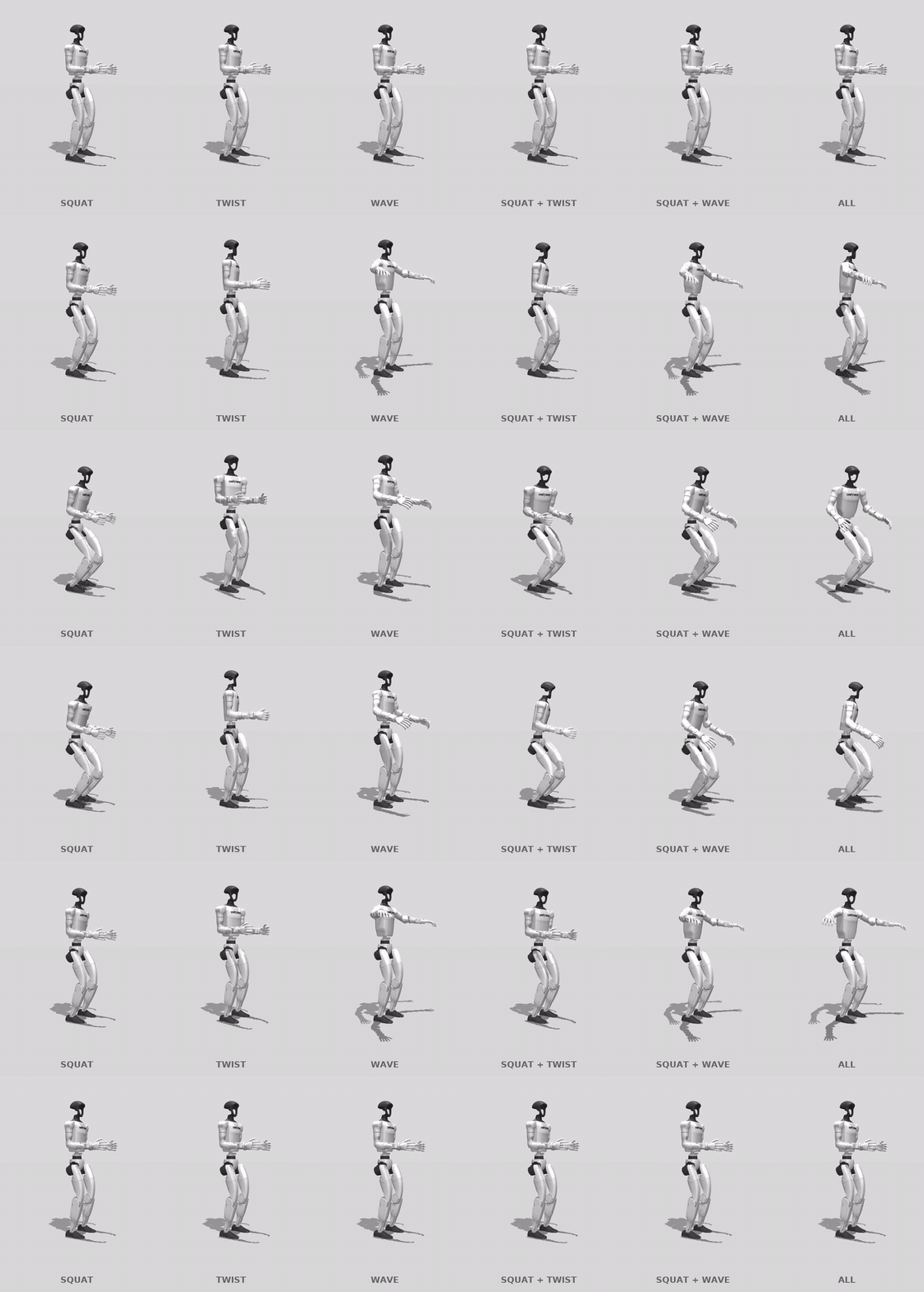
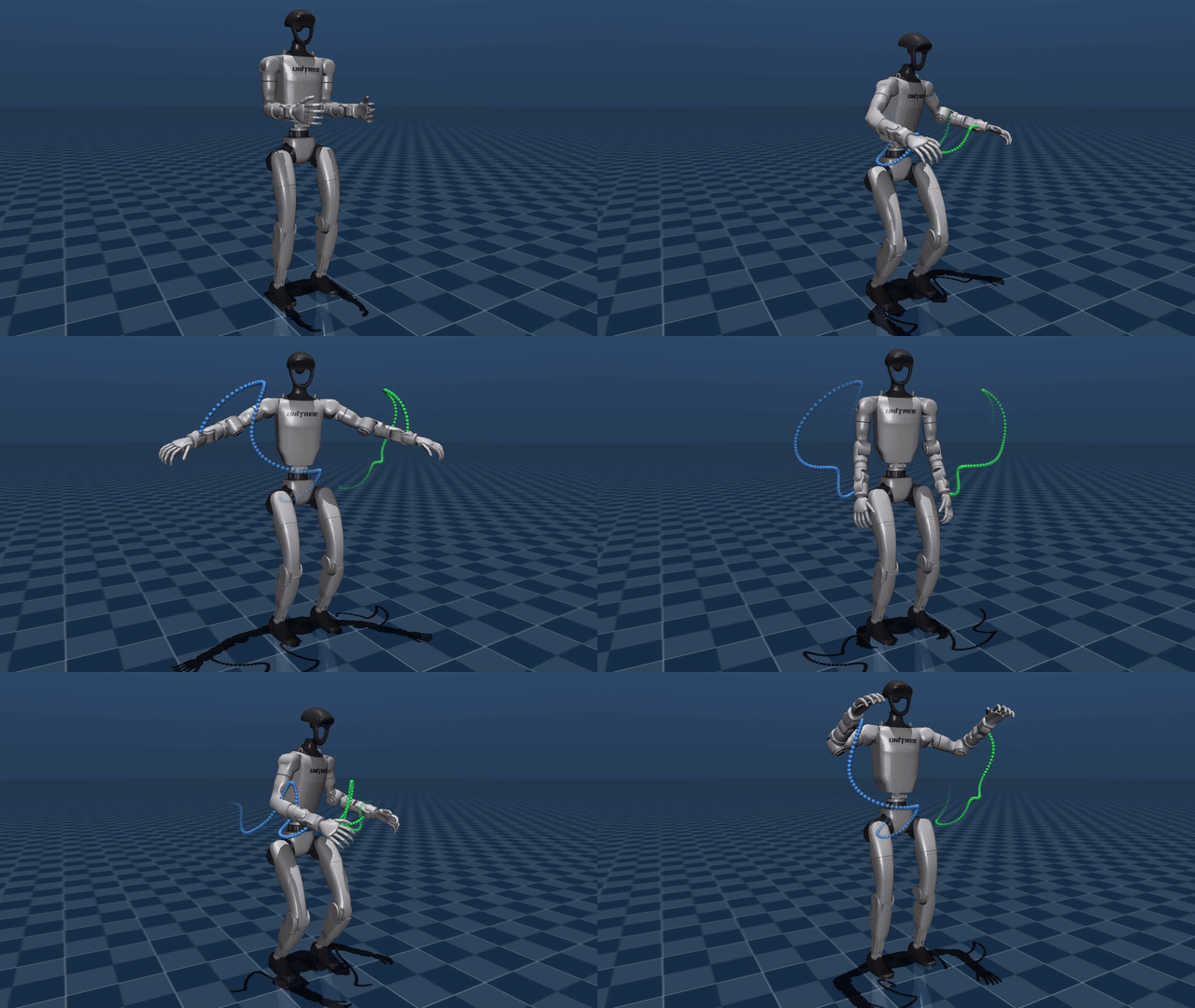
A free-floating Unitree G1 (35 DOF) squats, twists and waves while balancing on its
feet (examples/g1_demo.py). Per step, rigidax computes:
- M and h, the foot contact Jacobians, and Jc_dot·v (via autodiff)
- reference accelerations that keep the feet planted (KKT solve)
- the contact wrenches that balance the floating base
- the feedforward joint torques
Joint PD supplies the feedback. A step takes about 190 µs. MuJoCo's position servos are replaced by pure torque motors.
env -u PYTHONPATH MUJOCO_GL=egl python examples/g1_demo.py --out g1_demo.mp4
# one motion set, frax-style grey studio: --motion squat|twist|wave|squat,wave|all --style light
Use
import jax, rigidax as rx
jax.config.update("jax_enable_x64", True)

model = rx.load("robot.xml")              # or .urdf; strip_meshes=True if meshes are missing
q, v = model.q0, jax.numpy.zeros(model.nv)

M, bias = jax.jit(rx.dynamics_terms)(model, q, v)            # one kinematics pass
qacc = jax.jit(rx.forward_dynamics)(model, q, v, tau)
moon = model.replace(gravity=jax.numpy.array([0, 0, -1.62]))  # no recompile

# gradients w.r.t. physical parameters (e.g. system identification)
dL_dmass = jax.grad(lambda m: loss(model.replace(body_mass=m)))(model.params.body_mass)
Available functions: forward_kinematics, site_pose, body_pose, point_jacobian,
site_jacobian, body_jacobian, center_of_mass, center_of_mass_jacobian, rnea,
mass_matrix, bias_forces, gravity_forces, coriolis_forces, dynamics_terms,
forward_dynamics, mass_matrix_inverse, integrate, difference.
Every function takes an optional kin= argument to reuse a forward-kinematics pass.
Conventions follow MuJoCo: q uses [pos, wxyz quat] for free joints and wxyz for
ball joints. v uses world-frame linear and body-frame angular velocity.
Tests
env -u PYTHONPATH python -m pytest # unset ROS's PYTHONPATH if it is sourced
Speed vs frax (CPU, float64, single thread, jax 0.4.30)
Median µs per call, from bench/bench_vs_frax.py, two runs. A ratio above 1 means rigidax is faster.
| Panda single | G1 (35 dof) single | Panda batch 1024 | G1 batch 1024 | |
|---|---|---|---|---|
| mass matrix | 0.96–0.98x | 0.97x | 1.09x | 1.02–1.15x |
| bias forces | 0.85–0.91x | 0.78–0.80x | 0.95–1.02x | 0.91–0.92x |
| forward dynamics | 0.82–0.87x | 0.95–0.96x | 0.97–1.11x | 0.94–0.97x |
The two are about equal overall. The single-call bias computation is still 10–20% slower. GPU has not been benchmarked.
Known limitations (1.0)
- Synthesized fingers: Dex3 finger motion is inferred from context (LAFAN1 has no finger data). Finger collisions are handled with rigid envelopes, so fists held against the torso in the fight guard still touch it in about 1% of frames.
- GPU: the GPU path works but is not tuned (~6k frames/s on an RTX 3060 laptop).
- G1 forearm pronation: on the G1 this lives on
wrist_roll_link. The twist task currently targetselbow_link.
Roadmap
- Foot skating p95 (contact-aware per-frame weights), GPU throughput
- Capsule/box collision primitives
- Close the remaining bias-forces gap; GPU benchmarks
- Analytic derivatives of RNEA and ABA
1 maintainer

Metadata
1 maintainer
Release files for rigidax 1.0.0
For a detailed explanation of source distributions (sdists) and built distributions (wheels), please see the package formats documentation.
Source distribution (sdist)
| File | Size | Uploaded | Provenance | Actions |
|---|---|---|---|---|
| rigidax-1.0.0.tar.gz | 47.1 kB | Without provenance | Details for rigidax-1.0.0.tar.gz |
Built distribution (wheel)
| File | Interpreter | ABI | Platform | Actions Reset |
|---|---|---|---|---|
| rigidax-1.0.0-py3-none-any.whl | Python 3 | none | any | Details for rigidax-1.0.0-py3-none-any.whl |
Total release size: 85.3 kB
Release files / rigidax-1.0.0.tar.gz
| Download URL | rigidax-1.0.0.tar.gz |
|---|---|
| Size | 47.1 kB |
| Tags | Source |
|
SHA-256 checksum How to use checksums |
cd454e8056677b3e823d0868d80e12489ae63269c221c7ed0b4f7b26d26c3928
|
|
BLAKE2b-256 checksum How to use checksums |
f90d57026c0e51391473c89418c7bc281a771d29fe1b6ad6d6c731f39c7e6cd6
|
| Upload date | |
|
Uploaded using Trusted Publishing? What is trusted publishing? |
No |
| Uploaded via |
uv/0.13.0 {"installer":{"name":"uv","version":"0.13.0","subcommand":["publish"]},"python":null,"implementation":{"name":null,"version":null},"distro":{"name":"Ubuntu","version":"22.04","id":"jammy","libc":null},"system":{"name":null,"release":null},"cpu":null,"openssl_version":null,"setuptools_version":null,"rustc_version":null,"ci":null}
|
Release files / rigidax-1.0.0-py3-none-any.whl
| Download URL | rigidax-1.0.0-py3-none-any.whl |
|---|---|
| Size | 38.3 kB |
| Tags | Python 3 |
|
SHA-256 checksum How to use checksums |
c2d6f95f0f9e7d2c2da43ff17c38653418077b45ec21d1d61584fb6fb90c0314
|
|
BLAKE2b-256 checksum How to use checksums |
666631e6fd57d376a14b01b8e5f26b2ed421e26f0f73afb746f48542374036e2
|
| Upload date | |
|
Uploaded using Trusted Publishing? What is trusted publishing? |
No |
| Uploaded via |
uv/0.13.0 {"installer":{"name":"uv","version":"0.13.0","subcommand":["publish"]},"python":null,"implementation":{"name":null,"version":null},"distro":{"name":"Ubuntu","version":"22.04","id":"jammy","libc":null},"system":{"name":null,"release":null},"cpu":null,"openssl_version":null,"setuptools_version":null,"rustc_version":null,"ci":null}
|
Security for rigidax 1.0.0
Provenance
Provenance describes where a file came from. On PyPI, provenance is shared via attestations, which provide a verifiable record of the build or publishing details. View details, limitations and caveats.
No provenance found
None of the files in this release were uploaded with provenance metadata.
A note on package security
PyPI is a repository for distributing packages, not a service for auditing them. While third-party security researchers and our staff do their best to detect and remove malicious packages, PyPI cannot guarantee the quality, security or suitability of any given package.
To learn more about protecting yourself from malicious actors, visit our package security documentation.













