ros2_http_gateway
A YAML file in, an authenticated HTTP API out. No code to write, no client to build.







One config file decides exactly which ROS 2 topics, services and actions are reachable over HTTP -- with per-endpoint roles, state-based preconditions, audit logging, server-sent events and a generated OpenAPI 3.1 document. Nothing is exposed unless you name it.
No code, only config
Serve the file and you get the endpoints, an OpenAPI document describing them and a built-in
console for exercising them straight away. Below is examples/demo.yaml,
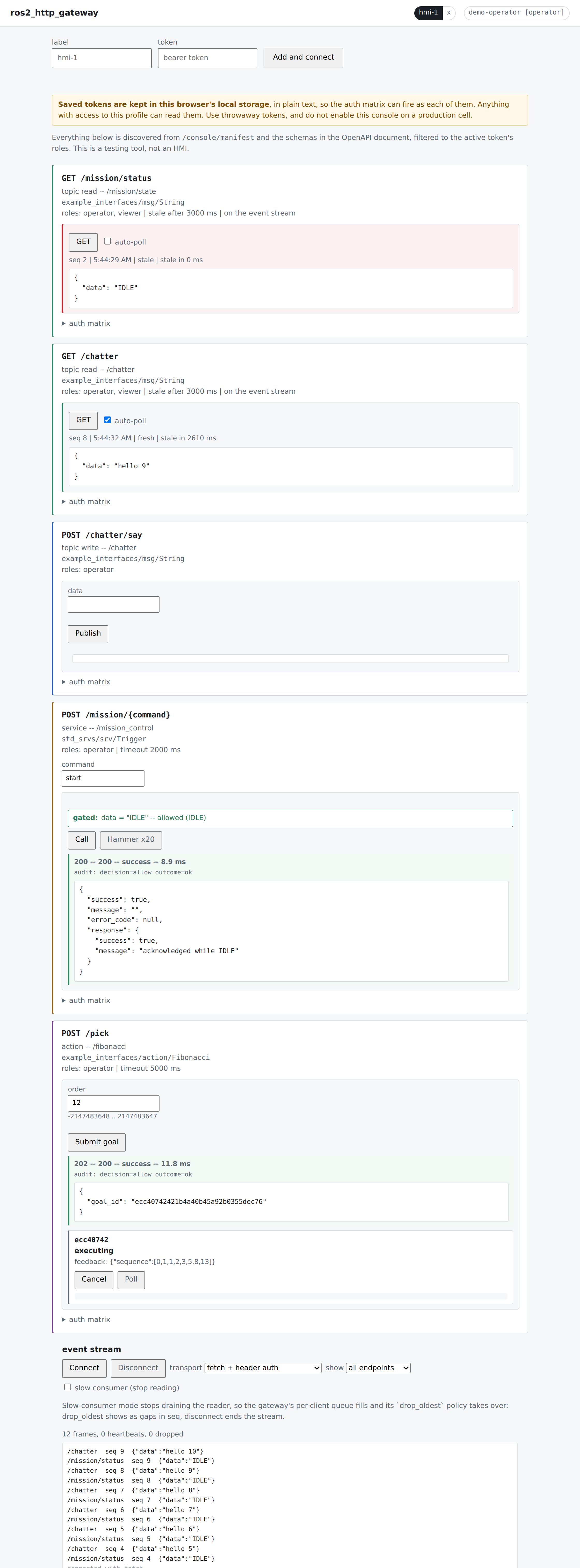
trimmed; the screenshot under it is that console rendering itself from exactly this config --
forms, live tiles, gates, goal cards:
endpoints:
  /mission/status:                        # GET the newest sample, flagged stale after 3 s
    topic: /mission/state
    type: example_interfaces/msg/String
    roles: [viewer, operator]
    stale_after_ms: 3000

  /chatter/say:                           # POST publishes the body
    topic: /chatter
    type: example_interfaces/msg/String
    method: POST
    roles: [operator]

  /mission/{command}:                     # POST calls a service, gated on live state
    service: /mission_control
    type: std_srvs/srv/Trigger
    method: POST
    roles: [operator]
    timeout_ms: 2000
    preconditions:
      - state_endpoint: /mission/status
        field: data
        allow: { start: [IDLE], abort: [RUNNING], reset: ["*"] }

  /pick:                                  # POST submits a goal; status, feedback and cancel follow
    action: /fibonacci
    type: example_interfaces/action/Fibonacci
    roles: [operator]

auth:
  tokens:
    - token_sha256: "61112491d046c3f6f8ab801f170d9b2d0c734a17ceff60dee92123fb507cfc3f" # sha256 of 'demo-operator-token'
      user: demo-operator
      roles: [operator]

sse: { path: /events, include: [/mission/status, /chatter] }
http: { bind: 127.0.0.1, port: 8080, base_path: /api/v1, console: true }
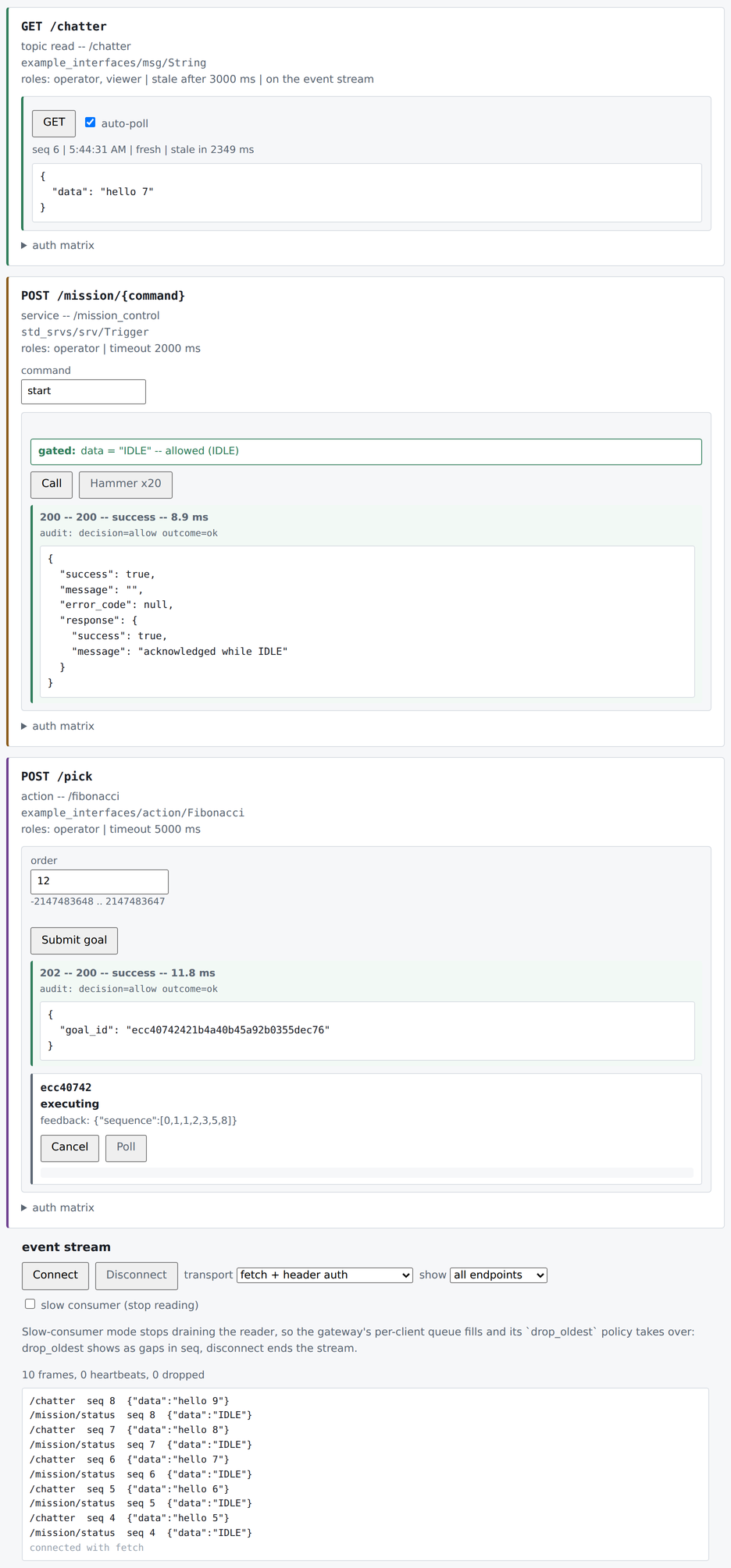
Reading down that screenshot: a topic tile counting down to its staleness bound; a service showing
the live state it is gated on (data = "IDLE" -- allowed) beside the button, with the audit line
the call produced; a goal card mid-flight with feedback; and the event stream, with its two
transports and a slow-consumer switch. Full page.
Try it in two terminals
The demo publishes example_interfaces messages, which a ros-base install does not carry
(std_srvs and the rest come with it already):
sudo apt install ros-$ROS_DISTRO-example-interfaces
# terminal 1 -- a demo node: mission state cycling IDLE/RUNNING, a 2 Hz topic, a service, an action
ros2 run ros2_http_gateway ros2-http-gateway-demo

# terminal 2
ros2-http-gateway examples/demo.yaml
examples/demo.yaml is the checkout path; an installed copy sits at
$(ros2 pkg prefix ros2_http_gateway)/share/ros2_http_gateway/examples/demo.yaml.
Open http://127.0.0.1:8080/api/v1/console and paste demo-operator-token. Or stay in the shell:
curl -H 'Authorization: Bearer demo-operator-token' \
  http://127.0.0.1:8080/api/v1/mission/status
Paste demo-viewer-token instead and the write, the service and the action disappear from the
page: the console is built from a manifest filtered to the token's roles. The service is gated on
live mission state, so POST /api/v1/mission/start flips between success and
PRECONDITION_FAILED every eight seconds as the demo cycles.
Interactive API docs are at /api/v1/docs, the OpenAPI document at /api/v1/openapi.json.
Validate a config without starting anything
ros2-http-gateway --check examples/demo.yaml                     # exit 0/1
ros2-http-gateway --check --dump-openapi api.json examples/demo.yaml
--check resolves every interface type, compiles every converter and checks every precondition
field against the real message definition, then prints one line per endpoint. It needs no running
system when the config pins its types, which is what makes it usable as a CI gate; add --online
on the robot to verify those pinned types against the live graph too.
Why not rosbridge
rosbridge_suite exposes the whole ROS graph over a WebSocket with, at best, a shared secret.
That is the right tool for a debugging UI on a bench, and the wrong tool for a machine that has to
pass a security review.
| rosbridge | ros2_http_gateway | |
|---|---|---|
| Exposed surface | whole graph, discovered at runtime | only what the config names |
| Transport | WebSocket, custom protocol | plain HTTP + SSE, described in OpenAPI |
| Auth | optional shared secret | per-token identity, per-endpoint roles |
| Authorisation | none | roles plus state-based preconditions |
| Audit | none | one JSON line per authenticated request |
Install
pip install ros2-http-gateway
rclpy is deliberately not a pip dependency; it comes from your sourced ROS 2 environment.
--help and --version work without one, everything else needs
source /opt/ros/$ROS_DISTRO/setup.bash.
On a Debian-managed Python -- which is what a ROS container gives you -- install into a virtualenv
rather than fighting PEP 668. --system-site-packages is what keeps rclpy and the interface
packages importable, and upgrading pip inside the venv matters on Humble, where pip 22 installs an
editable package with setup.py develop and so ignores pyproject.toml metadata entirely:
sudo apt install python3-venv          # not present in a ros-base image
python3 -m venv --system-site-packages .venv
.venv/bin/python -m pip install --upgrade pip
.venv/bin/python -m pip install ros2-http-gateway
In a colcon workspace, where rosdep covers the runtime dependencies:
cd ~/ws/src && git clone https://github.com/justagist/ros2_http_gateway.git
cd ~/ws && rosdep install --from-paths src -y --ignore-src
colcon build --packages-select ros2_http_gateway
source install/setup.bash
ros2 run ros2_http_gateway ros2-http-gateway --help
example_interfaces and test_msgs are declared as test dependencies rather than runtime ones, so
rosdep install picks them up but a deployment install does not: the gateway itself needs neither,
only the demo node and the test suite do. That is why the demo names the one apt install it
needs, and says so again in its own error message if you forget.
Documentation
| docs/configuration.md | every config key, and the rule each one enforces |
| docs/protocol.md | the wire protocol: bodies, status codes, streams, audit |
| docs/security.md | the security model and its known gaps |
| docs/deployment.md | TLS, and several cells behind one nginx |
| bench/RESULTS.md | benchmark numbers, and how to reproduce them |
| CHANGELOG.md | what is real in each version |
The test console
Off unless http.console: true, and a testing tool rather than an HMI: every widget maps to one
protocol feature, and there is no dashboard, chart or saved layout in it. Everything comes from
<base>/console/manifest and the schemas in the OpenAPI document, so no endpoint is hardcoded.
- A token wallet -- several labelled tokens, one active, switchable in place.
- An auth matrix per endpoint: fire as nobody, as a bad token, and as each saved token, then read the 401/401/403/2xx grid. Anything that is not a GET is probed with a body no converter accepts, so an authorised token shows 400 -- proof the roles passed, with nothing published, called or submitted.
- Topic tiles with the sample, its
seqand stamp, and a countdown that visibly flips the tile when it expires. Manual GET or auto-poll. - Schema-driven forms for writes and services. Flat fields and one nesting level get widgets; arrays and anything deeper fall back to a raw JSON editor validated in the browser against the same schema the gateway will apply.
- The protocol taxonomy, visibly: a 4xx that never reached ROS, a 503 capacity limit, a 200 refused by a state gate, a 200 carrying a ROS-side error, and a plain success all look different.
- Goal cards: status by polling, feedback over the goal's own stream, cancel, the result, a
countdown to
result_ttl_s, then the 404 once evicted. Several at once. - An event-stream panel: per-endpoint filter, faint heartbeats, a seq-gap detector, and a
transport toggle between
fetchwith header auth andEventSourcewith the query token -- which also makes visible thatEventSourcecannot show you a heartbeat. - An audit hint under every response: the decision, outcome and reason that request wrote to the audit log.
Supported versions
Python 3.10+, ROS 2 Humble, Jazzy, Kilted, Lyrical and Rolling. Humble is the feature floor:
ros.executor: auto uses rclpy.experimental.EventsExecutor where it exists and falls back to
MultiThreadedExecutor where it does not.
One caveat, measured rather than assumed: on Humble a 1 kHz topic costs about 80% of a core, against under 5% on Jazzy and newer. That is rclpy's per-message dispatch on that distro -- an idle gateway still costs ~1%, and the cost is paid before any code here runs -- so nothing here can avoid it. Everything works on Humble; if you intend to stream kilohertz topics, budget for it or use a newer distro.
Design in one picture
+- rclpy thread(s) -----------------+      +- asyncio thread -----------------+
| MultiThreadedExecutor / Events    |      | Starlette + uvicorn + uvloop     |
| raw=True subscriptions (CDR)      |      | auth -> policy -> handler        |
|   -> atomic ref swap into caches  |=====>| SSE broadcaster (encode once,    |
| service clients / action clients  |queue |   fan out bytes)                 |
+-----------------------------------+      +----------------------------------+
ROS callbacks never run on the asyncio loop, and the loop never blocks on ROS. All expensive work -- config validation, type resolution, converter code generation, route and policy tables, the OpenAPI document -- happens at startup, so a request is lookups and precompiled code.
Performance
Measured with python3 bench/run.py on a 24-core i7-14650HX, Jazzy, rmw_fastrtps_cpp. Full
table and caveats in bench/RESULTS.md.
Cached topic GET |
11.8k req/s, p99 3.8 ms |
| Service round trip | p50 0.91 ms, p99 1.65 ms |
| State precondition | +10 us end to end, 1.1 us p99 measured alone |
msg -> dict (sensor_msgs/Imu) |
1.2 us, 44x rosidl_runtime_py |
| Event stream, 32 clients | 6.2k events/s for 18.7% of one core |
| Idle, no traffic | 0.5% of one core |
The stream row is the point of "encode once, fan out bytes": 32 clients cost 1.7x the CPU of one,
because a sample is converted and framed once and the same bytes object goes to every queue.
Throughput is a floor -- the load driver shares the machine with the gateway.
JSON representation
uint8[]andbyte[]become base64 strings. Large-blob topics -- images, point clouds -- are out of scope: this is a JSON gateway, not a data plane.int64/uint64become JSON strings by default (int64_as_string), because values above 2^53 do not survive a JavaScriptnumber.- Numeric arrays serialise straight from numpy, with no intermediate list. Numeric sequences,
which rclpy hands over as
array.array, become a zero-copy numpy view once they are long enough for that to pay (measured crossover: 64 elements).
Status codes
4xx means the request never reached ROS: 401/403 auth, 400 a malformed body or an out-of-range
value, 404 an unknown route or goal. 503 means a capacity limit was hit. 200 means it did reach
ROS, and error_code carries the outcome -- because "the service timed out" is a result, not a
protocol error. One envelope shape for all of them; the detail is in
docs/protocol.md.
Security model
Deny by default: an endpoint that is not in the config does not exist, and there is no discovery path that could add one at runtime.
- Tokens are compared as SHA-256 digests with
hmac.compare_digest, and every configured digest is compared even after a match, so neither the token nor its position in the file can be timed. Prefertoken_sha256:; a plaintexttoken:is hashed on load, warned about, and refused outright if the config file is world-readable. - Roles are per endpoint. Authentication and the role check both run before any state precondition, so a caller who may not use an endpoint learns nothing about the robot from being refused.
- Roles gate action, not description. An authenticated caller can already enumerate the routes by asking -- unknown paths answer 404, forbidden ones 403 -- so the OpenAPI document is served whole to any of them. The console manifest does filter by role, but that is defence in depth, not a boundary.
- Audit: one JSON line per authenticated request -- who, what, the decision and its reason, the outcome, the latency. Never tokens, never bodies, never the query string.
- No TLS, no rate limit, no body size limit. The gateway binds localhost unless told otherwise; all three belong in a reverse proxy. See docs/deployment.md.
Known gaps, and why, are in docs/security.md -- including the one place a credential may appear in a URL, and what that costs you.
Licence
Apache-2.0. See LICENSE.
1 maintainer

Download files
Download the file for your platform. If you're not sure which to choose, learn more about installing packages.
Source Distribution
Built Distribution
Filter files by name, interpreter, ABI, and platform.
If you're not sure about the file name format, learn more about wheel file names.
Copy a direct link to the current filters
File details
Details for the file ros2_http_gateway-0.2.0.tar.gz.
File metadata
- Download URL: ros2_http_gateway-0.2.0.tar.gz
- Upload date:
- Size: 682.5 kB
- Tags: Source
- Uploaded using Trusted Publishing? Yes
- Uploaded via:
twine/7.0.0 CPython/3.13.14
File hashes
| Algorithm | Hash digest | |
|---|---|---|
| SHA256 |
845dada3fe57adbb2302ad3566e81cf24987db20447efec0d2083f28b9cf44d0
|
|
| MD5 |
d6c015803697c3ab7df3f250c72ae3a0
|
|
| BLAKE2b-256 |
31685d5207c55e79a387a8a7f9d5afd9d826ddd70b76d8e707bae63895eb56d6
|
Provenance
The following attestation bundles were made for ros2_http_gateway-0.2.0.tar.gz:
Publisher:
release.yml on justagist/ros2_http_gateway
-
Statement:
-
Statement type:
https://in-toto.io/Statement/v1 -
Predicate type:
https://docs.pypi.org/attestations/publish/v1 -
Subject name:
ros2_http_gateway-0.2.0.tar.gz -
Subject digest:
845dada3fe57adbb2302ad3566e81cf24987db20447efec0d2083f28b9cf44d0 - Sigstore transparency entry: 2343616291
- Sigstore integration time:
-
Permalink:
justagist/ros2_http_gateway@3c16b5b7768d5a1f965aab26f14032a8d41b8304 -
Branch / Tag:
refs/tags/v0.2.0 - Owner: https://github.com/justagist
-
Access:
private
-
Token Issuer:
https://token.actions.githubusercontent.com -
Runner Environment:
github-hosted -
Publication workflow:
release.yml@3c16b5b7768d5a1f965aab26f14032a8d41b8304 -
Trigger Event:
push
-
Statement type:
File details
Details for the file ros2_http_gateway-0.2.0-py3-none-any.whl.
File metadata
- Download URL: ros2_http_gateway-0.2.0-py3-none-any.whl
- Upload date:
- Size: 563.5 kB
- Tags: Python 3
- Uploaded using Trusted Publishing? Yes
- Uploaded via:
twine/7.0.0 CPython/3.13.14
File hashes
| Algorithm | Hash digest | |
|---|---|---|
| SHA256 |
003296795491b2c942978a128156248c907e1619c5fe3fe4730b169d6aca21d9
|
|
| MD5 |
2dffc316e4bcda1350f44367271e1c44
|
|
| BLAKE2b-256 |
fb34fa6eb2eab8e89a8f7cde4f308d690a815f963e766012c1a08e70a2330d3d
|
Provenance
The following attestation bundles were made for ros2_http_gateway-0.2.0-py3-none-any.whl:
Publisher:
release.yml on justagist/ros2_http_gateway
-
Statement:
-
Statement type:
https://in-toto.io/Statement/v1 -
Predicate type:
https://docs.pypi.org/attestations/publish/v1 -
Subject name:
ros2_http_gateway-0.2.0-py3-none-any.whl -
Subject digest:
003296795491b2c942978a128156248c907e1619c5fe3fe4730b169d6aca21d9 - Sigstore transparency entry: 2343616692
- Sigstore integration time:
-
Permalink:
justagist/ros2_http_gateway@3c16b5b7768d5a1f965aab26f14032a8d41b8304 -
Branch / Tag:
refs/tags/v0.2.0 - Owner: https://github.com/justagist
-
Access:
private
-
Token Issuer:
https://token.actions.githubusercontent.com -
Runner Environment:
github-hosted -
Publication workflow:
release.yml@3c16b5b7768d5a1f965aab26f14032a8d41b8304 -
Trigger Event:
push
-
Statement type: