
ROTA




Rotational Order Tracking & Analysis. Rota is Latin for "wheel".
ROTA is a lightweight, open-source Python library for order analysis of noise and vibration signals from rotating machinery (engines, electric motors, gearboxes), with tools for order-based sound resynthesis. It depends only on NumPy and SciPy. The project rule is that each function is implemented independently from the published literature and tested on synthetic signals with known analytic ground truth.
The design document is ROADMAP.md.
Status
Pre-alpha. The current release is 0.3.0; functions and signatures may still change before 1.0.
| Module | Contents | Since |
|---|---|---|
rota.speed |
Tachometer pulses to rpm, rpm to shaft angle, control-signal cleanup and resampling, vehicle speed to rpm, steady-segment selection; tacholess speed estimation (order comb + dynamic programming, with confidence and search-boundary flags); virtual rpm. Later: signal alignment (v0.4) | 0.1–0.3 |
rota.angle |
Resampling from uniform time to uniform shaft angle (computed order tracking) with angle-domain anti-aliasing; the inverse mapping; time warping to a reference speed (stationarize) | 0.1, 0.3 |
rota.maps |
Rpm-frequency (Campbell) map, rpm-order map. Later: binning options (v0.4) | 0.1 |
rota.slices |
Order spectrum, order slice. Later: frequency slice, overall level, metric versus rpm, order share (v0.4) | 0.1 |
rota.extract |
Order extraction (second-generation Vold-Kalman filter, joint over orders and shafts; phase-locked tracked harmonics), order removal, residual, resolvability check | 0.2 |
rota.resynth |
Order tables (explicit peak/RMS), additive order synthesis offline and in blocks, broadband synthesis without frame-rate pumping, order editing, speed remapping, order-plus-residual recombination, steady listening excerpts, provenance sidecars | 0.3 |
rota.synth |
Speed profiles and run-up signals with analytic ground truth; tone-plus-noise listening stimuli | 0.1, 0.3 |
rota.metrics |
Speed-track error, waveform similarity (energy-weighted), residual order energy, window and pumping checks, envelope statistics | 0.1–0.3 |
rota.tonal |
Thin bridge to open-source psychoacoustic tools: calibrated level, resampling, order prominence | v0.4 (planned) |
rota.plot |
Plotting helpers, kept separate from computation | v0.4 (planned) |
Planned for v1.0: full validation report, complete documentation, Zenodo DOI.
Out of scope: real-time audio I/O, GUI, rotor-dynamics analysis (orbits, Bode plots), spatial audio, reading proprietary file formats, and the psychoacoustic metrics themselves (loudness, sharpness, roughness, tonality).
Installation
Python 3.10 or later, NumPy 1.23 or later, SciPy 1.9 or later. From PyPI:
pip install rota-order
The distribution is called rota-order because the name rota is taken on PyPI; the import name is rota (import rota).
From source:
git clone https://github.com/ZhenxianLi/ROTA.git
cd ROTA
pip install -e .
To run the tests:
pip install -e ".[test]"
pytest
Matplotlib is an optional extra for rota.plot and the examples: pip install -e ".[plot]".
Quick start
A synthetic run-up from 1000 to 4000 rpm containing a single order, analysed with an order-rpm map. Because the signal comes from rota.synth, the result can be compared with the known amplitude.
import numpy as np
import rota

fs = 16000.0                              # sampling rate, Hz
t = np.arange(int(10 * fs)) / fs          # time, s

# Linear speed ramp in rpm, and a signal with one order (order 2, amplitude 1.0)
rpm = rota.synth.rpm_profiles(t, "linear", start=1000, stop=4000)
sig = rota.synth.synth_runup(fs, rpm, orders=[{"order": 2, "amplitude": 1.0}], seed=0)
# sig.x: signal, sig.rpm: speed in rpm

# Order-rpm map with 0.25 order resolution, amplitudes as RMS
m = rota.maps.rpm_order_map(sig.x, fs, sig.rpm, order_resolution=0.25, amplitude="rms")

# Amplitude of order 2 as a function of speed
s = rota.slices.order_slice(m, 2)
# s.rpm: speed in rpm, s.amplitude: order amplitude (RMS, as selected for the map)
The amplitude convention of every function is stated in its docstring.
Examples
Four scripts in examples/ cover order maps and slices, tachometer and tacholess speed, order extraction and removal, and order-table resynthesis. Each builds its signal with rota.synth and prints its results against the known truth.
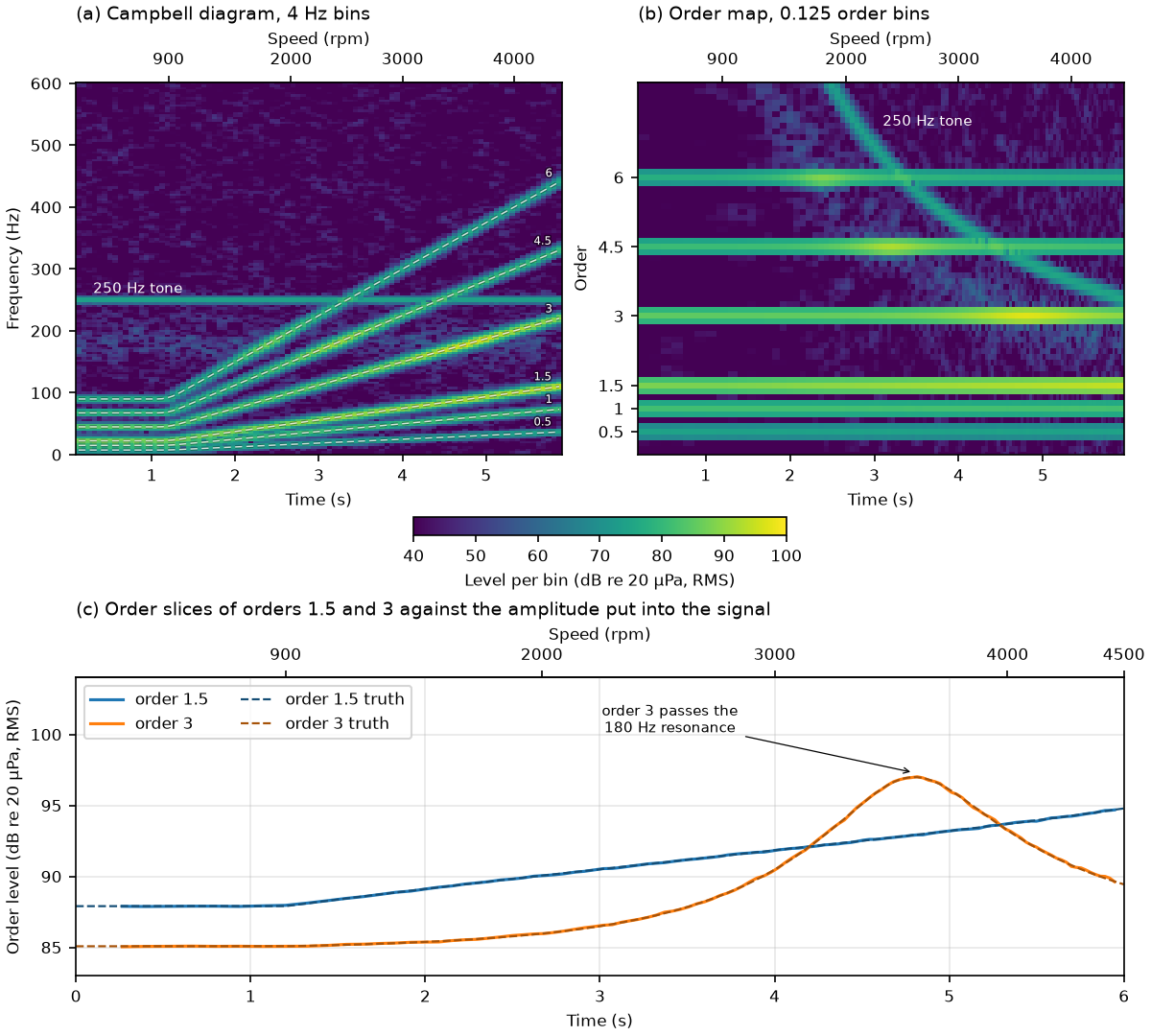
Campbell diagram and order map of a run-up from idle (half orders, a 180 Hz resonance, a fixed 250 Hz tone, noise), and two order slices against the amplitude put into the signal (examples/01_order_map.py).
Conventions
- Units. Time in s, sampling rate and frequency in Hz, rotational speed in rev/min (rpm), shaft angle in revolutions, order in cycles per revolution, vehicle speed in km/h.
- Arrays. Signals have shape
(n,)or(n, ch). Every operator acts on each channel independently and linearly, so amplitude and phase relations between channels are preserved. - Amplitude. Peak or RMS is always stated in the docstring and, where there is a choice, selected by an explicit
amplitudeargument ("peak"or"rms"). - No hidden constants. Gains, calibration factors and reference pressures are passed explicitly. They are never built into a function.
- Randomness. Every random process takes a
numpy.random.Generatoror an integer seed. - Estimators. Functions that estimate quantities (speed, order amplitude) are meant to return a confidence and to report when a search boundary was reached.
Design principles
- Independent implementation: algorithms follow public literature only (see Independence statement).
- Verifiable: each function is tested on synthetic signals with known analytic ground truth.
- Transparent: docstrings give the literature, the amplitude definition and the units.
- Plain Python: snake_case functions, NumPy arrays as input and output, computation separate from plotting.
- Interoperable: results can be passed on to open-source psychoacoustic tools such as SQAT and MoSQITo. ROTA does not depend on them.
- Multichannel first: operators are linear per channel (see Conventions).
- Reproducible: seedable randomness, and planned JSON sidecar files recording the parameters of each resynthesis.
- No hidden constants.
Validation
Analytic ground truth from rota.synth is the first reference: every test signal comes with its true speed, shaft angle, and amplitude and phase of each order. Where a public implementation elsewhere exists, a black-box comparison with explicit parameters is planned as a second reference, comparing physical quantities (speed curves, order amplitudes along a ridge), not map cells; when the two disagree, the analytic truth decides. This comparison has not been run yet: every result reported so far is against the analytic truth only. Resynthesis is tested by round trip: synthesise, analyse, compare with the input table. Continuous integration runs pytest only.
The design document defines 14 validation signals (T1 to T14). Version 0.1 covers T1 (single order, constant amplitude, linear run-up), T2 (several orders, a fixed-frequency resonance, noise), T5 (multi-pulse tachometer with jitter and dropped pulses) and T14 (low-speed start from idle with orders half an order apart). Version 0.2 adds T3 (exponential run-down), T4 (crossing orders on two shafts), T6 (fast run-up), T8 (twin shafts 0.5–4 % apart), T10 (true speed outside the search range), T12 (order removal) and T13 (extraction error versus speed-reference error). Version 0.3 adds T9 (order table → synthesis → analysis → table round trip, tests/test_ordertable.py) and T11 (broadband synthesis: PSD accuracy and no frame-rate pumping, tests/test_broadband.py). Cases and measured results: validation/README.md.
Tolerances (the analytic column is enforced by the test suite; the black-box column is the target for the planned comparison):
| Quantity | Against analytic truth | Against black-box reference (planned) |
|---|---|---|
| Speed, median relative error | <= 0.1 % | <= 0.1 % |
| Tacholess speed, fraction of frames within 3 % (steady or slowly rising) | >= 90 % | within 5 percentage points |
| Order amplitude, stationary segments | <= 0.2 dB | <= 0.5 dB |
| Order amplitude near a resonance | <= 1 dB | <= 1 dB |
| Order waveform correlation (edges removed) | >= 0.99 | >= 0.99 |
| Vold-Kalman -3 dB bandwidth | within 5 % of the set value | within 5 % |
| Order-table round trip, amplitude (T9) | <= 0.2 dB | not compared |
| Remaining energy of a removed order in the residual (T12) | <= -20 dB | not compared |
| Frame-rate pumping of broadband synthesis (T11) | <= 1 dB | not compared |
All rows of the analytic column are met by the current release; measured values are in validation/README.md.
Independence statement
ROTA is an independent academic project. It is not affiliated with, endorsed by, or supported by MathWorks or any commercial software vendor. MATLAB is a registered trademark of The MathWorks, Inc.
All algorithms are implemented from the published literature cited in each docstring, and ROTA reads no proprietary file formats.
License
ROTA is free software: you can redistribute it and/or modify it under the terms of the GNU General Public License as published by the Free Software Foundation, either version 3 of the License, or (at your option) any later version. See LICENSE.
Citation
See CITATION.cff (GitHub shows it as "Cite this repository"). A Zenodo DOI is planned for v1.0.
Acknowledgements
ROTA is designed, implemented and maintained by Zhenxian Li. Claude (Anthropic) was used as an assistant during development.
1 maintainer

Metadata
1 maintainer
Release files for rota-order 0.3.0
For a detailed explanation of source distributions (sdists) and built distributions (wheels), please see the package formats documentation.
Source distribution (sdist)
| File | Size | Uploaded | Provenance | Actions |
|---|---|---|---|---|
| rota_order-0.3.0.tar.gz | 277.1 kB | With provenance | Details for rota_order-0.3.0.tar.gz |
Built distribution (wheel)
| File | Interpreter | ABI | Platform | Actions Reset |
|---|---|---|---|---|
| rota_order-0.3.0-py3-none-any.whl | Python 3 | none | any | Details for rota_order-0.3.0-py3-none-any.whl |
Total release size: 433.5 kB
Release files / rota_order-0.3.0.tar.gz
| Download URL | rota_order-0.3.0.tar.gz |
|---|---|
| Size | 277.1 kB |
| Tags | Source |
|
SHA-256 checksum How to use checksums |
459689a22356d31972ab46d3ac4da56ae20dec75c5dc450ceff05811fdeca5a2
|
|
BLAKE2b-256 checksum How to use checksums |
b04f1d60f51af0e2964cf1b1af23729f0688fb80449cde5a814cbb475de1757b
|
| Upload date | |
|
Uploaded using Trusted Publishing? What is trusted publishing? |
Yes |
| Uploaded via |
twine/7.0.0 CPython/3.13.16
|
Provenance
Provenance describes where a file came from. On PyPI, provenance is shared via attestations, which provide a verifiable record of the build or publishing details. View details, limitations and caveats.


PyPI Publish Attestation
PyPI verified that this artifact, at this checksum, originated from the publisher listed below.
Signed by GitHub Actions, verified by PyPI on Oct 26, 2026.
Transparency logRelease files / rota_order-0.3.0-py3-none-any.whl
| Download URL | rota_order-0.3.0-py3-none-any.whl |
|---|---|
| Size | 156.3 kB |
| Tags | Python 3 |
|
SHA-256 checksum How to use checksums |
9670cfa1b920f3a492a03145c75916c269a81b6c35c29a56c05e031f57bcc348
|
|
BLAKE2b-256 checksum How to use checksums |
43eecb584b2670ee9bf4c413c874ba44ef176a8d3981e49c19be213f3f9e804d
|
| Upload date | |
|
Uploaded using Trusted Publishing? What is trusted publishing? |
Yes |
| Uploaded via |
twine/7.0.0 CPython/3.13.16
|
Provenance
Provenance describes where a file came from. On PyPI, provenance is shared via attestations, which provide a verifiable record of the build or publishing details. View details, limitations and caveats.
PyPI Publish Attestation
PyPI verified that this artifact, at this checksum, originated from the publisher listed below.
Signed by GitHub Actions, verified by PyPI on Oct 26, 2026.
Transparency logSecurity for rota-order 0.3.0
Provenance
Provenance describes where a file came from. On PyPI, provenance is shared via attestations, which provide a verifiable record of the build or publishing details. View details, limitations and caveats.
Full provenance
All 2 files in this release have been uploaded with provenance metadata.
Attestation for rota_order-0.3.0.tar.gz
PyPI Publish Attestation
PyPI verified that this artifact, at this checksum, originated from the publisher listed below.
Signed by GitHub Actions, verified by PyPI on Oct 26, 2026.
Transparency logA note on package security
PyPI is a repository for distributing packages, not a service for auditing them. While third-party security researchers and our staff do their best to detect and remove malicious packages, PyPI cannot guarantee the quality, security or suitability of any given package.
To learn more about protecting yourself from malicious actors, visit our package security documentation.














