
MCP Server for AI-powered RTL diagram generation

Project description
RTLViz - AI-Powered RTL Diagram Generator
⚠️ RtlViz can make mistakes, so double-check it.
An MCP (Model Context Protocol) server that enables AI assistants to generate publication-quality RTL block diagrams from Verilog/SystemVerilog code.
Installation
pip install rtlviz
rtlviz-setup
That's it! The setup command auto-configures your AI IDE (Claude Desktop or VS Code).
Manual Setup (Alternative)
If auto-setup doesn't work for your IDE, configure manually:
Claude Desktop — claude_desktop_config.json
Windows: %APPDATA%\Claude\claude_desktop_config.json
macOS: ~/Library/Application Support/Claude/claude_desktop_config.json
Linux: ~/.config/claude/claude_desktop_config.json
{
  "mcpServers": {
    "rtlviz": {
      "command": "rtlviz-server"
    }
  }
}
Claude Code (VS Code Extension) — ~/.claude/settings.json
{
  "mcpServers": {
    "rtlviz": {
      "command": "rtlviz-server"
    }
  }
}
VS Code Copilot — .vscode/mcp.json
{
  "servers": {
    "rtlviz": {
      "command": "rtlviz-server"
    }
  }
}
Cursor — ~/.cursor/mcp.json
{
  "mcpServers": {
    "rtlviz": {
      "command": "rtlviz-server"
    }
  }
}
Windsurf — ~/.codeium/windsurf/mcp_config.json
{
  "mcpServers": {
    "rtlviz": {
      "command": "rtlviz-server"
    }
  }
}
Quick Start Guide
Step 1: Install the Package
pip install rtlviz
Step 2: Run Setup
rtlviz-setup
This automatically configures RTLViz for all your AI IDEs (Claude Desktop, Claude Code, VS Code Copilot, Cursor, Windsurf).
Step 3: Ask Your AI to Generate a Diagram
Open your AI IDE and ask:
"use rtlviz to generate block diagram for [your-project-path]"

Step 4: Get Your Interactive Block Diagram
The AI analyzes your RTL code and generates a publication-quality block diagram:
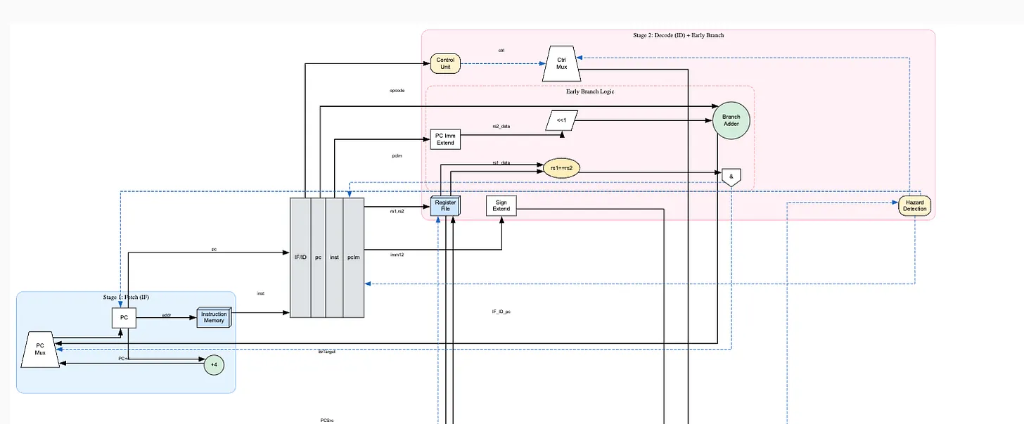
💡 Recommended: Works best with latest AI models like Claude Opus 4.5 or Claude Sonnet 4.5 for accurate RTL analysis.
How It Works
RTLViz uses the Model Context Protocol (MCP) to seamlessly integrate with your AI IDE:
- Local MCP Server — A lightweight server runs locally, exposing RTL analysis capabilities to your AI assistant
- Skill Injection — The AI dynamically loads the
rtlviz://promptresource, which contains expert RTL analysis heuristics - Semantic RTL Parsing — The AI performs deep analysis of your Verilog/SystemVerilog, tracing signal dependencies and identifying pipeline stages
- Graphviz DOT Generation — Architecture is encoded as DOT with semantic clustering, orthogonal routing, and component-specific styling
- Interactive Rendering — The
render_diagramtool generates a zoomable, pannable HTML5 viewer with Viz.js
Zero infrastructure. No API keys. 100% local execution.
Enterprise & Privacy
- Safe for Work: All RTL analysis happens locally or via your enterprise-approved LLM provider.
- Telemetry: We collect minimal, anonymous usage data (version, session ID) to improve the tool.
- No IP addresses or personal data.
- No file contents or code.
- Opt-Out: Set the environment variable
RTLVIZ_TELEMETRY=0to disable all network calls.- Firewall Friendly: If blocked, the tool fails silently and continues working.
Developing & Releasing
Analytics Setup
To enable your own analytics dashboard:
- Deploy
analytics/google_apps_script.jsas a Google Web App (Execute as Me, Access: Anyone). - Set
RTLVIZ_TELEMETRY_URLinsrc/rtlviz/telemetry.pyto your Web App URL.
Publishing to PyPI
- Bump Version: Update
pyproject.tomlandsrc/rtlviz/telemetry.py. - Build:
python -m build - Upload:
twine upload dist/*
Developers
- Naveen Venkat - naveenvenkat1711@gmail.com
- Hariharan - hari.ayyaps@gmail.com
License
MIT
Release history Release notifications | RSS feed


Download files
Download the file for your platform. If you're not sure which to choose, learn more about installing packages.
Source Distribution
Built Distribution
Filter files by name, interpreter, ABI, and platform.
If you're not sure about the file name format, learn more about wheel file names.
Copy a direct link to the current filters
File details
Details for the file rtlviz-0.2.8.tar.gz.
File metadata
- Download URL: rtlviz-0.2.8.tar.gz
- Upload date:
- Size: 194.5 kB
- Tags: Source
- Uploaded using Trusted Publishing? No
- Uploaded via: twine/6.2.0 CPython/3.12.8
File hashes
| Algorithm | Hash digest | |
|---|---|---|
| SHA256 |
5b52f240efb692d4418c329db72b9a67d11147ad7d0dfc0c43d216341aab4f8f
|
|
| MD5 |
b4437909eabb88f6052ec7727007816b
|
|
| BLAKE2b-256 |
85e7d8f549bdf9826cfe382398e431be66fadcc7fe889a1cc6feb0abf37ab9cd
|
File details
Details for the file rtlviz-0.2.8-py3-none-any.whl.
File metadata
- Download URL: rtlviz-0.2.8-py3-none-any.whl
- Upload date:
- Size: 14.9 kB
- Tags: Python 3
- Uploaded using Trusted Publishing? No
- Uploaded via: twine/6.2.0 CPython/3.12.8
File hashes
| Algorithm | Hash digest | |
|---|---|---|
| SHA256 |
981545fa61888f275c8b3d389ef7694f47d506d0d2265972cc53c4e5803660f3
|
|
| MD5 |
224ec9c276cfcc4723ff8dcfecfde9d9
|
|
| BLAKE2b-256 |
01deb25192bce02ec2f1a8177bf9e46ac95367dc2d04d50df32e753fe5373941
|






