
rumblex

Transcription with word timestamps, speaker labels and subtitles, built on Reson8/Rumble-2-Flash.
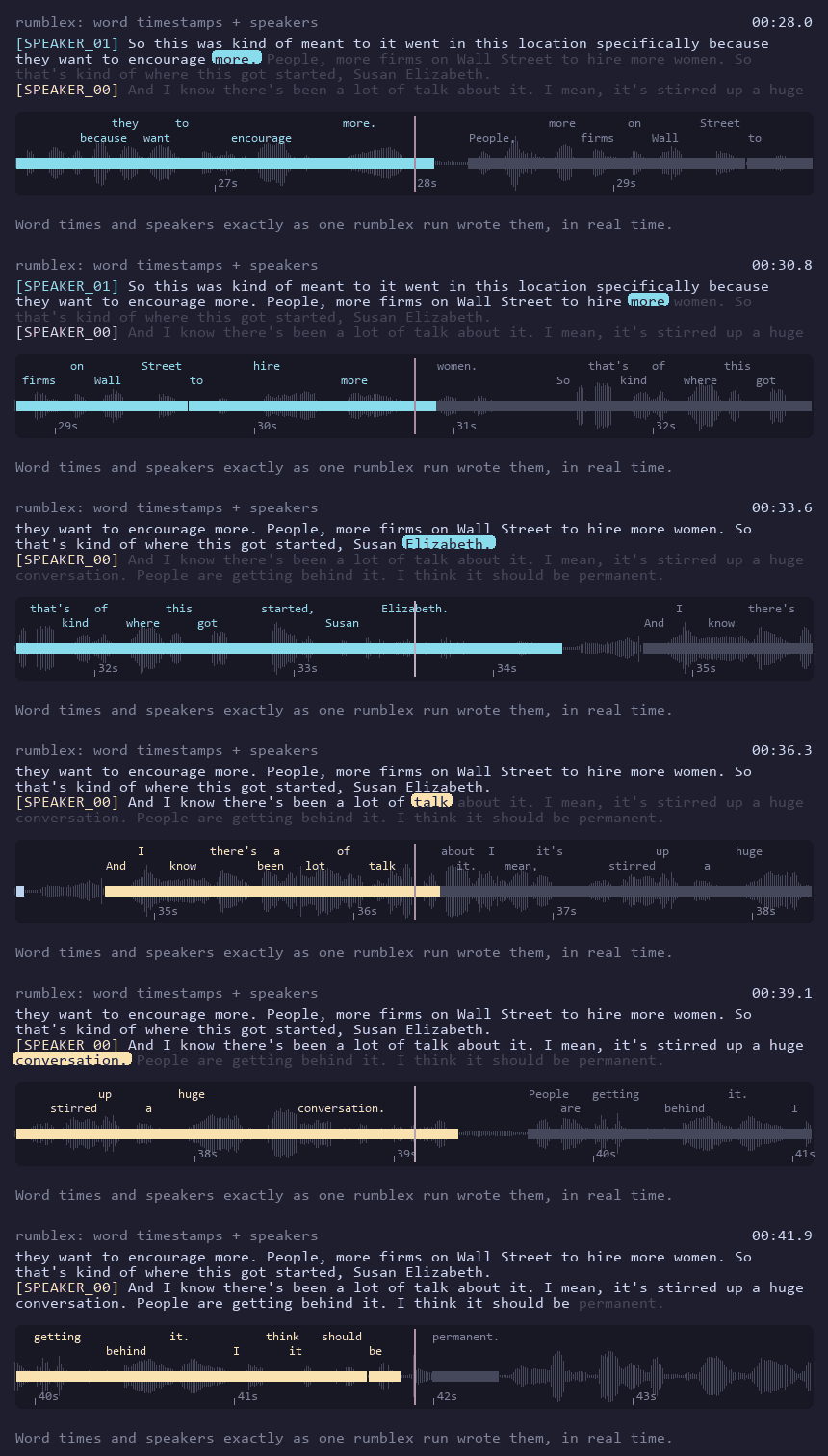
Rumble-2-Flash has a CTC head next to its decoder. rumblex uses it for word timestamps: the decoder writes the text and the CTC head aligns it to the audio, reusing the encoder pass that already ran. So alignment is one linear layer and a Viterbi search, not a second model.
The model is a 0.5B fine-tune of Qwen3-ASR-0.6B. Its card lists 45 languages; I've benchmarked 13 of them (below). You can try it in the browser with the demo Space.
Independent project, not affiliated with Reson8.
Features
- Any input ffmpeg reads. Long files are split into speech chunks with Silero VAD.
- Batched transcription; a chunk's output doesn't depend on what it's batched with. Exposes the model's
language,prompt(hotwords),digits,fillerandverbatimoptions. - Word timestamps from the CTC head. If alignment fails on a chunk, its words get proportional times.
- Two per-word confidences:
probability, the decoder's (exp of the mean log-prob of the word's tokens), andscore, the CTC head's (the lowest of its tokens' peak probabilities).probabilityis the better of the two at telling wrong words from right ones (eval); it is empty for--textand for words with proportional times. - Alignment of a transcript you already have (
--text,rumblex.align): no decoding, only the encoder and the CTC head. - Optional per-word speaker labels via pyannote.
- JSON, SRT, VTT (optionally with karaoke tags), TSV and TXT.
Install
pip install rumblex
pip install "rumblex[diarize]"   # with speaker labels
Needs Python 3.11 or 3.12 and ffmpeg on PATH. On Windows, PyPI's torch is CPU-only, so for a GPU install
torch and torchaudio from pytorch.org first. Ampere and newer
run in bf16, older GPUs in float32 (a 6 GB GTX 1060 works at the default batch size). CPU works but is slow.
From source, git clone https://github.com/EdwardGlockner/rumblex && cd rumblex && uv sync (add
--extra diarize for speaker labels). The lock file pins CUDA 12.6 wheels, which still support Pascal; for
RTX 50-series install torch yourself and use pip install -e ..
Use
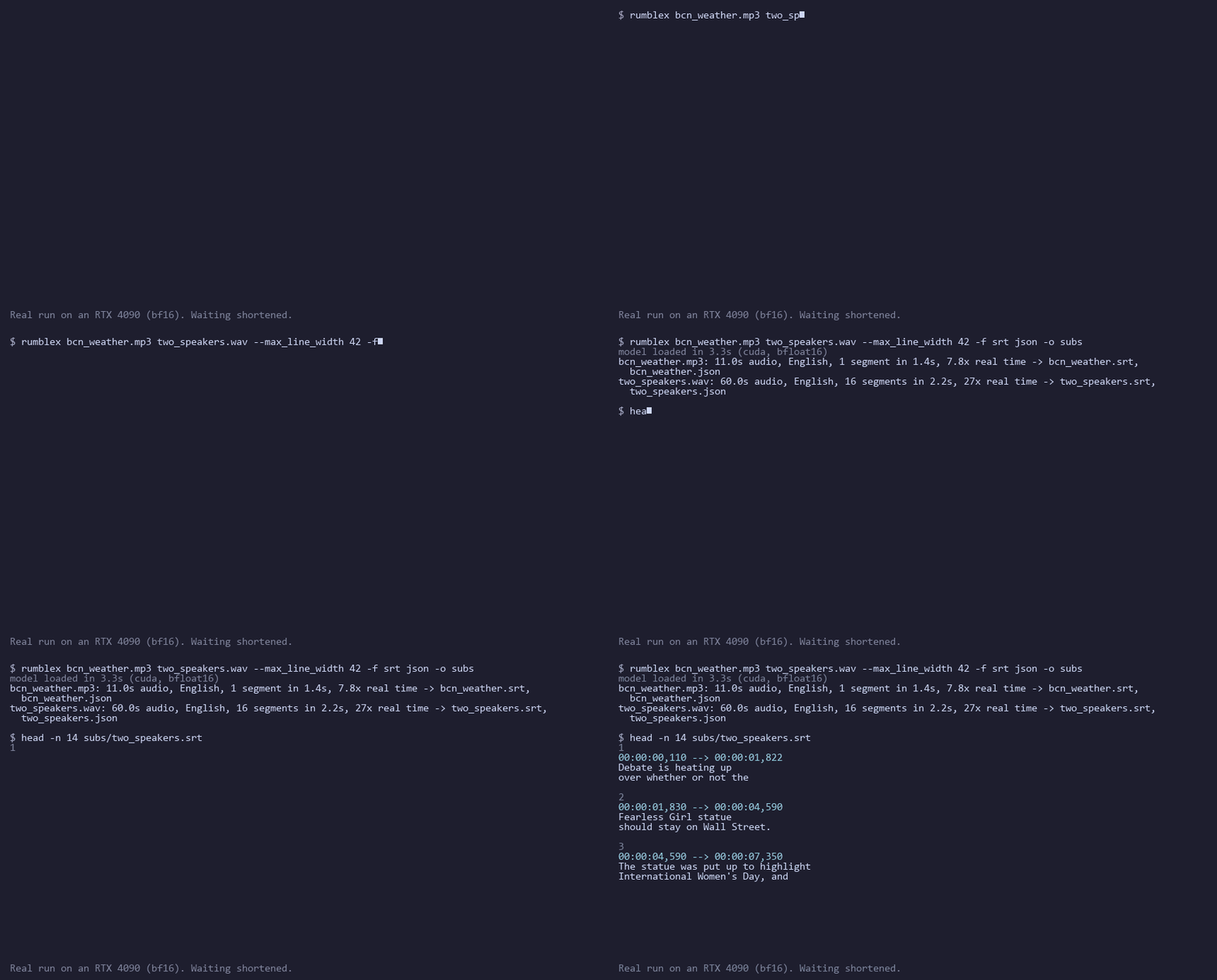
rumblex meeting.mp4                                   # all formats into the current folder
rumblex talk.wav -f srt vtt --max_line_width 42
rumblex interview.m4a --language Dutch --diarize -f srt txt
rumblex call.wav --prompt "Kubernetes, metoprolol"   # hotwords
rumblex lecture.mp3 --text lecture.txt               # word times for your own transcript
import rumblex

model = rumblex.load_model()
result = rumblex.transcribe("meeting.mp4", model)
for seg in result.segments:
    print(seg.start, seg.end, seg.text)
rumblex.write_result(result, "meeting.mp4", "out/", ["srt", "json"])

text = open("lecture.txt", encoding="utf-8").read()
result = rumblex.align("lecture.mp3", text, model)  # no transcribing
More in examples/.
vLLM. On Linux, decoding can run on a vLLM server (pip install "rumblex[vllm]"):
vllm serve Reson8/Rumble-2-Flash --max-model-len 4096 --gpu-memory-utilization 0.5
rumblex meeting.mp4 --vllm_url http://localhost:8000/v1
Alignment still runs the encoder locally, so leave some GPU memory free. On LibriSpeech this went from 467× to 601× real time with the same WER (run).
Speaker labels. Accept the conditions on
pyannote/speaker-diarization-community-1
and run hf auth login. rumblex turns off pyannote's telemetry unless you set
PYANNOTE_METRICS_ENABLED=true.
Compared with WhisperX
Same audio, one RTX 4090, one session, rumblex 0.1.0 (bf16, batch 32) vs WhisperX 3.8.6 with large-v3
(float16, batch 16, default aligners). Language given to both, Whisper's normalisers for WER. Speed is one
20–60 min file per dataset, models already loaded. Details and raw results:
docs/bench_2026-11-20_rtx4090_release.
| dataset | rumblex WER | WhisperX WER | rumblex speed | WhisperX speed |
|---|---|---|---|---|
| AMI meetings (500 utt.) | 10.9% | 17.2% | 329× real time | 104× |
| Earnings-22 calls (500 utt.) | 9.3% | 10.6% | 430× | 102× |
| LibriSpeech test-clean (200 utt.) | 2.2% | 1.6% | 467× | 92× |
| FLEURS Dutch (364 utt.) | 9.2% | 7.0% | 380× | 79× |
rumblex is 3–5× faster, mostly because alignment reuses the encoder (0.3–0.9 s per file vs 7–17 s for WhisperX). It wins WER on meetings and calls, mostly through fewer deleted words; WhisperX wins on clean English and Dutch. rumblex passes clips up to 20 s whole while WhisperX runs VAD on everything, which may flatter rumblex on these short clips. A few hundred utterances per set, so treat it as rough.
Languages
FLEURS (read speech), 350 utterances per language, same settings as above on another RTX 4090 pod (run). WER is scored with the Open ASR Leaderboard's normaliser, as on the model card; the run also has it with Whisper's normalisers. Speed is the ratio of the two systems on a 20-minute file per language, since that pod was slower overall than the one above.
| language | rumblex WER | WhisperX WER | rumblex faster by |
|---|---|---|---|
| German | 5.0% | 3.3% | 3.7× |
| Spanish | 3.1% | 3.4% | 3.2× |
| French | 5.5% | 5.6% | 3.1× |
| Italian | 2.3% | 1.8% | 3.2× |
| Portuguese | 4.0% | 3.3% | 3.0× |
| Dutch | 6.2% | 4.5% | 3.1× |
| Swedish | 10.8% | 5.8% | 3.7× |
| Polish | 7.0% | 4.1% | 3.1× |
| Russian | 6.7% | 4.6% | 2.7× |
| Turkish | 6.3% | 3.8% | 3.4× |
| Arabic | 19.1% | 14.7% | 3.4× |
| Hindi | 12.6% | 26.5% | 1.9× |
WhisperX large-v3 has the lower WER in most of these; rumblex is level on Spanish and French and well ahead on Hindi. English FLEURS (Whisper's normaliser) was 6.3% vs 5.2%. Word timestamps came from the CTC head in all but 1 of 4,288 chunks outside Hindi; for Hindi see Limitations.
Timestamp accuracy
200 LibriSpeech utterances against Montreal Forced Aligner references (another aligner, not human labels), with the current aligner (run, settings chosen on dev-clean in docs/alignment_eval.md).
| mean absolute error | rumblex | WhisperX |
|---|---|---|
| word start | 53 ms | 75 ms |
| word end | 58 ms | 34 ms |
The encoder runs at 13 frames per second against WhisperX's 20 ms aligner, which shows in the ends. rumblex pulls each word end back to where the audio goes quiet, and since 0.1.1 penalises the blank before Viterbi, which took starts from 58 to 53 ms.
How it works
- ffmpeg decodes to 16 kHz mono.
- Silero VAD packs speech into chunks of up to 20 s (shorter files go in whole).
- Rumble-2-Flash transcribes the chunks in batches; a hook keeps the encoder states (13 frames/s).
- The CTC head and Viterbi align the decoder's tokens to those states, grouped into words at spaces.
- Optionally, pyannote labels speakers and each word gets the speaker it overlaps most.
- Writers produce the output files.
Model details: docs/model_inspection.md.
Limitations
- Timing resolution is limited to 13 frames/s; word ends are less precise than WhisperX's.
- Chunks are decoded independently, so a sentence crossing a chunk boundary can be broken there.
- Words split at spaces, so Chinese and Japanese get one "word" per chunk.
- WhisperX large-v3 had lower WER on clean English and on FLEURS in most languages measured (13 so far, all read speech except the English meeting and call sets).
- Hindi word times are less reliable: Hindi text runs to about 10 tokens per second of audio against the encoder's 13 frames, so in fast speech the CTC path doesn't fit and 30 of 360 chunks fell back to proportional times.
- With
--text, text without punctuation gets word ends about 10 ms earlier on average than the model's own punctuated output (docs/align_text_eval.md). - vLLM needs Linux and a GPU vLLM supports.
Development
uv sync --extra dev
uv run pytest
uv run ruff check . && uv run ruff format --check .
Benchmark scripts are in scripts/README.md, and every number above links to its raw results (docs/README.md).
License
Apache-2.0, like Rumble-2-Flash. The pyannote models have their own terms.
1 maintainer

Metadata
1 maintainer
Release files for rumblex 0.3.0
For a detailed explanation of source distributions (sdists) and built distributions (wheels), please see the package formats documentation.
Source distribution (sdist)
| File | Size | Uploaded | Provenance | Actions |
|---|---|---|---|---|
| rumblex-0.3.0.tar.gz | 78.8 kB | With provenance | Details for rumblex-0.3.0.tar.gz |
Built distribution (wheel)
| File | Interpreter | ABI | Platform | Actions Reset |
|---|---|---|---|---|
| rumblex-0.3.0-py3-none-any.whl | Python 3 | none | any | Details for rumblex-0.3.0-py3-none-any.whl |
Total release size: 138.1 kB
Release files / rumblex-0.3.0.tar.gz
| Download URL | rumblex-0.3.0.tar.gz |
|---|---|
| Size | 78.8 kB |
| Tags | Source |
|
SHA-256 checksum How to use checksums |
ec783f7cc9c77784b79c6b06b227655935d55663c9cf5bfcefe73c74f6737707
|
|
BLAKE2b-256 checksum How to use checksums |
8617fa7d42d0fbd331eb13a724a3cc65f42f77cd9bcf79735430ae9efa6e02e6
|
| Upload date | |
|
Uploaded using Trusted Publishing? What is trusted publishing? |
Yes |
| Uploaded via |
twine/7.0.0 CPython/3.13.16
|
Provenance
Provenance describes where a file came from. On PyPI, provenance is shared via attestations, which provide a verifiable record of the build or publishing details. View details, limitations and caveats.


PyPI Publish Attestation
PyPI verified that this artifact, at this checksum, originated from the publisher listed below.
Signed by GitHub Actions, verified by PyPI on Nov 23, 2026.
Transparency logRelease files / rumblex-0.3.0-py3-none-any.whl
| Download URL | rumblex-0.3.0-py3-none-any.whl |
|---|---|
| Size | 59.4 kB |
| Tags | Python 3 |
|
SHA-256 checksum How to use checksums |
fe2efce6b942e3961f5839a4af27920a05886e5403e7ba9ec5a77e5ed54af8aa
|
|
BLAKE2b-256 checksum How to use checksums |
ad85e7cbc9a7074f3c24d26a594b8c302c9bf230a5ab3a7c47f01e87f918096d
|
| Upload date | |
|
Uploaded using Trusted Publishing? What is trusted publishing? |
Yes |
| Uploaded via |
twine/7.0.0 CPython/3.13.16
|
Provenance
Provenance describes where a file came from. On PyPI, provenance is shared via attestations, which provide a verifiable record of the build or publishing details. View details, limitations and caveats.
PyPI Publish Attestation
PyPI verified that this artifact, at this checksum, originated from the publisher listed below.
Signed by GitHub Actions, verified by PyPI on Nov 23, 2026.
Transparency logSecurity for rumblex 0.3.0
Provenance
Provenance describes where a file came from. On PyPI, provenance is shared via attestations, which provide a verifiable record of the build or publishing details. View details, limitations and caveats.
Full provenance
Both files in this release have been uploaded with provenance metadata.
Attestation for rumblex-0.3.0.tar.gz
PyPI Publish Attestation
PyPI verified that this artifact, at this checksum, originated from the publisher listed below.
Signed by GitHub Actions, verified by PyPI on Nov 23, 2026.
Transparency logA note on package security
PyPI is a repository for distributing packages, not a service for auditing them. While third-party security researchers and our staff do their best to detect and remove malicious packages, PyPI cannot guarantee the quality, security or suitability of any given package.
To learn more about protecting yourself from malicious actors, visit our package security documentation.














