
rupaka
rupaka (रूपक) means a form, a play that the audience sees, and the figure of speech that shows one thing through another.
A rupaka demo is one interactive figure that teaches one idea. You write it as a JSON spec of small blocks: sliders, plots, 3D scenes, flows, and a gate that asks the learner to predict first.
Python checks the spec (validate), and a small runtime draws it in the browser with no network. A model can write a spec for you (author), because a spec cannot run code.
Install
uv add rupaka # or: pip install rupaka
The headless check (check) needs playwright: uv add "rupaka[check]". It uses the Chromium that playwright install chromium gives, or the browser in $FASTCDP_CHROME. It never runs your everyday Chrome.
A demo in one minute
Build the spec with the Python builders. You can also write the same thing as JSON.
from rupaka.spec import *
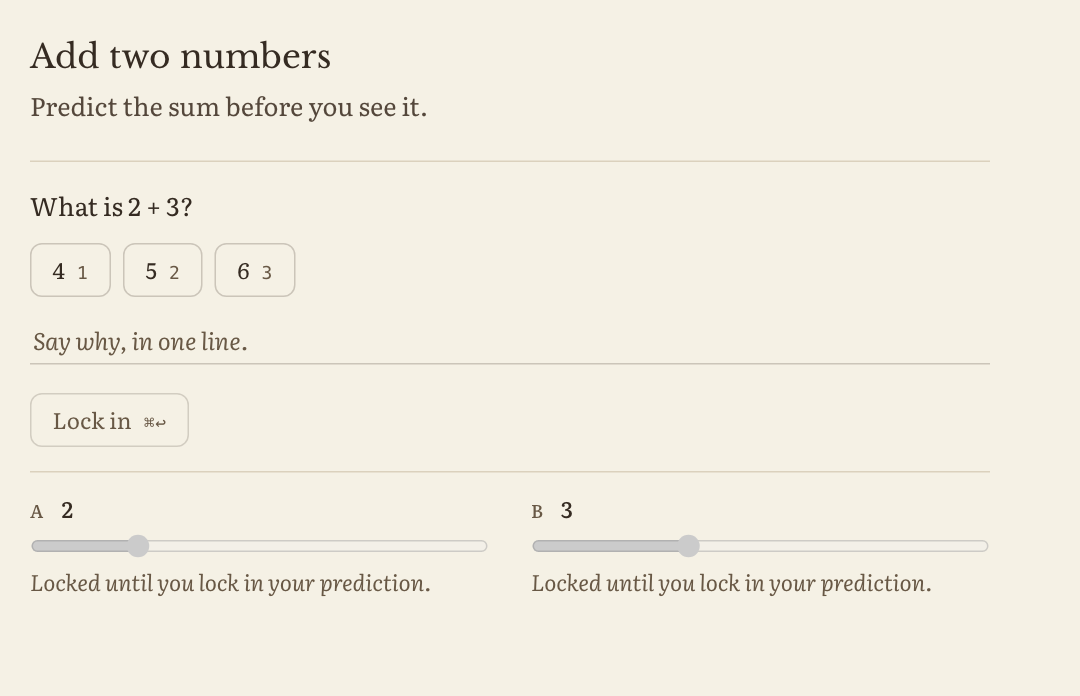
This demo asks for a sum. The answer and the sliders wait for the prediction.
d = demo('sum', 'Add two numbers', ask='Predict the sum before you see it.', state=dict(a=2, b=3), derive=[expr('a + b', 'sum')],
         blocks=[gate('s', 'What is {a} + {b}?', [4, 5, 6], 'sum', why='Say why, in one line.', context='For a = {a} and b = {b}:'),
                 readout('{a} + {b} = {sum}', after='s'),
                 row(slider('a', 'a', 0, 9, 1, lock='s'), slider('b', 'b', 0, 9, 1, lock='s'))])
validate gives the errors. An empty list means that the spec is good.
assert validate(d) == []
A readout that shows the sum before the gate breaks the think rule, so validate refuses it:
bad = {**d, 'blocks': [d['blocks'][0], readout('{a} + {b} = {sum}')]}
assert any('wait' in e or 'after' in e for e in validate(bad))
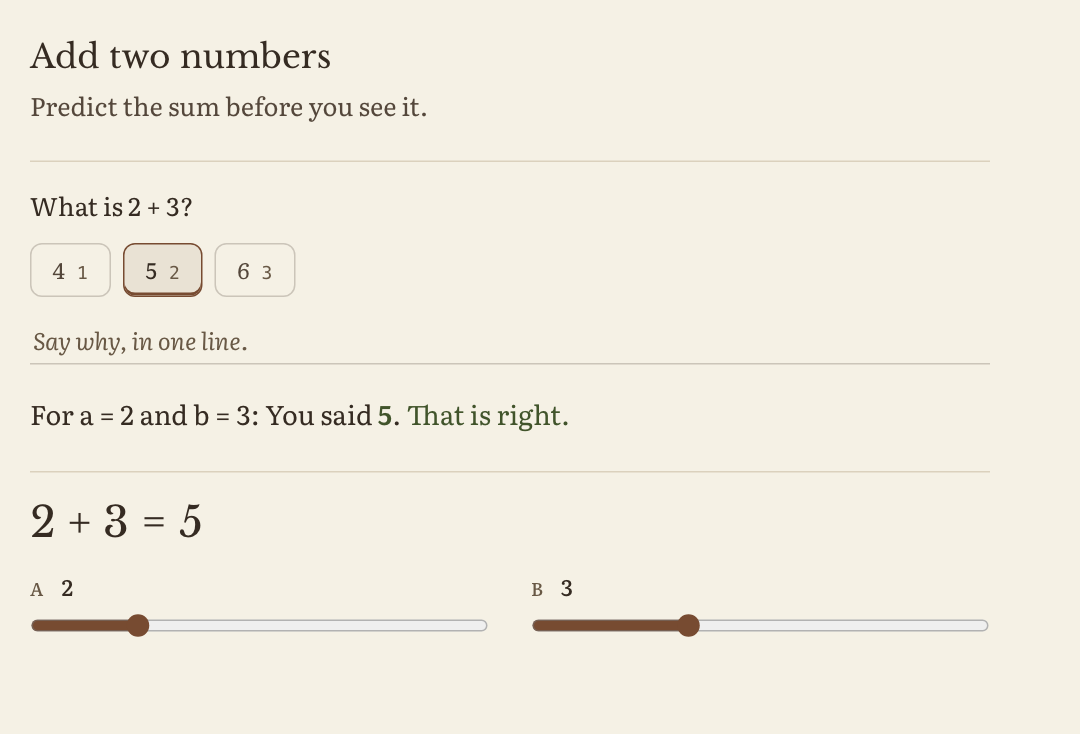
save(d, 'sum.html') writes one page that works from file://. Open it in a browser. Before the lock in, the sum is hidden. After it, the learner sees the result and can move the sliders:
| before the prediction | after the prediction |
|---|---|
 |
 |
The page functions are in rupaka.render:
from rupaka.render import *
page(d) gives the same page as a string:
assert '<script' in page(d)
More examples
Predict, then move a slider
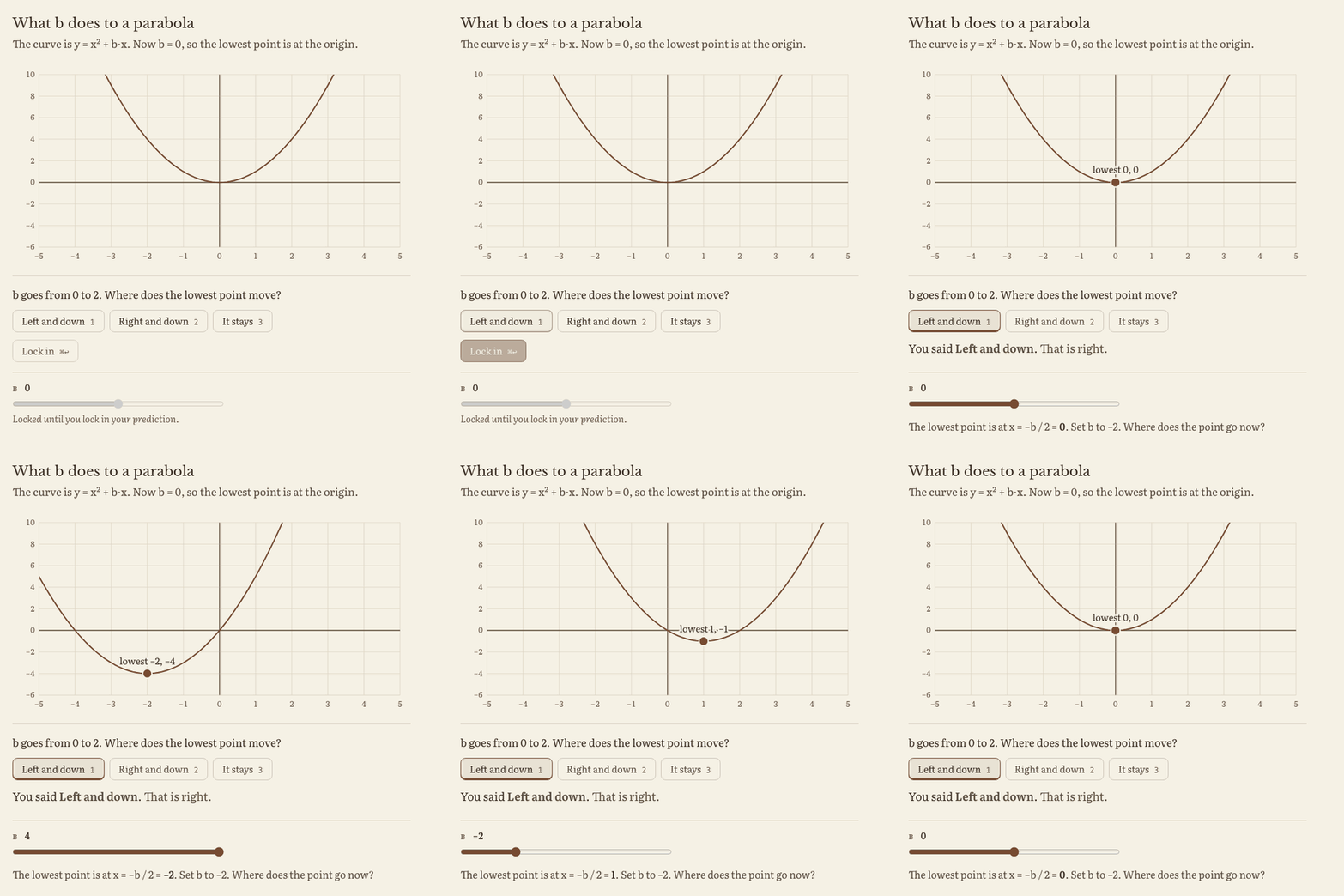
A plot of a curve. The lowest point and the caption wait for the gate, and the slider is locked until the lock in. The animation at the top of this page is this demo.
p = demo('parabola', 'What b does to a parabola', ask='The curve is y = x² + b·x. Now b = 0, so the lowest point is at the origin.',
         state=dict(b=0), derive=[expr('x^2 + b * x', 'curve', over=dict(x=[-5, 5, 101])), expr('-b / 2', 'vx'), expr('-(b^2) / 4', 'vy')],
         blocks=[axis([-5, 5], plot('curve'), point(x='vx', y='vy', label='lowest', after='move'), y=[-6, 10], height=300),
                 gate('move', 'b goes from 0 to 2. Where does the lowest point move?', ['Left and down', 'Right and down', 'It stays'],
                      is_('Left and down'), hides=['vx', 'vy']),
                 slider('b', 'b', -4, 4, 0.5, lock='move'),
                 caption('The lowest point is at x = −b / 2 = **{vx:2}**. Set b to −2. Where does the point go now?', after='move')])
assert validate(p) == []
A 3D scene
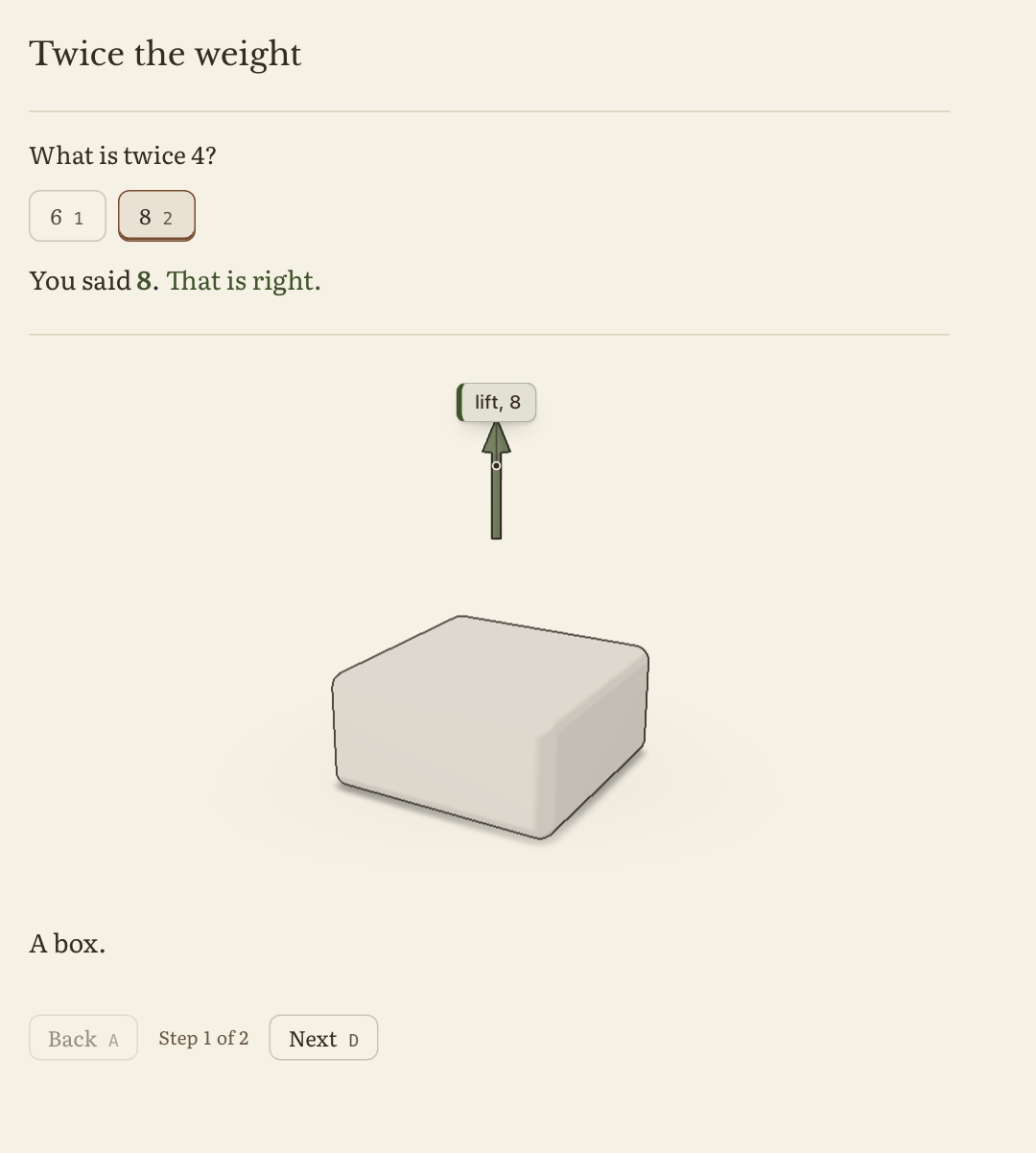
A scene holds bodies, forces, labels and camera shots. The force arrow shows the answer, so it waits for the gate.
s = demo('lift', 'Twice the weight', state=dict(step=1, cam='wide', w=4), derive=[expr('w * 2', 'up')],
         blocks=[gate('g', 'What is twice {w}?', [6, 8], 'up'),
                 scene(body('base', 'box', [2, 1, 2]), force([0, 1, 0], 'up', on='base', at=[0, 1.5, 0], label='lift, {up}', after='g'),
                       shot(bind='cam'), shot('close:base', step=2), bind='step', steps=['A box.', 'Look closer.'])])
assert validate(s) == []
A worked example and a flow
An explainer (mode='learn') has no gate. It builds one step at a time: the host moves on with Rupaka.set(el, {step: n}). A pair is one row of a worked example, and a flow is a few boxes with arrows.
page(panel, theme='paper') gives the paper look.
panel = demo('targets', 'Make a question and its answer', mode='learn', state=dict(step=1),
             blocks=[pair(['[18]'], '47', heads=['Input tensor', 'Target'], step=1), pair(['[18, 47]'], '56', step=2),
                     flow([dict(id='g', text='Guess'), dict(id='c', text='Compare'), dict(id='a', text='Adjust')], step=3)])
assert validate(panel) == []
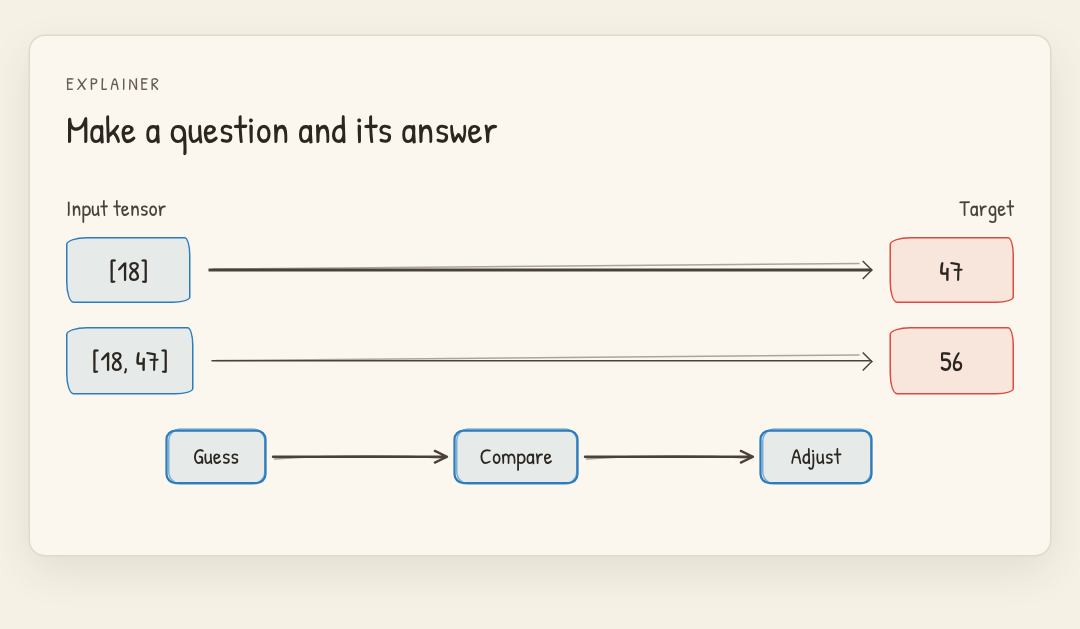
A board with a side panel
rupaka.board is the board of the screen guide. A model writes one JSON line for each mark: a step with a spoken line, marks on the page, and a side panel.
parse_board checks each line against what the page has. A bad line drops. The model never sends HTML or script.
from rupaka.board import parse_board, clean_context
The page tells the board its parts (anchors). Here it has one passage:
text = 'A search engine splits the query into words. It finds the pages that match and makes a ranked list. Then it shows the top results.'
ctx = clean_context(dict(anchors=[dict(id='p1', kind='passage', text=text)]))
Each step says one line, marks the passage and adds boxes to a flow in the side panel:
lines = """{"op": "step", "say": "First the engine splits the query into words."}
{"op": "underline", "at": {"a": "p1", "text": "splits the query into words"}}
{"op": "panel", "head": "How a search works"}
{"op": "node", "id": "q", "text": "Query"}
{"op": "node", "id": "w", "text": "Words"}
{"op": "edge", "from": "q", "to": "w"}
{"op": "step", "say": "Then it finds the pages that match and makes a ranked list."}
{"op": "circle", "at": {"a": "p1", "text": "ranked list"}}
{"op": "node", "id": "p", "text": "Pages that match"}
{"op": "edge", "from": "w", "to": "p"}
{"op": "node", "id": "r", "text": "Ranked list"}
{"op": "edge", "from": "p", "to": "r"}
{"op": "step", "say": "Last, it shows the top results."}
{"op": "box", "at": {"a": "p1", "text": "the top results"}}
{"op": "node", "id": "t", "text": "Top results"}
{"op": "edge", "from": "r", "to": "t"}"""
board = parse_board(lines, ctx)
assert len(board.steps) == 3 and not board.dropped
The page draws it with rupakaBoard.play(board), from the script rupaka.board.bundle('js') and the style bundle('css'):
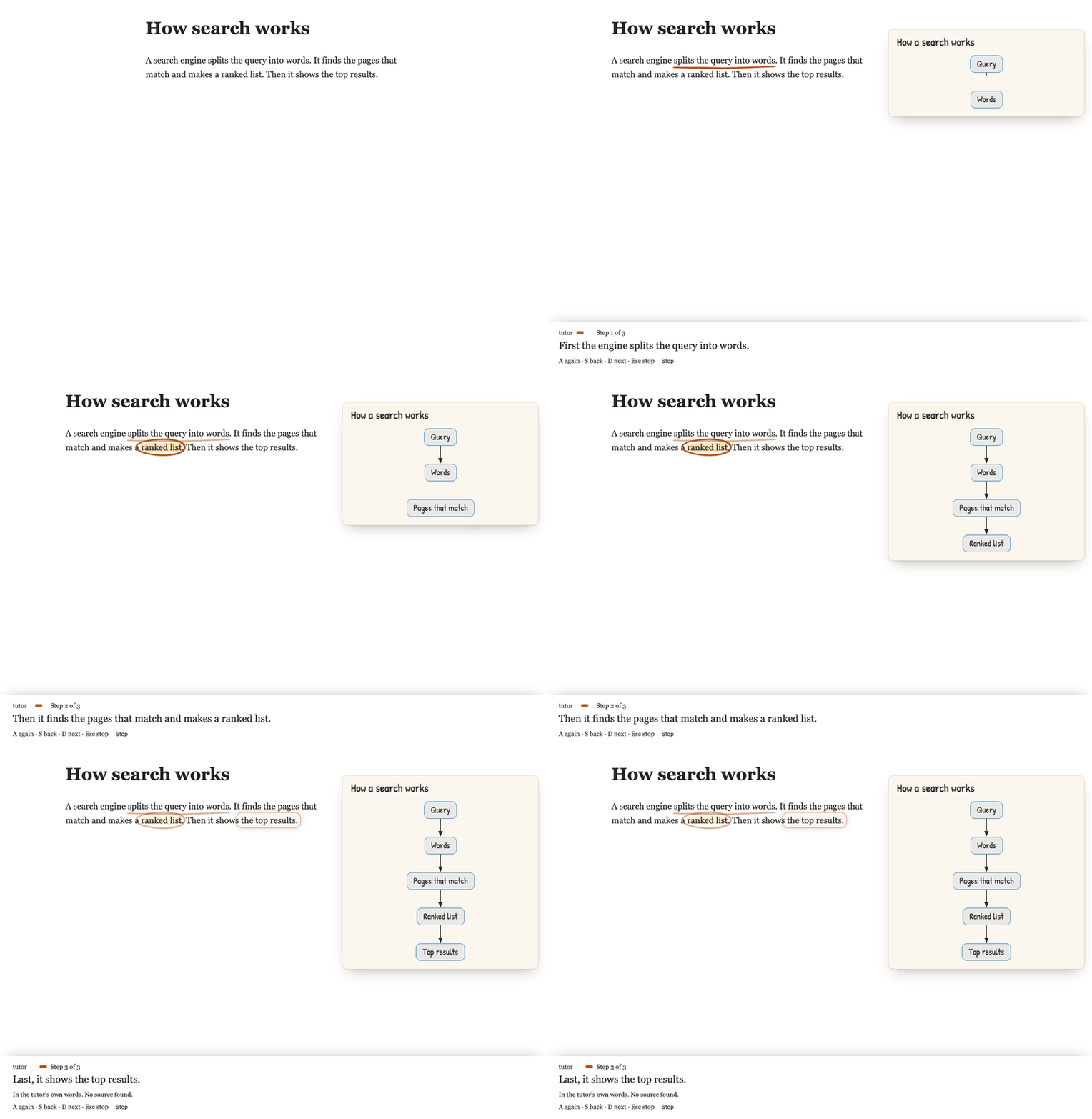
A panel can also be a table, a list, a faded example with blanks, a card of a wrong idea, or three stages (see the board docs).
Plain English
plain_why finds the parts of a text that are hard to read: long sentences, a reading grade over 9, semicolons, vague words and nicknames. It needs no model.
why = plain_why('The model, which was trained on a very large amount of text from many sources over many weeks, uses attention; it is good.')
assert any('semicolon' in w for w in why) and any('grade' in w for w in why)
plain_errors(spec) checks all the texts of a demo.
assert plain_errors(d) == []
Make a demo with a model
author(concept, ask) asks a model for a demo, then validates it, plays it in a headless browser and repairs it. ask(prompt, sp) is any function that sends a prompt and a system prompt to a model and gives back text. For example, with the rishi package:
from rishi import Chat, resp_text
from rupaka.agent import author
spec = author('compound interest', lambda p, sp: resp_text(Chat('claude/sonnet', sp=sp)(p)))
author gives a spec that passes all the checks, or None. See the agent docs for a live run.
Put a demo in a page
| where | how |
|---|---|
| a notebook (leela, Jupyter) | show(spec): an HTML output in a sandboxed frame, and the application/vnd.rupaka+json mime |
| Markdown | md(spec) writes a ```rupaka fence; md(spec, frame=True) writes a frame that leela draws today |
| a FastHTML page | Demo(spec) and Assets('/rupaka'); serve bundle('js') and bundle('css') at that prefix |
| a file | save(spec, 'demo.html') writes one page that works from file:// with no network |
check(spec) draws the demo in headless Chromium and plays it.
A FastHTML app serves the runtime at a prefix and puts the demo in a route:
from fasthtml.common import *
from rupaka.render import Demo, Assets, bundle

app, rt = fast_app(hdrs=Assets('/rupaka'))

@rt('/rupaka/{name}')
def get(name: str):
    kind = {'rupaka.js': 'js', 'rupaka.css': 'css', 'three.js': 'three'}[name]
    return Response(bundle(kind), media_type='text/css' if kind == 'css' else 'text/javascript')

@rt('/')
def index(): return Titled('Add two numbers', Demo(d))
A static site can use save(spec, 'demo.html'), or put host(spec) (a div with the spec in it) in a page that loads rupaka.js and rupaka.css.
The blocks
| block | what it does |
|---|---|
gate |
asks one question and hides the result until the learner locks in a prediction |
readout |
shows one large line from a template, for example {a} + {b} = {sum} |
caption |
explains the result after the reveal, and ends with a new question |
slider, toggle, choice |
change a number, turn a thing on or off, pick one case |
wheel, ranklist |
pick one item on a ring; drag rows to change an order |
axis, plot, point |
axes with a curve or dots, and a dot that the learner can drag |
bars, grid, pixels |
bars of a list, a heatmap, a grey image of rows of numbers |
row, stack |
put blocks side by side, or one above the other as one group |
pair, flow |
one row of a worked example; a few boxes with arrows |
scene, body, force, label3d, shot |
a 3D view, its parts, its arrows, its labels and its cameras |
Each block has a manifest (rupaka/blocks/<name>/block.json) and an example. examples() gives the example of each block by name, and the spec docs have all the props.
The gallery
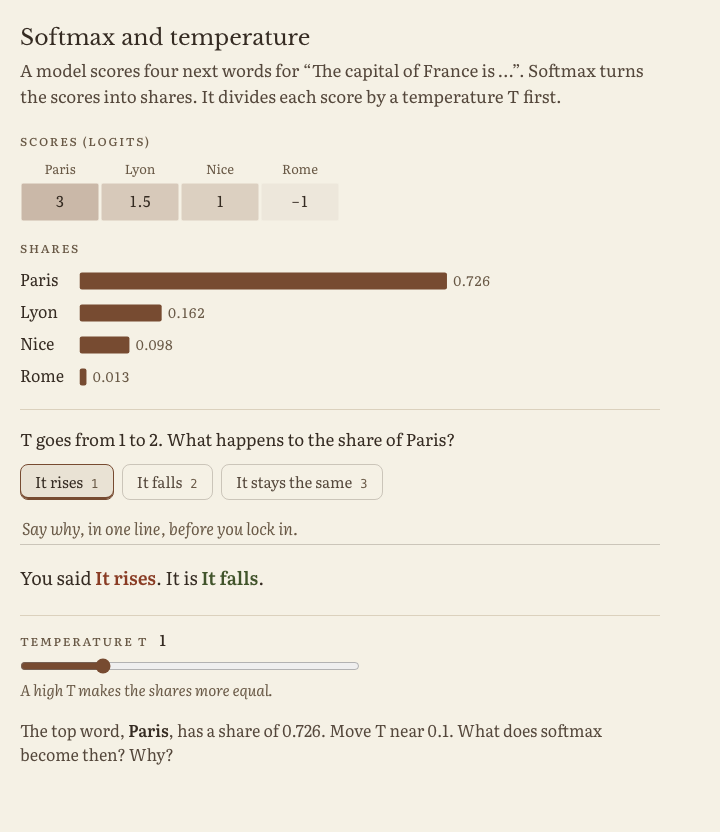
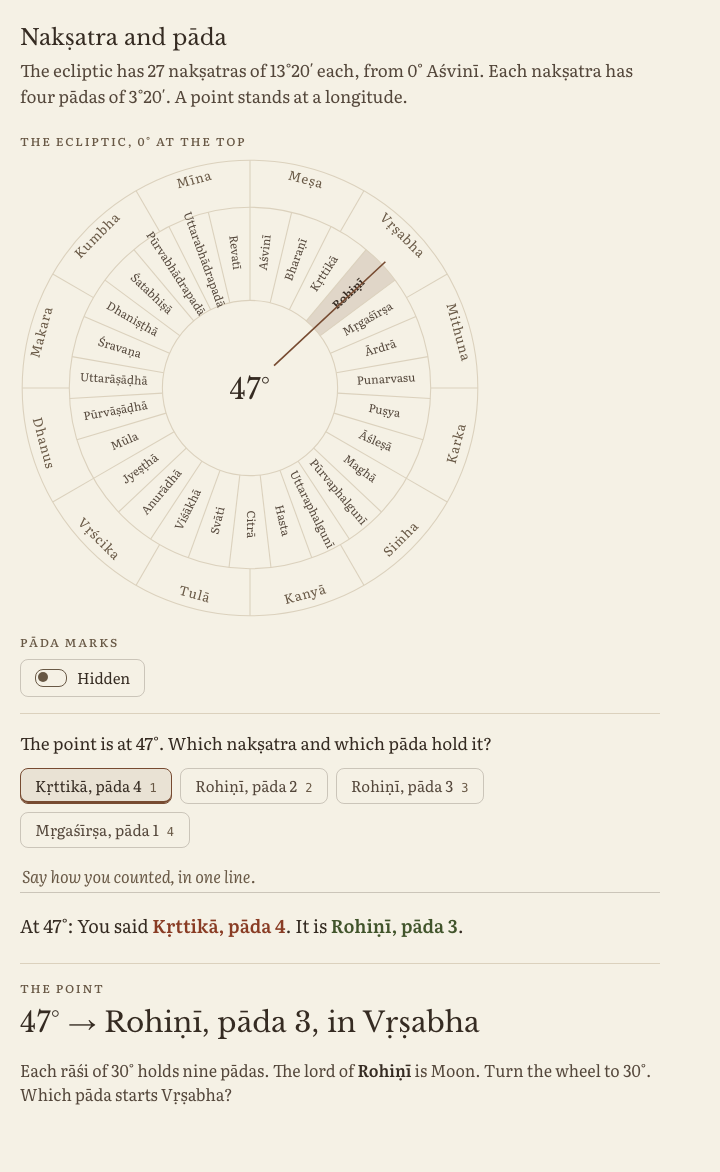
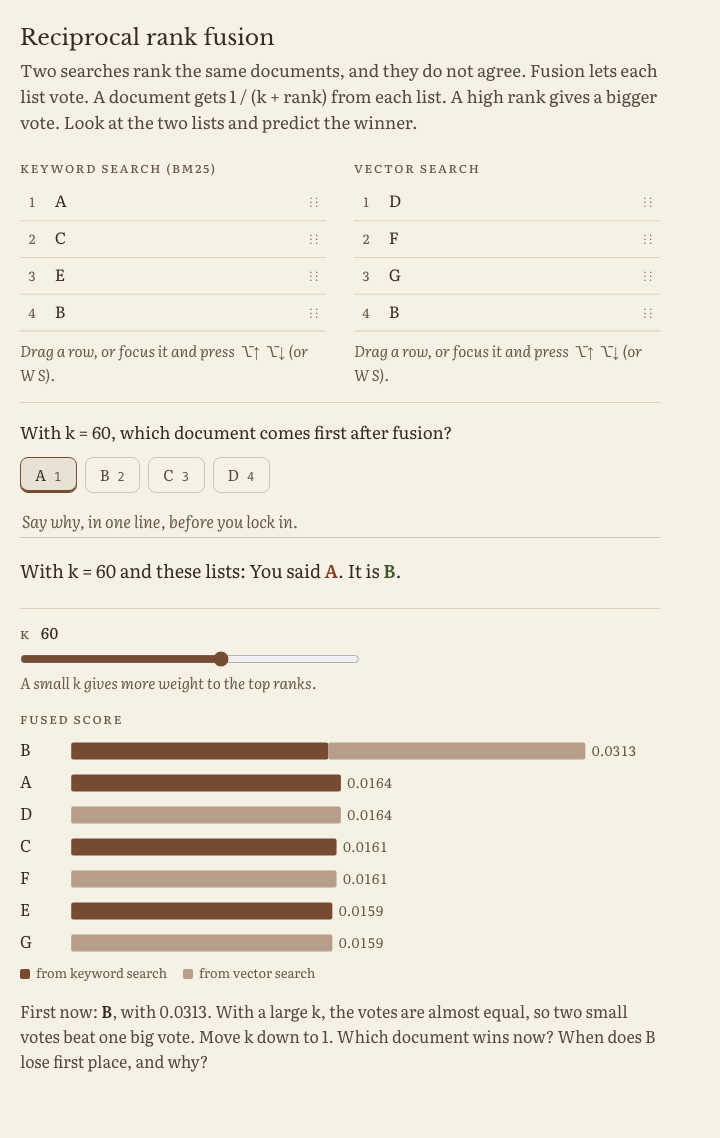
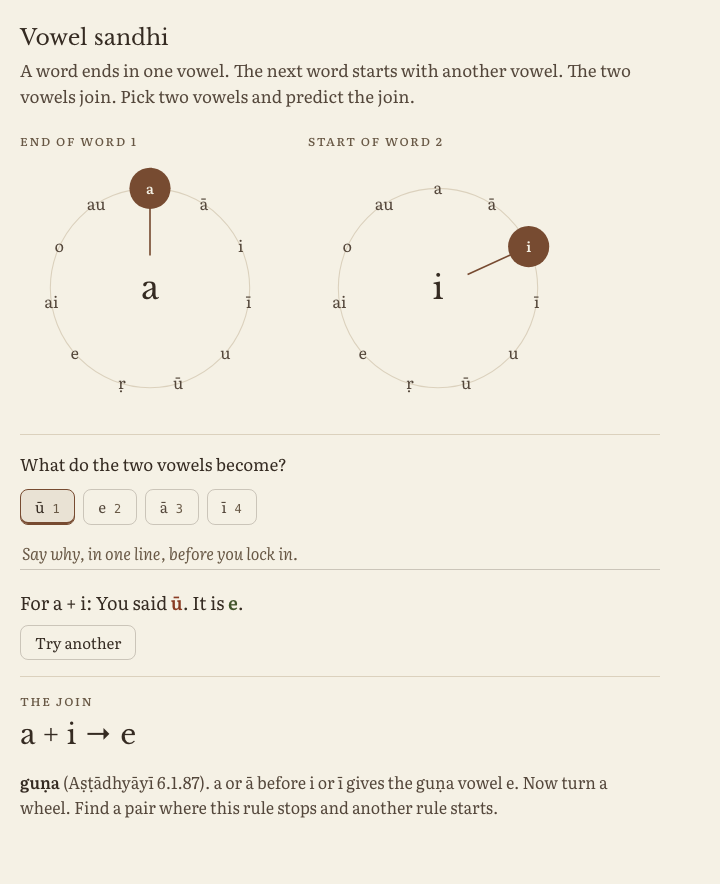
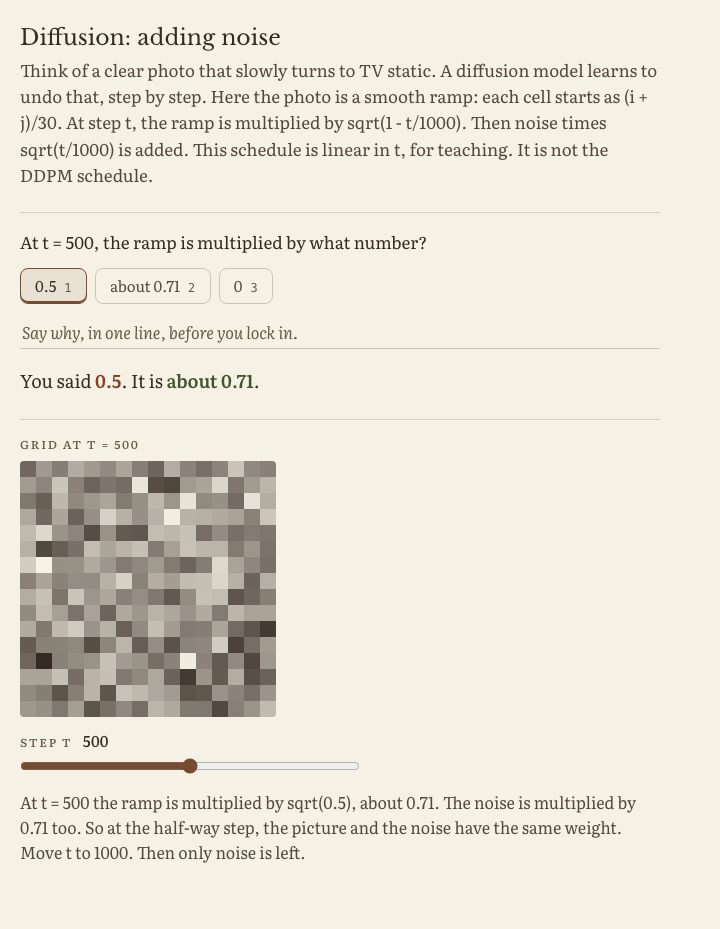
rupaka/demos/ holds hand-made demos: vowel sandhi, reciprocal rank fusion, softmax and temperature, nakṣatra and pāda, a parabola and diffusion noise. gallery() gives them by id, and the gallery page shows them.
| softmax and temperature | nakṣatra and pāda | reciprocal rank fusion |
|---|---|---|
 |
 |
 |
| vowel sandhi | diffusion noise |
|---|---|
 |
 |
More
How a demo teaches
A demo never shows the answer first. Each demo follows one loop:
- Predict. The demo shows the inputs and asks one question. The result is hidden.
- Reveal. The learner locks in with ⌘↩. The demo shows the result and says if the prediction was right.
- Manipulate. Now the controls are live. The result changes when the inputs change.
- Explain. The caption ends with a new question that the learner answers with the controls.
The validator enforces step 1: a block that shows a value which the answer depends on must wait for the gate.
An explainer is the one exception. It has "mode": "learn" and no gate, so it shows a thing at once (see Explainers below).
What a demo is
A demo is a JSON spec, not code. It has a small state, derived values from named functions (fns), and a list of blocks. A model can write a spec safely, because a spec cannot run code.
| part | what it is |
|---|---|
| block | a reusable UI part in rupaka/blocks/<name>/: its JS, its CSS, a block.json manifest and an example |
| fn | a pure function that computes a derived value: rules, rrf, softmax, lookup, expr, field, ids, pick, sort, fmt |
| gate | the block that asks for the prediction and hides the result until the lock in |
| spec | the JSON object: state, derive, blocks and tables, and a mode that is predict (the default) or learn |
The host API
A host page can read and change a demo that it mounted. In these calls, el is the element that holds the demo: the [data-rupaka] element, or the element that you gave to Rupaka.mount.
| call | what it does |
|---|---|
Rupaka.state(el) |
gives a copy of the input keys (the keys of spec.state) and their values |
Rupaka.set(el, state) |
sets the input keys that state has, then runs derive one time and draws one time. It ignores other keys. |
Rupaka.options(el, gate) |
gives the option values of the gate gate, in the order that the gate shows them. Each value is the value itself, not the text that the gate shows. The gate reads options from the state after derive, and this call does the same. An unknown gate gives null. |
Rupaka.settle(el, gate, pick, {answer}) |
closes the gate gate as if the learner picked pick. It draws the verdict and shows the blocks that wait for the gate. With pick null, the gate closes with no verdict. An unknown gate does nothing and gives false. The options object is optional. |
Rupaka.open(el, gate) |
opens the closed gate gate again, as the Try another button of the gate does. It removes the pick, the reason and the verdict, and hides the blocks that wait for the gate. It draws one time. It does not move the focus. A gate that is open does not change, and the call gives true. A gate that waits for the host to save a prediction does not open, and the call gives false. An unknown gate does nothing and gives false. |
Rupaka.mount(el, spec, {save}) |
calls save(state) after each change of an input key. state is the value that Rupaka.state(el) gives. |
Rupaka.append(el, block, {into}) |
adds one block at the end of the demo, or at the end of the stack or row at the path into, with no rebuild. The parts that show stay. It gives the path of the new block, for example 'blocks.3'. An unknown block type or a bad into throws an error. |
Rupaka.anchor(el, path) |
gives the element of the block or the part at path, or null. Each block has data-rk-id: its path in the spec, such as 'blocks.2'. A part adds to it: 'blocks.2.cells.0', 'blocks.2.to', 'blocks.3.nodes.1'. The element can be hidden, for example in a later step. |
Rupaka.set, Rupaka.settle and Rupaka.open never send rk-predict, never add to st.log and never call save. Rupaka.options only reads. A lock does not stop Rupaka.set. Each call throws an error when no demo is mounted in el.
To show one demo in two windows, mount the spec in each window. Send Rupaka.state of the first copy to the second window, and call Rupaka.set there. To send a pick, send its index in Rupaka.options of the first copy. In the second window, find the value at that index in Rupaka.options, and call Rupaka.settle with it. When the learner in the first window clicks Try another, call Rupaka.open in the second window.
A host can remove the gate answers from the spec of a copy that a room sees, so that the room cannot read them early. Then give the answer to Rupaka.settle in answer. The gate uses it to draw the verdict. answer is {is: value} or a path in the state, as in a gate. When the spec has an answer, the gate uses the answer in the spec. Rupaka does not write answer into the spec or the state. When the spec has no answer and you give no answer, the gate closes with no verdict.
rupaka.poll makes a question for a room from a gate. of_gate(spec, gate) gives the question and the index of the answer. public(p) gives the part that the room sees.
3D scenes
A scene block draws a physical thing in 3D: a jet that hovers, a gearbox, a molecule. It holds four kinds of part:
| block | what it is |
|---|---|
body |
a primitive (box, cylinder, cone, sphere, capsule, torus) or a group. in puts a body in another body, so a compound part moves as one. A state key in rot turns it |
force |
an arrow on a body. Its length is mag times the scene scale, so arrows compare. mag can be a state key or a derived key |
label3d |
a chip on a point, with a leader line. Chips never overlap: each chip goes to a free place around its point |
shot |
a named camera: wide, side, front, top or close:<body id>. The scene finds the framing from the bounds of what shows |
The scene has a toon look: flat colours in three soft bands, ink outlines, a soft floor and a contact shadow. The colours come from the page theme, in light and dark.
With bind, a scene builds one step at a time: a part with step: n shows from step n, and the camera moves to the newest shot. With prefers-reduced-motion, the camera cuts and parts show at once.
The think rule holds: a force or a label that shows the answer of a gate must wait for the gate.
rupaka keeps a copy of three.js (0.185.0, MIT) in rupaka/static/vendor/three/. It loads only for a spec that has a scene, and never from a CDN:
page,save,showandmd(frame=True)put three.js in the page when a spec has a scene, so the page works offline and fromfile://.- A server that serves the runtime at a prefix also serves
bundle('three')asthree.jsat that prefix, besiderupaka.js. The runtime loads it from there the first time that a scene mounts. A host that serves it at another place setsRupaka.basebefore the first scene mounts.
Scenes and the board
The board of the screen guide speaks one line for each step. It drives a scene with the host API, so “again”, “slower” and “next” need no new code:
| board operation | host call |
|---|---|
{"op": "step", "n": 3} with a scene spec |
Rupaka.set(el, {step: 3}), where step is the bind of the scene |
{"op": "demo", "set": {...}} |
Rupaka.set(el, {...}), for example a slider value or a step |
{"op": "cam", "shot": "side"} |
Rupaka.cam(el, 'side'). It sets the key that a shot block binds. It gives false for a bad name, or when the scene has no bound shot |
shots(spec) gives the shot names that a spec knows, so a host can check a cam operation before it draws. Each scene element also tells its state: data-rk-shot is the shot now, and data-rk-still is 1 when nothing moves.
Explainers
Sometimes the learner must see a thing before there is a good question, for example how a jet hovers. An explainer shows a scene at once, with no prediction step.
Set "mode": "learn" on the spec. Then validate lets the spec have no gate. All the other checks still run.
- An explainer cannot have a gate, and no block can wait for a gate or lock to a gate.
validaterefuses each one and says what to remove. - With no
mode, or with"mode": "predict", a spec with no gate is refused as before. Amodethat is notpredictorlearnis refused. - The runtime shows a small “Explainer” label above the title, so the learner knows that there is no prediction step. The
.rkelement hasdata-rk-mode="learn".
ex = demo('box', 'A box', mode='learn', state=dict(step=1), blocks=[scene(body('b', 'box', [1, 1, 1]), bind='step', steps=['A box.'])])
Panels that build with a voice
A board panel shows a worked example one row at a time, while a voice speaks. Use an explainer with the state key step:
- A block with
"step": nshows when the step isnor more, and draws in from the left. The host moves on withRupaka.set(el, {step: n}). - A
pairis one row: input cells, an arrow and the answer, for example[18] → 47. Its cells come in one by one, 80 ms apart. - A
flowis two to five nodes with at most eight arrows, in arowor acycle. - A server can stream the panel. It sends the start of the spec, then one block at a time.
append(spec, block)checks each block in Python, andRupaka.append(el, block)adds it in the page. Rupaka.anchor(el, path)gives the element of a part, so the board can draw a curve from a mark on the page to that part.theme='paper'onhost,pageorDemo(the attributedata-rk-theme="paper") gives a warm paper ground, light boxes, sketch lines and a hand font, Patrick Hand (OFL).
The screen-guide board
rupaka.board is the board of the screen guide. A learner says “I don’t get X”, and a model answers with a board: one short spoken
line for each step, and marks on the page (a circle, a box, an arrow, a label, a sketch on a figure) and a small worked example in a
side panel. abhyasa and Leela both use it.
- The model writes JSON lines in a closed language (
OPS).parse_board(text, ctx)checks each line against the page context: a bad line drops, and two bad lines in a row end the board. The model never sends HTML, script or a link. clean_context(raw)keeps only the known keys of what the page sends (its anchors, the focus, the thread and the demo) and cuts them to size.stream_board(chunks, ctx, on_step)gives each step to the page as soon as it is whole.static/board.jsdraws a checked board aswindow.rupakaBoard.play(board). The side panel is on the paper of the demos, in the hand font. A host servesbundle('js'),bundle('css')and the pen libraries inassets().libs.
The decisions about learning (when the tutor is sure, which sources to trust, the prompts) stay in the app.
Develop
The notebooks in nbs/ are the source of the Python. The JS and CSS are hand-written files under rupaka/static/, rupaka/blocks/ and rupaka/fns/.
uv sync
uv run nbdev-prepare
uv run pytest
1 maintainer

Metadata
1 maintainer
Release files for rupaka 0.0.13
For a detailed explanation of source distributions (sdists) and built distributions (wheels), please see the package formats documentation.
Source distribution (sdist)
| File | Size | Uploaded | Provenance | Actions |
|---|---|---|---|---|
| rupaka-0.0.13.tar.gz | 639.5 kB | Without provenance | Details for rupaka-0.0.13.tar.gz |
Built distribution (wheel)
| File | Interpreter | ABI | Platform | Actions Reset |
|---|---|---|---|---|
| rupaka-0.0.13-py3-none-any.whl | Python 3 | none | any | Details for rupaka-0.0.13-py3-none-any.whl |
Total release size: 1.3 MB
Release files / rupaka-0.0.13.tar.gz
| Download URL | rupaka-0.0.13.tar.gz |
|---|---|
| Size | 639.5 kB |
| Tags | Source |
|
SHA-256 checksum How to use checksums |
efba2cc02d6899af96b104e563077f80d46ad22f623678dc24c1a3f0a8933c56
|
|
BLAKE2b-256 checksum How to use checksums |
c925cf95d80bfbeface9a9a681b470623431c9ba6a24bab69db873a3c14c57d2
|
| Upload date | |
|
Uploaded using Trusted Publishing? What is trusted publishing? |
No |
| Uploaded via |
twine/7.0.0 CPython/3.14.6
|
Release files / rupaka-0.0.13-py3-none-any.whl
| Download URL | rupaka-0.0.13-py3-none-any.whl |
|---|---|
| Size | 682.9 kB |
| Tags | Python 3 |
|
SHA-256 checksum How to use checksums |
91def7326d433c4754ec726a495ce4a1758f02edddf1e24f9aa8f9ced0c0554e
|
|
BLAKE2b-256 checksum How to use checksums |
f7b6b096017e0503605f75bc955f0ebf8a11e9cd7abe1589c34fbcb6f28dfe80
|
| Upload date | |
|
Uploaded using Trusted Publishing? What is trusted publishing? |
No |
| Uploaded via |
twine/7.0.0 CPython/3.14.6
|
Security for rupaka 0.0.13
Provenance
Provenance describes where a file came from. On PyPI, provenance is shared via attestations, which provide a verifiable record of the build or publishing details. View details, limitations and caveats.
No provenance found
None of the files in this release were uploaded with provenance metadata.
A note on package security
PyPI is a repository for distributing packages, not a service for auditing them. While third-party security researchers and our staff do their best to detect and remove malicious packages, PyPI cannot guarantee the quality, security or suitability of any given package.
To learn more about protecting yourself from malicious actors, visit our package security documentation.














