





What this is for
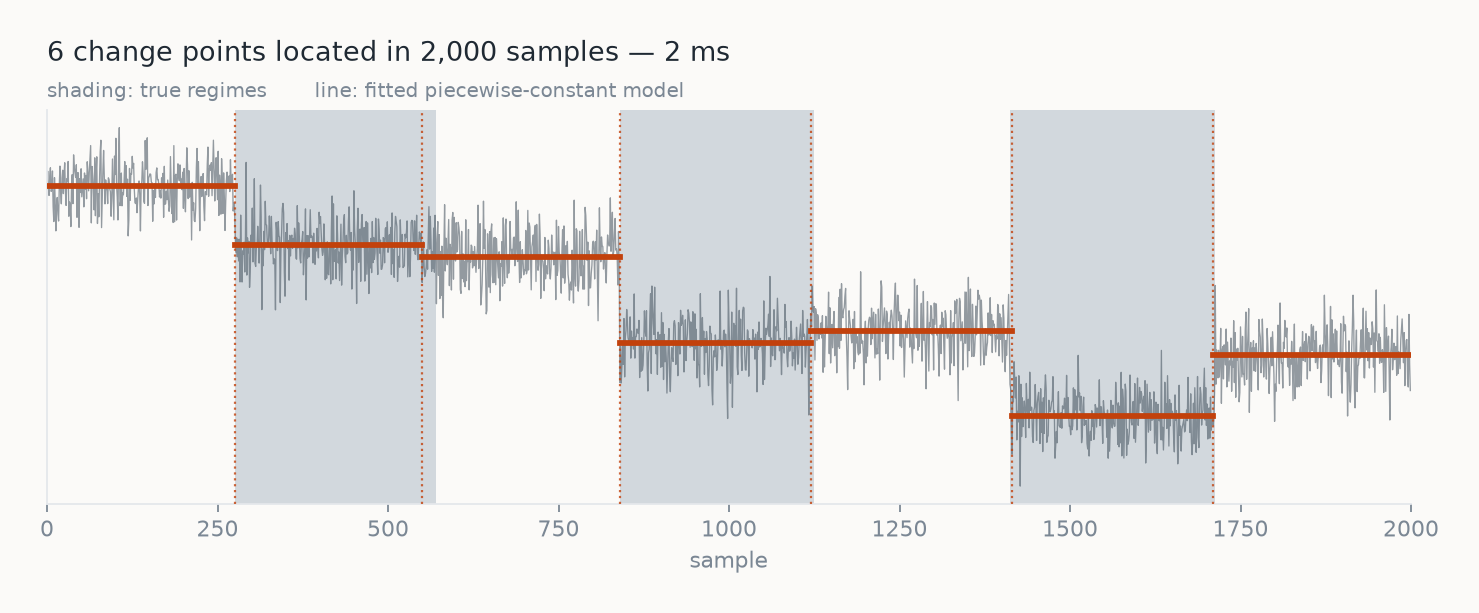
You have a sequence of measurements, and partway through, something changed — and stayed changed. Change point detection finds those moments: the boundaries between stretches where the data behaves one way and stretches where it behaves another.
That is a different question from anomaly detection. An anomaly is one odd reading. A change point is where a new normal begins. If your latency rose after a deploy and stayed up, no single request looks wrong, but there is a moment worth finding.
It comes up wherever a process has regimes:
- Operations — when did the error rate shift, and does it line up with the release?
- Industrial sensors — split a run into phases, or catch where a machine's vibration signature changed.
- Finance — divide a series into volatility regimes instead of assuming one.
- Genomics — copy number segmentation, which is where much of this literature comes from.
- Wearables — cut an accelerometer trace into activities.
You supply the signal and either the number of changes you expect or a penalty for adding one. You get back the breakpoints.
Quick start
pip install ruptures-rs
import ruptures_rs as rpt

# A synthetic signal with six changes, so the example runs anywhere.
signal, true_bkps = rpt.pw_constant(2_000, 1, 6, noise_std=3, seed=11)

# "I expect six changes. Where are they?"
bkps = rpt.Dynp(model="l2", min_size=20, jump=5).fit(signal).predict(6)
#  -> [275, 550, 840, 1120, 1415, 1710, 2000]      in 1.6 ms

# "I don't know how many. Charge me 500 for each one you add."
bkps = rpt.Pelt(model="l2", min_size=20).fit(signal).predict(pen=500)

rpt.display(signal, true_bkps, bkps)   # needs matplotlib
A breakpoint is the end of a segment, and the last one is always the length
of the signal — the same convention ruptures uses.
Choose a detector by what you know going in. Dynp when you know the number
of changes and want the exact optimum. Pelt when you do not, and would rather
set a penalty. Binseg and BottomUp for a quick approximate answer. Window
for a fast scan of a long signal.
Choose a cost by the kind of change you are looking for. l2 for shifts in
the mean, normal for shifts in variance or correlation, rbf for changes in
distribution that are not just the mean, linear and ar for a change in a
relationship or a temporal model.
A drop-in replacement for ruptures
This reimplements ruptures, the
standard Python library for this problem, with the same API.
- import ruptures as rpt
+ import ruptures_rs as rpt
That is the whole migration. Same classes, same arguments, same breakpoints — verified by 1,392 tests that run both libraries on the same input and demand identical output, not merely similar output.
It also installs where the reference currently cannot. One abi3 wheel per
platform covers Python 3.10 through 3.14, including musl, so pip install
never has to go looking for a C compiler.
Fast enough to change what you attempt
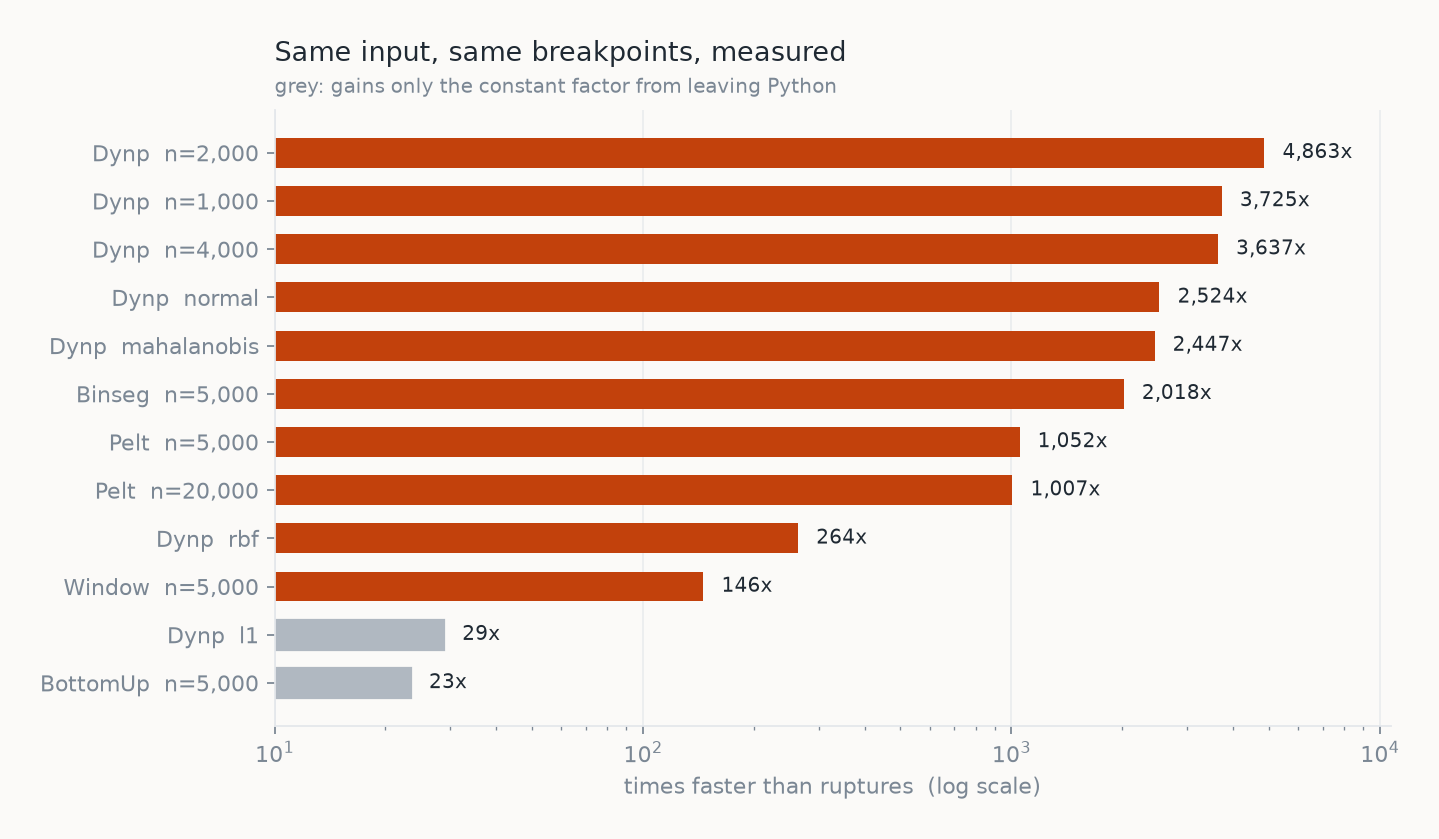
ruptures evaluates its cost function once per cell of a dynamic-programming
table, and every call is an O(segment length) NumPy reduction. Nearly all of
those costs are a difference of prefix sums in disguise, which makes them O(1) —
so the gain is structural, not just the constant factor from leaving Python.
The practical effect is that exact segmentation stops being something you budget for. A 50,000-point signal takes 0.06 s here, and is not a workload the reference can run at all.
Choosing a penalty without guessing
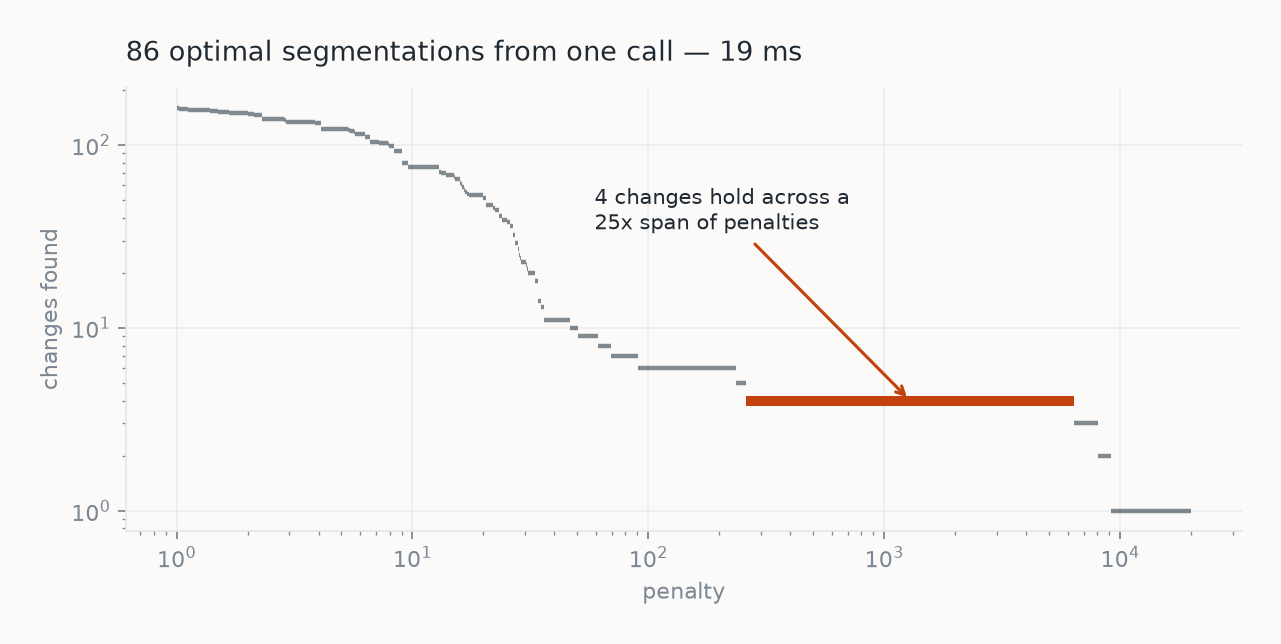
Penalised detection asks you for a penalty, and nobody knows theirs in advance.
Crops returns every segmentation that is optimal somewhere in a penalty
range, with the exact interval each one owns:
for regime in rpt.Crops(model="l2", min_size=10).fit_predict(signal, 1, 20_000):
    print(f"{regime.n_bkps:2d} changes for penalty in "
          f"[{regime.pen_min:,.0f}, {regime.pen_max:,.0f}]")
The answer that survives the widest span of penalties is the defensible one,
because it is the least sensitive to the parameter you could not justify
picking. ruptures has no equivalent, and it is only practical here because
PELT became cheap enough to run dozens of times.
examples/penalty_path.py works through it.
What's included
Everything in ruptures 1.1.9, plus Crops:
| Detectors | Dynp, Pelt, Binseg, BottomUp, Window, KernelCPD, Crops |
| Costs | l1, l2, normal, rbf, cosine, rank, mahalanobis, clinear, linear, ar |
| Datasets | pw_constant, pw_linear, pw_normal, pw_wavy |
| Metrics | precision_recall, hausdorff, randindex, meantime, hamming |
| Also | display, cost_factory, BaseCost, BaseEstimator, Bnode, exceptions |
Your own custom_cost still works. It runs on a pure-Python implementation,
because a Python callable inside the inner loop cannot be made faster by
crossing an FFI boundary to reach it — same answers, original speed.
estimator.accelerated reports which path you are on.
Going deeper
- Benchmarks — every measured row, and how it was measured.
- Accuracy and correctness — why prefix sums are a numerical trap, what is done about it, and how the test suite is built.
- Where the answers differ — the four places this package
and
rupturescan disagree, stated precisely, each pinned by a test. - Changelog.
For code you cannot edit
When a dependency deep in the stack imports ruptures by name:
import ruptures_rs
ruptures_rs.install()   # before anything imports `ruptures`

import ruptures as rpt  # this is now ruptures_rs
It refuses rather than half-patching the module graph if the real ruptures
has already been imported.
Development
pip install maturin pytest numpy scipy ruptures
maturin develop --release
pytest tests/ -q
cargo test
Licence and credit
BSD-2-Clause, the same licence as ruptures.
This is a reimplementation of ruptures
by Charles Truong, Laurent Oudre and Nicolas Vayatis, whose API, algorithms and
semantics it deliberately reproduces. The pure-Python fallback in
_fallback.py is a direct port of their code. If you use this in research,
cite their paper:
C. Truong, L. Oudre, N. Vayatis. Selective review of offline change point detection methods. Signal Processing, 167:107299, 2020.
1 maintainer

Metadata
1 maintainer
Release files for ruptures-rs 0.1.1
For a detailed explanation of source distributions (sdists) and built distributions (wheels), please see the package formats documentation.
Source distribution (sdist)
| File | Size | Uploaded | |
|---|---|---|---|
| ruptures_rs-0.1.1.tar.gz | 89.8 kB | Details |
Built distributions (wheels)
| File | Reset | |||
|---|---|---|---|---|
| ruptures_rs-0.1.1-cp310-abi3-win_amd64.whl | CPython 3.10 | abi3 | Windows x86-64 | Details |
| ruptures_rs-0.1.1-cp310-abi3-musllinux_1_2_x86_64.whl | CPython 3.10 | abi3 | Linux musl 1.2+ x86-64 | Details |
| ruptures_rs-0.1.1-cp310-abi3-musllinux_1_2_aarch64.whl | CPython 3.10 | abi3 | Linux musl 1.2+ ARM64 | Details |
| ruptures_rs-0.1.1-cp310-abi3-manylinux_2_17_x86_64.manylinux2014_x86_64.whl | CPython 3.10 | abi3 | Linux glibc 2.17+ x86-64 | Details |
| ruptures_rs-0.1.1-cp310-abi3-manylinux_2_17_aarch64.manylinux2014_aarch64.whl | CPython 3.10 | abi3 | Linux glibc 2.17+ ARM64 | Details |
| ruptures_rs-0.1.1-cp310-abi3-macosx_11_0_arm64.whl | CPython 3.10 | abi3 | macOS 11.0+ ARM64 | Details |
| ruptures_rs-0.1.1-cp310-abi3-macosx_10_12_x86_64.whl | CPython 3.10 | abi3 | macOS 10.12+ x86-64 | Details |
Total release size: 3.4 MB
Release files / ruptures_rs-0.1.1.tar.gz
| Download URL | ruptures_rs-0.1.1.tar.gz |
|---|---|
| Size | 89.8 kB |
| Tags | Source |
|
SHA-256 checksum How to use checksums |
3ec53c3a13cedbb5cf771fe2937577e8442cd895278b01d5f39dfbfc7b8bc572
|
|
BLAKE2b-256 checksum How to use checksums |
d261691332db2b3b42244e1f38d4c34b1c27e92f22c1b4f7385c2aafc2456ff7
|
| Upload date | |
|
Uploaded using Trusted Publishing? What is trusted publishing? |
Yes |
| Uploaded via |
twine/7.0.0 CPython/3.13.14
|
Provenance
Provenance describes where a file came from. On PyPI, provenance is shared via attestations, which provide a verifiable record of the build or publishing details. View details, limitations and caveats.


PyPI Publish Attestation
PyPI verified that this artifact, at this checksum, originated from the publisher listed below.
Signed by GitHub Actions, verified by PyPI on Sep 7, 2026.
Transparency logRelease files / ruptures_rs-0.1.1-cp310-abi3-win_amd64.whl
| Download URL | ruptures_rs-0.1.1-cp310-abi3-win_amd64.whl |
|---|---|
| Size | 321.8 kB |
| Tags | CPython 3.10 Windows x86-64 abi3 |
|
SHA-256 checksum How to use checksums |
ec4a7caa7be651da8e1c58bbd7ee01490ceb1b8d17e36ee3f580e572ca098da7
|
|
BLAKE2b-256 checksum How to use checksums |
259eff2b918f002d2324139dcac2465ea3b9643217e88e5a9d5bc1a228564cd7
|
| Upload date | |
|
Uploaded using Trusted Publishing? What is trusted publishing? |
Yes |
| Uploaded via |
twine/7.0.0 CPython/3.13.14
|
Provenance
Provenance describes where a file came from. On PyPI, provenance is shared via attestations, which provide a verifiable record of the build or publishing details. View details, limitations and caveats.
PyPI Publish Attestation
PyPI verified that this artifact, at this checksum, originated from the publisher listed below.
Signed by GitHub Actions, verified by PyPI on Sep 7, 2026.
Transparency logRelease files / ruptures_rs-0.1.1-cp310-abi3-musllinux_1_2_x86_64.whl
| Download URL | ruptures_rs-0.1.1-cp310-abi3-musllinux_1_2_x86_64.whl |
|---|---|
| Size | 656.3 kB |
| Tags | CPython 3.10 Linux musl 1.2+ x86-64 abi3 |
|
SHA-256 checksum How to use checksums |
33999c70f25f0ce0bc6700d56070d85005f0fec47d383e21d4f853e46df1c8b7
|
|
BLAKE2b-256 checksum How to use checksums |
58d96929085ef286057767a34f038934b7f9d0d84ccd03c6c892899affa35414
|
| Upload date | |
|
Uploaded using Trusted Publishing? What is trusted publishing? |
Yes |
| Uploaded via |
twine/7.0.0 CPython/3.13.14
|
Provenance
Provenance describes where a file came from. On PyPI, provenance is shared via attestations, which provide a verifiable record of the build or publishing details. View details, limitations and caveats.
PyPI Publish Attestation
PyPI verified that this artifact, at this checksum, originated from the publisher listed below.
Signed by GitHub Actions, verified by PyPI on Sep 7, 2026.
Transparency logRelease files / ruptures_rs-0.1.1-cp310-abi3-musllinux_1_2_aarch64.whl
| Download URL | ruptures_rs-0.1.1-cp310-abi3-musllinux_1_2_aarch64.whl |
|---|---|
| Size | 611.0 kB |
| Tags | CPython 3.10 Linux musl 1.2+ ARM64 abi3 |
|
SHA-256 checksum How to use checksums |
a2c8d65ab8c4c70c0189b4a02983841eeefca2242bc935be3915e5e2ffd5345c
|
|
BLAKE2b-256 checksum How to use checksums |
bed5abc1158ba99dedb9d87f365514215915109cd4aa9fd8b2ecf01ef22fa075
|
| Upload date | |
|
Uploaded using Trusted Publishing? What is trusted publishing? |
Yes |
| Uploaded via |
twine/7.0.0 CPython/3.13.14
|
Provenance
Provenance describes where a file came from. On PyPI, provenance is shared via attestations, which provide a verifiable record of the build or publishing details. View details, limitations and caveats.
PyPI Publish Attestation
PyPI verified that this artifact, at this checksum, originated from the publisher listed below.
Signed by GitHub Actions, verified by PyPI on Sep 7, 2026.
Transparency logRelease files / ruptures_rs-0.1.1-cp310-abi3-manylinux_2_17_x86_64.manylinux2014_x86_64.whl
| Download URL | ruptures_rs-0.1.1-cp310-abi3-manylinux_2_17_x86_64.manylinux2014_x86_64.whl |
|---|---|
| Size | 444.0 kB |
| Tags | CPython 3.10 Linux glibc 2.17+ x86-64 abi3 |
|
SHA-256 checksum How to use checksums |
7c1ab5c8676bda9a9afebfbd33983b1ca9832bd94afbb04a8556c3446f38589a
|
|
BLAKE2b-256 checksum How to use checksums |
25f37393fb0e946e6964960986dd1f77b5b277a987132fed0e035519b7c716c4
|
| Upload date | |
|
Uploaded using Trusted Publishing? What is trusted publishing? |
Yes |
| Uploaded via |
twine/7.0.0 CPython/3.13.14
|
Provenance
Provenance describes where a file came from. On PyPI, provenance is shared via attestations, which provide a verifiable record of the build or publishing details. View details, limitations and caveats.
PyPI Publish Attestation
PyPI verified that this artifact, at this checksum, originated from the publisher listed below.
Signed by GitHub Actions, verified by PyPI on Sep 7, 2026.
Transparency logRelease files / ruptures_rs-0.1.1-cp310-abi3-manylinux_2_17_aarch64.manylinux2014_aarch64.whl
| Download URL | ruptures_rs-0.1.1-cp310-abi3-manylinux_2_17_aarch64.manylinux2014_aarch64.whl |
|---|---|
| Size | 432.4 kB |
| Tags | CPython 3.10 Linux glibc 2.17+ ARM64 abi3 |
|
SHA-256 checksum How to use checksums |
3ed307a660d6ddf44a39c32355fc429382e176f6bb99a345020af3da4ee59db2
|
|
BLAKE2b-256 checksum How to use checksums |
d3982ed149cb71e9ebca9e9f0d13555a446c8b0f7c88673d81e7d5db4e33bfd9
|
| Upload date | |
|
Uploaded using Trusted Publishing? What is trusted publishing? |
Yes |
| Uploaded via |
twine/7.0.0 CPython/3.13.14
|
Provenance
Provenance describes where a file came from. On PyPI, provenance is shared via attestations, which provide a verifiable record of the build or publishing details. View details, limitations and caveats.
PyPI Publish Attestation
PyPI verified that this artifact, at this checksum, originated from the publisher listed below.
Signed by GitHub Actions, verified by PyPI on Sep 7, 2026.
Transparency logRelease files / ruptures_rs-0.1.1-cp310-abi3-macosx_11_0_arm64.whl
| Download URL | ruptures_rs-0.1.1-cp310-abi3-macosx_11_0_arm64.whl |
|---|---|
| Size | 396.9 kB |
| Tags | CPython 3.10 abi3 macOS 11.0+ ARM64 |
|
SHA-256 checksum How to use checksums |
8cda6b3104726dbe2e38b86a6866a91fed7cd8f41930345b54fadfcd3c0cdf4e
|
|
BLAKE2b-256 checksum How to use checksums |
dbbf0e9b4ceee4fb12fa1ccc512bddb84eca7430443445f56b1f08fce41f85bf
|
| Upload date | |
|
Uploaded using Trusted Publishing? What is trusted publishing? |
Yes |
| Uploaded via |
twine/7.0.0 CPython/3.13.14
|
Provenance
Provenance describes where a file came from. On PyPI, provenance is shared via attestations, which provide a verifiable record of the build or publishing details. View details, limitations and caveats.
PyPI Publish Attestation
PyPI verified that this artifact, at this checksum, originated from the publisher listed below.
Signed by GitHub Actions, verified by PyPI on Sep 7, 2026.
Transparency logRelease files / ruptures_rs-0.1.1-cp310-abi3-macosx_10_12_x86_64.whl
| Download URL | ruptures_rs-0.1.1-cp310-abi3-macosx_10_12_x86_64.whl |
|---|---|
| Size | 416.0 kB |
| Tags | CPython 3.10 abi3 macOS 10.12+ x86-64 |
|
SHA-256 checksum How to use checksums |
ea213a193cf120c65d5c7a87dcf4a04617f80a8f0ccccc77783efb3002fb669e
|
|
BLAKE2b-256 checksum How to use checksums |
bba3f02f933de617e89669ff1fa8b168c463c53707b949fca0b79dfbb12e72ed
|
| Upload date | |
|
Uploaded using Trusted Publishing? What is trusted publishing? |
Yes |
| Uploaded via |
twine/7.0.0 CPython/3.13.14
|
Provenance
Provenance describes where a file came from. On PyPI, provenance is shared via attestations, which provide a verifiable record of the build or publishing details. View details, limitations and caveats.
PyPI Publish Attestation
PyPI verified that this artifact, at this checksum, originated from the publisher listed below.
Signed by GitHub Actions, verified by PyPI on Sep 7, 2026.
Transparency log













