


This repo aims at providing Triton kernel for RWKV models. RWKV is a brand new network architecture that integrates the advantages of transformers and RNNs, and can be used for a variety of natural language processing tasks. Also, RWKV is the state-of-the-art RNN model.
This project implements multi-level state chain differentiation for RWKV6, efficient differentiation of all input parameters, while maintaining high computational precision (both bf16 and fp32). Currently, it does not consider pure fp16 variants such as RWKV x060c.
Some benchmarks (chunk_rwkv6(fla) vs CUDA kernel)
Since the project is under active development, the calculated times may differ.
fused_recurrent_rwkv6 will be much slower!
| Test Case | Implementation | Forward Time | Backward Time |
|---|---|---|---|
| Test Case 1: B=8, T=4096, C=4096, HEAD_SIZE=64 | CUDA BF16 | 9.69 ms | 46.41 ms |
| FLA BF16 | 13.06 ms | 40.79 ms | |
| Test Case 2: B=32, T=4096, C=4096, HEAD_SIZE=64 | CUDA BF16 | 32.80 ms | 148.05 ms |
| FLA BF16 | 50.17 ms | 162.42 ms | |
| Test Case 3: B=8, T=4096, C=4096, HEAD_SIZE=128 | CUDA BF16 | 12.01 ms | 65.68 ms |
| FLA BF16 | 14.18 ms | 51.36 ms | |
| Test Case 4: B=8, T=4096, C=4096, HEAD_SIZE=256 | CUDA BF16 | 40.82 ms | 225.59 ms |
| FLA BF16 | 19.34 ms | 72.03 ms | |
| Test Case 5: B=16, T=4096, C=4096, HEAD_SIZE=128 | CUDA BF16 | 20.56 ms | 109.76 ms |
| FLA BF16 | 27.72 ms | 102.35 ms | |
| Test Case 6: B=16, T=4096, C=4096, HEAD_SIZE=256 | CUDA BF16 | 61.54 ms | 344.85 ms |
| FLA BF16 | 38.24 ms | 144.12 ms |
from fla.ops.rwkv6 import chunk_rwkv6, fused_recurrent_rwkv6, native_recurrent_rwkv6
@torch.compile(fullgraph=True)
# torch.compiler introduces errors in numerical precision (torch 2.4)
def RUN_FLA_CHUNK(B, T, C, H, r, k, v, w, u, h, scale=1.0, chunk_size=32):
    r = r.view(B,T,H,-1).transpose(1,2)
    k = k.view(B,T,H,-1).transpose(1,2)
    v = v.view(B,T,H,-1).transpose(1,2)
    # u can be 3d or 2d (B, H, -1) or just (H, -1) to save VRAM
    w = -torch.exp(w.view(B,T,H,-1).transpose(1,2))
    # change to scale=-1.0 when using fp16, this will apply scale to r and k.
    o, final_state = chunk_rwkv6(r, k, v, w, u=u, scale=scale, initial_state=h,
        output_final_state=True, chunk_size=chunk_size)
    return o.transpose(1,2).reshape(B,T,C), final_state
This repo aims at providing a collection of efficient Triton-based implementations for state-of-the-art linear attention models. Any pull requests are welcome!

Table of Contents
News
- [2024-12]: :loudspeaker:
flanow officially supports kernels with variable-length inputs. - [2024-11]: The inputs are now switched from head-first to seq-first format.
- [2024-11]: :rocket:
flanow provides a flexible way for training hybrid models. - [2024-10]: :fire: Announcing
flame, a minimal and scalable framework for trainingflamodels. Check out the details here. - [2024-09]:
flanow includes a fused linear and cross-entropy layer, significantly reducing memory usage during training. - [2024-09]: :tada: Add GSA implementation to
fla(paper). - [2024-05]: :tada: Add DeltaNet implementation to
fla(paper). - [2024-05]: :rocket:
flav0.1: a variety of subquadratic kernels/layers/models integrated (RetNet/GLA/Mamba/HGRN/HGRN2/RWKV6, etc., see Models). - [2023-12]: :tada: Launched
fla, offering a collection of implementations for state-of-the-art linear attention models.
Models
Roughly sorted according to the timeline supported in fla
| Date | Model | Title | Paper | Code | fla impl |
|---|---|---|---|---|---|
| 2023-07 | RetNet | Retentive network: a successor to transformer for large language models | arxiv | official | code |
| 2023-12 | GLA | Gated Linear Attention Transformers with Hardware-Efficient Training | arxiv | official | code |
| 2023-12 | Based | An Educational and Effective Sequence Mixer | blog | official | code |
| 2024-01 | Rebased | Linear Transformers with Learnable Kernel Functions are Better In-Context Models | arxiv | official | code |
| 2021-02 | Delta Net | Linear Transformers Are Secretly Fast Weight Programmers | arxiv | official | code |
| 2021-10 | ABC | Attention with Bounded-memory Control | arxiv | code | |
| 2023-09 | HGRN | Hierarchically Gated Recurrent Neural Network for Sequence Modeling | openreview | official | code |
| 2024-04 | HGRN2 | HGRN2: Gated Linear RNNs with State Expansion | arxiv | official | code |
| 2024-04 | RWKV6 | Eagle and Finch: RWKV with Matrix-Valued States and Dynamic Recurrence | arxiv | official | code |
| 2024-06 | Samba | Samba: Simple Hybrid State Space Models for Efficient Unlimited Context Language Modeling | arxiv | official | code |
| 2024-05 | Mamba2 | Transformers are SSMs: Generalized Models and Efficient Algorithms Through Structured State Space Duality | arxiv | official | code |
| 2024-09 | GSA | Gated Slot Attention for Efficient Linear-Time Sequence Modeling | arxiv | official | code |
Installation
The following requirements should be satisfied
As fla is actively developed now, you should alwayd check for latest version pip install --upgrade rwkv-fla triton
Or you can install if with pip install rwkv-fla[cuda], pip install rwkv-fla[xpu], pip install rwkv-fla[rocm]
If you do need to use fla ops/modules and contemplate further explorations, an alternative way is to install the package from source
pip install -U git+https://github.com/TorchRWKV/flash-linear-attention
or
pip install -U git+https://gitee.com/uniartisan2018/flash-linear-attention
or manage fla with submodules
git submodule add https://github.com/TorchRWKV/flash-linear-attention.git 3rdparty/rwkv-fla
ln -s 3rdparty/rwkv-fla/fla fla
[!CAUTION] If you're not working with Triton v2.2 or its nightly release, it's important to be aware of potential issues with the
FusedChunkimplementation, detailed in this issue. You can run the testpython tests/test_fused_chunk.pyto check if your version is affected by similar compiler problems. While we offer some fixes for Triton<=2.1, be aware that these may result in reduced performance.For both Triton 2.2 and earlier versions (up to 2.1), you can reliably use the
Chunkversion (with hidden states materialized into HBMs). After careful optimization, this version generally delivers high performance in most scenarios.
Acknowledgments
The rwkv-fla project is a fork of the fla project. We extend our sincere gratitude to the original maintainers for their tremendous efforts and contributions. This project builds upon the work described in:
@software{yang2024fla,
  title  = {FLA: A Triton-Based Library for Hardware-Efficient Implementations of Linear Attention Mechanism},
  author = {Yang, Songlin and Zhang, Yu},
  url    = {https://github.com/sustcsonglin/flash-linear-attention},
  month  = jan,
  year   = {2024}
}
Their innovative work and expertise laid the foundation for the development of rwkv-fla.
Models
| Date | Model | Title | Paper | Code | FLA impl |
|---|---|---|---|---|---|
| 2023-07 | RetNet (@MSRA@THU) | Retentive network: a successor to transformer for large language models | [arxiv] | [official] [RetNet] | code |
| 2023-12 | GLA (@MIT@IBM) | Gated Linear Attention Transformers with Hardware-Efficient Training | [arxiv] | [official] | code |
| 2023-12 | Based (@Stanford@Hazyresearch) | An Educational and Effective Sequence Mixer | [blog] | [official] | code |
| 2024-01 | Rebased | Linear Transformers with Learnable Kernel Functions are Better In-Context Models | [arxiv] | [official] | code |
| 2021-02 | Delta Net | Linear Transformers Are Secretly Fast Weight Programmers | [arxiv] | [official] | code |
| 2023-09 | Hedgehog (@HazyResearch) | The Hedgehog & the Porcupine: Expressive Linear Attentions with Softmax Mimicry | openreview | code | |
| 2023-10 | PolySketchFormer (@CMU@Google) | Fast Transformers via Sketching Polynomial Kernels | arxiv | TODO | |
| 2023-07 | TransnormerLLM | A Faster and Better Large Language Model with Improved TransNormer (@Shanghai AI Lab) | openreview arxiv | [official] [Lightning2] | TODO |
| 2023-05 | RWKV-v4 (@BlinkDL) | Reinventing RNNs for the Transformer Era | arxiv | [official] | TODO |
| 2023-10 | GateLoop | Fully Data-Controlled Linear Recurrence for Sequence Modeling | openreview arxiv | [official] [jax] | TODO |
| 2021-10 | ABC (@UW) | Attention with Bounded-memory Control | arxiv | code | |
| 2023-09 | VQ-transformer | Linear-Time Transformers via Vector Quantization | arxiv | [official] | TODO |
| 2023-09 | HGRN | Hierarchically Gated Recurrent Neural Network for Sequence Modeling | openreview | [official] | code |
| 2024-04 | HGRN2 | HGRN2: Gated Linear RNNs with State Expansion | arxiv | [official] | code |
| 2024-04 | RWKV6 | Eagle and Finch: RWKV with Matrix-Valued States and Dynamic Recurrence | arxiv | [official] | code |
| 2024-06 | Samba | Samba: Simple Hybrid State Space Models for Efficient Unlimited Context Language Modeling | arxiv | [official] | code |
| 2024-05 | Mamba2 | Transformers are SSMs: Generalized Models and Efficient Algorithms Through Structured State Space Duality | arxiv | [official] | code |
Usage
Token Mixing
We provide "token mixing" linear attention layers in fla.layers for you to use.
You can replace the standard multihead attention layer in your model with other linear attention layers.
Example usage is as follows:
>>> import torch
>>> from fla.layers import MultiScaleRetention
>>> batch_size, num_heads, seq_len, hidden_size = 32, 4, 2048, 1024
>>> device, dtype = 'cuda:0', torch.bfloat16
>>> retnet = MultiScaleRetention(hidden_size=hidden_size, num_heads=num_heads).to(device=device, dtype=dtype)
>>> retnet
MultiScaleRetention(
  (q_proj): Linear(in_features=1024, out_features=1024, bias=False)
  (k_proj): Linear(in_features=1024, out_features=1024, bias=False)
  (v_proj): Linear(in_features=1024, out_features=2048, bias=False)
  (g_proj): Linear(in_features=1024, out_features=2048, bias=False)
  (o_proj): Linear(in_features=2048, out_features=1024, bias=False)
  (g_norm_swish_gate): FusedRMSNormSwishGate(512, eps=1e-05)
  (rotary): RotaryEmbedding()
)
>>> x = torch.randn(batch_size, seq_len, hidden_size).to(device=device, dtype=dtype)
>>> y, *_ = retnet(x)
>>> y.shape
torch.Size([32, 2048, 1024])
We provide the implementations of models that are compatible with 🤗 Transformers library.
Here's an example of how to initialize a GLA model from the default configs in fla:
>>> from fla.models import GLAConfig
>>> from transformers import AutoModelForCausalLM
>>> config = GLAConfig()
>>> config
GLAConfig {
  "attn": null,
  "attn_mode": "chunk",
  "bos_token_id": 1,
  "clamp_min": null,
  "conv_size": 4,
  "elementwise_affine": true,
  "eos_token_id": 2,
  "expand_k": 0.5,
  "expand_v": 1,
  "feature_map": null,
  "fuse_cross_entropy": true,
  "fuse_norm": true,
  "hidden_act": "swish",
  "hidden_ratio": 4,
  "hidden_size": 2048,
  "initializer_range": 0.02,
  "intermediate_size": null,
  "max_position_embeddings": 2048,
  "model_type": "gla",
  "norm_eps": 1e-06,
  "num_heads": 4,
  "num_hidden_layers": 24,
  "num_kv_heads": null,
  "tie_word_embeddings": false,
  "transformers_version": "4.45.0",
  "use_cache": true,
  "use_gk": true,
  "use_gv": false,
  "use_output_gate": true,
  "use_short_conv": false,
  "vocab_size": 32000
}

>>> AutoModelForCausalLM.from_config(config)
GLAForCausalLM(
  (model): GLAModel(
    (embeddings): Embedding(32000, 2048)
    (layers): ModuleList(
      (0-23): 24 x GLABlock(
        (attn_norm): RMSNorm(2048, eps=1e-06)
        (attn): GatedLinearAttention(
          (q_proj): Linear(in_features=2048, out_features=1024, bias=False)
          (k_proj): Linear(in_features=2048, out_features=1024, bias=False)
          (v_proj): Linear(in_features=2048, out_features=2048, bias=False)
          (g_proj): Linear(in_features=2048, out_features=2048, bias=False)
          (gk_proj): Sequential(
            (0): Linear(in_features=2048, out_features=16, bias=False)
            (1): Linear(in_features=16, out_features=1024, bias=True)
          )
          (o_proj): Linear(in_features=2048, out_features=2048, bias=False)
          (g_norm_swish_gate): FusedRMSNormSwishGate(512, eps=1e-06)
        )
        (mlp_norm): RMSNorm(2048, eps=1e-06)
        (mlp): GLAMLP(
          (gate_proj): Linear(in_features=2048, out_features=11264, bias=False)
          (down_proj): Linear(in_features=5632, out_features=2048, bias=False)
          (act_fn): SiLU()
        )
      )
    )
    (norm): RMSNorm(2048, eps=1e-06)
  )
  (lm_head): Linear(in_features=2048, out_features=32000, bias=False)
)
Fused Modules
We offer a collection of fused modules in fla.modules to facilitate faster training:
Rotary Embedding: rotary positional embeddings as adopted by the Llama architecture, a.k.a., Transformer++.Norm Layers:RMSNorm,LayerNormandGroupNormRMSNormLinear,LayerNormLinearandGroupNormLinearto reduce memory usage of intermediate tensors for improved memory efficiency.
Norm Layers with Gating: combine norm layers with element-wise gating, as used by RetNet/GLA.Cross Entropy: faster Triton implementation of cross entropy loss.Linear Cross Entropy: fused linear layer and cross entropy loss to avoid the materialization of large logits tensors. Also refer to implementations by mgmalek and Liger-Kernel.Linear KL Divergence: fused linear layer and KL divergence loss in a similar vein as CE loss.
Generation
Upon successfully pretraining a model, it becomes accessible for generating text using the 🤗 text generation APIs. In the following, we give a generation example:
>>> import fla
>>> from transformers import AutoModelForCausalLM, AutoTokenizer
>>> name = 'fla-hub/gla-1.3B-100B'
>>> tokenizer = AutoTokenizer.from_pretrained(name)
>>> model = AutoModelForCausalLM.from_pretrained(name).cuda()
>>> input_prompt = "Power goes with permanence. Impermanence is impotence. And rotation is castration."
>>> input_ids = tokenizer(input_prompt, return_tensors="pt").input_ids.cuda()
>>> outputs = model.generate(input_ids, max_length=64)
>>> tokenizer.batch_decode(outputs, skip_special_tokens=True)[0]
We also provide a simple script here for benchmarking the generation speed. Simply run it by:
$ python -m benchmarks.benchmark_generation \
  --path 'fla-hub/gla-1.3B-100B' \
  --repetition_penalty 2. \
  --prompt="Hello everyone, I'm Songlin Yang"

Prompt:
Hello everyone, I'm Songlin Yang
Generated:
Hello everyone, I'm Songlin Yang.
I am a 20 year old girl from China who is currently studying in the United States of America for my Master degree and also working as an English teacher at school here on campus since last summer (1st semester). My main goal to be able do well with this course so that we can have

Prompt length: 10, generation length: 64
Total prompt processing + decoding time: 4593ms
All of the pretrained models currently available can be found in fla-hub.
>>> from huggingface_hub import list_models
>>> for model in list_models(author='fla-hub'): print(model.id)
Hybrid Models
fla provides a flexible method to incorporate standard attention layers into existing linear attention models.
This is easily achieved by specifying the attn argument in the model configuration.
For example, to create a 2-layer Samba model with interleaved Mamba and local attention layers, using a sliding window size of 2048:
>>> from fla.models import SambaConfig
>>> from transformers import AutoModelForCausalLM
>>> config = SambaConfig(num_hidden_layers=2)
>>> config.attn = {
  'layers': [1],
  'num_heads': 18,
  'num_kv_heads': 18,
  'window_size': 2048
}
>>> config
SambaConfig {
  "attn": {
    "layers": [
      1
    ],
    "num_heads": 18,
    "num_kv_heads": 18,
    "window_size": 2048
  },
  "bos_token_id": 1,
  "conv_kernel": 4,
  "eos_token_id": 2,
  "expand": 2,
  "fuse_cross_entropy": true,
  "fuse_norm": true,
  "hidden_act": "silu",
  "hidden_ratio": 4,
  "hidden_size": 2304,
  "initializer_range": 0.02,
  "intermediate_size": 4608,
  "max_position_embeddings": 2048,
  "model_type": "samba",
  "norm_eps": 1e-05,
  "num_hidden_layers": 2,
  "pad_token_id": 0,
  "rescale_prenorm_residual": false,
  "residual_in_fp32": false,
  "state_size": 16,
  "tie_word_embeddings": false,
  "time_step_floor": 0.0001,
  "time_step_init_scheme": "random",
  "time_step_max": 0.1,
  "time_step_min": 0.001,
  "time_step_rank": 144,
  "time_step_scale": 1.0,
  "transformers_version": "4.45.0",
  "use_bias": false,
  "use_cache": true,
  "use_conv_bias": true,
  "vocab_size": 32000
}

>>> AutoModelForCausalLM.from_config(config)
SambaForCausalLM(
  (backbone): SambaModel(
    (embeddings): Embedding(32000, 2304)
    (layers): ModuleList(
      (0): SambaBlock(
        (mixer_norm): RMSNorm(2304, eps=1e-05)
        (mixer): MambaMixer(
          (conv1d): Conv1d(4608, 4608, kernel_size=(4,), stride=(1,), padding=(3,), groups=4608)
          (act): SiLU()
          (in_proj): Linear(in_features=2304, out_features=9216, bias=False)
          (x_proj): Linear(in_features=4608, out_features=176, bias=False)
          (dt_proj): Linear(in_features=144, out_features=4608, bias=True)
          (out_proj): Linear(in_features=4608, out_features=2304, bias=False)
        )
        (mlp_norm): RMSNorm(2304, eps=1e-05)
        (mlp): SambaMLP(
          (gate_proj): Linear(in_features=2304, out_features=12288, bias=False)
          (down_proj): Linear(in_features=6144, out_features=2304, bias=False)
          (act_fn): SiLU()
        )
      )
      (1): SambaBlock(
        (mixer_norm): RMSNorm(2304, eps=1e-05)
        (mixer): Attention(
          (q_proj): Linear(in_features=2304, out_features=2304, bias=False)
          (k_proj): Linear(in_features=2304, out_features=2304, bias=False)
          (v_proj): Linear(in_features=2304, out_features=2304, bias=False)
          (o_proj): Linear(in_features=2304, out_features=2304, bias=False)
          (rotary): RotaryEmbedding()
        )
        (mlp_norm): RMSNorm(2304, eps=1e-05)
        (mlp): SambaMLP(
          (gate_proj): Linear(in_features=2304, out_features=12288, bias=False)
          (down_proj): Linear(in_features=6144, out_features=2304, bias=False)
          (act_fn): SiLU()
        )
      )
    )
    (norm_f): RMSNorm(2304, eps=1e-05)
  )
  (lm_head): Linear(in_features=2304, out_features=32000, bias=False)
)
During inference, you DO NOT need to revise anything for generation! The model will produce output as-is, without any need for additional configurations or modifications.
Evaluations
The lm-evaluation-harness library allows you to easily perform (zero-shot) model evaluations. Follow the steps below to use this library:
-
Install
lm_evalfollowing their instructions. -
Run evaluation with:
$ PATH='fla-hub/gla-1.3B-100B'
$ python -m evals.harness --model hf \
    --model_args pretrained=$PATH,dtype=bfloat16 \
    --tasks wikitext,lambada_openai,piqa,hellaswag,winogrande,arc_easy,arc_challenge,boolq,sciq,copa,openbookqa \
    --batch_size 64 \
    --num_fewshot 0 \
    --device cuda \
    --show_config
We've made fla compatible with hf-style evaluations, you can call evals.harness to finish the evaluations.
Running the command above will provide the task results reported in the GLA paper.
[!Tip] If you are using
lm-evaluation-harnessas an external library and can't find (almost) any tasks available, before callinglm_eval.evaluate()orlm_eval.simple_evaluate(), simply run the following to load the library's stock tasks!
>>> from lm_eval.tasks import TaskManager; TaskManager().initialize_tasks()
Benchmarks
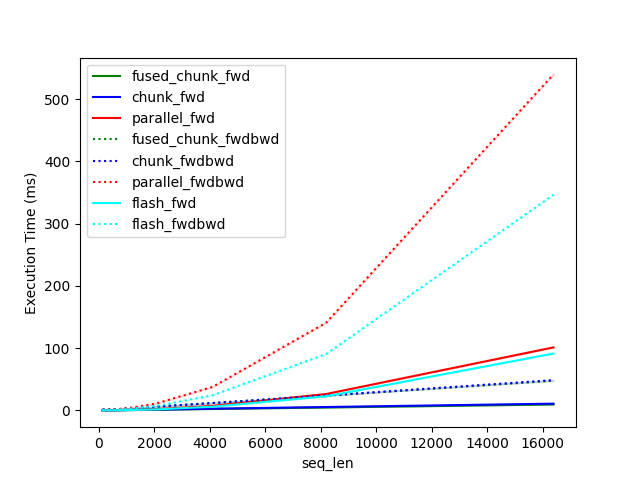
We compared our Triton-based RetNet implementation with CUDA-based FlashAttention2, using a batch size of 8, 32 heads, and a head dimension of 128, across different sequence lengths. These tests were conducted on a single A100 80GB GPU, as illustrated in the following graph
# you might have to first install `fla` to enable its import via `pip install -e .`
$ python benchmark_retention.py
Performance:
   seq_len  fused_chunk_fwd  chunk_fwd  parallel_fwd  fused_chunk_fwdbwd  chunk_fwdbwd  parallel_fwdbwd  flash_fwd  flash_fwdbwd
0    128.0         0.093184   0.185344      0.067584            1.009664      1.591296         1.044480   0.041984      0.282624
1    256.0         0.165888   0.219136      0.126976            1.024000      1.596928         1.073152   0.074752      0.413696
2    512.0         0.308224   0.397312      0.265216            1.550336      1.603584         1.301504   0.156672      0.883712
3   1024.0         0.603136   0.747520      0.706560            3.044864      3.089408         3.529728   0.467968      2.342912
4   2048.0         1.191424   1.403904      2.141184            6.010880      6.059008        11.009024   1.612800      7.135232
5   4096.0         2.377728   2.755072      7.392256           11.932672     11.938816        37.792770   5.997568     24.435200
6   8192.0         4.750336   5.491712     26.402817           23.759359     23.952385       141.014023  22.682114     90.619904
7  16384.0         9.591296  10.870784    101.262337           47.666176     48.745472       539.853821  91.346947    346.318848
Citation
If you find this repo useful, please consider citing our works:
@inproceedings{yang2024gla,
  title     = {Gated Linear Attention Transformers with Hardware-Efficient Training},
  author    = {Yang, Songlin and Wang, Bailin and Shen, Yikang and Panda, Rameswar and Kim, Yoon},
  booktitle = {Proceedings of ICML},
  year      = {2024}
}

@software{yang2024fla,
  title  = {FLA: A Triton-Based Library for Hardware-Efficient Implementations of Linear Attention Mechanism},
  author = {Yang, Songlin and Zhang, Yu},
  url    = {https://github.com/sustcsonglin/flash-linear-attention},
  month  = jan,
  year   = {2024}
}

@inproceedings{yang2024parallelizing,
  title     = {Parallelizing Linear Transformers with the Delta Rule over Sequence Length},
  author    = {Yang, Songlin and Wang, Bailin and Zhang, Yu and Shen, Yikang and Kim, Yoon},
  booktitle = {Proceedings of NeurIPS},
  year      = {2024}
}

@inproceedings{zhang2024gsa,
  title     = {Gated Slot Attention for Efficient Linear-Time Sequence Modeling},
  author    = {Zhang, Yu and Yang, Songlin and Zhu, Ruijie and Zhang, Yue and Cui, Leyang and Wang, Yiqiao and Wang, Bolun and Shi, Freda and Wang, Bailin and Bi, Wei and Zhou, Peng and Fu, Guohong},
  booktitle = {Proceedings of NeurIPS},
  year      = {2024}
}
1 maintainer

Release files for rwkv-fla 0.1.202501171350
For a detailed explanation of source distributions (sdists) and built distributions (wheels), please see the package formats documentation.
Source distribution (sdist)
| File | Size | Uploaded | |
|---|---|---|---|
| rwkv_fla-0.1.202501171350.tar.gz | 463.2 kB | Details |
Built distribution (wheel)
| File | Interpreter | ABI | Platform | Reset |
|---|---|---|---|---|
| rwkv_fla-0.1.202501171350-py3-none-any.whl | Python 3 | none | any | Details |
Total release size: 1.2 MB
Release files / rwkv_fla-0.1.202501171350.tar.gz
| Download URL | rwkv_fla-0.1.202501171350.tar.gz |
|---|---|
| Size | 463.2 kB |
| Tags | Source |
|
SHA-256 checksum How to use checksums |
5c9b71cac29e92b0f4fa3247c8185000495e2c1c458e3df7d1dc7f1276ae35fb
|
|
BLAKE2b-256 checksum How to use checksums |
20ac02b7598b9369c5f2f2ea812b5a8376de561667d4c433f4245dd46999427b
|
| Upload date | |
|
Uploaded using Trusted Publishing? What is trusted publishing? |
No |
| Uploaded via |
twine/6.0.1 CPython/3.9.21
|
Release files / rwkv_fla-0.1.202501171350-py3-none-any.whl
| Download URL | rwkv_fla-0.1.202501171350-py3-none-any.whl |
|---|---|
| Size | 704.3 kB |
| Tags | Python 3 |
|
SHA-256 checksum How to use checksums |
06e6f84b4bc9a3ae10485f10ac1790e53fed17a21bed7b0ccf8fedf784f7cae9
|
|
BLAKE2b-256 checksum How to use checksums |
ba52d72b3c15377bcb00e3e78b752c5db38346dd1e2ac4fa2cf78ca7a40c90f3
|
| Upload date | |
|
Uploaded using Trusted Publishing? What is trusted publishing? |
No |
| Uploaded via |
twine/6.0.1 CPython/3.9.21
|














