
SafeAgentDB
The Shadow-Sandbox DB Layer for AI Agents
Let AI modify your production database. Without the terror.





Production DB                     In-Memory SQLite Sandbox
      |                                     |
      |--- clone tenant rows -------------->|
      |                                     |--- AI operates freely (CRUD)
      |                                     |--- Pydantic validates every row
      |                                     |--- Rich diff shows what changed
      |<-- atomic sync (on approval) -------|
      |                                     |--- sandbox destroyed
The Problem
You are building AI-powered features. An agent that manages tasks. A copilot that updates billing. An assistant that edits user profiles. Your AI needs write access to the database.
Two things keep you up at night:
| Nightmare | What Happens |
|---|---|
| AI Logical Error | The LLM writes status = 'yolo_swag' instead of 'done'. Or sets balance = -99999. Without a safety net, it goes straight to production. |
| Multi-Tenancy Breach | Your agent operates for User 42 but accidentally touches User 99's rows. One wrong WHERE clause = data breach. |
SafeAgentDB eliminates both. Every AI write is sandboxed, validated, diffed, tenant-scoped, and synced atomically -- or not at all.
The 7 Safety Gates
Every call to commit_to_production() passes through 7 sequential gates. If any gate fails, the entire transaction rolls back. Nothing touches production.
Gate 1: TENANT ISOLATION AT CLONE
  Only rows matching your tenant_id are copied into the sandbox. Two
  deliberate exceptions: tables you list in reference_tables are cloned
  in full, and at commit the cascade check reads the tenant column of
  rows that reference a row being deleted, so it can name the tenants a
  referential action would reach.

Gate 2: ROW-LEVEL DIFFING
  Every change is computed as an explicit INSERT / UPDATE / DELETE
  with before/after values, keyed on the primary key or your row_key.
  A table whose rows cannot be identified is refused outright, and so is
  a row whose key the agent changed with UPDATE (see "Key changes").

Gate 3: PYDANTIC RE-VALIDATION
  Every INSERT and UPDATE row is validated against your SafeModel, as
  production will hold it (JSON decoded, timestamps parsed). Strict mode.
  No type coercion. The message names every failing field and why.

Gate 4: ROW KEY + TENANT WHERE CLAUSE
  Every UPDATE/DELETE statement carries WHERE <row key> AND tenant_id = ?
  A statement that would match rows by tenant alone is refused, not run.

Gate 5: NO UNSEEN WRITES
  A DELETE, or an UPDATE of a referenced column, that would make production
  run ON DELETE / ON UPDATE CASCADE, SET NULL or SET DEFAULT on rows the
  diff does not show is refused with CascadeError, unless you pass
  allow_cascades=True. Another tenant's rows are refused either way.

Gate 6: COMPARE AND SWAP
  The clone-time values are part of the WHERE clause, so checking and
  writing are a single statement with no window between them. If another
  process changed the row first, the statement matches nothing and you
  get a ConflictError naming the drifted columns -- not a silent overwrite.

Gate 7: ATOMIC SYNC
  The entire changeset executes in ONE transaction, in unit-of-work order
  (INSERTs parents first, then UPDATEs, then DELETEs children first, except
  where a foreign key between two of its rows needs otherwise), writing
  only the columns the agent actually changed.
The gates that need only the sandbox and the schema also run inside diff(),
through the same helpers the commit uses: validation, the tenant guard, row-key
problems, key changes, generated keys, values that cannot be decoded, and rows
that reference each other in a cycle. Three checks need production rows and are
commit-only: drift since the clone, uniqueness against rows outside the
tenant, and referential actions on rows the sandbox did not clone. A clean
banner says so.
See Guarantees and limits for what these gates deliberately do not cover.
Getting Started
1. Install
pip install safeagentdb
With database drivers:
pip install safeagentdb[pg]      # PostgreSQL
pip install safeagentdb[mysql]   # MySQL / MariaDB
2. Define Your Schema Validator
Create a SafeModel subclass for each table an AI agent can write to. This is your contract -- any row that violates it will be rejected before it touches production.
from typing import Literal
from safeagentdb import SafeModel

class TaskValidator(SafeModel):
    __table_name__ = "tasks"      # links this validator to the "tasks" table

    id: int
    user_id: int
    title: str
    status: Literal["todo", "in_progress", "done"]  # AI can ONLY write these values
SafeModel inherits from Pydantic BaseModel with strict=True and extra="forbid". No silent type coercion. No extra fields sneaking through.
3. Sandbox the AI Agent
from sqlalchemy import create_engine
from safeagentdb import ShadowDB

engine = create_engine("postgresql://user:pass@localhost/mydb")

with ShadowDB(engine, tables=["tasks"], tenant_id=42) as sandbox:
    # The AI does whatever it wants -- all writes stay in the sandbox
    sandbox.execute("UPDATE tasks SET status = 'done' WHERE id = 1")
    sandbox.execute(
        "INSERT INTO tasks (id, user_id, title, status) "
        "VALUES (100, 42, 'AI-generated task', 'todo')"
    )

    # Review: see exactly what changed, with validation status
    changeset = sandbox.diff()
    changeset.print()

    # Approve: commit exactly what was reviewed, and nothing else
    sandbox.commit_to_production(changeset=changeset)
4. Review the Diff
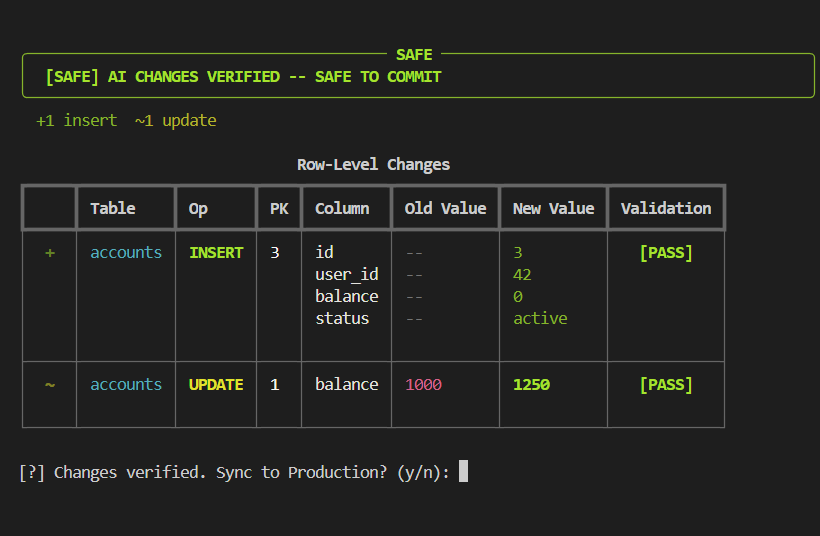
sandbox.diff().print() renders a color-coded Rich dashboard:
+------------------------------------- SAFE --------------------------------------+
|  [SAFE] AI CHANGES VERIFIED -- SAFE TO COMMIT                                   |
+---------------------------------------------------------------------------------+
  +1 insert  ~1 update

                                 Row-Level Changes
+---------------------------------------------------------------------------------+
|     | Table | Op     | PK  | Column  | Old Value | New Value         | Valid.   |
|-----+-------+--------+-----+---------+-----------+-------------------+----------|
|  +  | tasks | INSERT | 100 | id      | --        | 100               | [PASS]   |
|     |       |        |     | user_id | --        | 42                |          |
|     |       |        |     | title   | --        | AI-generated task |          |
|     |       |        |     | status  | --        | todo              |          |
|     |       |        |     |         |           |                   |          |
|-----+-------+--------+-----+---------+-----------+-------------------+----------|
|  ~  | tasks | UPDATE | 1   | status  | todo      | done              | [PASS]   |
|     |       |        |     |         |           |                   |          |
+---------------------------------------------------------------------------------+
  >> ALL VALIDATIONS PASSED
Color coding: INSERT = green, UPDATE = yellow, DELETE = red. Validation badges: [PASS] green, [FAIL] red.
Non-TTY safe: When piped to a file or running in CI, display() automatically falls back to clean plain text with zero ANSI escape codes.
5. Handle Validation Failures
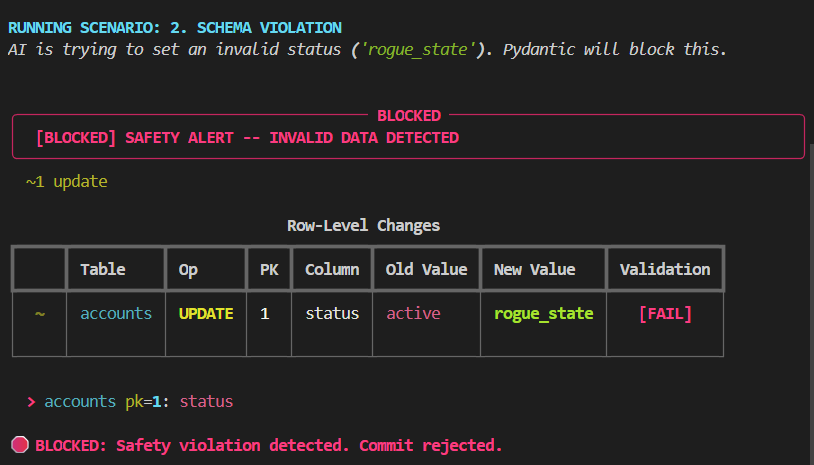
When the AI writes bad data, SafeAgentDB blocks the sync before anything touches production:
with ShadowDB(engine, tables=["tasks"], tenant_id=42) as sandbox:
    sandbox.execute("UPDATE tasks SET status = 'yolo_swag' WHERE id = 1")

    changeset = sandbox.diff()
    changeset.print()     # Shows [BLOCKED] banner with [FAIL] badge

    if not changeset.is_valid:
        print("AI output rejected. Production untouched.")
    else:
        sandbox.commit_to_production(changeset=changeset)
The [BLOCKED] banner appears:
API Reference
ShadowDB
The core context manager. Creates an isolated sandbox from your production database.
ShadowDB(
    prod_engine: Engine,            # Any SQLAlchemy engine (Postgres, MySQL, SQLite, ...)
    tables: Sequence[str],          # Table names to clone into the sandbox
    tenant_id: Any,                 # The tenant/user ID to scope all operations to
    tenant_column: str = "user_id", # Column name used for tenant filtering
    *,
    row_key: dict[str, list[str]] | None = None,   # Explicit row key per table
    reference_tables: Sequence[str] | None = None, # Shared lookup tables, cloned in full
    on_conflict: "abort" | "ignore" = "abort",     # What to do on production drift
    require_validators: bool = True,               # Missing SafeModel: error or warning
    allow_cascades: bool = False,                  # Let referential actions run in-tenant
)
tenant_id is converted once, at __enter__, to the Python type of the tenant
column, so "42" taken from a URL works for an integer column, 42 works for
a NUMERIC one, and every later comparison is like with like. A value that does
not convert exactly ("forty-two", "42.0", Decimal("42.5") for an integer
column) raises UsageError.
Keyword options:
| Option | Default | What it does |
|---|---|---|
row_key |
None |
Explicit row-identifying columns per table, e.g. {"events": ["tenant_id", "event_uuid"]}. Required for a table with no primary key, and usable to override one. The columns must exist and must be unique across the cloned rows, or SchemaError is raised. |
reference_tables |
None |
Tables to clone in full, ignoring the tenant filter. Use it for shared lookup tables (statuses, currencies, plans) so that foreign keys pointing at them are enforced in the sandbox. See Reference tables. |
on_conflict |
"abort" |
"abort" raises ConflictError when a production row changed between clone and commit, rolling the whole changeset back. "ignore" applies the changeset in part: it skips the drifted row, applies the rest, records each skip in skipped_conflicts and raises a ConflictWarning per skipped row. |
require_validators |
True |
True: a table with no registered SafeModel is a failed row in diff() and a MissingValidatorError at commit. False: a warning in both places, and the row is written unvalidated. |
allow_cascades |
False |
False: a DELETE, or an UPDATE of a referenced column, that would make production run a referential action (CASCADE, SET NULL, SET DEFAULT) on any existing row raises CascadeError, because that effect is not in the diff that was reviewed. True: such actions may run on this tenant's rows. Rows of another tenant, or rows whose owner cannot be determined, are refused either way. A cascade the diff already shows -- the child table is cloned and the agent's delete removed the children in the sandbox too -- needs no opt-in, because the children are deleted first and the parent's DELETE then triggers nothing. |
Key changes
A changeset is keyed on the row key, so an UPDATE that changes a row's key
would reach production as a DELETE of the old key plus an INSERT of the new
one. Production would then run the ON DELETE action of every foreign key
pointing at the row, not the ON UPDATE action the agent's statement
triggered: children an UPDATE would re-point get deleted instead, or the
commit fails on a RESTRICT. So a key change is refused, in diff() (as a
blocking error) and at commit, with a message saying key changes must go
through the application.
Key changes are recorded exactly, not guessed from values: the sandbox installs
TEMP triggers that log every UPDATE changing a row key. A key changed and
changed back is not refused, nor is a DELETE plus an INSERT the agent issued
as such -- those are applied as exactly that. Swapping two rows' keys is a key
change and is refused. Dropping or altering the tracking objects is detected and
raises SchemaError.
Tables must have an identifiable row. A table with no primary key and no
row_keyraisesSchemaErrorat__enter__. Without a key, SafeAgentDB cannot tell two rows apart, and anyUPDATEit built would match every row the tenant owns.
Generated keys
A serial or identity (GENERATED ... AS IDENTITY) primary key is filled by a
sequence that lives in production. SQLite has no equivalent, so the sandbox fills the column with a placeholder and
the diff says so rather than showing an id that will not survive:
 + | tasks | INSERT | pending | id      | -- | (assigned by production)
   |       |        |         | user_id | -- | 42
   |       |        |         | title   | -- | Ship v3
At commit the column is left out of the INSERT, production's sequence assigns
the real key, and it is read back and reported:
with ShadowDB(prod_engine, tables=["tasks"], tenant_id=42) as sandbox:
    sandbox.execute("INSERT INTO tasks (user_id, title) VALUES (42, 'Ship v3')")
    sandbox.commit_to_production()

    for key in sandbox.assigned_keys:
        print(key.table, key.provisional, "->", key.assigned)
        # tasks {'id': 4503599627370497} -> {'id': 901}
A placeholder is recognised by tracking which keys the sandbox itself
generated, never by size, so an ordinary large integer -- a snowflake id, a
hash -- is just a value. A TEMP trigger records any key the agent writes
itself into the provisional column.
Three things are still refused, with GeneratedValueError:
- The agent supplying the key itself. That bypasses the sequence, so a later ordinary insert can collide with it.
- A row referencing a key the sandbox generated. The parent's real key is only known once it is written, and SafeAgentDB will not guess it. This covers a foreign-key column pointing at a provisional key, and any other column holding exactly a key the sandbox generated. Insert the parent through the application first, then let the agent reference its real key.
- A row deleted and re-inserted under the same custom
row_key. That reads as anUPDATEcarrying a new placeholder in the generated column, which production would store as a real id.
A generated non-key column (a gen_random_uuid() default, say) is refused
only when the agent leaves it empty; supplying a value is fine.
A key production assigns by itself without a sequence -- a SQLite rowid alias
(id INTEGER PRIMARY KEY, with or without AUTOINCREMENT) or a MySQL
AUTO_INCREMENT column -- gets a placeholder too when the agent leaves it out,
and is assigned and reported the same way. The clone holds one tenant, so the
next id the sandbox would count to is often one another tenant already has.
Unlike a sequence, these accept an explicit key, and applications assign them
deliberately, so a key the agent supplies is written as given: production's
own uniqueness check decides, and a key another tenant holds fails the commit
with IntegrityViolationError. Whether a SQLite column is a rowid alias is
asked of SQLite rather than read off the declaration, since INT PRIMARY KEY,
INTEGER PRIMARY KEY DESC and WITHOUT ROWID tables are not.
Reference tables
The clone is tenant-scoped, so a shared lookup table with no tenant column
clones zero rows. A foreign key pointing at it could never be satisfied, so
SafeAgentDB drops that constraint in the sandbox and says so in
unsupported_constraints:
tasks: FOREIGN KEY (status_id) -> statuses not enforced -- the parent table
cloned 0 rows, so every reference would look dangling. If statuses holds no
tenant data, pass reference_tables=['statuses'] to clone it in full.
Listing the table restores the constraint:
with ShadowDB(
    prod_engine,
    tables=["tasks"],
    tenant_id=42,
    reference_tables=["statuses"],       # cloned in full, tenant filter ignored
) as sandbox:
    ...
Two things to know before you list a table:
- Every row becomes visible to the agent. Only list tables whose whole contents any tenant may see. A table holding tenant data must never be listed.
- They are read-only. Reference tables are excluded from the changeset, and
modifying one raises
SyncErrorfromdiff()rather than failing later.
Context Manager Lifecycle:
| Phase | What Happens |
|---|---|
__enter__ |
1. Reflects schema from production and converts tenant_id to the tenant column's type. 2. Creates an in-memory SQLite sandbox with foreign keys enforced, carrying constraints, unique indexes, column defaults and referential actions across (on a SQLite production the actions are read from PRAGMA foreign_key_list, since SQLAlchemy's inspector omits them). 3. Resolves a row key per table, raising SchemaError if one is missing. 4. Clones only rows where tenant_column = tenant_id. 5. Snapshots the cloned state for later diffing, installs the key-change tracking triggers and records the schema. 6. Opens a SQLAlchemy Session. Any database error -- an unknown table, an unreachable server -- raises SchemaError with the driver's error as __cause__. |
inside with |
AI operates freely on the sandbox via execute(), query(), or session. Schema changes (DDL) by the agent make diff() and the commit raise SchemaError. |
__exit__ |
Session closed. Sandbox engine disposed. All in-memory data destroyed. |
Re-entry. A ShadowDB that exited without committing can be entered again;
each entry takes a fresh clone and the earlier sandbox's work is gone. Entering
one that is already open raises UsageError (the open sandbox is left as it
is), and so does entering one that has committed.
Methods:
| Method | Signature | Description |
|---|---|---|
execute |
(sql: str, params: dict | None) -> CursorResult |
Execute raw SQL inside the sandbox and return a standard SQLAlchemy CursorResult. Without params the string goes to SQLite exactly as written, so a literal such as '{"a":1}' is never read as a bind parameter. With params it runs as a text() statement with :name placeholders; Decimal, datetime, date, time and UUID values are bound as text. A failing statement raises AgentSQLError (driver error as __cause__); everything the agent did before it is kept. |
query |
(sql: str, params: dict | None) -> list[dict] |
Execute a statement that returns rows and return them as plain dictionaries. A statement that returns no rows raises AgentSQLError -- it has still run, so use execute() for writes. |
diff |
() -> ChangeSet |
Flushes pending changes, snapshots the current sandbox state, and computes a row-level diff against the original clone. Returns a ChangeSet object. Raises SchemaError if the agent changed the sandbox schema, SyncError if it changed a reference table, and UsageError after a successful commit (the committed changes would otherwise be shown for approval again). |
commit_to_production |
(changeset: ChangeSet | None = None) -> int |
Pass the ChangeSet you reviewed and the commit refuses with ChangesetMismatchError if the sandbox changed since -- the recommended form wherever anything approves the change. Omit it to commit whatever the sandbox currently holds. Runs all 7 safety gates and syncs approved changes to production in one atomic transaction, writing only the columns the agent changed. Returns the number of rows SafeAgentDB's own statements wrote, summed from each statement's rowcount; rows production changed through a referential action you allowed with allow_cascades=True are not counted. Raises CascadeError, ChangesetMismatchError, ConflictError, GeneratedValueError, IntegrityViolationError, MissingValidatorError, RowValidationError, SchemaError or SyncError -- see Errors -- and UsageError outside the with block or when changeset is not a ChangeSet. Can only be called once per sandbox (double-commit raises SyncError). |
Properties:
| Property | Type | Description |
|---|---|---|
clone_stats |
dict[str, int] |
Number of rows cloned per table when the sandbox was created. |
tables |
list[str] |
Table names available in this sandbox. |
dialect |
str |
Production database dialect name ('postgresql', 'mysql', 'sqlite'). |
row_keys |
dict[str, list[str]] |
The row-identifying columns in use for each cloned table. |
reference_table_names |
list[str] |
Tables cloned in full and treated as read-only. |
generated_columns |
dict[str, list[str]] |
Columns whose production-side generated default the sandbox could not reproduce. |
provisional_key_columns |
dict[str, list[str]] |
Key columns the sandbox fills with a placeholder for production to replace. See Generated keys. |
assigned_keys |
list[AssignedKey] |
For the last commit, the real keys production assigned to rows that held a placeholder. |
skipped_conflicts |
list[SkippedConflict] |
Rows the last commit left unapplied under on_conflict="ignore". Empty otherwise. |
unsupported_constraints |
list[str] |
Schema elements that could not be reproduced in the sandbox, and are therefore not enforced there. See below. |
session |
Session |
Raw SQLAlchemy Session for ORM-style operations if needed. |
unsupported_constraints
The sandbox is SQLite; production usually is not. Anything that could not be
carried across is listed here rather than dropped silently, and is rendered in
both the Rich and plain diff output under a NOT ENFORCED IN SANDBOX heading:
with ShadowDB(prod_engine, tables=["users"], tenant_id=42) as sandbox:
    for item in sandbox.unsupported_constraints:
        print(item)
    # users.prefs: JSONB stored as TEXT in the sandbox; values valid here may
    #   still be rejected by production
    # users.code: server default "gen_random_uuid()" has no SQLite equivalent
A violation of anything on this list will not be caught by diff(). It surfaces
only when production rejects the commit.
SafeModel
Pydantic v2 base model for defining table schemas. Subclass it and set __table_name__ to auto-register a validator.
class SafeModel(BaseModel):
    model_config = ConfigDict(strict=True, extra="forbid")
    __table_name__: ClassVar[str] = ""
| Feature | Behavior |
|---|---|
strict=True |
No silent type coercion. An int field rejects "42" (a string). |
extra="forbid" |
Any column not in the model raises a validation error. |
__table_name__ |
Setting this on a subclass auto-registers it in the global validator registry. |
| Auto-registration | Happens at class definition time via __init_subclass__. No manual wiring needed. |
Helper functions (importable from safeagentdb.models):
| Function | Description |
|---|---|
get_validator(table_name) |
Returns the SafeModel subclass registered for a table, or None. |
validate_row(table_name, row_data, *, require_validator=True) |
Validates a dict against the registered model. With require_validator=True (the default) a missing validator raises MissingValidatorError; with False it warns and returns None. Raises pydantic's ValidationError on bad data -- this low-level helper is not wrapped; the commit wraps it in RowValidationError. |
format_validation_error(exc) |
Every failing field of a pydantic ValidationError with its reason and the value it got, as used in the dashboard and in RowValidationError. |
missing_validator_message(table_name) |
The single wording used by both RowDiff.validate() and validate_row(), so the dashboard and the commit can never disagree. |
ChangeSet
Returned by sandbox.diff(). Contains the full set of row-level changes.
| Member | Type | Description |
|---|---|---|
diffs |
list[RowDiff] |
Raw list of individual row changes. |
is_empty |
bool |
True if the AI made no changes. |
is_valid |
bool |
True when nothing SafeAgentDB can check without production rows is wrong: per-row validation plus every blocking_errors entry. Stricter in 0.3.0 -- a tenant breach, a duplicate row key, a write to a reference table, a key change or a cycle between rows now make it False, where 0.2.x reported those only at commit or not at all. A clean is_valid still does not promise the commit will succeed: drift, uniqueness against other tenants' rows, and referential actions on rows that were not cloned need production. |
unsupported_constraints |
list[str] |
Schema elements not enforced in the sandbox, carried through from ShadowDB so the rendered diff can warn about them. |
blocking_errors |
list[str] |
Problems the commit will refuse that were found without touching production: a tenant breach, a row key that no longer identifies a row, a row key the agent changed, a write to a reference table, rows that reference each other in a cycle. Any entry makes is_valid False. |
fingerprint |
str |
Hash of what this changeset would write, over a canonical form that tags every value with its type, so values of different types (1, True, 1.0, "1"; b'x' and the text "b'x'") never hash alike. Pass the changeset to commit_to_production() and it is compared, so only what was reviewed can land. |
summary |
dict[str, int] |
{"INSERT": n, "UPDATE": n, "DELETE": n} |
print() |
-> None |
Renders the Rich color-coded dashboard directly to the terminal. |
display() |
-> str |
Returns the diff as a printable string. Auto-detects TTY: Rich ANSI in terminals, plain ASCII in pipes/CI. |
validate_all() |
-> list[tuple[RowDiff, bool, str]] |
Returns per-row validation results: (diff, is_valid, message). |
RowDiff
A single row-level change.
| Field | Type | Description |
|---|---|---|
table |
str |
Table name. |
diff_type |
DiffType |
DiffType.INSERT, DiffType.UPDATE, or DiffType.DELETE. |
pk |
dict[str, Any] |
Row key values identifying the row: the primary key, or the row_key you supplied. |
old |
dict | None |
Row data before the change (None for INSERTs). |
new |
dict | None |
Row data after the change (None for DELETEs). |
changed_columns() |
-> list[str] |
Column names that differ between old and new (UPDATEs only), compared by type as well as value: 1 to true in a JSON value is a change, a JSON or timestamp value that is only formatted differently is not. |
logical_row(row) |
-> dict |
A row as production will hold it: JSON decoded, timestamps parsed. What the SafeModel sees. |
require_validator |
bool |
Whether a missing SafeModel makes this row invalid. Set from ShadowDB(require_validators=...). |
validate() |
-> tuple[bool, str] |
Runs Pydantic validation on this row. Returns (is_valid, message). Treats a missing validator exactly as the commit will. |
Errors
All exceptions live in safeagentdb.errors and are importable from
safeagentdb. Every one derives from SafeAgentDBError, so a whole agent
session can be wrapped in a single except.
SafeAgentDBError
|-- SchemaError                 production schema cannot be sandboxed safely,
|                               or the agent changed the sandbox schema
|-- SyncError                   a changeset was rejected or could not be applied
|   |-- ConflictError           production drifted between clone and commit
|   |-- CascadeError            a referential action would act on unseen rows
|   |-- ChangesetMismatchError  the sandbox changed since the review
|   |-- DuplicateRowKeyError    the row key does not identify one row
|   |-- GeneratedValueError     a row needs a value only production can generate
|   |-- IntegrityViolationError production rejected a row the sandbox accepted
|   +-- RowValidationError      a row failed its SafeModel at commit
|-- AgentSQLError               a statement the agent ran in the sandbox failed
|-- UsageError                  the API was misused (also a RuntimeError)
+-- MissingValidatorError       no SafeModel registered and one is required
Every exception a public method raises derives from SafeAgentDBError: errors
while __enter__ reads production, every database error during a commit
(starting the transaction, the reads before an INSERT, the cascade check, the
conflict diagnosis, bind-time errors), the agent's own failed statements,
commit-time validation failures and misuse. Where a driver or pydantic error was
the cause, it is kept as __cause__. The one documented exception is the
low-level safeagentdb.models.validate_row() helper, which raises pydantic's
ValidationError directly.
| Exception | Raised when |
|---|---|
SchemaError |
A cloned table has no primary key and no usable row_key; a row_key names missing columns or is not unique in the cloned rows; the production schema cannot be reproduced in SQLite; __enter__ hit a database error (unknown table, unreachable server); the tenant column holds different types in different tables; the agent changed the sandbox schema or dropped the tracking triggers. |
SyncError |
Anything diff() reports as blocking (tenant breach, changed row key, cycle between rows, write to a reference table); an UPDATE/DELETE has no row-identifying key; a value production's type cannot take (text in a JSON column that is not JSON, text in a datetime column that is not a timestamp); a database error during the commit; the sandbox is committed twice. |
ConflictError |
A guarded UPDATE/DELETE matched nothing, or a row key matches more than one row. Carries .table, .row_key and .columns (the drifted column names). The message only blames another writer when re-reading the row shows a column that changed; otherwise it says it cannot name one, and if an earlier statement's referential action (under allow_cascades=True) could have changed the row, it says that. |
GeneratedValueError |
A new row supplies a key production is meant to assign, needs a generated value the sandbox could not hold for it, references a key the sandbox generated, or was deleted and re-inserted under the same custom row_key. Carries .table and .columns. See Generated keys. |
IntegrityViolationError |
Production rejected a row the sandbox accepted. The message gives the driver's reason and the possible causes without claiming one: a row outside the tenant or in a table that was not cloned, or the unit-of-work order not suiting the changeset (a unique value moved from a deleted row to a new one). Carries .table and .row_key, and the driver's IntegrityError as __cause__. |
RowValidationError |
A row failed its SafeModel at commit. diff() reports the same row as failed first. Carries .table, .row_key, .errors (pydantic's structured errors) and pydantic's ValidationError as __cause__. |
MissingValidatorError |
A table has no registered SafeModel and require_validators is True. Also subclasses KeyError, so 0.1.x handlers keep working. |
DuplicateRowKeyError |
A row key does not identify a single row: two sandbox rows share it, or an INSERT carries a key production already holds. Carries .table and .row_key. |
CascadeError |
A DELETE, or an UPDATE to a referenced column, would make production run a referential action on rows the diff does not show: rows of this tenant (unless allow_cascades=True), rows of another tenant, or rows with no determinable owner. Carries .table, .referencing_table, .action, and .tenants (other tenants) or .unattributed_rows (rows whose referencing table has no tenant column, or whose tenant value is NULL). |
ChangesetMismatchError |
commit_to_production(changeset=...) was given a changeset the sandbox no longer matches. Carries .reviewed and .current fingerprints. |
AgentSQLError |
A statement passed to execute() or query() failed, or query() was given a statement that returns no rows. The sandbox keeps everything done before it. |
UsageError |
A method was called outside the with block; diff() was called after a successful commit; an open or committed ShadowDB was entered again; on_conflict or changeset has the wrong value; tenant_id does not convert exactly to the tenant column's type. Subclasses RuntimeError, which these cases raised before 0.3.0 (a bad on_conflict raised ValueError). |
MissingValidatorWarning |
Not an error: warned when require_validators=False and a row is written unvalidated. |
ConflictWarning |
Not an error: warned once per row skipped under on_conflict="ignore". |
Handling a conflict:
from safeagentdb import ConflictError

try:
    sandbox.commit_to_production()
except ConflictError as exc:
    print(f"{exc.table} row {exc.row_key} drifted on {exc.columns}")
    # Nothing was written. Re-clone and let the agent try again.
Partially applying instead, with on_conflict="ignore":
with ShadowDB(engine, tables=["tasks"], tenant_id=42, on_conflict="ignore") as sandbox:
    ...
    written = sandbox.commit_to_production()   # fewer than the changeset held

    for skip in sandbox.skipped_conflicts:     # never silent
        print(f"skipped {skip.table} {skip.row_key}: {skip.columns} drifted")
Each skipped row also raises a ConflictWarning, so a partial apply is visible
even when nobody inspects the result.
DiffType
Enum with three values: INSERT, UPDATE, DELETE.
Advanced Scenarios
Multi-Table Operations
SafeAgentDB supports sandboxing multiple tables at once. Validators are matched by __table_name__:
class UserValidator(SafeModel):
    __table_name__ = "users"
    id: int
    user_id: int
    email: str
    plan: Literal["free", "pro", "enterprise"]

class InvoiceValidator(SafeModel):
    __table_name__ = "invoices"
    id: int
    user_id: int
    amount_cents: int
    status: Literal["pending", "paid", "refunded"]

with ShadowDB(engine, tables=["users", "invoices"], tenant_id=42) as sandbox:
    sandbox.execute("UPDATE users SET plan = 'pro' WHERE id = 1")
    sandbox.execute("UPDATE invoices SET status = 'paid' WHERE id = 1")
    sandbox.diff().print()
    sandbox.commit_to_production()
Programmatic Approval Workflow
Use is_valid and summary to build approval logic without human intervention:
with ShadowDB(engine, tables=["tasks"], tenant_id=42) as sandbox:
    run_ai_agent(sandbox)  # AI does its thing

    changeset = sandbox.diff()

    if changeset.is_empty:
        print("AI made no changes.")
    elif not changeset.is_valid:
        log.error("AI output rejected", extra=changeset.summary)
    elif changeset.summary["DELETE"] > 10:
        log.warning("AI wants to delete too many rows, needs human review")
    else:
        sandbox.commit_to_production()
Tenant Security: What Gets Blocked
SafeAgentDB enforces tenant isolation at three levels:
# Scenario 1: AI tries to INSERT a row for a different tenant
sandbox.execute("INSERT INTO tasks VALUES (99, 777, 'evil', 'todo')")
sandbox.commit_to_production()
# --> SyncError: "This changeset cannot be committed:
#       - Tenant breach blocked on INSERT: row in 'tasks' has user_id=777, expected 42."

# Scenario 2: AI tries to UPDATE a row to change its tenant
sandbox.execute("UPDATE tasks SET user_id = 777 WHERE id = 1")
sandbox.commit_to_production()
# --> SyncError: "This changeset cannot be committed:
#       - Tenant breach blocked on UPDATE: row in 'tasks' has user_id=777, expected 42."

# Scenario 3: Even if AI could somehow craft a rogue row,
# every UPDATE/DELETE uses: WHERE pk = ? AND user_id = 42
# at the SQL level -- the database itself enforces the scope.
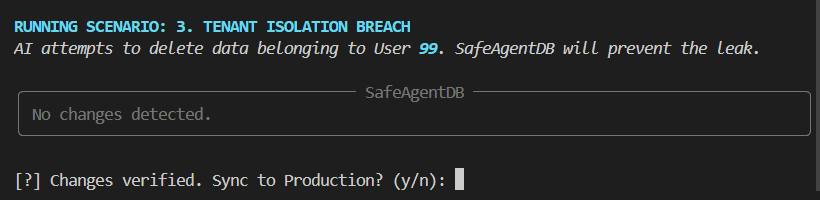
When an AI agent tries to access another tenant's data, the sandbox simply contains no rows for them -- the diff shows nothing changed:
Using the Raw SQLAlchemy Session
For ORM-style access, use sandbox.session directly:
from sqlalchemy import text

with ShadowDB(engine, tables=["tasks"], tenant_id=42) as sandbox:
    result = sandbox.session.execute(text("SELECT count(*) FROM tasks"))
    count = result.scalar()
Supported Databases
The sandbox is always in-memory SQLite. What differs is how well each production database is supported:
| Production | Support | What that means |
|---|---|---|
| PostgreSQL | First-class | The production target SafeAgentDB is designed and tested for. CI runs the server-backed suite (tests/test_server_backed.py) against PostgreSQL 16: tenant isolation, compare-and-swap against a concurrent transaction, sequences, foreign keys and their order, cascades, key changes, JSONB/ARRAY and timestamptz round-trips. JSONB, JSON, ARRAY and HSTORE are carried as JSON text; UUID, INET, CIDR, MACADDR, CITEXT, TSVECTOR as text. |
| SQLite | Best-effort | Exercised by most of the suite, which uses SQLite as the stand-in production, and the issues that were cheap to fix are fixed. The known limits are listed under SQLite production. |
| MySQL / MariaDB | Untested | Nothing in the library is MySQL-specific and every production statement is built from SQLAlchemy Core, so identifiers are quoted by the dialect. TINYINT/MEDIUMINT are integers in the sandbox; ENUM, SET and YEAR are carried as text. AUTO_INCREMENT keys are held provisionally (see Generated keys); the three tests for that in tests/test_review_b1.py were run against MySQL 8.0 and run when MYSQL_DATABASE_URL is set, but CI has no MySQL job and nothing else is tested against a MySQL server, so treat the rest as unverified. |
| Others | Not supported | Other SQLAlchemy dialects may work, but nothing is known about them. |
The production sync always uses the original production metadata; the type mapping only applies to the throwaway sandbox. Values are carried through it as follows:
- JSON (
JSON,JSONB,ARRAY,HSTORE): every value is held as its JSON encoding, scalars included, and decoded back at commit. The string"123", the number123andtruestay distinct. Text the agent writes into such a column must be JSON ('"hello"'for a string); anything else is refused rather than guessed at. SQLNULLand JSONnullare the same value in the sandbox, as in SQLAlchemy's ownJSONtype. - Datetimes: held as ISO 8601 text, which keeps a UTC offset. A
timestamptzkeeps its instant; on a SQLite production the stored text is read as it is and an offset is written back with the value. A value with an offset for a column without time zone (PostgreSQLtimestamp) is refused, since the database would convert it by its session time zone and drop the offset without saying so; write the time without an offset. - Text-mapped types (
UUID,INET, ...): held and written back as text.
SQLite production
Best-effort. Fixed for 0.3.0: referential actions are read from
PRAGMA foreign_key_list and carried into the sandbox, and datetime offsets
survive. Known limits:
DATETIME,DATE,TIMEandBOOLEANcolumns are left out of the compare-and-swap guard. SQLite stores them as text or numbers in whatever format the writer chose ('2024-01-01 10:00:00','2024-01-01T10:00:00','true',1) and compares that storage literally, so a guard on them failed with nothing changed -- including for SQLite's ownCURRENT_TIMESTAMPformat. A concurrent edit confined to such a column is therefore not detected on SQLite. The same columns are guarded on PostgreSQL.- A datetime written back is stored in SQLAlchemy's text format plus the
offset (
'2024-01-01 10:00:00.000000+02:00'), so a value copied from a row stored as'2024-01-01T10:00:00Z'lands as the same instant in a different format. - SQLite's dynamic typing means a value the sandbox accepts is accepted by a
SQLite production too, whatever its declared type; nothing beyond your
SafeModelchecks the type.
Guarantees and limits
SafeAgentDB is a safety net, not a proof of correctness. This section is the honest version of what that means.
What the sandbox does catch
- Schema violations on every INSERT/UPDATE row, via your
SafeModel(strict mode, no coercion, no extra columns). NOT NULL,PRIMARY KEY,UNIQUE,CHECKandFOREIGN KEYviolations, for every constraint that could be reproduced in SQLite. Foreign keys are enforced (PRAGMA foreign_keys=ON).- Column defaults, so an
INSERTthat omits a defaultedNOT NULLcolumn behaves in the sandbox as it does in production. - Cross-tenant writes, at clone time, at validation time, and in the
WHEREclause of every statement. - Unidentifiable rows: a table with no primary key and no
row_keyis refused rather than guessed at. - Indirect writes through referential actions: the tenant filter applies to
the statements SafeAgentDB issues. A foreign key declared
ON DELETE CASCADE,SET NULLorSET DEFAULT(or theON UPDATEforms) makes the database act on further rows by itself, and noWHEREclause of ours constrains those. Every such key pointing into a cloned table is found at__enter__-- across all of production, not just the cloned tables -- reported inunsupported_constraints, and checked at commit, inside the transaction: if the action would act on any existing row,CascadeErrorrolls the changeset back, because that effect is not in the diff.allow_cascades=Truepermits it within the tenant. Another tenant's rows, and rows with no determinable owner, are refused either way: an audit log keyed only ontask_idcannot be attributed to anyone, and an unknown owner is not treated as the acting tenant. A referencing row is the acting tenant's only when its tenant value equals the tenant id after a lossless conversion:42,Decimal("42")and'42'are tenant 42, while'042','+42',' 42'and'42.0'in aTEXTcolumn belong to another tenant. When the referencing table is cloned, the sandbox runs the action itself, so the diff shows its effect and the commit needs no opt-in. - Key changes: an
UPDATEthat changes a row key is refused, because it would reach production asDELETE+INSERTand run the wrong referential actions. See Key changes. - Exactly what was reviewed:
commit_to_production(changeset=...)compares the changeset's fingerprint against a freshly computed diff and refuses if the sandbox moved on, so an approval cannot be widened after the fact. The fingerprint tags every value with its type. A change Python considers equal (1totrueinside a JSON value) is detected and written; a value only formatted differently is not a change. - Production drift: a row changed by another process between clone and
commit is a
ConflictError, not a silent overwrite. The clone-time values are carried in theWHEREclause of theUPDATE/DELETEitself, so the check and the write are one statement. This holds at any isolation level, including PostgreSQLREAD COMMITTEDand MySQLREPEATABLE READ, and takes no row locks. AnUPDATEguards the columns the agent changed, so an unrelated concurrent edit to a different column of the same row is allowed to coexist; aDELETEguards the whole row. On PostgreSQL this is verified in CI; on a SQLite production some column types are left out of the guard (see SQLite production). - Values only production can generate: a
serial/identity key is left for production's sequence to assign and reported back, never invented by the sandbox. Supplying one by hand, or pointing at a placeholder that does not exist yet, is refused withGeneratedValueError. - Statement order: INSERTs parents first, then UPDATEs, then DELETEs
children first, except where a foreign key between two rows of the changeset
needs otherwise -- in one table (an org chart, a comment thread) or across
tables, and including a foreign key onto a
UNIQUEcolumn that is not the primary key. A value a parent starts to hold is written before any child references it, and a child stops referencing a value before its parent gives it up: re-pointing a child and then deleting or renaming its old parent commits. Rows with no order production would accept one statement at a time -- rows that reference each other in a cycle, or a child that follows its parent's new value throughON UPDATE CASCADE-- are refused indiff().
What the sandbox cannot catch
-
Anything listed in
unsupported_constraints. Dialect-specific column types are stored asTEXT/VARCHAR, so a malformed UUID passes in the sandbox and is rejected by production. Server defaults with no SQLite equivalent, foreign keys pointing outside the cloned tables, referential actions whose referencing table was not cloned, andCHECKconstraints that reflection could not reproduce are all listed there. -
The shape of a cascade into a table that was not cloned. The commit refuses it (see above), but cannot show you the affected rows in the diff. Clone the referencing table to see them.
-
The validity rules of remapped columns. JSON and datetime values are carried through the sandbox as text and converted back exactly (see Supported Databases), but the sandbox does not enforce, say, an
ARRAYelement type, and JSON and text-mapped columns are excluded from the compare-and-swap guard because the two sides hold different representations. -
Uniqueness against rows you did not clone. The sandbox holds one tenant's rows. A value that is unique within that tenant can still collide with another tenant's row, and that only surfaces when production rejects the commit.
-
Database-side logic. Triggers, rules, row-level security policies, stored procedures, generated columns, partial and functional indexes, deferrable constraints and exclusion constraints are not cloned and never run in the sandbox.
-
Dialect semantics. SQLite has dynamic typing, different collation and case-sensitivity rules, and no fixed-width integer overflow. A value SQLite accepts may be rejected or stored differently by PostgreSQL or MySQL.
-
Concurrency beyond the rows being written. The compare-and-swap guard covers the rows in the changeset. A row the agent merely read is not guarded, so a decision based on stale data can still be applied. Nor is a row inserted by someone else in the meantime: uniqueness against it surfaces as
IntegrityViolationErrorat commit, not as a conflict. -
Columns whose equality is unreliable.
Float/REAL/DOUBLE,JSON,JSONB,ARRAY,HSTORE,TSVECTOR,MONEYand binary columns are excluded from the guard: their values do not survive a driver round-trip reliably enough to gate a write on, and comparing them would reject correct changesets. A concurrent edit confined to such a column is not detected. On a SQLite production,DATETIME,DATE,TIMEandBOOLEANare excluded too. -
Changesets the unit-of-work order does not suit. INSERTs run before DELETEs, so moving a unique value from a row the agent deleted to a row it inserted fails in production with
IntegrityViolationError(nothing is written). Commit the delete first, in its own changeset. -
Key changes. Refused, never translated: change keys through the application.
-
An
ON UPDATE CASCADEon a cloned child. The children follow the parent's new value in the sandbox, which no order of single statements can reproduce: the parent would have to change both before and after them. It is refused indiff(). Change the referenced value through the application. (ON UPDATE SET NULLandSET DEFAULTcommit: the children are written first, so production has nothing left to act on.) -
An upsert on the agent's own new row, in a table whose key production assigns.
INSERT ... ON CONFLICT DO UPDATEorINSERT OR IGNOREnaming a key the sandbox generated is recorded as a key the agent supplied, so the row is refused withGeneratedValueError. Update the row with a plainUPDATEinstead. -
Rows the agent inserts into SafeAgentDB's own change log. The log of key changes refuses
UPDATEandDELETE, and dropping or altering it raisesSchemaError, but an agent that inserts a forged row into it can hide a key change. What is then committed is theDELETEplusINSERTthe diff shows, truthfully, and a referential action that would reach rows outside the diff is still refused unlessallow_cascades=True. -
Unguarded columns on an UPDATE. By design only the changed columns are guarded, so a concurrent edit to a column the agent did not touch is allowed through. That is the point -- it keeps unrelated work from colliding -- but it does mean the row as a whole is not frozen between clone and commit.
-
Scale. The entire tenant scope is copied into memory. This is designed for one tenant's working set, not for a full-table migration.
-
A new row referencing another new row. Refused rather than resolved. If your agent needs to build a parent and its children in one go, create the parent through the application first.
Verified against a real server
The sandbox is SQLite, so most of the suite uses SQLite as the stand-in
production database. The claims that only a real server can settle --
compare-and-swap against a genuinely concurrent transaction, sequences assigning
keys, foreign keys and statement order, cascades and key changes, JSONB and
timestamptz round-trips, tenant isolation -- are covered by
tests/test_server_backed.py, which CI runs against a PostgreSQL 16 service
container. They are skipped locally unless you set DATABASE_URL:
DATABASE_URL=postgresql+psycopg2://user:pass@localhost/db python -m pytest -m requires_db
MySQL is not covered beyond the AUTO_INCREMENT tests in tests/test_review_b1.py,
which run when MYSQL_DATABASE_URL is set; see
Supported Databases.
Operational notes
- The sandbox is always in-memory SQLite, whatever your production dialect.
MetaData.reflectresolves foreign keys, so asking for one table may clone the tables it references as well. Checkclone_statsto see what was copied.- Foreign key enforcement is suspended while the tenant's rows are loaded, since a tenant-scoped clone is a partial view and may reference parents that were not copied. It is on for everything the agent does afterwards.
commit_to_production()can be called once per sandbox, anddiff()raisesUsageErrorafter it.- The sandbox's own tracking objects are
TEMPtables and triggers named_safeagentdb_*. They live in SQLite's temp schema, never reach a diff, and are read-only to the agent.
Why Not Raw SQLAlchemy?
| Concern | Raw SQLAlchemy | SafeAgentDB |
|---|---|---|
| AI writes bad data | Goes to production immediately | Pydantic validates every row first |
| AI touches wrong tenant | Your problem | Tenant guard on clone, on data, and in SQL WHERE |
| Reviewing changes | Write your own diff logic | sandbox.diff().print() with Rich dashboard |
| Partial failures | Manual transaction handling | Single atomic transaction, all-or-nothing |
| Sandbox isolation | Build it yourself | In-memory SQLite, auto-created, auto-destroyed |
| Cross-dialect support | Handle type mismatches yourself | Auto-maps Postgres/MySQL types to SQLite |
Raw SQLAlchemy is a general-purpose ORM. SafeAgentDB is a purpose-built safety layer for the specific threat model of AI agents writing to databases.
How Sync Works Internally
sandbox.commit_to_production(changeset)
  |
  |-- 1. Flush the sandbox session; refuse if the agent changed the schema
  |                                                       --> SchemaError
  |-- 2. Snapshot the sandbox and read the key-change log
  |-- 3. Compute the row-level diff vs the clone, keyed on the row key,
  |      comparing values by type (canonical form)
  |-- 4. Compare fingerprints with the reviewed changeset --> ChangesetMismatchError
  |-- 5. Refuse blocking errors: tenant breach, changed row key, row cycle,
  |      reference-table write, ambiguous row key          --> SyncError
  |
  |-- 6. Order: INSERTs (parents first, rows by their references),
  |             UPDATEs (parents first),
  |             DELETEs (children first, rows by their references)
  |
  |-- Inside ONE engine.begin() transaction, FOR EACH diff:
  |     |-- 7. Tenant matches in row data                  --> SyncError
  |     |-- 8. Written JSON/datetime values decode         --> SyncError
  |     |-- 9. SafeModel validation                        --> RowValidationError
  |     |                                                     MissingValidatorError
  |     |-- 10. Generated-key checks                       --> GeneratedValueError
  |     |-- 11. INSERT? refuse a key production holds      --> DuplicateRowKeyError
  |     |       insert(table).values(row, provisional key left out)
  |     |
  |     |-- 12. Row key present and correct                --> SyncError
  |     |-- 13. Referential actions: count referencing rows per tenant
  |     |       other tenant / unknown owner               --> CascadeError
  |     |       this tenant, without allow_cascades        --> CascadeError
  |     |
  |     '-- 14. One compare-and-swap statement:
  |           |-- UPDATE: update(table)
  |           |             .where(row key AND tenant_id
  |           |                    AND each changed, guardable column = its clone value)
  |           |             .values(only the changed columns)
  |           |-- DELETE: delete(table)
  |           |             .where(row key AND tenant_id
  |           |                    AND every guardable column = its clone value)
  |           |-- rowcount == 1 --> applied
  |           |-- rowcount == 0 --> re-read to explain --> ConflictError
  |           '-- rowcount > 1  --> the key is not unique --> ConflictError
  |
  |-- Any database error, at any step                    --> SyncError (cause kept)
  '-- Any failure --> full rollback, zero writes
A NULL clone-time value becomes col IS NULL rather than col = NULL, which
never matches. Because the guard value is a Python value rather than a bind
parameter, that branch is exact on every dialect and needs no
IS NOT DISTINCT FROM or <=> handling.
Every statement sent to production -- the writes, the existing-key read, the
cascade check and the conflict diagnosis -- is built from SQLAlchemy Core
constructs (insert(), update(), delete(), select()), so identifiers are
quoted by the dialect and values are always bound. The only literal SQL is
inside the sandbox: SQLite PRAGMAs and the tracking triggers, built from
schema identifiers quoted by SQLite's own preparer.
Architecture
safeagentdb/
|-- __init__.py     Public API: ShadowDB, SafeModel, ChangeSet, RowDiff, DiffType, errors
|-- errors.py       SafeAgentDBError hierarchy: SchemaError, SyncError, ConflictError, ...
|-- engine.py       Schema reflection and translation, sandbox creation, row cloning
|-- sandbox.py      ShadowDB context manager with execute(), query(), diff(), commit_to_production()
|-- models.py       SafeModel base class + auto-registration validator registry
|-- diff.py         Row-level diff engine + Rich dashboard renderer + plain-text fallback
|-- sync.py         Atomic production sync: tenant guards, row-key guard, compare-and-swap
'-- py.typed        PEP 561 type checker marker

tests/
|-- conftest.py              Fixtures, including the server engine for DATABASE_URL
|-- test_core.py             End-to-end release check (script style)
|-- test_mega.py             Exhaustive coverage of the public API
|-- test_weaknesses.py       Regression guards for the four findings in docs/AUDIT.md
|-- test_hardening.py        The machinery added in 0.2.0
|-- test_audit_followups.py  Five issues found reviewing that work
|-- test_review_findings.py  The six findings of the second review (docs/AUDIT.md)
|-- test_review_0_3.py       The findings of the pre-0.3.0 review (docs/REVIEW_0_3.md)
|-- test_review_round4.py    Round 4 of that review: the findings in its fixes
|-- test_review_b1.py        B-1, found by the benchmark: keys production assigns by itself
'-- test_server_backed.py    Claims only a real server can settle (PostgreSQL in CI)

docs/
|-- AUDIT.md         The weakness audit and the second review
|-- REVIEW_0_3.md    The pre-0.3.0 review, with the status of each finding
'-- review-repros/   Runnable reproductions for REVIEW_0_3.md, kept as they were run
Run the suite with python -m pytest -q and the linter with ruff check .;
both run in CI on Python 3.10, 3.11 and 3.12, and the server-backed tests run
against PostgreSQL 16.
License
MIT -- see LICENSE.
1 maintainer

Metadata
1 maintainer
Release files for safeagentdb 0.3.1
For a detailed explanation of source distributions (sdists) and built distributions (wheels), please see the package formats documentation.
Source distribution (sdist)
| File | Size | Uploaded | Provenance | Actions |
|---|---|---|---|---|
| safeagentdb-0.3.1.tar.gz | 313.5 kB | Without provenance | Details for safeagentdb-0.3.1.tar.gz |
Built distribution (wheel)
| File | Interpreter | ABI | Platform | Actions Reset |
|---|---|---|---|---|
| safeagentdb-0.3.1-py3-none-any.whl | Python 3 | none | any | Details for safeagentdb-0.3.1-py3-none-any.whl |
Total release size: 391.6 kB
Release files / safeagentdb-0.3.1.tar.gz
| Download URL | safeagentdb-0.3.1.tar.gz |
|---|---|
| Size | 313.5 kB |
| Tags | Source |
|
SHA-256 checksum How to use checksums |
56b08f8eee10946955a4dff0e3515c9643ef751221943f4c5ec7fd1ad7d19536
|
|
BLAKE2b-256 checksum How to use checksums |
d3312e098df75a292cb5b822a9db917e1fdc58786ef1aea6009386ee27688f88
|
| Upload date | |
|
Uploaded using Trusted Publishing? What is trusted publishing? |
No |
| Uploaded via |
twine/7.0.0 CPython/3.11.9
|
Release files / safeagentdb-0.3.1-py3-none-any.whl
| Download URL | safeagentdb-0.3.1-py3-none-any.whl |
|---|---|
| Size | 78.1 kB |
| Tags | Python 3 |
|
SHA-256 checksum How to use checksums |
3de82d927e34922707ad275f65563f11b0d302409ad3848df4f3e1aaf55af0bb
|
|
BLAKE2b-256 checksum How to use checksums |
9466f26b6849ecd9c3096911acb6ca3aafa717cf04b4a4ca37542f64e66396be
|
| Upload date | |
|
Uploaded using Trusted Publishing? What is trusted publishing? |
No |
| Uploaded via |
twine/7.0.0 CPython/3.11.9
|
Security for safeagentdb 0.3.1
Provenance
Provenance describes where a file came from. On PyPI, provenance is shared via attestations, which provide a verifiable record of the build or publishing details. View details, limitations and caveats.
No provenance found
None of the files in this release were uploaded with provenance metadata.
A note on package security
PyPI is a repository for distributing packages, not a service for auditing them. While third-party security researchers and our staff do their best to detect and remove malicious packages, PyPI cannot guarantee the quality, security or suitability of any given package.
To learn more about protecting yourself from malicious actors, visit our package security documentation.














