
SaliencyTools
Comparing saliency maps produced by XAI methods.




This module is a work in progress, contributions are welcome!
SaliencyTools is an open-source Python package providing thirteen curated, image-native metrics for comparing saliency maps generated by explainability methods (SHAP, LIME, GradCAM, Integrated Gradients, …). Unlike general-purpose distance libraries, all metrics operate directly on 2-D NumPy arrays, preserve spatial structure, and handle signed attribution maps natively.
Installation
pip install saliencytools
Usage
import numpy as np
from saliencytools.maskcompare import (
    sign_agreement_ratio,
    ssim,
    mean_absolute_error,
    euclidean_distance,
    cosine_distance,
    mean_squared_error,
    psnr,
    emd,
    correlation_distance,
    jaccard_distance,
    czenakowski_distance,
    kl_divergence,
    auc_judd,
    # preprocessing utilities
    normalize_mask_0_1,
    clip_mask,
)

# Two signed attribution maps (e.g. from SHAP and LIME on the same input)
map_a = np.random.randn(28, 28)
map_b = np.random.randn(28, 28)

print(sign_agreement_ratio(map_a, map_b))
print(ssim(map_a, map_b))

# Set-theoretic metrics require non-negative inputs
map_a_nn = normalize_mask_0_1(map_a)
map_b_nn = normalize_mask_0_1(map_b)
print(jaccard_distance(map_a_nn, map_b_nn))

# AUC-Judd is directed: first argument is the prediction, second is the reference
# e.g. compare a LIME explanation against a prototype
print(auc_judd(map_a, map_b))
Metrics implemented
| Category | Metric | Function |
|---|---|---|
| Geometric | Euclidean distance | euclidean_distance |
| Geometric | Cosine distance | cosine_distance |
| Geometric | Mean Absolute Error | mean_absolute_error |
| Geometric | Mean Squared Error | mean_squared_error |
| Statistical | Earth Mover's Distance | emd |
| Statistical | Peak Signal-to-Noise Ratio | psnr |
| Statistical | Correlation distance | correlation_distance |
| Set-theoretic | Jaccard distance | jaccard_distance |
| Set-theoretic | Czekanowski distance | czenakowski_distance |
| Binary | Sign Agreement Ratio | sign_agreement_ratio |
| Structural | SSIM | ssim |
| Information-theoretic | KL Divergence (symmetric) | kl_divergence |
| Information-theoretic | AUC-Judd (directed) | auc_judd |
Preprocessing utilities: normalize_mask_0_1, clip_mask, normalize_mask
Set-theoretic metrics (jaccard_distance, czenakowski_distance) require non-negative inputs; apply normalize_mask_0_1 first.
auc_judd is intentionally asymmetric: auc_judd(prediction, reference) scores how well the prediction recovers the above-mean regions of the reference map.
Proxy benchmark
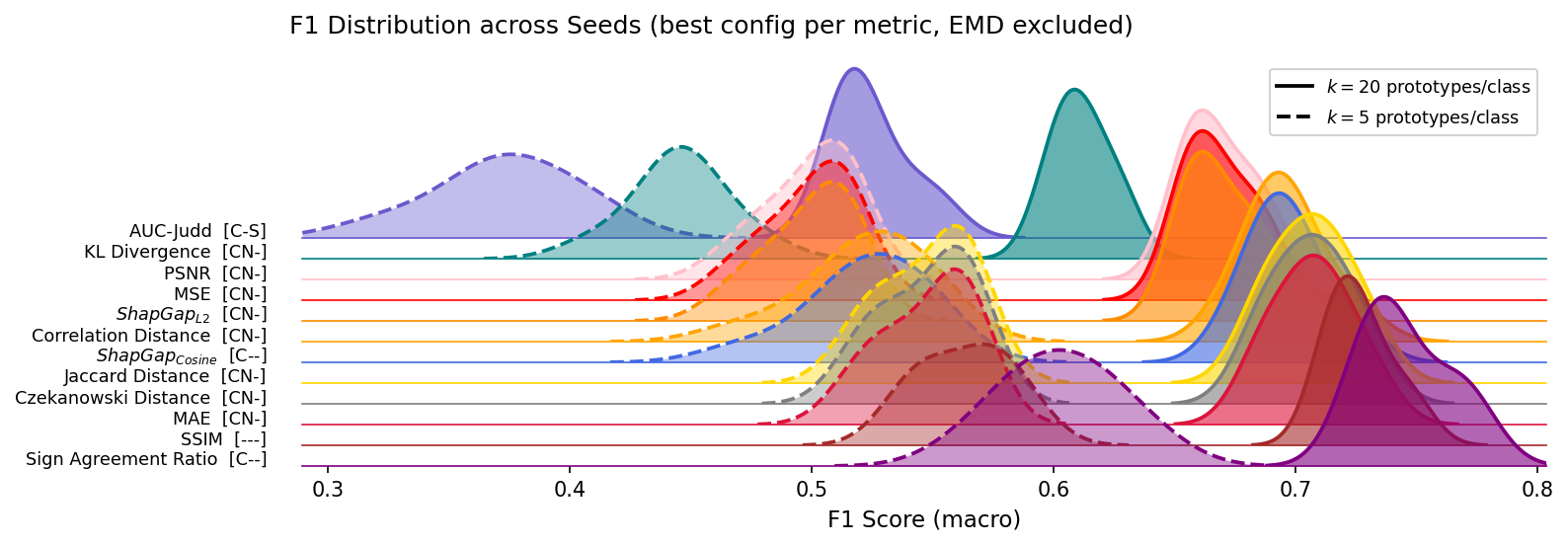
Because real saliency maps have no ground truth, we validate metric discriminability with a controlled proxy benchmark: a k-nearest-neighbour classifier on MNIST, evaluated with macro-F1 across 8 preprocessing configurations and 10 independent prototype draws.
Key findings (k=20 prototypes/class, 10 seeds):
| Metric | Mean F1 | Best config | Time (s) |
|---|---|---|---|
| Sign Agreement Ratio | 0.746 ± 0.017 | [---] |
~11 |
| SSIM | 0.726 ± 0.013 | [---] |
~228 |
| MAE | 0.707 ± 0.016 | [CN-] |
~9 |
| … | |||
| Earth Mover's Distance | 0.380 ± 0.009 | [---] |
~283 |
[C--] = clip to [-1,1]; [N--] = normalize to [0,1]; [S--] = Sobel filter.
Reproducing the benchmark
# Full multi-seed run (k=20 prototypes/class, 10 seeds; resumes safely if interrupted)
python run_benchmark.py --out results_seeds.json

# k-sensitivity run
python run_benchmark.py --k 5 --out results_k5.json
Estimated runtime: 3–4 hours on CPU for the default run. Use --resume to continue an interrupted run.
Reproducing paper tables and figures
# LaTeX results table (auto-detects multi-seed format)
python paper/generate_tables.py --results results_seeds.json

# All figures (heatmap, F1-vs-time, stability, joyplot)
# Add --results-k5 to overlay the k=5 KDE on the joyplot
python paper/generate_figures.py --results results_seeds.json --multi-seed
python paper/generate_figures.py --results results_seeds.json --results-k5 results_k5.json --multi-seed
Tables are written to paper/tables/ and figures to paper/figures/.
Why SaliencyTools?
Existing alternatives fall short for saliency map comparison:
- distancia (GitHub, docs) — broad coverage of mathematical distances, but images must be converted to flat lists (spatial structure lost), several metrics contain implementation errors, and there is no image-native preprocessing pipeline.
- saliency-metrics (GitHub, docs) — targets saliency evaluation specifically, but abandoned since 2022 with incomplete documentation.
- Quantus (GitHub) — evaluates explanation quality relative to a model (faithfulness, robustness, localisation); requires the model and input data. SaliencyTools only needs two maps, making it suitable for lightweight, model-agnostic comparison. The two tools are complementary.
SaliencyTools is image-native, actively maintained, and formally tested for symmetry, non-negativity, and identity axioms (test/test_metrics.py).
Further reading
- Interpretable Machine Learning Book — https://christophm.github.io/interpretable-ml-book/pixel-attribution.html
- Bylinskii et al. (2019) — What Do Different Evaluation Metrics Tell Us About Saliency Models? — IEEE TPAMI
- Samek et al. (2017) — Evaluating the Visualization of What a Deep Neural Network Has Learned — IEEE TNNLS
- Wörheide et al. (2021) — Multilevel Correspondence Analysis — https://doi.org/10.1364/JOSAA.31.000532
- Google
saliencylibrary — https://pypi.org/project/saliency/
1 maintainer

Metadata
1 maintainer
Release files for saliencytools 0.35
For a detailed explanation of source distributions (sdists) and built distributions (wheels), please see the package formats documentation.
Source distribution (sdist)
| File | Size | Uploaded | |
|---|---|---|---|
| saliencytools-0.35.tar.gz | 13.7 kB | Details |
Built distribution (wheel)
| File | Interpreter | ABI | Platform | Reset |
|---|---|---|---|---|
| saliencytools-0.35-py3-none-any.whl | Python 3 | none | any | Details |
Total release size: 25.8 kB
Release files / saliencytools-0.35.tar.gz
| Download URL | saliencytools-0.35.tar.gz |
|---|---|
| Size | 13.7 kB |
| Tags | Source |
|
SHA-256 checksum How to use checksums |
69cfeeb1af1ca92746c37bdbf68601c98be4211918ef2f91e8920adc4c317c17
|
|
BLAKE2b-256 checksum How to use checksums |
65ad85e39cd938fdf2c8818b778cb26e96964c729ede0bc07715e6319e09ae1f
|
| Upload date | |
|
Uploaded using Trusted Publishing? What is trusted publishing? |
No |
| Uploaded via |
twine/6.1.0 CPython/3.10.12
|
Release files / saliencytools-0.35-py3-none-any.whl
| Download URL | saliencytools-0.35-py3-none-any.whl |
|---|---|
| Size | 12.1 kB |
| Tags | Python 3 |
|
SHA-256 checksum How to use checksums |
137dde4012537158c186df9c0358004b619b9ae610349691c7f1501c7f28208c
|
|
BLAKE2b-256 checksum How to use checksums |
e20896a8181a6a2fa7128f3109644a1220e41e81c85c378403d65e81f1bc8fff
|
| Upload date | |
|
Uploaded using Trusted Publishing? What is trusted publishing? |
No |
| Uploaded via |
twine/6.1.0 CPython/3.10.12
|














