
Toolkit for transforming molecular dynamics (MD) trajectories into rich graph representations

Project description
SAWNERGY



A toolkit for transforming molecular dynamics (MD) trajectories into rich graph representations, sampling
random and self-avoiding walks, learning node embeddings, and visualizing residue interaction networks (RINs). SAWNERGY
keeps the full workflow — from cpptraj output to skip-gram embeddings (node2vec approach) — inside Python, backed by efficient Zarr-based archives and optional GPU acceleration.
Installation
pip install sawnergy
Optional: For GPU training, install PyTorch separately (e.g.,
pip install torch). Note: RIN building requirescpptraj(AmberTools). Ensure it is discoverable via$PATHor theCPPTRAJenvironment variable. Probably the easiest solution: install AmberTools via Conda, activate the environment, and SAWNERGY will find the cpptraj executable on its own, so just run your code and don't worry about it.
UPDATES:
v1.0.9 — What’s new:
v1.0.9 — What’s new:
SGNS_Torchis no longer deprecated.- The root cause was weight initialization; it’s fixed.
SG_TorchandSG_PureMLno longer use biases.- Affine/Linear layers no longer translate embeddings away from the origin.
- Warm starts for frame embeddings.
- Each frame initializes from the preceding frame’s representation. This speeds convergence and keeps the basis approximately consistent.
- Alignment function for comparing embeddings from different latent spaces.
- Based on the Orthogonal Procrustes solution: finds the best-fit orthogonal map between two embedding sets. Orthogonality preserves angles and relative distances, enabling direct comparison across bases.
v1.0.8 — What’s new:
- Temporary deprecation of
SGNS_Torchsawnergy.embedding.SGNS_Torchcurrently produces noisy embeddings in practice. The issue likely stems from weight initialization, although the root cause has not yet been conclusively determined.- Action: The class and its
__init__docstring now carry a deprecation notice. Constructing the class emits aDeprecationWarningand logs a warning. - Use instead: Prefer
SG_Torch(plain Skip-Gram with full softmax) or the PureML backendsSGNS_PureML/SG_PureML. - Compatibility: No breaking API changes; imports remain stable. PureML backends are unaffected.
- Embedding visualizer update
- Now you can L2 normalize your embeddings before display.
- Small improvements in the embedding module
- Improved API with a lot of good defaults in place to ease usage out of the box.
- Small internal model tweaks.
v1.0.7 — What’s new:
- Added plain Skip-Gram model
- Now, the user can choose if they want to apply the negative sampling technique (two binary classifiers) or train a single classifier over the vocabulary (full softmax). For more detail, see: node2vec, word2vec, and negative_sampling.
- Set a harsher default for low interaction energies pruning during RIN construction
- Now we zero out 85% of the lowest interaction energies as opposed to the past 30% default, leading to more meaningful embeddings.
- BUG FIX: Visualizer
- Previously, the visualizer would silently draw edges of 0 magnitude, meaning they were actually being drawn but were invisible due to full transparency and 0 width. As a result, the displayed image/animation would be very laggy. Now, this was fixed, and given the higher pruning default, the displayed interaction networks are clean and smooth under rotations, dragging, etc.
- New Embedding Visualizer (3D)
- New lightweight viewer for per-frame embeddings that projects embeddings with PCA to a 3D scatter. Supports the same node coloring semantics, optional node labels, and the same antialiasing/depthshade controls. Works in headless setups using the same backend guard and uses a blocking
show=Truefor scripts.
- New lightweight viewer for per-frame embeddings that projects embeddings with PCA to a 3D scatter. Supports the same node coloring semantics, optional node labels, and the same antialiasing/depthshade controls. Works in headless setups using the same backend guard and uses a blocking
Why SAWNERGY?
- Bridge simulations and graph ML: Convert raw MD trajectories into residue interaction networks ready for graph algorithms and downstream machine learning tasks.
- Deterministic, shareable artifacts: Every stage produces compressed Zarr archives that contain both data and metadata so runs can be reproduced, shared, or inspected later.
- High-performance data handling: Heavy arrays live in shared memory during walk sampling to allow parallel processing without serialization overhead; archives are written in chunked, compressed form for fast read/write.
- Flexible objectives & backends: Train Skip-Gram with negative sampling (
objective="sgns") or plain Skip-Gram (objective="sg"), using either PureML (default) or PyTorch. - Visualization out of the box: Plot and animate residue networks without leaving Python, using the data produced by RINBuilder.
Pipeline at a Glance
MD Trajectory + Topology
          │
          ▼
      RINBuilder
          │   →  RIN archive (.zip/.zarr) → Visualizer (display/animate RINs)
          ▼
        Walker
          │   →  Walks archive (RW/SAW per frame)
          ▼
       Embedder
          │   →  Embedding archive (frame × vocab × dim)
          ▼
     Downstream ML
Each stage consumes the archive produced by the previous one. Metadata embedded in the archives ensures frame order, node indexing, and RNG seeds stay consistent across the toolchain.
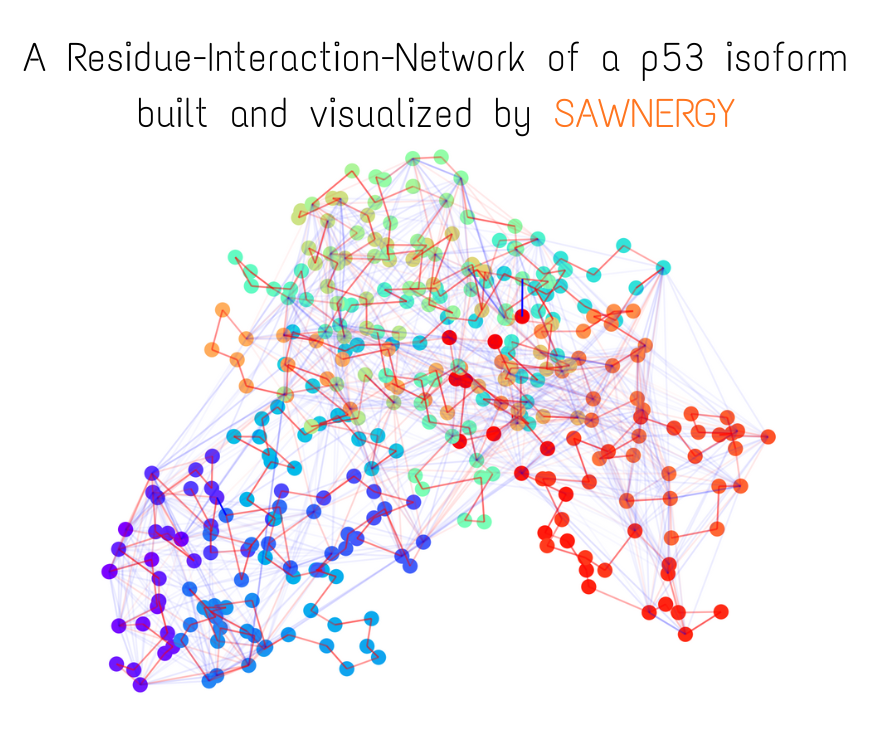
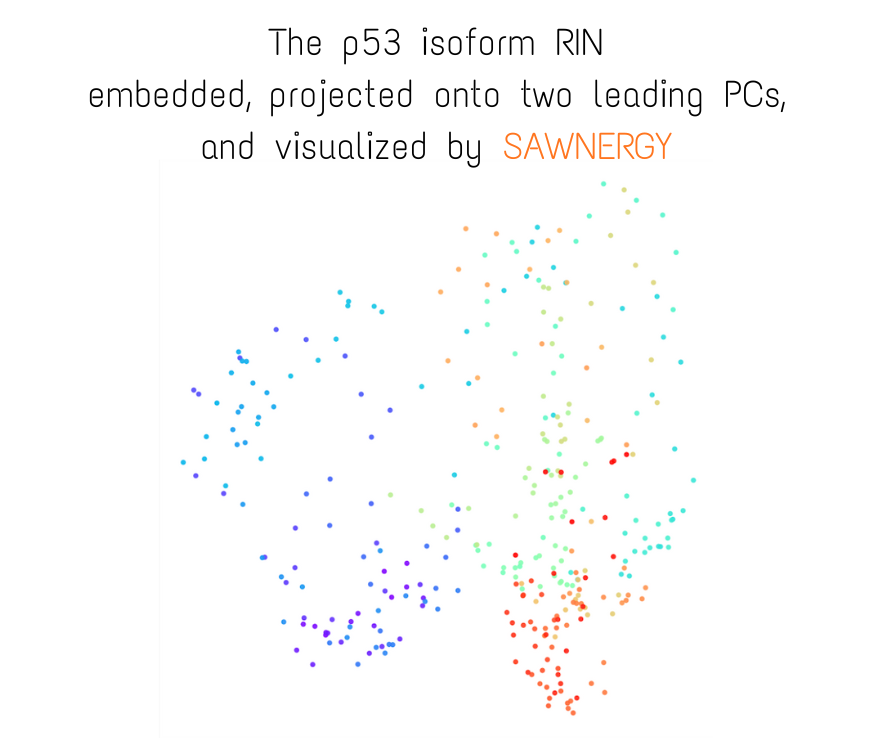
Small visual example (constructed fully from trajectory and topology files)
Core Components
sawnergy.rin.RINBuilder
- Wraps the AmberTools
cpptrajexecutable to:- compute per-frame electrostatic (EMAP) and van der Waals (VMAP) energy matrices at the atomic level,
- project atom–atom interactions to residue–residue interactions using compositional masks,
- prune, symmetrize, remove self-interactions, and L1-normalize the matrices,
- compute per-residue centers of mass (COM) over the same frames.
- Outputs a compressed Zarr archive with transition matrices, optional pre-normalized energies, COM snapshots, and rich metadata (frame range, pruning quantile, molecule ID, etc.).
- Supports parallel
cpptrajexecution, batch processing, and keeps temporary stores tidy viaArrayStorage.compress_and_cleanup.
sawnergy.visual.Visualizer
- Opens RIN archives, resolves dataset names from attributes, and renders nodes plus attractive/repulsive edge bundles in 3D using Matplotlib.
- Allows both static frame visualization and trajectory animation.
- Handles backend selection (
Aggfallback in headless environments) and offers convenient color palettes viavisualizer_util.
sawnergy.walks.Walker
- Attaches to the RIN archive and loads attractive/repulsive transition matrices into shared memory using
walker_util.SharedNDArrayso multiple processes can sample without copying. - Samples random walks (RW) and self-avoiding walks (SAW), optionally time-aware, that is, walks move through transition matrices with transition probabilities proportional to cosine similarity between the current and next frame. Randomness is controlled by the seed passed to the class constructor.
- Persists walks as
(time, walk_id, length+1)tensors (1-based node indices) alongside metadata such aswalk_length,walks_per_node, and RNG scheme.
sawnergy.embedding.Embedder
- Consumes walk archives, generates skip-gram pairs, and normalizes them to 0-based indices.
- Selects skip-gram (SG / SGNS) backends dynamically via
model_base="pureml"|"torch"with per-backend overrides supplied throughmodel_kwargs. - Handles deterministic per-frame seeding and returns the requested embedding
kind("in","out", or"avg") fromembed_frameandembed_all. - Persists per-frame matrices with rich provenance (walk metadata, objective, hyperparameters, RNG seeds) when
embed_alltargets an output archive.
Supporting Utilities
sawnergy.sawnergy_utilArrayStorage: thin wrapper over Zarr v3 with helpers for chunk management, attribute coercion to JSON, and transparent compression to.ziparchives.- Parallel helpers (
elementwise_processor,compose_steps, etc.), temporary file management, logging, and runtime inspection utilities.
sawnergy.logging_util.configure_logging: configure rotating file/console logging consistently across scripts.
Archive Layouts
| Archive | Key datasets (name → shape, dtype) | Important attributes (root attrs) |
|---|---|---|
| RIN | ATTRACTIVE_transitions → (T, N, N), float32 • REPULSIVE_transitions → (T, N, N), float32 (optional) • ATTRACTIVE_energies → (T, N, N), float32 (optional) • REPULSIVE_energies → (T, N, N), float32 (optional) • COM → (T, N, 3), float32 |
time_created (ISO) • com_name = "COM" • molecule_of_interest (int) • frame_range = (start, end) inclusive • frame_batch_size (int) • prune_low_energies_frac (float in [0,1]) • attractive_transitions_name / repulsive_transitions_name (dataset names or None) • attractive_energies_name / repulsive_energies_name (dataset names or None) |
| Walks | ATTRACTIVE_RWs → (T, N·num_RWs, L+1), int32 (optional) • REPULSIVE_RWs → (T, N·num_RWs, L+1), int32 (optional) • ATTRACTIVE_SAWs → (T, N·num_SAWs, L+1), int32 (optional) • REPULSIVE_SAWs → (T, N·num_SAWs, L+1), int32 (optional) Note: node IDs are 1-based. |
time_created (ISO) • seed (int) • rng_scheme = "SeedSequence.spawn_per_batch_v1" • num_workers (int) • in_parallel (bool) • batch_size_nodes (int) • num_RWs / num_SAWs (ints) • node_count (N) • time_stamp_count (T) • walk_length (L) • walks_per_node (int) • attractive_RWs_name / repulsive_RWs_name / attractive_SAWs_name / repulsive_SAWs_name (dataset names or None) • walks_layout = "time_leading_3d" |
| Embeddings | FRAME_EMBEDDINGS → (T, N, D), float32 |
created_at (ISO) • frame_embeddings_name = "FRAME_EMBEDDINGS" • time_stamp_count = T • node_count = N • embedding_dim = D • model_base = "torch" or "pureml" • embedding_kind = `"in" |
Notes
- In RIN,
Tequals the number of frame batches written (i.e.,frame_rangeswept in steps offrame_batch_size).ATTRACTIVE/REPULSIVE_energiesare pre-normalized absolute energies (written only whenkeep_prenormalized_energies=True), whereasATTRACTIVE/REPULSIVE_transitionsare the row-wise L1-normalized versions used for sampling. - All archives are Zarr v3 groups. ArrayStorage also maintains per-block metadata in root attrs:
array_chunk_size_in_block,array_shape_in_block, andarray_dtype_in_block(dicts keyed by dataset name). You’ll see these in every archive. - In Embeddings,
alphaandnum_negative_samplesapply to SGNS only and are ignored forobjective="sg".
Quick Start
from pathlib import Path
from sawnergy.logging_util import configure_logging
from sawnergy.rin import RINBuilder
from sawnergy.walks import Walker
from sawnergy.embedding import Embedder

import logging
configure_logging("./logs", file_level=logging.WARNING, console_level=logging.INFO)

# 1. Build a Residue Interaction Network archive
rin_path = Path("./RIN_demo.zip")
rin_builder = RINBuilder()
rin_builder.build_rin(
    topology_file="system.prmtop",
    trajectory_file="trajectory.nc",
    molecule_of_interest=1,
    frame_range=(1, 100),
    frame_batch_size=10,
    prune_low_energies_frac=0.85,
    output_path=rin_path,
    include_attractive=True,
    include_repulsive=False
)

# 2. Sample walks from the RIN
walker = Walker(rin_path, seed=123)
walks_path = Path("./WALKS_demo.zip")
walker.sample_walks(
    walk_length=16,
    walks_per_node=100,
    saw_frac=0.25,
    include_attractive=True,
    include_repulsive=False,
    time_aware=False,
    output_path=walks_path,
    in_parallel=False
)
walker.close()

# 3. Train embeddings per frame (PyTorch backend)
import torch

embedder = Embedder(walks_path, seed=999)
embeddings_path = embedder.embed_all(
    RIN_type="attr",
    using="merged",
    num_epochs=10,
    negative_sampling=False,
    window_size=4,
    device="cuda" if torch.cuda.is_available() else "cpu",
    model_base="torch",
    output_path="./EMBEDDINGS_demo.zip"
)
print("Embeddings written to", embeddings_path)
For the PureML backend, set
model_base="pureml"and pass the optimizer / scheduler classes insidemodel_kwargs.
Visualization
from sawnergy.visual import Visualizer

v = Visualizer("./RIN_demo.zip")
v.build_frame(1,
    node_colors="rainbow",
    displayed_nodes="ALL",
    displayed_pairwise_attraction_for_nodes="DISPLAYED_NODES",
    displayed_pairwise_repulsion_for_nodes="DISPLAYED_NODES",
    show_node_labels=True,
    show=True
)
Visualizer lazily loads datasets and works even in headless environments (falls back to the Agg backend).
from sawnergy.embedding import Visualizer

viz = Visualizer("./EMBEDDINGS_demo.zip", normalize_rows=True)
viz.build_frame(1, show=True)
Advanced Notes
- Time-aware walks: Set
time_aware=True, providestickinessandon_no_optionswhen callingWalker.sample_walks. - Shared memory lifecycle: Call
Walker.close()(or use a context manager) to release shared-memory segments. - PureML vs PyTorch: Select the backend at call time with
model_base="pureml"|"torch"(defaults to"pureml") and pass optimizer / scheduler overrides throughmodel_kwargs. - ArrayStorage utilities: Use
ArrayStoragedirectly to peek into archives, append arrays, or manage metadata.
Project Structure
├── sawnergy/
│   ├── rin/           # RINBuilder and cpptraj integration helpers
│   ├── walks/         # Walker class and shared-memory utilities
│   ├── embedding/     # Embedder + SG/SGNS backends (PureML / PyTorch)
│   ├── visual/        # Visualizer and palette utilities
│   │
│   ├── logging_util.py
│   └── sawnergy_util.py
│
└── README.md
Acknowledgments
SAWNERGY builds on the AmberTools cpptraj ecosystem, NumPy, Matplotlib, Zarr, and PyTorch (for GPU acceleration if necessary; PureML is available by default).
Big thanks to the upstream communities whose work makes this toolkit possible.
Release history Release notifications | RSS feed


Download files
Download the file for your platform. If you're not sure which to choose, learn more about installing packages.
Source Distribution
Built Distribution
Filter files by name, interpreter, ABI, and platform.
If you're not sure about the file name format, learn more about wheel file names.
Copy a direct link to the current filters
File details
Details for the file sawnergy-1.0.9.tar.gz.
File metadata
- Download URL: sawnergy-1.0.9.tar.gz
- Upload date:
- Size: 97.4 kB
- Tags: Source
- Uploaded using Trusted Publishing? No
- Uploaded via: twine/6.2.0 CPython/3.12.1
File hashes
| Algorithm | Hash digest | |
|---|---|---|
| SHA256 |
a91a174eddb2ea957bac599158721731a37143c703143ac5ccb373b23f7bcd0d
|
|
| MD5 |
1900edf02eea4411aca1cc71baba7dcc
|
|
| BLAKE2b-256 |
bca2a7f093de1c502ca0e7238f0fa927ad9abda970682604e51ee1c7c25395dd
|
File details
Details for the file sawnergy-1.0.9-py3-none-any.whl.
File metadata
- Download URL: sawnergy-1.0.9-py3-none-any.whl
- Upload date:
- Size: 92.1 kB
- Tags: Python 3
- Uploaded using Trusted Publishing? No
- Uploaded via: twine/6.2.0 CPython/3.12.1
File hashes
| Algorithm | Hash digest | |
|---|---|---|
| SHA256 |
893938d77517fe67e3bcd5345ee22da87b6273b018ca87accbab90e03d29f60b
|
|
| MD5 |
7e5265d635561ab077b857f721d24d2f
|
|
| BLAKE2b-256 |
08194100a007f53b1da7bf6e2dd77e729a4cf83d2b8ce1ab2c99b514ca133b2a
|






