
Intel(R) Extension for Scikit-learn*


Extension for Scikit-learn is a free software AI accelerator designed to deliver over 10-100X acceleration to your existing scikit-learn code. The software acceleration is achieved with vector instructions, AI hardware-specific memory optimizations, threading, and optimizations.
With Extension for Scikit-learn, you can:
- Speed up training and inference by up to 100x with equivalent mathematical accuracy
- Benefit from performance improvements across different hardware configurations, including GPUs and multi-GPU configurations
- Integrate the extension into your existing Scikit-learn applications without code modifications
- Continue to use the open-source scikit-learn API
- Enable and disable the extension with a couple of lines of code or at the command line
🛠 Installation
Intel(R) Extension for Scikit-learn is available at the Python Package Index, in Conda-Forge and in Intel's conda channel.
To install through pip:
pip install scikit-learn-intelex
See the documentation for more details about supported platforms and other ways of installing it.
You can build the package from sources as well.
⚡️ Get Started
Easiest way to benefit from accelerations from the extension is by patching scikit-learn with it:
- Enable CPU optimizations
import numpy as np
from sklearnex import patch_sklearn
patch_sklearn()

from sklearn.cluster import DBSCAN

X = np.array([[1., 2.], [2., 2.], [2., 3.],
              [8., 7.], [8., 8.], [25., 80.]], dtype=np.float32)
clustering = DBSCAN(eps=3, min_samples=2).fit(X)
-
Enable GPU optimizations
Note: executing on GPU has additional system software requirements - see details.
import numpy as np
from sklearnex import patch_sklearn, config_context
patch_sklearn()

from sklearn.cluster import DBSCAN

X = np.array([[1., 2.], [2., 2.], [2., 3.],
              [8., 7.], [8., 8.], [25., 80.]], dtype=np.float32)
with config_context(target_offload="gpu:0"):
    clustering = DBSCAN(eps=3, min_samples=2).fit(X)
Usage without patching
Alternatively, all functionalities are also available under a separate module which can be imported directly, without involving any patching.
-
To run on CPU:
import numpy as np
from sklearnex.cluster import DBSCAN

X = np.array([[1., 2.], [2., 2.], [2., 3.],
              [8., 7.], [8., 8.], [25., 80.]], dtype=np.float32)
clustering = DBSCAN(eps=3, min_samples=2).fit(X)
-
To run on GPU:
import numpy as np
from sklearnex import config_context
from sklearnex.cluster import DBSCAN

X = np.array([[1., 2.], [2., 2.], [2., 3.],
              [8., 7.], [8., 8.], [25., 80.]], dtype=np.float32)
with config_context(target_offload="gpu:0"):
    clustering = DBSCAN(eps=3, min_samples=2).fit(X)
🚀 Scikit-learn patching
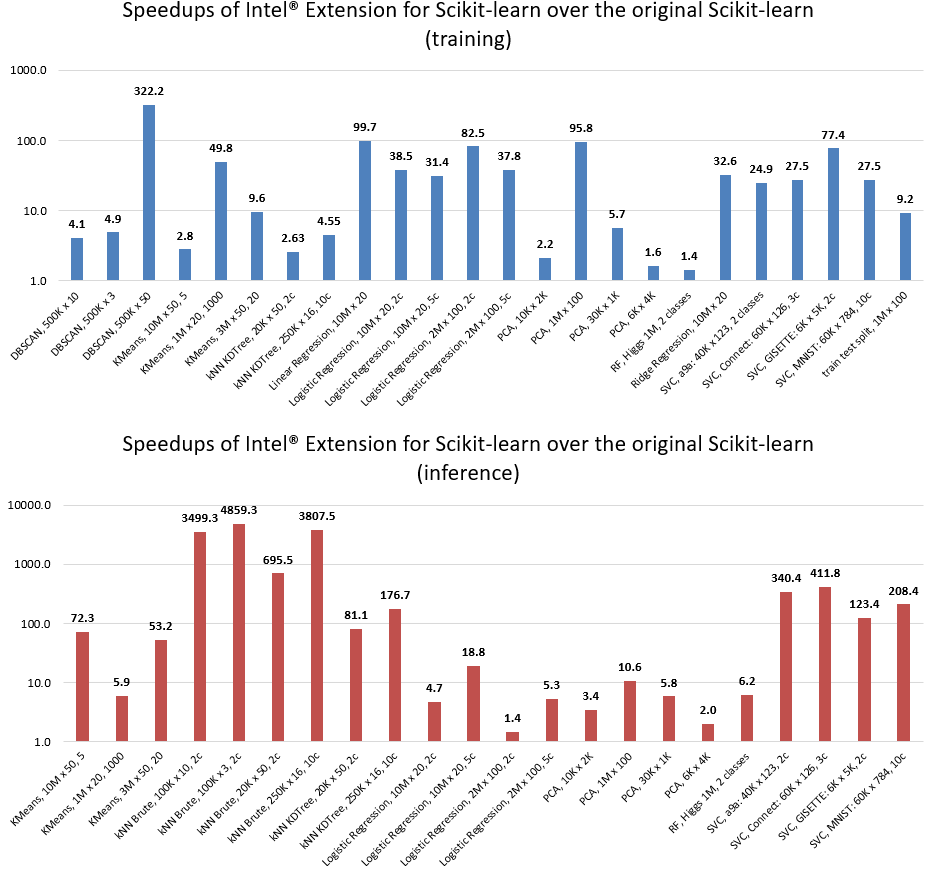
- HW: c5.24xlarge AWS EC2 Instance using an Intel Xeon Platinum 8275CL with 2 sockets and 24 cores per socket
- SW: scikit-learn version 0.24.2, scikit-learn-intelex version 2021.2.3, Python 3.8
Intel(R) Extension for Scikit-learn patching affects performance of specific Scikit-learn functionality. Refer to the list of supported algorithms and parameters for details. In cases when unsupported parameters are used, the package fallbacks into original Scikit-learn. If the patching does not cover your scenarios, submit an issue on GitHub.
Read more about it in the documentation for scikit-learn patching.
👀 Follow us on Medium
We publish blogs on Medium, so follow us to learn tips and tricks for more efficient data analysis with the help of Intel(R) Extension for Scikit-learn. Here are our latest blogs:
- Save Time and Money with Intel Extension for Scikit-learn
- Superior Machine Learning Performance on the Latest Intel Xeon Scalable Processors
- Leverage Intel Optimizations in Scikit-Learn
- Intel Gives Scikit-Learn the Performance Boost Data Scientists Need
- From Hours to Minutes: 600x Faster SVM
- Improve the Performance of XGBoost and LightGBM Inference
- Accelerate Kaggle Challenges Using Intel AI Analytics Toolkit
- Accelerate Your scikit-learn Applications
- Accelerate Linear Models for Machine Learning
- Accelerate K-Means Clustering
🔗 Important links
- Notebook examples
- Documentation
- scikit-learn API and patching
- Benchmark code
- Building from Sources
- About Intel(R) oneAPI Data Analytics Library
💬 Support
Report issues, ask questions, and provide suggestions using:
You may reach out to project maintainers privately at onedal.maintainers@intel.com
2 maintainers


Metadata
2 maintainers
Release files for scikit-learn-intelex 2026.2.0
For a detailed explanation of source distributions (sdists) and built distributions (wheels), please see the package formats documentation.
Built distributions (wheels)
Total release size: 23.6 MB
Release files / scikit_learn_intelex-2026.2.0-py314-none-win_amd64.whl
| Download URL | scikit_learn_intelex-2026.2.0-py314-none-win_amd64.whl |
|---|---|
| Size | 2.0 MB |
| Tags | Python 3.14 Windows x86-64 |
|
SHA-256 checksum How to use checksums |
f2440d97f84945c202c2cb9bcfa9811fa07df2e6b7b9a31c15f2be6a7540b3eb
|
|
BLAKE2b-256 checksum How to use checksums |
47407e5fc7d7e6c295ec38ee1aac303a8d095d913b52eebf4a84660551816bf4
|
| Upload date | |
|
Uploaded using Trusted Publishing? What is trusted publishing? |
No |
| Uploaded via |
twine/3.8.0 colorama/0.4.4 importlib-metadata/4.6.4 keyring/23.5.0 pkginfo/1.8.2 readme-renderer/34.0 requests-toolbelt/0.9.1 requests/2.34.2 rfc3986/1.5.0 tqdm/4.57.0 urllib3/1.26.5 CPython/3.10.6
|
Release files / scikit_learn_intelex-2026.2.0-py314-none-manylinux_2_28_x86_64.whl
| Download URL | scikit_learn_intelex-2026.2.0-py314-none-manylinux_2_28_x86_64.whl |
|---|---|
| Size | 2.8 MB |
| Tags | Linux glibc 2.28+ x86-64 Python 3.14 |
|
SHA-256 checksum How to use checksums |
4a4ee9dc67f48f634f11f114c07e1196592f57d6868398284e0d1080c2fa245d
|
|
BLAKE2b-256 checksum How to use checksums |
c32c3038656aa26bd5f24ffedd1d10a0637313eb61844a802665d41100ce4b68
|
| Upload date | |
|
Uploaded using Trusted Publishing? What is trusted publishing? |
No |
| Uploaded via |
twine/3.8.0 colorama/0.4.4 importlib-metadata/4.6.4 keyring/23.5.0 pkginfo/1.8.2 readme-renderer/34.0 requests-toolbelt/0.9.1 requests/2.34.2 rfc3986/1.5.0 tqdm/4.57.0 urllib3/1.26.5 CPython/3.10.6
|
Release files / scikit_learn_intelex-2026.2.0-py313-none-win_amd64.whl
| Download URL | scikit_learn_intelex-2026.2.0-py313-none-win_amd64.whl |
|---|---|
| Size | 2.0 MB |
| Tags | Python 3.13 Windows x86-64 |
|
SHA-256 checksum How to use checksums |
dd0cd1f14aa7d7245dd4543d0a79ee761a61fdfd6bfa61438f1c4605dc4c4313
|
|
BLAKE2b-256 checksum How to use checksums |
98995de6eec737ae508c6a3e961bf678e573c6a00188a75baa0a290f9b8ff867
|
| Upload date | |
|
Uploaded using Trusted Publishing? What is trusted publishing? |
No |
| Uploaded via |
twine/3.8.0 colorama/0.4.4 importlib-metadata/4.6.4 keyring/23.5.0 pkginfo/1.8.2 readme-renderer/34.0 requests-toolbelt/0.9.1 requests/2.34.2 rfc3986/1.5.0 tqdm/4.57.0 urllib3/1.26.5 CPython/3.10.6
|
Release files / scikit_learn_intelex-2026.2.0-py313-none-manylinux_2_28_x86_64.whl
| Download URL | scikit_learn_intelex-2026.2.0-py313-none-manylinux_2_28_x86_64.whl |
|---|---|
| Size | 2.7 MB |
| Tags | Linux glibc 2.28+ x86-64 Python 3.13 |
|
SHA-256 checksum How to use checksums |
3fd6a853414702c5b431cd6e9232991642e7c3acb31b5b5113874d9cbbb28eb2
|
|
BLAKE2b-256 checksum How to use checksums |
e603462a080c37a5f2b56f783b400f19c8042e8fe5420e5de7b3662c3335f415
|
| Upload date | |
|
Uploaded using Trusted Publishing? What is trusted publishing? |
No |
| Uploaded via |
twine/3.8.0 colorama/0.4.4 importlib-metadata/4.6.4 keyring/23.5.0 pkginfo/1.8.2 readme-renderer/34.0 requests-toolbelt/0.9.1 requests/2.34.2 rfc3986/1.5.0 tqdm/4.57.0 urllib3/1.26.5 CPython/3.10.6
|
Release files / scikit_learn_intelex-2026.2.0-py312-none-win_amd64.whl
| Download URL | scikit_learn_intelex-2026.2.0-py312-none-win_amd64.whl |
|---|---|
| Size | 2.0 MB |
| Tags | Python 3.12 Windows x86-64 |
|
SHA-256 checksum How to use checksums |
06a75ced846010ce8d56bfc2b2515e193a353d2240a7e6589e4b2c5b40304413
|
|
BLAKE2b-256 checksum How to use checksums |
772cf9ed3889bee1b151a6aed56d26e14ed023779909930098716b41f11d97c5
|
| Upload date | |
|
Uploaded using Trusted Publishing? What is trusted publishing? |
No |
| Uploaded via |
twine/3.8.0 colorama/0.4.4 importlib-metadata/4.6.4 keyring/23.5.0 pkginfo/1.8.2 readme-renderer/34.0 requests-toolbelt/0.9.1 requests/2.34.2 rfc3986/1.5.0 tqdm/4.57.0 urllib3/1.26.5 CPython/3.10.6
|
Release files / scikit_learn_intelex-2026.2.0-py312-none-manylinux_2_28_x86_64.whl
| Download URL | scikit_learn_intelex-2026.2.0-py312-none-manylinux_2_28_x86_64.whl |
|---|---|
| Size | 2.7 MB |
| Tags | Linux glibc 2.28+ x86-64 Python 3.12 |
|
SHA-256 checksum How to use checksums |
6be4527302973bdf6f08b543619cde49cbc3725c54e8b9621e697cb8941ae843
|
|
BLAKE2b-256 checksum How to use checksums |
5c1aa926ee01294348b4e1c117e8d44d7be6f0ec03d0400291bf4c8e67e213f5
|
| Upload date | |
|
Uploaded using Trusted Publishing? What is trusted publishing? |
No |
| Uploaded via |
twine/3.8.0 colorama/0.4.4 importlib-metadata/4.6.4 keyring/23.5.0 pkginfo/1.8.2 readme-renderer/34.0 requests-toolbelt/0.9.1 requests/2.34.2 rfc3986/1.5.0 tqdm/4.57.0 urllib3/1.26.5 CPython/3.10.6
|
Release files / scikit_learn_intelex-2026.2.0-py311-none-win_amd64.whl
| Download URL | scikit_learn_intelex-2026.2.0-py311-none-win_amd64.whl |
|---|---|
| Size | 2.0 MB |
| Tags | Python 3.11 Windows x86-64 |
|
SHA-256 checksum How to use checksums |
fbd377a294f9c03938284b51ddf0770e90f85b1f0f61dce8384a2382842bf173
|
|
BLAKE2b-256 checksum How to use checksums |
a9ad54fdd49b405fd56aca174909f9878e30276c83b5499ed192d321a517f99f
|
| Upload date | |
|
Uploaded using Trusted Publishing? What is trusted publishing? |
No |
| Uploaded via |
twine/3.8.0 colorama/0.4.4 importlib-metadata/4.6.4 keyring/23.5.0 pkginfo/1.8.2 readme-renderer/34.0 requests-toolbelt/0.9.1 requests/2.34.2 rfc3986/1.5.0 tqdm/4.57.0 urllib3/1.26.5 CPython/3.10.6
|
Release files / scikit_learn_intelex-2026.2.0-py311-none-manylinux_2_28_x86_64.whl
| Download URL | scikit_learn_intelex-2026.2.0-py311-none-manylinux_2_28_x86_64.whl |
|---|---|
| Size | 2.8 MB |
| Tags | Linux glibc 2.28+ x86-64 Python 3.11 |
|
SHA-256 checksum How to use checksums |
c80198883dc8ecb349ca3200ae3deafbb269c09db3633e752462ef0eb7c7321f
|
|
BLAKE2b-256 checksum How to use checksums |
8e56109ad97f8162d88c8add8ac53673c1d58a5378bc1d6193d9fe1d651e1c4c
|
| Upload date | |
|
Uploaded using Trusted Publishing? What is trusted publishing? |
No |
| Uploaded via |
twine/3.8.0 colorama/0.4.4 importlib-metadata/4.6.4 keyring/23.5.0 pkginfo/1.8.2 readme-renderer/34.0 requests-toolbelt/0.9.1 requests/2.34.2 rfc3986/1.5.0 tqdm/4.57.0 urllib3/1.26.5 CPython/3.10.6
|
Release files / scikit_learn_intelex-2026.2.0-py310-none-win_amd64.whl
| Download URL | scikit_learn_intelex-2026.2.0-py310-none-win_amd64.whl |
|---|---|
| Size | 2.0 MB |
| Tags | Python 3.10 Windows x86-64 |
|
SHA-256 checksum How to use checksums |
59de65ea7029a50103c78f5dd2fe92e8db8e4af138a7c4529e2eb9fa29837646
|
|
BLAKE2b-256 checksum How to use checksums |
f127d466654edc79d4eec262cec340a8123fd8a85f6097d37fc651d94a994f77
|
| Upload date | |
|
Uploaded using Trusted Publishing? What is trusted publishing? |
No |
| Uploaded via |
twine/3.8.0 colorama/0.4.4 importlib-metadata/4.6.4 keyring/23.5.0 pkginfo/1.8.2 readme-renderer/34.0 requests-toolbelt/0.9.1 requests/2.34.2 rfc3986/1.5.0 tqdm/4.57.0 urllib3/1.26.5 CPython/3.10.6
|
Release files / scikit_learn_intelex-2026.2.0-py310-none-manylinux_2_28_x86_64.whl
| Download URL | scikit_learn_intelex-2026.2.0-py310-none-manylinux_2_28_x86_64.whl |
|---|---|
| Size | 2.8 MB |
| Tags | Linux glibc 2.28+ x86-64 Python 3.10 |
|
SHA-256 checksum How to use checksums |
0f41d41da8a9e6539a084a204611219222b6be62b16618cfad529bb669f1763e
|
|
BLAKE2b-256 checksum How to use checksums |
9f0d9f59c3d00b6d76b68e1083a174e0ab31a26af76875e287fa676910a38702
|
| Upload date | |
|
Uploaded using Trusted Publishing? What is trusted publishing? |
No |
| Uploaded via |
twine/3.8.0 colorama/0.4.4 importlib-metadata/4.6.4 keyring/23.5.0 pkginfo/1.8.2 readme-renderer/34.0 requests-toolbelt/0.9.1 requests/2.34.2 rfc3986/1.5.0 tqdm/4.57.0 urllib3/1.26.5 CPython/3.10.6
|
Security for scikit-learn-intelex 2026.2.0
Provenance
Provenance describes where a file came from. On PyPI, provenance is shared via attestations, which provide a verifiable record of the build or publishing details. View details, limitations and caveats.
No provenance found
None of the files in this release were uploaded with provenance metadata.
A note on package security
PyPI is a repository for distributing packages, not a service for auditing them. While third-party security researchers and our staff do their best to detect and remove malicious packages, PyPI cannot guarantee the quality, security or suitability of any given package.














