
sdcguard
Hi, I'm Hari. sdcguard catches GPUs that give wrong answers without crashing.
A GPU can return wrong numbers and keep going. No error, no crash, and the loss curve looks fine. Sometimes the chip is bad, sometimes it's a library bug. Meta sees roughly one faulty device per thousand, and ByteDance found 18 incidents in 35 million GPU-hours, 15 of them silent (AEGIS).
The usual health checks test an idle GPU. sdcguard checks the math of your actual training run or vLLM server while it runs.
Try it
pip install "sdcguard[all]"
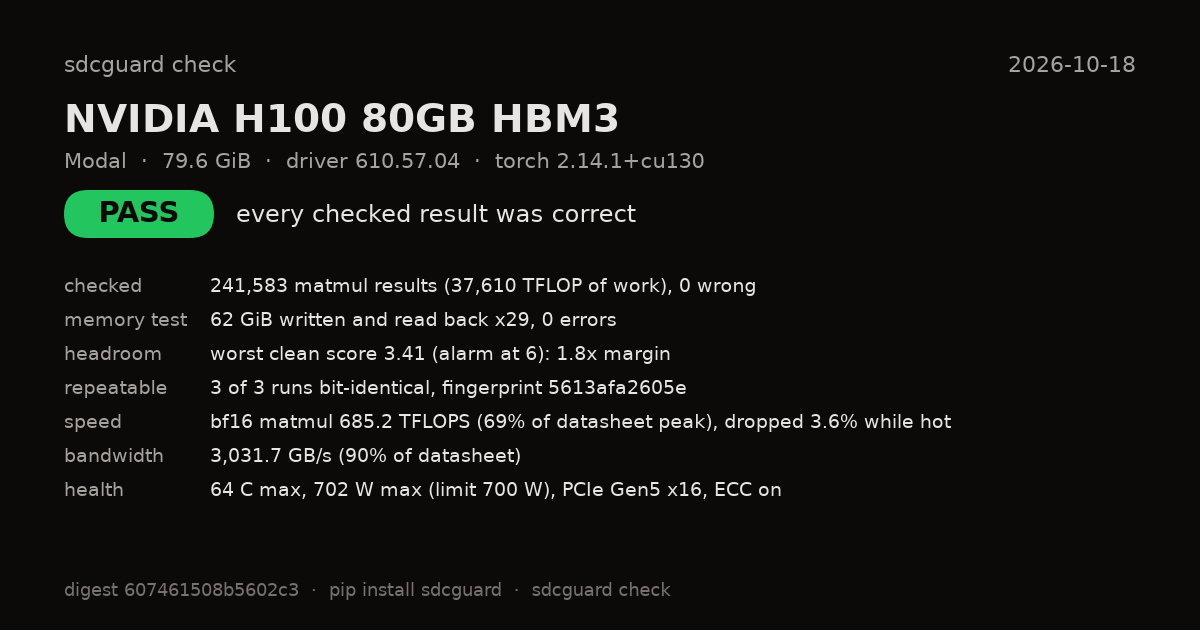
sdcguard check
That takes about five minutes per machine. It runs matmuls in every precision your GPU supports and checks them against float64, tests memory, trains and serves a small model with the checks on, and makes sure a fixed model gives the same output every time. Each GPU gets PASS, FAIL, SUSPECT or INCOMPLETE. A FAIL saves the inputs and the wrong output so you can replay them on another GPU.
Add --share to put your result on the public board.
No GPU? python -m sdcguard.demo runs a simulated bad GPU on your CPU, or try it in
Colab.
A real bug the usual tools missed
cuBLAS has a bug (NVIDIA known issue 6862950) that gives wrong FP16, BF16 and FP8 matmuls on Hopper GPUs running under MPS with less than 100% of the SMs. It was reported on NVIDIA's forum on October 2, 2026, and NVIDIA confirmed it on October 6.
I ran sdcguard, DCGM and gpu-burn on one H200 at four MPS shares, with the rules written down before the run:
| MPS share | sdcguard check | DCGM diagnostic | gpu-burn |
|---|---|---|---|
| 100% | pass | pass | pass |
| 40% | FAIL | pass | pass |
| 75% | FAIL | pass | pass |
| 14% | FAIL | pass | pass |
DCGM and gpu-burn weren't broken. Their own matmuls never hit the bad code path, so they had nothing to find. A test of the GPU isn't a test of your job. Full rules and logs are in METHOD.md.
In training
from sdcguard import SDCGuard

guard = SDCGuard(every=20).protect(model)    # checks every nn.Linear: forward, dX and dW
for step, (x, y) in enumerate(loader):
    with guard.on_step(step):                # every 20th step is checked
        loss = model(x, y); loss.backward()
    optimizer.step(); optimizer.zero_grad()
    if guard.log.events:
        print(guard.log.events[0].to_json()); break
In tests on an H100 (October 18), checking every 20th step cost 1.7% on GPT-2 small and 1.3% on a 0.9B model.
It works with autocast,
DDP, FSDP2, tensor parallel and torch.compile. With the Hugging Face Trainer it's one line:
trainer = Trainer(..., callbacks=[SDCGuardCallback(every=20, stop_on_alert=True)]) # from sdcguard.hf
In vLLM
SDCGUARD=1 SDCGUARD_SHARE=0.125 vllm serve Qwen/Qwen2.5-7B-Instruct
This checks one linear layer in eight. On Qwen2.5-7B on an H100 it cost at most about 4% of throughput, the answers were word for word the same as plain vLLM, and a weight bit I flipped on purpose was caught and the layer named. Checking every layer costs about 30% on the 7B model for now. I'm working on making that cheaper.
When a check fires, sdcguard keeps the exact numbers that failed (copied on the GPU before vLLM reuses the memory) and rechecks them in float64 on the CPU, so the alert tells you whether the output was really wrong.
For any other PyTorch model there's ServeGuard().attach(model, share=0.125).
Across a fleet
sdcguard screen --minutes 10                         # screen every GPU on a node
sdcguard replay screen_out/GPU-.../evidence_0.pt     # replay a failure on another GPU
sdcguard report node*/sdcguard_check --out fleet_report
sdcguard blas                                        # every cuBLAS algorithm on a few shapes, checked
sdcguard issues                                      # which known cuBLAS bugs apply to this machine
There are also Kubernetes and Slurm health checks (deploy/), signed per-GPU certificates, and alerts to Slack, Discord, Prometheus or NVIDIA NVSentinel.
How it works
For C = A @ B, the sum of each block of 128 output columns has to equal A times the matching column sums of
B. Both sides are cheap to compute, so a wrong value in C shows up as a mismatch. This is algorithm-based
fault tolerance (Huang and Abraham, 1984). The hard part is bf16: normal rounding makes the two sides differ a
little, so sdcguard models each block's rounding noise and only alarms past six times that. In 24.6 million
checks of clean training on an H100 it raised no false alarm. On NVIDIA GPUs the checks run as Triton kernels.
What it can't do yet
- Small errors. Anything under about 1% of a block slips through. ByteDance found its real incidents with
fp32 checksums, not bf16 ones. The fp32 check (
precise="fused") is still experimental. - Anything outside the checked matmuls: attention internals, norms, the optimizer. The experimental
recompute=Truecheck covers activation-checkpointed blocks in training. - Quantized layers (FP8, AWQ, GPTQ) and fused MoE experts in vLLM.
- AMD GPUs.
- It hasn't caught a naturally bad GPU yet. So far the evidence is injected faults and the cuBLAS bug above.
Project layout
src/sdcguard/     the library
experiments/      the GPU experiments behind every number here
scripts/          the runners that launch them on cloud GPUs
results/          raw results of every GPU run
docs/             METHOD.md (how each number was measured), EVIDENCE.md, WHY.md, the board
deploy/           Kubernetes, Slurm and Docker
tests/            pytest -q runs them all on a CPU
Feedback
This is alpha (0.4.0), MIT licensed, and I built it on my own. If you try it, I'd love to hear how it went, and most of all if you have a GPU you think is bad. Open an issue.
1 maintainer

Metadata
1 maintainer
Release files for sdcguard 0.4.0
For a detailed explanation of source distributions (sdists) and built distributions (wheels), please see the package formats documentation.
Source distribution (sdist)
| File | Size | Uploaded | Provenance | |
|---|---|---|---|---|
| sdcguard-0.4.0.tar.gz | 274.4 kB | With provenance | Details |
Built distribution (wheel)
| File | Interpreter | ABI | Platform | Reset |
|---|---|---|---|---|
| sdcguard-0.4.0-py3-none-any.whl | Python 3 | none | any | Details |
Total release size: 564.7 kB
Release files / sdcguard-0.4.0.tar.gz
| Download URL | sdcguard-0.4.0.tar.gz |
|---|---|
| Size | 274.4 kB |
| Tags | Source |
|
SHA-256 checksum How to use checksums |
a90b854387e1affa663d42d9f4b6c520715ac4e085f1125b03b19a5076f76056
|
|
BLAKE2b-256 checksum How to use checksums |
bfa11adf39893002a4012a819bc6573d96640079ab734d1e242b71d77b84509c
|
| Upload date | |
|
Uploaded using Trusted Publishing? What is trusted publishing? |
Yes |
| Uploaded via |
twine/7.0.0 CPython/3.13.16
|
Provenance
Provenance describes where a file came from. On PyPI, provenance is shared via attestations, which provide a verifiable record of the build or publishing details. View details, limitations and caveats.


PyPI Publish Attestation
PyPI verified that this artifact, at this checksum, originated from the publisher listed below.
Signed by GitHub Actions, verified by PyPI on Oct 22, 2026.
Transparency logRelease files / sdcguard-0.4.0-py3-none-any.whl
| Download URL | sdcguard-0.4.0-py3-none-any.whl |
|---|---|
| Size | 290.2 kB |
| Tags | Python 3 |
|
SHA-256 checksum How to use checksums |
9e18a709c28d7f0b3f3b896a8d4ae798e12adf1cdb64c4c28cdda0a26161d1c6
|
|
BLAKE2b-256 checksum How to use checksums |
303fbd4a7552464958026613daa3178e1dc14b9f9d0be9189d2e58fcc187c2a6
|
| Upload date | |
|
Uploaded using Trusted Publishing? What is trusted publishing? |
Yes |
| Uploaded via |
twine/7.0.0 CPython/3.13.16
|
Provenance
Provenance describes where a file came from. On PyPI, provenance is shared via attestations, which provide a verifiable record of the build or publishing details. View details, limitations and caveats.
PyPI Publish Attestation
PyPI verified that this artifact, at this checksum, originated from the publisher listed below.
Signed by GitHub Actions, verified by PyPI on Oct 22, 2026.
Transparency logSecurity for sdcguard 0.4.0
Provenance
Provenance describes where a file came from. On PyPI, provenance is shared via attestations, which provide a verifiable record of the build or publishing details. View details, limitations and caveats.
Full provenance
All 2 files in this release have been uploaded with provenance metadata.
Attestation for sdcguard-0.4.0.tar.gz
PyPI Publish Attestation
PyPI verified that this artifact, at this checksum, originated from the publisher listed below.
Signed by GitHub Actions, verified by PyPI on Oct 22, 2026.
Transparency logA note on package security
PyPI is a repository for distributing packages, not a service for auditing them. While third-party security researchers and our staff do their best to detect and remove malicious packages, PyPI cannot guarantee the quality, security or suitability of any given package.
To learn more about protecting yourself from malicious actors, visit our package security documentation.














