
sdcguard
Catch GPUs that compute wrong answers, inside your own PyTorch training and vLLM serving.
A GPU can return wrong numbers without crashing. Sometimes the hardware is at fault, sometimes a library, and from the outside the two look the same. ByteDance found 18 such incidents over 3.5 x 10^7 GPU-hours, and 15 of them were silent (AEGIS, OSDI '26). The usual health checks run a test on an idle GPU. sdcguard checks the math of your actual job while it runs, with the kernels, precisions and settings you really use.
A real bug the usual tools missed
NVIDIA lists cuBLAS known issue 6862950 in the CUDA 13.4 Update 2 release notes: on Hopper GPUs, a process running under MPS with less than 100% of the SMs can get wrong FP16, BF16 and FP8 matmul results. On October 20 we ran a head-to-head on an H200, with the rules written before the run:
| MPS share | sdcguard check |
DCGM diagnostic | gpu-burn |
|---|---|---|---|
| 100% | PASS | pass | pass |
| 40% | FAIL | pass | pass |
| 75% | FAIL | pass | pass |
| 14% | FAIL | pass | pass |
DCGM and gpu-burn didn't malfunction. Their own test matmuls came out right at every share, so the bug never reached them. A test of the GPU isn't a test of your job. Rules, predictions and raw logs: METHOD.md, results/h2h.
Install
pip install "sdcguard[all]"
Python 3.10+, PyTorch 2.5+, an NVIDIA GPU. The demo and self-test also run on a CPU.
Check a GPU
sdcguard check            # every GPU on this machine, about 5 minutes
sdcguard check --share    # same, plus a link to add your result to the public board
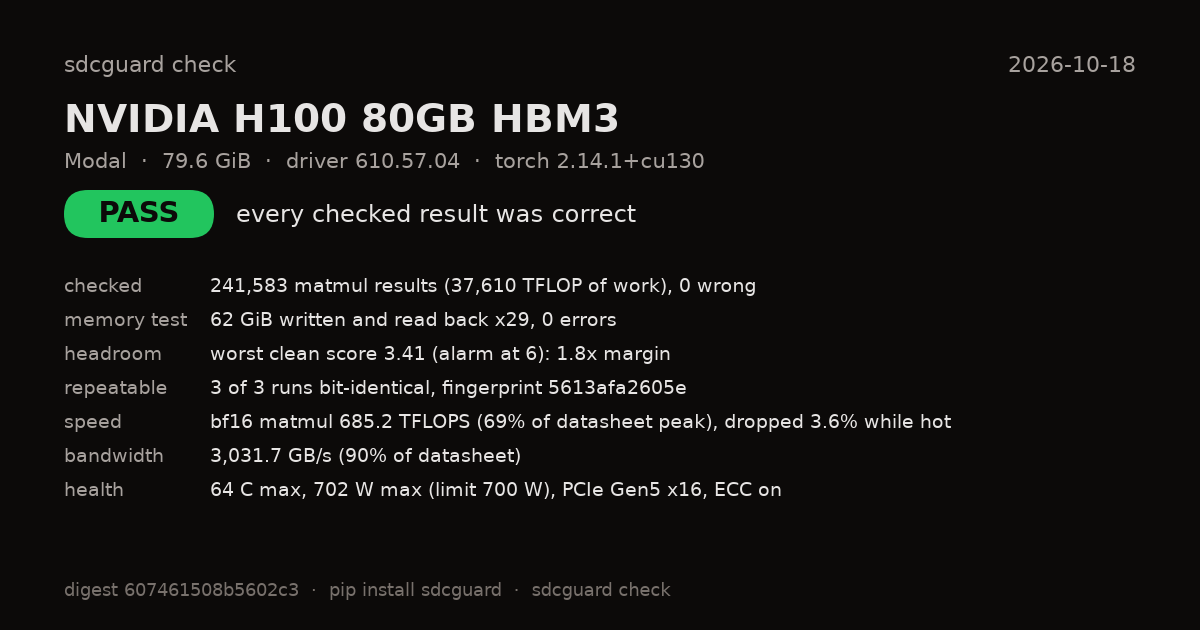
It trains and serves a small model with checks on, runs matmuls in every precision the GPU supports (BF16, FP16, TF32, FP32, FP64, INT8, FP8) checked in float64, pattern-tests most of the memory, measures speed, and runs a fixed model three times to see that the output stays bit-identical. The precisions matter: in ByteDance's study, four GPUs with bad matmuls all got BF16 and FP16 right (SDCs in the Wild, OSDI '26).
Each GPU gets PASS, FAIL, SUSPECT (output that should repeat didn't) or INCOMPLETE (part of the check couldn't
run or couldn't judge its results). A FAIL saves the inputs and the wrong output, so sdcguard replay can
recompute them on another GPU. PASS means these checks found nothing, not that the GPU is flawless. Shared
results go on the board.
In training
from sdcguard import SDCGuard

guard = SDCGuard(every=20).protect(model)    # checks nn.Linear layers: forward, dX and dW
for step, (x, y) in enumerate(loader):
    with guard.on_step(step):                # only every 20th step is checked
        loss = model(x, y); loss.backward()
    optimizer.step(); optimizer.zero_grad()
    if guard.log.events:                     # stop and look at the evidence
        print(guard.log.events[0].to_json()); break
Checking every 20th step cost 1.7% on GPT-2 small and 1.3% on a 0.9B model (H100). With
exact_reductions=False the gradients are bit-identical to a run without sdcguard.
In serving
SDCGUARD=1 SDCGUARD_SHARE=0.125 vllm serve Qwen/Qwen2.5-7B-Instruct
This checks one linear layer in eight. With Qwen2.5-7B on an H100 (vLLM 0.31, compiled mode) it cost about 4% of throughput, every compared answer was word for word the same, and a weight bit flipped in a checked layer was caught and named. Checking every layer costs about 23% for now (details).
Any other PyTorch model:
from sdcguard.serve import ServeGuard

guard = ServeGuard().attach(model, share=0.125)   # bf16 or fp16 model on its GPU
...                                                # serve as usual, eager or torch.compile
for event in guard.poll():                         # doesn't stall the GPU
    print(event.to_json())
guard.coverage_report() shows which layers actually ran their check and how many times.
Across a fleet
sdcguard screen --minutes 10                         # screen every GPU on the node
sdcguard replay screen_out/GPU-.../evidence_0.pt     # recompute a failure on another GPU
sdcguard report node*/sdcguard_check --out fleet_report
There's also sdcguard nhc, a node health check for Kubernetes and Slurm (deploy/), signed
per-GPU certificates (sdcguard keygen, sdcguard check --key, sdcguard verify), and alerts to Slack,
Discord or Prometheus. An alert is where an investigation starts. It doesn't prove the board is bad.
How it works
For C = A @ B, the sum of each block of 128 output columns has to equal A times the matching column sums
of B. Both sides are cheap to compute, so a wrong value in C shows up as a mismatch. This is
algorithm-based fault tolerance (Huang and Abraham, 1984). Each block also gets a randomly signed sum, so most
errors can't cancel out. Normal bf16 rounding makes the two sides differ a little, so sdcguard estimates each
block's rounding noise and alarms only past 6 times that. On NVIDIA GPUs the checks run as Triton kernels.
What it catches, and what it misses
It catches:
- wrong results in the matmuls it checks, during real training and serving, on one GPU, with no replicas or replay
- errors that repeat exactly every time, because each result is checked against the math, not an earlier run
- in a fault-injection study on GPT-2, 99% of faults that moved a 128-column block by 10% or more, and 70% of those between 1% and 10% (harm study)
- a mantissa bit flip injected into real L4 tensor-core instructions with NVBit: the loss looked normal, and sdcguard flagged 30 of 30 steps (results)
It misses:
- small errors: nothing under about 1% of a block. ByteDance found that checksums of bf16 outputs located none of their incidents and fp32 accumulators found them (AEGIS, section 8). sdcguard's fp32 check (precise mode) is still experimental.
- anything outside the checked matmuls: attention internals, normalization, MoE experts, the optimizer, communication
- correct math on wrong inputs, like the wrong weights or a broken quantization
- steps and layers that sampling skips
No naturally defective GPU has been caught yet. The evidence so far is injected faults and a real library bug. On clean GPUs it raised no false alarm in 24.6 million checks of GPT-2 training on an H100 or in 1.68 million checks across 10 cloud GPUs.
Compared with what you may already run
| Tool | What it does | What it can't see |
|---|---|---|
| DCGM diagnostic, gpu-burn | Run the same test matmul many times on an idle GPU and compare the results with each other | An error that repeats exactly; BF16 and FP8; your job's own kernels and settings |
| Megatron Core rerun state machine | Reruns a step when a check rejects it; built in: NaN or Inf in the loss or gradient norms, opt-in spikes | Wrong results that leave the loss and gradients looking normal; jobs outside Megatron |
| TorchTitan's replayer, SCOUT | Bitwise replay of a step, or exact comparison across 3 or more replicas | An error every replica shares, like a library bug; serving |
Sources for each row are in WHY.md.
Coverage
- Tested: PyTorch training in bf16 and fp16 (DDP on 4 H100s, FSDP2 on CPU), Hugging Face and vLLM serving,
sdcguard checkon B200, H200, H100, A100, L40S, L4 and T4. - Not checked: fp32, TF32 and quantized matmuls in training and serving (
checktests them one matmul at a time), convolutions, fused MoE experts, vLLM's LM head, the inside of fused attention. - Not tested yet: Megatron tensor and pipeline parallel, DeepSpeed, multi-node, AMD.
No GPU? Try the demo
python -m sdcguard.demo       # simulated corruption during training, clearly labeled as a demo
python -m sdcguard.selftest   # checks that sdcguard works on this machine
Or run it in Colab. The same kind of simulation on 4 H100s:
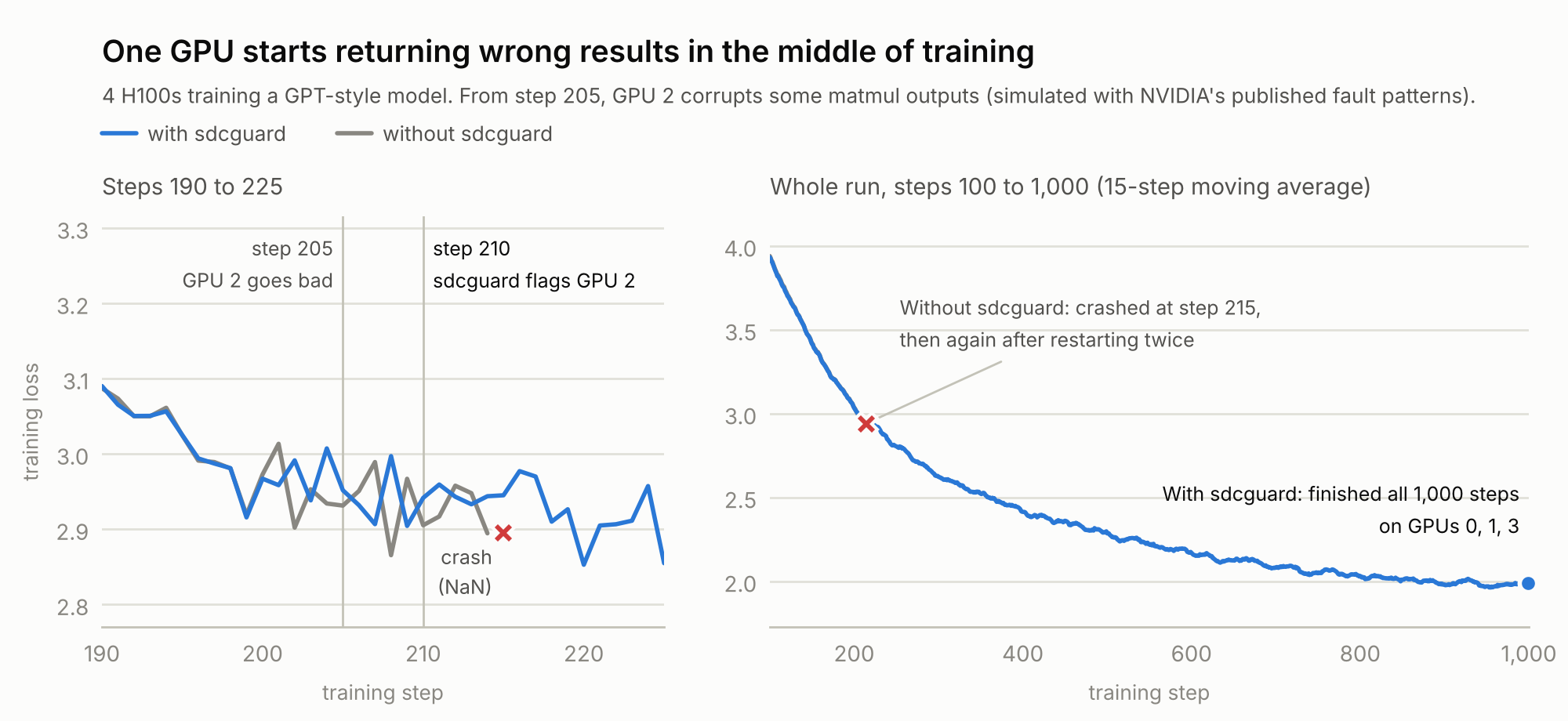
Logs and raw numbers: results/demo_4gpu.
More
- docs/METHOD.md: how every number was measured, with pass/fail criteria written before the GPU runs
- docs/EVIDENCE.md: what others published and what sdcguard measured, kept apart, negative results included
- docs/WHY.md: what already exists and what it misses
- results/: raw output of the GPU runs
- To reproduce:
pip install -e ".[experiments,dev]" && pytest -q, then the Modal scripts in scripts/
Status
Alpha (0.3.0), MIT license. Built by Hari Krishna Kancharla. Bug reports and results from your own GPUs are very welcome, most of all from a GPU you think is bad.
1 maintainer

Metadata
1 maintainer
Release files for sdcguard 0.3.0
For a detailed explanation of source distributions (sdists) and built distributions (wheels), please see the package formats documentation.
Source distribution (sdist)
| File | Size | Uploaded | Provenance | |
|---|---|---|---|---|
| sdcguard-0.3.0.tar.gz | 260.7 kB | With provenance | Details |
Built distribution (wheel)
| File | Interpreter | ABI | Platform | Reset |
|---|---|---|---|---|
| sdcguard-0.3.0-py3-none-any.whl | Python 3 | none | any | Details |
Total release size: 437.0 kB
Release files / sdcguard-0.3.0.tar.gz
| Download URL | sdcguard-0.3.0.tar.gz |
|---|---|
| Size | 260.7 kB |
| Tags | Source |
|
SHA-256 checksum How to use checksums |
41816a4b4c8173a959637d647c42b4261972d58e3045fba0083b3b33e7beaaba
|
|
BLAKE2b-256 checksum How to use checksums |
74035b0540b5aff82e64c808ab22f378684b7d155e7a2e9fc8db8a54fcc4ead5
|
| Upload date | |
|
Uploaded using Trusted Publishing? What is trusted publishing? |
Yes |
| Uploaded via |
twine/7.0.0 CPython/3.13.14
|
Provenance
Provenance describes where a file came from. On PyPI, provenance is shared via attestations, which provide a verifiable record of the build or publishing details. View details, limitations and caveats.


PyPI Publish Attestation
PyPI verified that this artifact, at this checksum, originated from the publisher listed below.
Signed by GitHub Actions, verified by PyPI on Oct 20, 2026.
Transparency logRelease files / sdcguard-0.3.0-py3-none-any.whl
| Download URL | sdcguard-0.3.0-py3-none-any.whl |
|---|---|
| Size | 176.3 kB |
| Tags | Python 3 |
|
SHA-256 checksum How to use checksums |
307d1c27c28a1c91118543c75b4ee549ac7dac3b1b8da9fdc9a66df69d9017bd
|
|
BLAKE2b-256 checksum How to use checksums |
a6fd40a8c613519346a5ac7d3a6ba25ecb4775542da15c6e55a08b7581194930
|
| Upload date | |
|
Uploaded using Trusted Publishing? What is trusted publishing? |
Yes |
| Uploaded via |
twine/7.0.0 CPython/3.13.14
|
Provenance
Provenance describes where a file came from. On PyPI, provenance is shared via attestations, which provide a verifiable record of the build or publishing details. View details, limitations and caveats.
PyPI Publish Attestation
PyPI verified that this artifact, at this checksum, originated from the publisher listed below.
Signed by GitHub Actions, verified by PyPI on Oct 20, 2026.
Transparency logSecurity for sdcguard 0.3.0
Provenance
Provenance describes where a file came from. On PyPI, provenance is shared via attestations, which provide a verifiable record of the build or publishing details. View details, limitations and caveats.
Full provenance
All 2 files in this release have been uploaded with provenance metadata.
Attestation for sdcguard-0.3.0.tar.gz
PyPI Publish Attestation
PyPI verified that this artifact, at this checksum, originated from the publisher listed below.
Signed by GitHub Actions, verified by PyPI on Oct 20, 2026.
Transparency logA note on package security
PyPI is a repository for distributing packages, not a service for auditing them. While third-party security researchers and our staff do their best to detect and remove malicious packages, PyPI cannot guarantee the quality, security or suitability of any given package.
To learn more about protecting yourself from malicious actors, visit our package security documentation.














