
🔐 sekrt




A fast TUI + CLI secret manager for developers and DevOps engineers.
Like pass, but with a modern
Textual interface, first-class API key,
SSH keypair and .env file support, and painless sync through any
private git remote (GitHub, GitLab, self-hosted — anything).
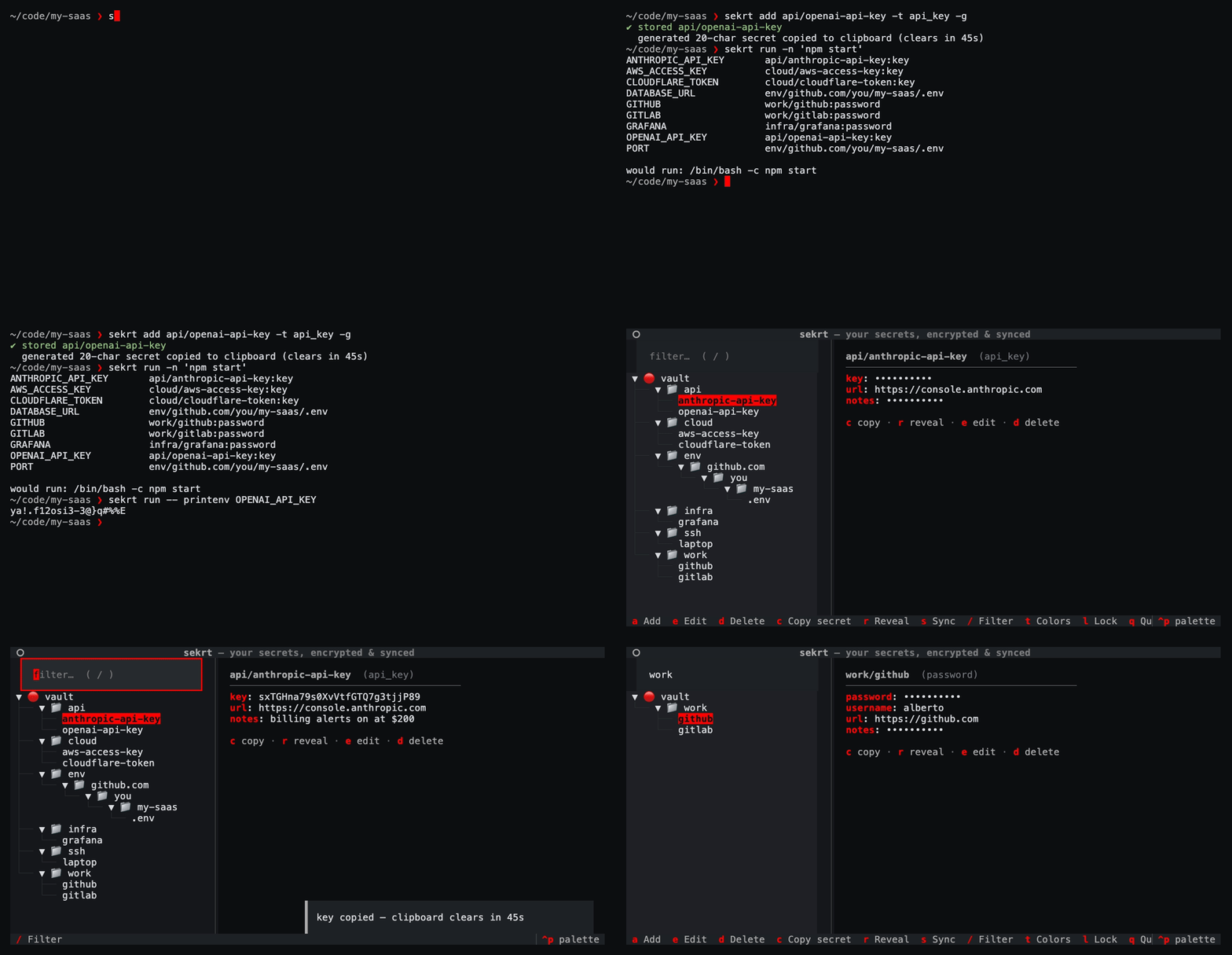
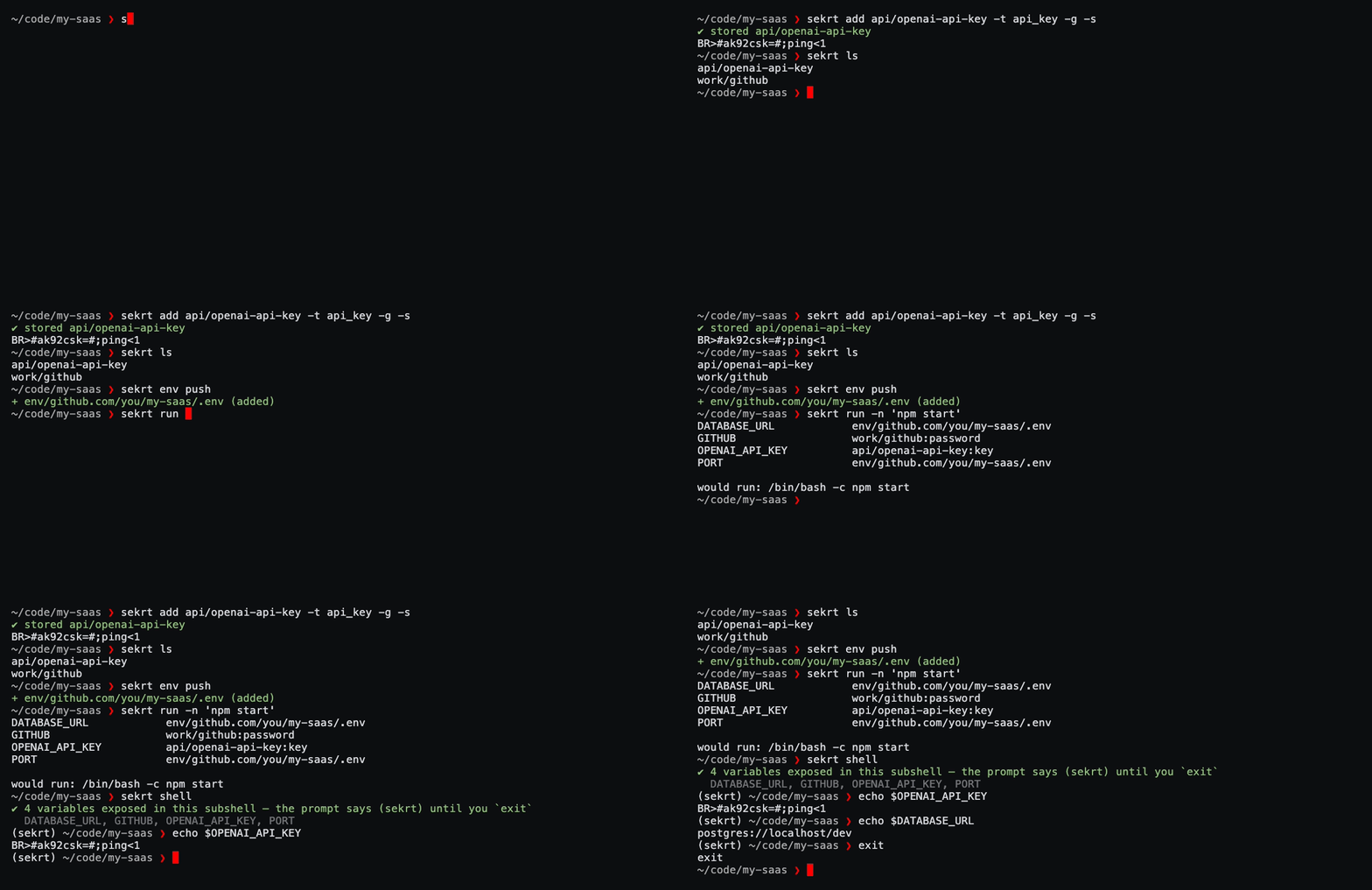
Store a generated API key, hand it to a command, then browse the same vault in the TUI — one session, start to finish.
- 🔑 Passwords & API keys — organised in folders, generated, copied with auto-clearing clipboard
- 📄
.envfiles — encrypt the.envof any repo into your vault, restore it in any fresh clone with one command - 🏃
sekrt run— hand a command your secrets in its environment only, for exactly as long as it runs - 🗝️ SSH keypairs — import, generate (ed25519), and restore with correct permissions
- ☁️ Git sync — every change is a commit;
sekrt syncpushes/pulls a private repo - 🖥️ TUI + CLI — a full keyboard-driven interface, script-friendly commands, and a few lines of inline picker or form when you leave a name out
- 🪶 Lightweight — three dependencies (
textual,click,cryptography), no daemon, no sudo, no gpg setup
Contents
- Install
- Quickstart
- Syncing with a git remote
- The
.envworkflow - Running a command with your secrets
- SSH keys
- Whole files
- The TUI
- The inline picker
- Inline forms
- Revealing a secret
- Colors
- CLI reference
- Security model
- Vault location & configuration
- Why not just
pass? - Development
- Roadmap
Install
uv tool install sekrt      # recommended
# or: pipx install sekrt
# or: pip install --user sekrt
Requires Python 3.11+. Nothing else to set up — no daemon, no GPG keyring, no sudo.
Quickstart
sekrt init                             # create a vault at ~/.local/share/sekrt
sekrt add work/github -u alberto -g    # generate & store a password
sekrt get work/github -c               # copy it (clipboard clears in 45s)
sekrt                                  # open the TUI
On a second machine, init asks whether you already have a vault in a git repo
and clones it for you if so — or skip the question with sekrt clone <url>.
That's a working local vault. init prompts you to choose (and confirm) a
passphrase — that passphrase is the vault; there's no recovery if you
lose it, so pick something you'll remember, and see the
security model below before you rely on it for real.
Anything that touches a secret asks for the passphrase — ls, find, rm and
status never do, because they decrypt nothing. sekrt unlock stops the asking
for an hour, courtesy of a RAM-backed, user-private key cache: gpg-agent,
without the agent.
sekrt unlock              # cache the key for 60 min
sekrt get work/github -c  # no prompt this time
sekrt lock                # forget it now
Syncing with a git remote
The vault is a plain git repository. sekrt sync is git pull --rebase
then git push against origin — so you need an empty private repo to
point it at (GitHub, GitLab, Gitea, a bare repo over SSH — anything git can
push to).
# 1. create an empty private repo, e.g. `gh repo create secrets --private --clone=false`
sekrt remote git@github.com:you/secrets.git   # or: sekrt init --remote <url> on a fresh vault
sekrt sync                                    # first push
On every other machine, sekrt init asks the one question that matters and
does the right thing with the answer:
$ sekrt init
Do you already have a sekrt vault pushed to a git repo? [y/N]: y
Vault repo URL: git@github.com:you/secrets.git
✔ vault cloned to ~/.local/share/sekrt
  3 entries available
  unlock with the passphrase that created this vault: `sekrt unlock`
sekrt clone <url> does the same thing in one shot if you'd rather not be asked.
Every add/edit/mv/rm auto-commits locally; sekrt sync is what
actually talks to the remote. Want every change pushed immediately instead?
sekrt autosync on
Remember: the remote only ever sees ciphertext and entry names — see what the remote sees below.
The .env workflow
.env files never land in your project repos — so every fresh clone starts
with a scavenger hunt. sekrt ends it:
cd ~/code/my-saas       # any git repo
sekrt env push         # encrypts .env into the vault, keyed by the repo's origin URL
sekrt sync
Months later, on another machine:
git clone git@github.com:you/my-saas.git && cd my-saas
sekrt env pull         # .env is back, byte for byte (0600 perms)
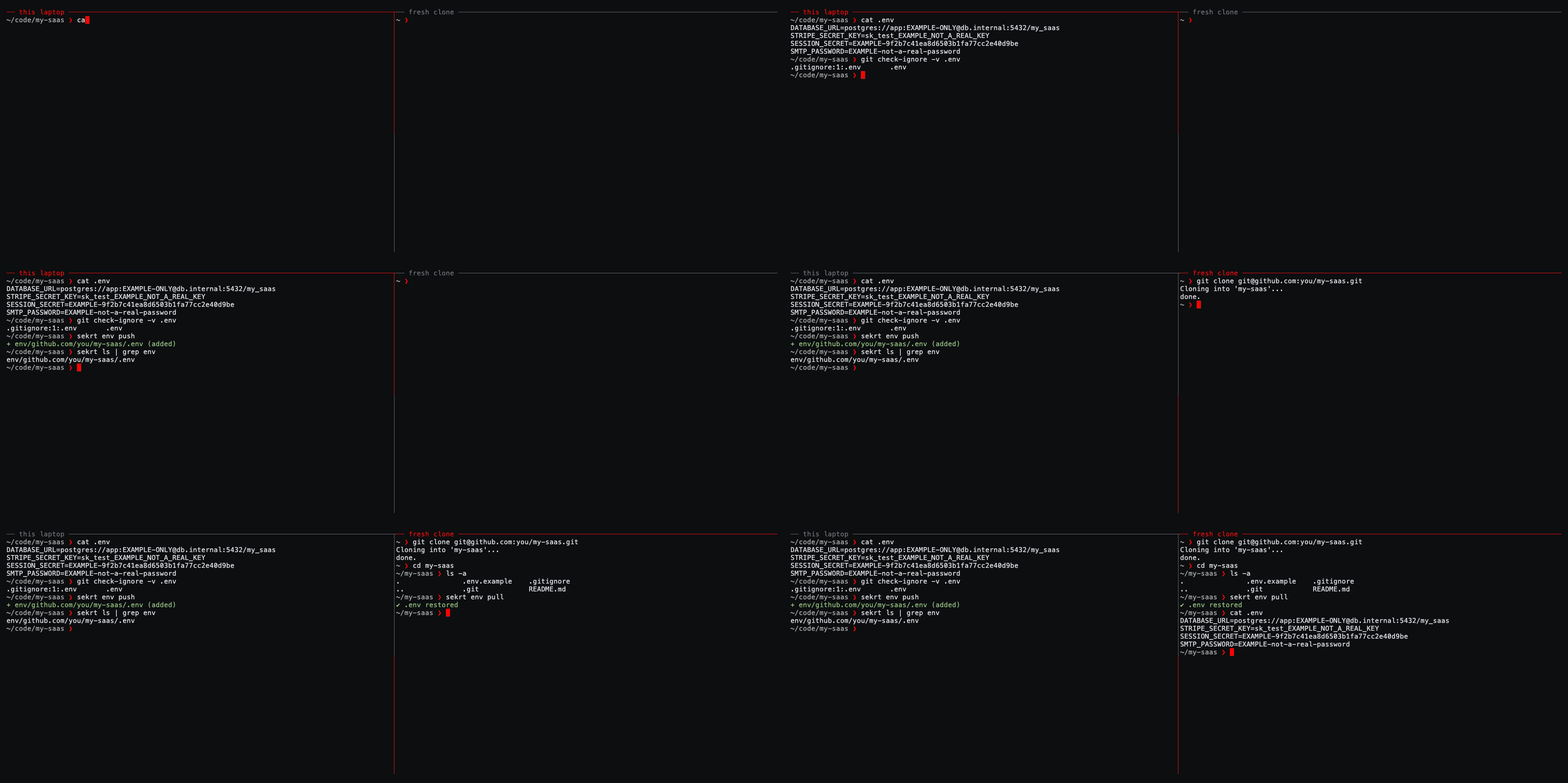
The key is the repo's origin URL, not the path on disk — so a clone anywhere
finds its own file, and HTTPS vs SSH remotes resolve to the same key. It
handles several env files per repo (sekrt env push .env apps/*/.env.*),
reports what actually changed rather than rewriting blindly, and never
overwrites a local file you've edited without --force.
📄 Full guide: the .env workflow — how repos are
identified, monorepos with one env file per service, the overwrite rules, using
--repo for forks and renames, what the remote can see, and troubleshooting.
Running a command with your secrets
sekrt expose && service log --token="$MY_TOKEN" cannot work — a child process
can't set variables in the shell that started it. So sekrt wraps the command
instead, and the secrets live in its environment, for exactly as long as it
runs:
sekrt run 'npm start'                             # everything, like a loaded .env
sekrt run -e UV_PUBLISH_TOKEN 'uv publish'        # or just the one
sekrt run 'service log --token="$MY_TOKEN"'       # a shell expands the reference
sekrt shell -e UV_PUBLISH_TOKEN                   # a subshell; `exit` revokes
sekrt shell tags its prompt — (sekrt) ~/code/my-saas ❯ — so a shell holding
secrets never looks like an ordinary one, and leaves your theme, aliases and
history exactly as they were (bash, zsh and fish).
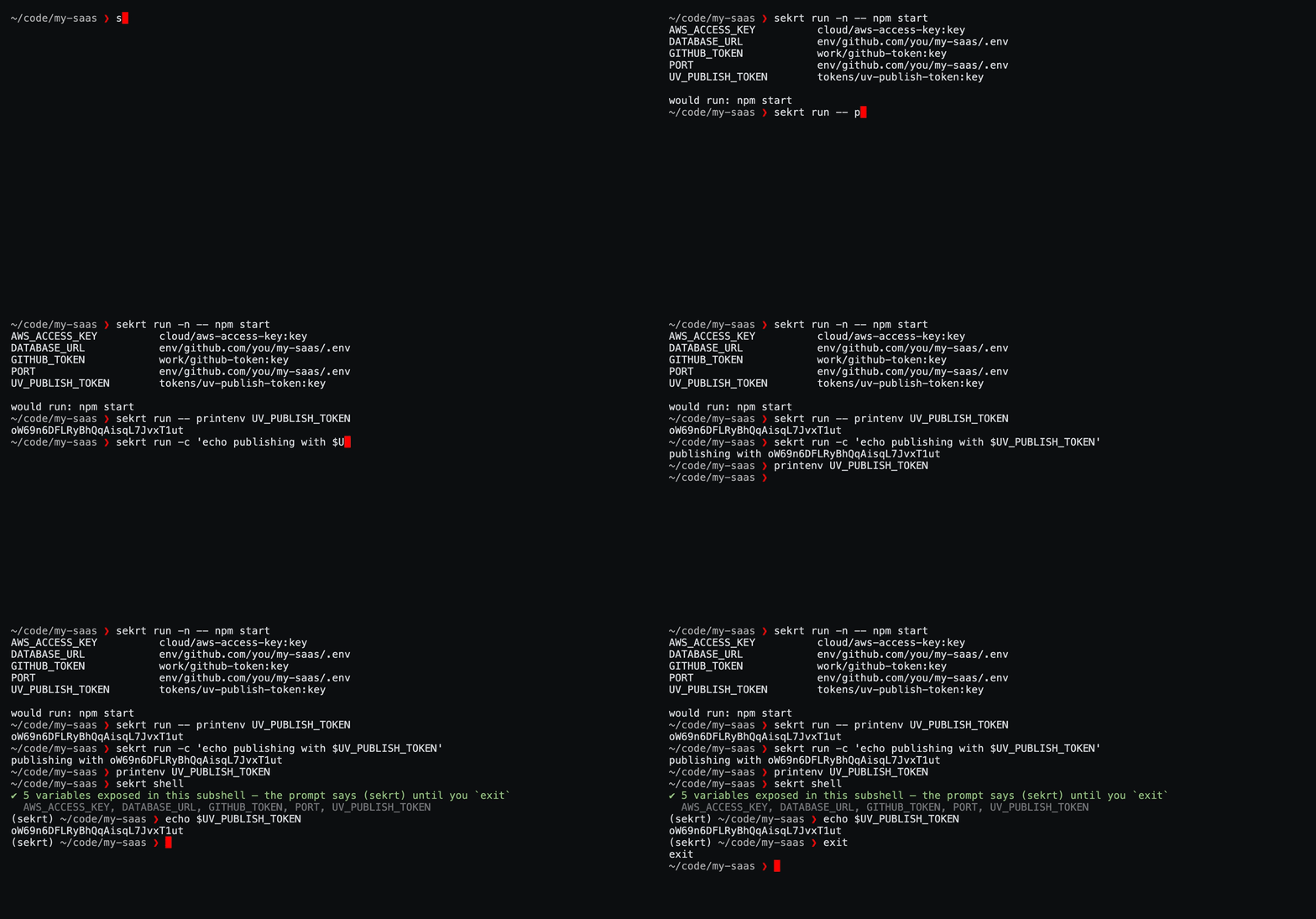
With nothing named, a command gets every password and api_key entry — under
the variable its name reads as, so api/my-token is $MY_TOKEN — plus whatever
this repo stored with sekrt env push. Notes, SSH keys and stored files stay out.
-e narrows it to what you name; -n shows what a command would get, names and
sources only. Never written to disk, never left in your shell, never put in a
command line (ps can read those), and $SEKRT_PASSPHRASE is stripped from the
child.
sekrt shell asks you to be specific, because a subshell lasts as long as you
leave it open and hands its variables to everything you start from it: name them
with -e, or type no flags at all and get this repo's stored .env files and
nothing else. The whole vault takes sekrt shell --all, which spells out what
that means and asks before opening anything (--yes to skip the question).
🏃 Full guide: running commands with your secrets — what is and
isn't exposed and why, narrowing it for code you don't control, the two forms,
$SEKRT_EXPOSED in your prompt, and troubleshooting.
SSH keys
sekrt ssh add laptop --key ~/.ssh/id_ed25519    # import an existing keypair
sekrt ssh add deploy --generate                 # or generate a fresh ed25519 key
sekrt ssh pub deploy                            # print the public key for GitHub
sekrt ssh restore deploy --dir ~/.ssh           # on a new machine: 0600/0644, done
Whole files
For anything bigger than a note — a list of MFA recovery codes, a keystore,
a PDF — sekrt file encrypts the file itself, byte-for-byte, no $EDITOR
round-trip:
sekrt file add mfa/github-recovery ~/Downloads/recovery-codes.txt
sekrt file get mfa/github-recovery                    # restores original filename, cwd
sekrt file get mfa/github-recovery -o ./codes.txt      # or pick the destination
sekrt file ls
Binary-safe (content is base64-encoded at rest), and sekrt show only
prints its size — use file get to get the bytes back out.
The TUI
sekrt with no arguments (or sekrt tui) opens the interface: a folder
tree of your vault, fuzzy filtering, a masked detail view, add/edit forms
with a built-in password generator, and one-key sync.

| Key | Action |
|---|---|
/ |
filter entries |
c |
copy the entry's secret (auto-clears in 45s) |
u |
copy the entry's username |
r |
reveal / mask fields |
a / e / d |
add / edit / delete |
s |
sync with the git remote |
t |
change the colors (see Colors) |
l |
lock the vault (prompts for the passphrase again) |
q |
quit |
.env, SSH and file entries show up in the tree read-only — add, restore
and inspect those from the CLI (sekrt env, sekrt ssh, sekrt file)
instead.
The inline picker
Nobody remembers cloud/aws-access-key-prod exactly. Leave the name out — or
type any part of it — and get, show, edit and rm open a few lines of
picker under your prompt instead of erroring:
sekrt get                 # pick from every entry
sekrt get aws             # start filtered to the matches for "aws"
🔐 passphrase ❯
 aws
❯ 🔐 cloud/aws-key-staging
  🔐 cloud/aws-access-key-prod
 ↑↓ move · enter print · esc cancel
The passphrase comes first, before the list draws — so the entry you pick is the
last thing you do, not the first. The filter matches scattered letters, not just
substrings, so awsp finds aws-access-key-prod.
The picker draws on stderr, so scripting is untouched: sekrt get > .token and
sekrt get | pbcopy still put nothing but the secret on stdout. Where there's no
terminal at all — a pipe, cron, CI — commands insist on an exact NAME instead.
Inline forms
add and ssh add carry the most flags of any command here, and typing six of
them to store one password is worse than the thing it replaces. Leave the name
out — or pass -i to start from what you already typed — and they ask instead:
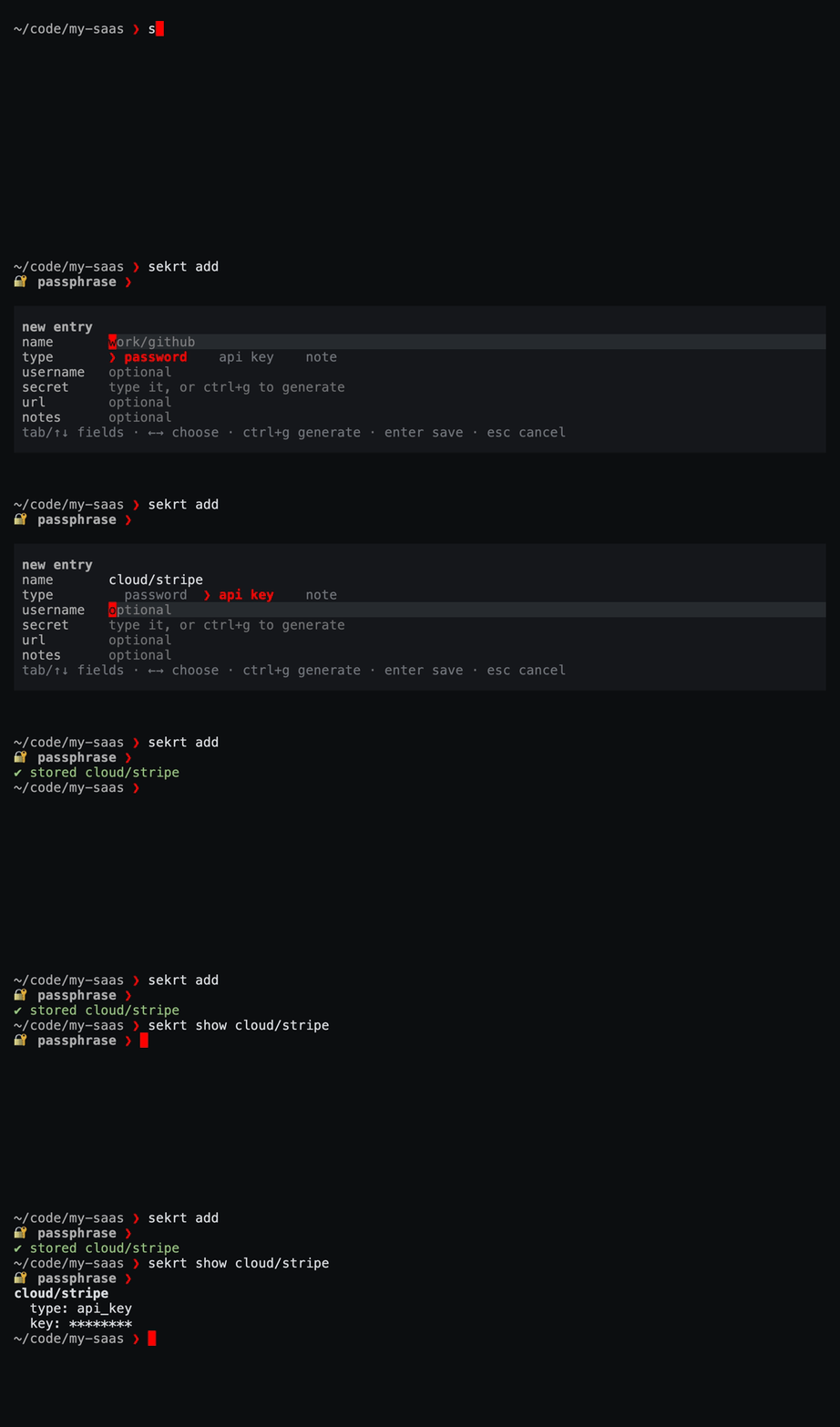
tab (or ↑/↓) moves between fields, ←/→ picks on the rows that are a
choice (password / api key / note, generate / import), ctrl+g fills the secret
in with a generated one, enter saves, esc leaves. Same rules as the picker:
drawn on stderr, only as many lines as there are fields, and where there's no
terminal the commands keep insisting on their arguments instead.
Revealing a secret
sekrt show masks the secret fields; --reveal (-r) prints them — last, after
the metadata, each one alone on an unindented line of its own:
work/github
  type: password
  username: alberto

  password:
aI9lSOSJ%E!@aHrX~R+8

  press c to copy password · any other key to dismiss
Nothing ever shares a line with a secret, so a double- or triple-click selects
the value and only the value — and a revealed SSH key comes out pasteable rather
than indented into uselessness. At a terminal, c copies it (cleared after 45s);
that prompt is stderr-only and erases itself, so a redirect still catches the
secret and nothing else, and where there's no terminal it never appears.
Colors
sekrt draws itself in three colors, and they're yours to pick. sekrt config
opens a panel under your prompt where ←/→ walks eleven ready-made palettes
and applies each as you land on it — swatches, preview and the panel's own
chrome repaint together, so a palette is judged in place rather than after a
restart. enter keeps it, esc leaves everything as it was, ctrl+r puts the
stock metal-and-red back.
preset     ███ metal  ███ teal  ███ amber  ███ indigo  ███ magenta  ███ mono
           ███ matrix  ███ ice  ███ violet  ███ rose  ███ sepia
primary    #aaaaaa  ███  borders, titles, entry names
secondary  #6e737a  ███  hints and muted text
accent     #ff0000  ███  cursor, key hints, highlights
────────────────────────────────────────────────────────────────────────────
🔴 sekrt — your secrets, encrypted & synced
❯ 🔐 work/github   password: ••••••••
←→ preset · tab/↑↓ fields · enter save · ctrl+r defaults · esc cancel
Eleven, one per hue, so no two cost you a keypress to tell apart. Want one of
your own? tab down to the fields and type it: hex (#00d7af, 0d7) or a CSS
name (cyan). The same editor is t inside the TUI, where the interface behind
it recolors live. The dark background is deliberately fixed — it's what keeps an
arbitrary accent readable.
sekrt config --preset matrix                     # any of the eleven, by name
sekrt config --preset amber --accent '#ff0088'   # a preset, then tune it
sekrt config --show                              # what's set now, plus the presets
sekrt config --reset                             # back to metal & red
Colors live in ~/.config/sekrt/config.json — not in the vault, so tweaking
them is neither a commit nor a push, and each machine can look however you like.
Aliases: sekrt colors, sekrt theme.
CLI reference
sekrt init [--remote URL]      create a vault, or clone one if you have it already
sekrt clone URL                set up from an existing vault repo, no questions asked
sekrt add [NAME] [-u USER] [-g] add password/api_key/note  (alias: insert)
sekrt get [NAME] [-c] [-f F]   print or copy a secret
sekrt show [NAME] [--reveal]   show all fields (-r: reveal secrets, c to copy)
sekrt ls [PREFIX]              list entries                (alias: list)
sekrt find QUERY               search names                (alias: search)
sekrt edit [NAME]              edit fields in $EDITOR (notes: raw multiline text)
sekrt mv OLD NEW               rename                      (alias: rename)
sekrt rm [NAME] [-f]           delete                      (alias: remove)
sekrt generate [LEN] [--token] generate without storing
sekrt env push|pull|ls|show|rm .env files per repository    (guide: docs/env.md)
sekrt run 'CMD'                run CMD with your secrets in its env (alias: exec)
sekrt run -e VAR 'CMD'         ...narrowed to VAR   (-n: show, don't run)
sekrt run 'CMD $VAR'           quoted: a shell reads it, so it expands $VAR
sekrt run -- CMD ARGS...       ...or hand over an argv, with no shell at all
sekrt shell -e VAR             a subshell holding VAR; exit revokes (alias: sh)
sekrt shell                    ...or this repo's stored .env files, and no more
sekrt shell --all              ...or the whole vault, after confirming (-y: skip)
sekrt ssh add|restore|ls|pub   SSH keypairs
sekrt file add|get|ls          whole files, binary-safe
sekrt remote URL               set the sync remote
sekrt sync                     pull --rebase + push
sekrt autosync on|off          push automatically on every change
sekrt git <args...>            raw git inside the vault
sekrt unlock [-t MIN] / lock   cache / forget the vault key
sekrt passwd                   change passphrase (re-encrypts everything)
sekrt status                   vault, remote, session info
sekrt config [--preset NAME]   pick the colors    (aliases: colors, theme)
sekrt tui                      open the interactive TUI
Every command has --help (e.g. sekrt add --help) with the full option
list and examples. Where NAME is optional above, omitting it (or typing
part of one) opens the inline picker — or, for add and
ssh add, an inline form.
Security model
- Encryption: every entry is an independent file encrypted with AES-256-GCM. The key is derived from your passphrase with scrypt (N=2¹⁵, r=8, p=1, random per-vault salt).
- Tamper binding: an entry's logical name is the GCM associated data — a ciphertext moved or renamed by an attacker fails to decrypt.
- What the remote sees: entry names and folder structure (like
pass), timestamps, and commit history. Entry contents are always ciphertext. Use names accordingly (work/github, notpassword-is-hunter2). - Session cache:
sekrt unlockstores the derived key (never the passphrase) in$XDG_RUNTIME_DIR— tmpfs on Linux: RAM-backed, user-only (0600), wiped on logout — with a TTL.sekrt lockclears it immediately. - Clipboard: auto-clears after 45 s, and only if it still holds the copied value. Secrets are never passed through argv.
sekrt run/sekrt shell: values are written to the wrapped process's environment and nowhere else — not to disk, not to your shell, and never into a command line (psis world-readable).$SEKRT_PASSPHRASEis stripped from the child, so a wrapped command cannot decrypt anything it wasn't handed, and on POSIX sekrtexecs the command, so nothing of sekrt stays running with the key in memory. Unnamed, the exposure is broad by design: every password and API key in the vault, which is convenient and means a wrapped command — and everything it starts — holds your whole working set of credentials.-e VARnarrows it to what that command actually needs, and-nshows what it would get; prefer both for anything you didn't write.- Files: vault dir
0700, entries0600, atomic writes, restored SSH keys0600/0644. - Threat model: protects secrets at rest and in your git remote. It does not protect against an attacker with root/physical access to your unlocked machine — nothing userspace does.
- Your passphrase is the whole game: anyone who obtains the vault files (including whoever hosts your sync remote) can attempt an offline brute-force. scrypt makes each guess expensive, but a weak passphrase falls anyway — use a long one. sekrt enforces a minimum of 8 characters; treat that as a floor, not a target.
- A compromised remote cannot read entry contents or swap ciphertexts
between names (AEAD name binding), but it can delete entries, serve you
an old version of the vault (rollback), or corrupt the vault config. If
sekrt syncsuddenly reports missing entries or a passphrase failure, investigate before typing your passphrase anywhere else.
Found a vulnerability? Please report it privately via GitHub security advisories rather than a public issue.
Vault location & configuration
| What | Default | Override |
|---|---|---|
| Vault directory | ~/.local/share/sekrt |
$SEKRT_VAULT |
| Passphrase (CI/scripts) | interactive prompt | $SEKRT_PASSPHRASE |
Editor for sekrt edit |
$EDITOR |
$VISUAL |
Colors (sekrt config) |
~/.config/sekrt/config.json |
$SEKRT_CONFIG |
The vault is a plain git repository — inspect it any time with
sekrt git log.
Upgrading from
tupacs? This project was published under that name through 0.1.0. TheTUPACS_*variables above still work as fallbacks, and vaults written by 0.1.0 (.tupentry files) are read as-is. Only the vault directory needs a hand — see the migration note.
Why not just pass?
pass is excellent, and sekrt borrows its best idea (one encrypted file
per secret, git-friendly). Differences: no GPG key management — a single
passphrase with scrypt+AES-GCM; a real TUI; structured entries (username,
URL, notes — not just a text blob); and purpose-built .env and SSH-key
workflows.
Development
git clone https://github.com/alberto-rota/sekrt && cd sekrt
uv sync                 # installs everything incl. dev deps
uv run pytest           # tests
uv run ruff check .     # lint
uv run sekrt --help
Try changes against a throwaway vault so you never touch your real one:
export SEKRT_VAULT=/tmp/sekrt-dev SEKRT_PASSPHRASE=dev
uv run sekrt init && uv run sekrt
While $SEKRT_VAULT is set the unlock prompt names that vault
(🔐 passphrase sekrt-dev ❯), so a scratch vault never gets mistaken for the
real one.
Contributions welcome — see CONTRIBUTING.md.
The docs/*.gif demos are recorded with VHS
from the tapes in docs/vhs/. Run them from the repo root with sekrt on
$PATH (brew install vhs, then uv tool install --editable .):
vhs docs/vhs/hero.tape         # -> docs/hero.gif  (the one at the top)
vhs docs/vhs/quickstart.tape   # -> docs/quickstart.gif
vhs docs/vhs/tui.tape          # -> docs/tui.gif (run quickstart.tape first to seed the demo vault)
vhs docs/vhs/env.tape          # -> docs/env.gif
vhs docs/vhs/env-multi.tape    # -> docs/env-multi.gif
vhs docs/vhs/env-safety.tape   # -> docs/env-safety.gif
vhs docs/vhs/run.tape          # -> docs/run.gif
vhs docs/vhs/forms.tape        # -> docs/forms.gif
The hero, env, run and forms tapes are self-contained: each rebuilds
its fixture — real git repos with remotes, a fresh clone, a scratch vault —
under /tmp/sekrt-vhs-* (setup-hero-demo.sh, setup-env-demo.sh,
setup-run-demo.sh) and points $HOME at it, so your real vault and
~/.gitconfig are never touched. Their fixtures generate secrets rather
than piping them in: sekrt add reads through getpass, which reads
/dev/tty, so a pipe is ignored and the recording would hang waiting for a
keyboard.
docs/screenshot.svg is a Textual export rather than a recording — a still of
the TUI at full size — so it has its own generator:
uv run python docs/vhs/make-screenshot.py # -> docs/screenshot.svg
Roadmap
-
sekrt grep— search inside decrypted entries - TOTP / 2FA codes (
sekrt otp NAME) - Import from
pass, Bitwarden, 1Password CSV - Diceware passphrase generation
- Windows clipboard & session-cache support
License
1 maintainer

Metadata
1 maintainer
Release files for sekrt 0.3.4
For a detailed explanation of source distributions (sdists) and built distributions (wheels), please see the package formats documentation.
Source distribution (sdist)
| File | Size | Uploaded | |
|---|---|---|---|
| sekrt-0.3.4.tar.gz | 1.8 MB | Details |
Built distribution (wheel)
| File | Interpreter | ABI | Platform | Reset |
|---|---|---|---|---|
| sekrt-0.3.4-py3-none-any.whl | Python 3 | none | any | Details |
Total release size: 1.9 MB
Release files / sekrt-0.3.4.tar.gz
| Download URL | sekrt-0.3.4.tar.gz |
|---|---|
| Size | 1.8 MB |
| Tags | Source |
|
SHA-256 checksum How to use checksums |
e4b9b098de17ef3a8ac77c3eef891fef4319352a4877d74305d58bf75a15851c
|
|
BLAKE2b-256 checksum How to use checksums |
9417602571695c2252c2ceffde5bbd204976cc2f8e04338c918279388e372c0d
|
| Upload date | |
|
Uploaded using Trusted Publishing? What is trusted publishing? |
No |
| Uploaded via |
uv/0.12.3 {"installer":{"name":"uv","version":"0.12.3","subcommand":["publish"]},"python":null,"implementation":{"name":null,"version":null},"distro":{"name":"macOS","version":null,"id":null,"libc":null},"system":{"name":null,"release":null},"cpu":null,"openssl_version":null,"setuptools_version":null,"rustc_version":null,"ci":null}
|
Release files / sekrt-0.3.4-py3-none-any.whl
| Download URL | sekrt-0.3.4-py3-none-any.whl |
|---|---|
| Size | 80.4 kB |
| Tags | Python 3 |
|
SHA-256 checksum How to use checksums |
129e0be0b50ea367c2547adcc40fbf543ddcec8833ac7954855e468ef5f49ad8
|
|
BLAKE2b-256 checksum How to use checksums |
2fcaa91106df15fed7e9f7089dff103616116d6ef8bcc821beeafcf3583e9da6
|
| Upload date | |
|
Uploaded using Trusted Publishing? What is trusted publishing? |
No |
| Uploaded via |
uv/0.12.3 {"installer":{"name":"uv","version":"0.12.3","subcommand":["publish"]},"python":null,"implementation":{"name":null,"version":null},"distro":{"name":"macOS","version":null,"id":null,"libc":null},"system":{"name":null,"release":null},"cpu":null,"openssl_version":null,"setuptools_version":null,"rustc_version":null,"ci":null}
|














