






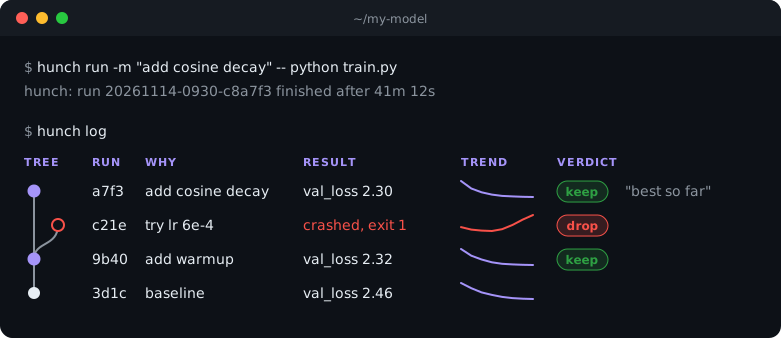
Every run keeps its code, config, environment, metrics and why, and knows which run it came from.
pip install sigmoid-hunch
If you know git, you know Hunch
| git | hunch |
|---|---|
git commit -m "why" |
hunch run -m "why" -- python train.py |
git log |
hunch log |
git log --oneline |
hunch log --oneline |
git show a7f3 |
hunch show a7f3 |
git diff 9b40 a7f3 |
hunch diff 9b40 a7f3 |
git notes add |
hunch note a7f3 "helps" --keep |
git config |
hunch config main-metric val_loss |
How is it different from git? Git tracks what you changed. Hunch tracks what you tried, and what happened. Run the same code 20 times with different learning rates: git sees one commit, Hunch sees 20 experiments with their results.
In your code
import hunch

hunch.init(config=args, why="warmup to fix loss spikes")
hunch.log({"val_loss": val_loss}, step=step)
Same names as W&B: import hunch as wandb works.
Your disk, your files
No server, no account, no telemetry, no dependencies, and git is optional. Runs are plain files in .hunch/.
Guide · File format · Questions · Contributing
Share it
Saved you a "what did I run last month?" moment? Tell one person, or post your hunch log in
Show and tell.




Tracking a research repo with Hunch? Show it:

[](https://github.com/sigmoid-ide/hunch)
Team

rainxchzed 
|
Apache-2.0 · Part of Sigmoid IDE · Like it? Give it a star.
1 maintainer

Metadata
1 maintainer
Release files for sigmoid-hunch 0.2.0
For a detailed explanation of source distributions (sdists) and built distributions (wheels), please see the package formats documentation.
Source distribution (sdist)
| File | Size | Uploaded | Provenance | Actions |
|---|---|---|---|---|
| sigmoid_hunch-0.2.0.tar.gz | 29.9 kB | Without provenance | Details for sigmoid_hunch-0.2.0.tar.gz |
Built distribution (wheel)
| File | Interpreter | ABI | Platform | Actions Reset |
|---|---|---|---|---|
| sigmoid_hunch-0.2.0-py3-none-any.whl | Python 3 | none | any | Details for sigmoid_hunch-0.2.0-py3-none-any.whl |
Total release size: 64.5 kB
Release files / sigmoid_hunch-0.2.0.tar.gz
| Download URL | sigmoid_hunch-0.2.0.tar.gz |
|---|---|
| Size | 29.9 kB |
| Tags | Source |
|
SHA-256 checksum How to use checksums |
b56312f00ee61346fd24d33b9c6dde5bb4b4b978d3c30f098946769883e193f0
|
|
BLAKE2b-256 checksum How to use checksums |
59300be5af0e6ab1f14129e71ddac701b7a5f6488dfd07c7625d418659950918
|
| Upload date | |
|
Uploaded using Trusted Publishing? What is trusted publishing? |
Yes |
| Uploaded via |
uv/0.13.7 {"installer":{"name":"uv","version":"0.13.7","subcommand":["publish"]},"python":null,"implementation":{"name":null,"version":null},"distro":{"name":"Ubuntu","version":"26.04","id":"resolute","libc":null},"system":{"name":null,"release":null},"cpu":null,"openssl_version":null,"setuptools_version":null,"rustc_version":null,"ci":true}
|
Release files / sigmoid_hunch-0.2.0-py3-none-any.whl
| Download URL | sigmoid_hunch-0.2.0-py3-none-any.whl |
|---|---|
| Size | 34.7 kB |
| Tags | Python 3 |
|
SHA-256 checksum How to use checksums |
f637717ac1e7907e029d1d2ee8df2e31863eed04d737601c34e2d169d33cfb2d
|
|
BLAKE2b-256 checksum How to use checksums |
55b0e87dbfeeb594059eaec3fbf9193586c47ae989f6664807020e1b2b578342
|
| Upload date | |
|
Uploaded using Trusted Publishing? What is trusted publishing? |
Yes |
| Uploaded via |
uv/0.13.7 {"installer":{"name":"uv","version":"0.13.7","subcommand":["publish"]},"python":null,"implementation":{"name":null,"version":null},"distro":{"name":"Ubuntu","version":"26.04","id":"resolute","libc":null},"system":{"name":null,"release":null},"cpu":null,"openssl_version":null,"setuptools_version":null,"rustc_version":null,"ci":true}
|
Security for sigmoid-hunch 0.2.0
Provenance
Provenance describes where a file came from. On PyPI, provenance is shared via attestations, which provide a verifiable record of the build or publishing details. View details, limitations and caveats.
No provenance found
None of the files in this release were uploaded with provenance metadata.
A note on package security
PyPI is a repository for distributing packages, not a service for auditing them. While third-party security researchers and our staff do their best to detect and remove malicious packages, PyPI cannot guarantee the quality, security or suitability of any given package.
To learn more about protecting yourself from malicious actors, visit our package security documentation.














