
Sigvue
Sigvue turns file-backed analysis scripts into a local browser application. A workspace package decides:
- Which items are available.
- How an item is opened.
- Which parameters configure processing, if any.
- How delivered data becomes analysis products.
- How those products are arranged and displayed.
The framework supplies the catalog, page layout, parameters, themes, refresh and playback controls, plot updates, background capability execution, and HTTP service.
Mental model
A workspace is an adapter between domain code and the Sigvue runtime. Plugin code owns data semantics; the framework owns application lifecycle and UI state.

The same factory may appear multiple times in browser.toml. Each entry creates
a separate workspace instance with its own identity, tags, and data
configuration while reusing the same source, delivery, processing, and
presentation code.
Install and run
python -m pip install sigvue
sigvue --config browser.toml
Open http://127.0.0.1:8000. The package contains no built-in workspaces; browser.toml chooses which independently installed or local workspace packages to load.
Runnable pipeline example
This repository includes external-style reference implementations under
example_pipelines/. They are intentionally outside
src/sigvue; they share reusable concrete plugin components through
example_pipelines.plugins while keeping domain analysis, Plotly presentation,
and workspace assembly local.
Generate all of the small synthetic
LTE-like and digital-modulation recordings, then launch them with:
python -m pip install -e ".[examples]"
python -m example_pipelines.scripts.generate_all
sigvue --config example_pipelines/browser.toml
The generated SigMF data is ignored by Git. The example exists to show a complete, copyable plugin repository shape; it is not built into the Sigvue package.
Framework-neutral authoring utilities
sigvue.helpers is deliberately limited to utilities that do not implement or
inherit the plugin contract:
- typed, profile-relative workspace configuration;
- atomic downloads with optional size/checksum verification and defensive tar extraction;
- byte formatting and resident-buffer accounting.
Concrete readers, lifecycle adapters, annotators, exporters, and plotting
additions are plugins, so they live with the examples rather than in the
framework package. The small bundled set keeps its copyable plugin kit under
example_pipelines/plugins/; the standalone
examples package provides the same seam for the richer radar, communications,
and waterfall workspaces. This keeps core policy-neutral while still giving
workspace authors drop-in implementations they can copy or package.
The workspace-author contract
Every workspace package defines one factory and composes framework objects.
Source owns discovery and opening, optional
Delivery owns request-dependent selection, Analysis owns configuration and
processing, and Presentation owns display. Annotation and export are
independent optional capabilities.
Import public plugin types from sigvue.plugin; sigvue.core is framework
implementation detail.
Only descriptive values such as identifiers, labels, tags, versions, and column definitions are plain data. Every behavioral constructor field requires an explicit framework object:
Workspace(
    source=RecordingSource(...),
    delivery=WindowDelivery(),          # optional
    analysis=RecordingAnalysis(),
    presentation=RecordingPresentation(),
    annotator=RecordingAnnotator(),     # optional
    exporter=RecordingExporter(),       # optional
)
A pipeline may use a helper such as recording_source(root) to construct and
return one of these objects. The helper is not itself a lifecycle hook; the
value returned to Workspace must still inherit the corresponding framework
base class. Structural lookalikes are rejected.
What create_workspace() constructs
create_workspace(config) must return one Workspace. These are the
values passed to its constructor:
| Constructor value | Required | Created by | Used for |
|---|---|---|---|
identifier, name, description |
Yes | Plugin defaults; profile may override | Standalone identity and fallback catalog metadata. |
source: Source[SourceData] |
Yes | Plugin | Discover DataResource records and open one domain value. |
analysis: Analysis[...] |
Yes | Plugin | A pipeline-specific object implementing process() and optionally overriding configure(). |
presentation: Presentation[...] |
Yes | Plugin | A pipeline-specific object implementing present() for display controls, views, statistics, and layout. |
delivery: Delivery[SourceData, DeliveredData] |
No | Plugin | Select a buffer, choose a segment, follow live data, or transform the opened value. |
annotator: Annotator[...] |
No | Plugin | Discover and persist domain-native annotations. Enables Annotate. |
exporter: Exporter[...] |
No | Plugin | Advertise formats/scopes and serialize domain data. Enables Download. |
discovery_columns |
No | Plugin | Define sortable metadata columns populated by DataResource.summary. |
lazy_views |
No | Plugin | False creates every declared view up front; True creates only the selected tab/switcher branch and fetches another branch when selected. |
version, category, tags |
No | Plugin defaults; profile may override display metadata | Catalog presentation and search. |
Start with only what is necessary
The smallest useful workspace has three behavioral objects:
Workspace(
    identifier="results",
    name="Results",
    description="Inspect complete result files.",
    source=ResultSource(),
    analysis=ResultAnalysis(),
    presentation=ResultPresentation(),
)
Choose when views are created
Workspace(..., lazy_views=False) is the default. It runs every declared view
callback during the initial item request, so tab and view-switcher changes are
client-local afterward. Use this eager mode when opening and processing the data
once is more important than the cost of creating every figure.
Set lazy_views=True when a workspace has many expensive views and should create
only what the user can currently see:
Workspace(
    ...,
    lazy_views=True,
)
Selecting another tab or switcher option then makes a normal item request and creates only that visible layout branch. This flag controls presentation view creation; source, delivery, analysis, and their caching still follow the normal workspace request lifecycle.
Add another object only when the workflow needs the behavior it owns:
| Requirement | Add or override | What becomes available |
|---|---|---|
| Discover and open data | Source |
Required catalog and item opening. DirectorySource handles common file trees. |
| Process the complete opened value | Analysis.process() |
Required computation; receives settings=None when configuration is not overridden. |
| Display products | Presentation.present() |
Required plots, tables, text, tabs, view switching, statistics, and display controls. |
| Add processing parameters | Analysis.configure() |
Processing number, select, and toggle controls through ParameterContext. |
| Select buffers, windows, or events | Delivery |
Static, seek, live, windowed, segmented, refresh, and overview behavior through DeliveryContext. |
| Read or write annotations | Annotator |
Framework annotation menu, fields, timeline markers, and plot-bound selection values. |
| Download domain data | Exporter |
Framework download menu with plugin-defined scopes and formats. |
| Add catalog columns | DiscoveryColumn values |
Searchable and sortable per-item metadata. |
process() deliberately receives no UI object. It consumes delivered domain
data plus typed settings and returns domain products. This keeps numerical work
testable outside Sigvue. Timeline UI belongs to Delivery, processing controls
belong to Analysis.configure(), and display controls and layout belong to
Presentation.present().
Pipelines that can reduce data before constructing figures may expose an
explicit point target from configure() or delivery with
ui.render_points(...). It behaves like an integer parameter grouped under
Rendering resolution. The framework does not decimate automatically: the
pipeline consumes the returned value where its domain-specific averaging,
subsampling, or aggregation is valid, and the user may change it at runtime.
The factory does not construct DeliveryContext, ParameterContext,
ViewContext, PageDefinition, PlaybackConfiguration, or OpenedItem. The framework creates those objects
for each request. A source or its DirectorySource.describe callback creates
DataResource values during discovery, not normally in the factory itself.
Public object ownership is intentionally narrow:
| Public object | Who creates it? | Where it is used |
|---|---|---|
Workspace |
Plugin factory | Returned from create_workspace(). |
Source subclass or DirectorySource |
Plugin factory | Passed as required source=. |
DirectorySource |
Plugin factory | Optional concrete replacement for writing a custom source. |
DataResource |
Source | Returned by discover(); later passed back to open(). |
Delivery subclass |
Plugin factory | Passed as optional delivery=. |
Analysis subclass |
Plugin | Passed as required analysis=; implements process() and optionally configure(). |
Presentation subclass |
Plugin | Passed as required presentation=; implements present(). |
DiscoveryColumn |
Plugin factory | Passed in optional discovery_columns=. |
Annotator / Exporter |
Plugin factory | Passed as optional capability objects. |
AnnotationField, CapabilityChoice |
Plugin capability | Advertise framework-rendered capability inputs. |
AnnotationRequest, ExportRequest |
Framework | Passed into plugin capability methods. |
DeliveryContext |
Framework | Passed into delivery for timeline and buffer selection. |
ParameterContext |
Framework | Passed into configure; exposes only typed parameter declarations. |
ViewContext |
Framework | Passed into present; exposes layout, display controls, views, and statistics. |
Segment |
Plugin delivery or analysis | Passed into ui.segmented(...). |
TraceStyle |
Framework | Returned by ui.trace_style(...) for plotting code. |
A fully populated factory has this shape; every line marked optional may simply be omitted:
def create_workspace(config):
    return Workspace(
        identifier="my-analysis",                 # required fallback metadata
        name="My Analysis",                       # required fallback metadata
        description="Inspect domain recordings.", # required fallback metadata
        source=MySource(config["data_root"]),      # required Source
        delivery=MyDelivery(),                     # optional Delivery
        analysis=MyAnalysis(),                     # required Analysis object
        presentation=MyPresentation(),             # required Presentation object
        annotator=MyAnnotator(),                   # optional capability
        exporter=MyExporter(),                     # optional capability
        discovery_columns=MY_COLUMNS,              # optional catalog schema
        lazy_views=True,                            # optional active-view-only creation
        category="signal analysis",               # optional fallback metadata
        tags=("windowed", "domain-format"),        # optional fallback metadata
    )
Contract relationships

Typed data path
Source, Delivery, Analysis, and Presentation are public generic base
objects. Pipeline-specific subclasses implement their named lifecycle methods.
Together their type parameters describe the complete data path:

The objects make every boundary explicit at construction time: the workspace
cannot accept a look-alike object that merely happens to have a method with the
right name. Type checkers can also verify individual Source, Delivery,
Analysis, and Presentation definitions.
The installed package includes a py.typed marker, so these checks also work
when sigvue is installed from a wheel.
Subclass the framework base objects when behavior needs state; this makes the contract visible and lets type checkers verify each boundary:
from collections.abc import Iterable

from sigvue.plugin import (
    Analysis,
    DataResource,
    Delivery,
    DeliveryContext,
    ParameterContext,
    Presentation,
    Source,
    ViewContext,
)


class MySource(Source[Recording]):
    def discover(self) -> Iterable[DataResource]:
        ...

    def open(self, resource: DataResource) -> Recording:
        ...


class WindowDelivery(Delivery[Recording, SampleWindow]):
    def prepare(
        self,
        recording: Recording,
        ui: DeliveryContext,
    ) -> SampleWindow:
        ...


class MyAnalysis(Analysis[SampleWindow, Settings, Products]):
    def configure(self, data: SampleWindow, ui: ParameterContext) -> Settings:
        ...

    def process(self, data: SampleWindow, settings: Settings | None) -> Products:
        ...


class MyPresentation(Presentation[Products]):
    def present(self, products: Products, ui: ViewContext) -> None:
        ...
DirectorySource handles the common filesystem case. All six behavioral base
classes are abstract, so incomplete pipeline objects fail immediately when
instantiated. At runtime, Workspace requires actual framework objects,
validates discovered DataResource values, and rejects duplicate resource
identifiers. There is one accepted
spelling for each boundary: source=, delivery=, analysis=,
presentation=, annotator=, and exporter=.
Request lifecycle
The factory runs when the profile is loaded or reloaded. Source I/O, delivery, configuration, processing, and presentation run later, when the browser opens data or changes request state.
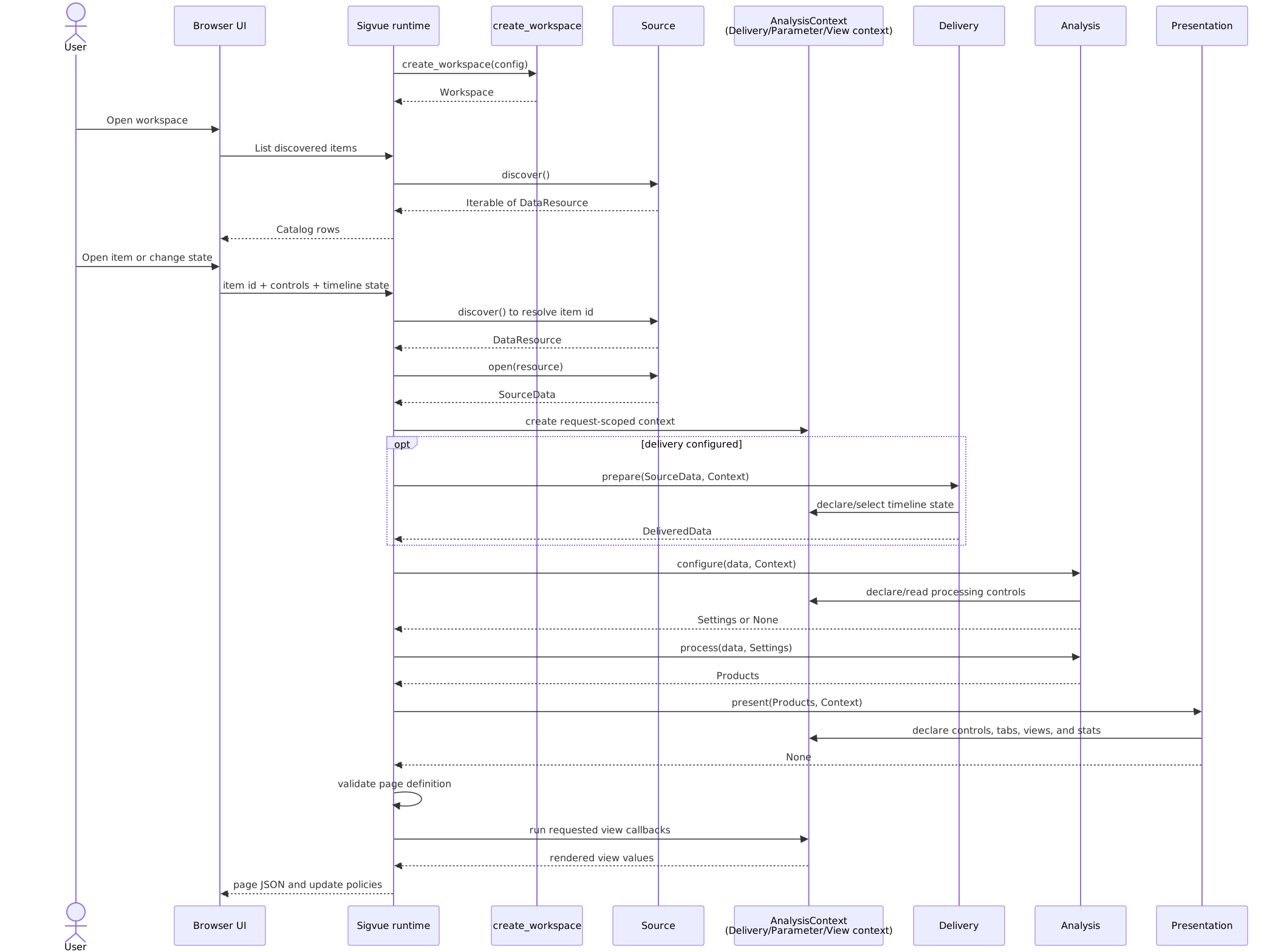
source.open() is called for the selected item on each page request. A domain
reader may therefore be lightweight and read only the requested interval when
delivery calls it. Processing results are cached by item revision, timeline
state, and configuration values. Presentation-only controls and theme changes
reuse those products; changing processing parameters or the delivered interval
runs process again. Live and explicitly refreshing pages do not retain a
process result across requests.
Minimal file-backed workspace
# src/my_workspace/workspace.py
import json
from collections.abc import Mapping
from pathlib import Path
from dataclasses import dataclass
from typing import TypedDict

import plotly.graph_objects as go

from sigvue.plugin import Analysis, DirectorySource, ParameterContext, Presentation, ViewContext, Workspace


class ResultFile(TypedDict):
    values: list[float]


def load_result(path: Path) -> ResultFile:
    return json.loads(path.read_text())


@dataclass(frozen=True)
class Settings:
    scale: float


class ResultAnalysis(Analysis[ResultFile, Settings, list[float]]):
    def configure(self, result: ResultFile, ui: ParameterContext) -> Settings:
        return Settings(scale=float(ui.number("scale", label="Scale", default=1.0, step=0.1)))

    def process(self, result: ResultFile, settings: Settings | None) -> list[float]:
        if settings is None:
            raise RuntimeError("Result analysis requires configured settings")
        return [settings.scale * value for value in result["values"]]


class ResultPresentation(Presentation[list[float]]):
    def present(self, values: list[float], ui: ViewContext) -> None:
        figure = go.Figure(go.Scatter(y=values, name="Value"))
        with ui.tab("Values"):
            ui.place_parameters("scale", label="Processing")
            ui.plot(figure, key="values")


def create_workspace(config: Mapping[str, object]) -> Workspace:
    source = DirectorySource[ResultFile](
        Path(str(config["data_root"])),
        pattern="*.result.json",
        loader=load_result,
    )
    return Workspace(
        # Required fallback metadata; browser.toml may override it per instance.
        identifier="result-analysis",
        name="Result Analysis",
        description="Inspect result files.",
        # Required contracts.
        source=source,
        analysis=ResultAnalysis(),
        presentation=ResultPresentation(),
    )
This example uses all three lifecycle stages because it has a processing
parameter. The required contract is one source, one analysis, and one
presentation. When an Analysis subclass does not override configure, its
base implementation returns None to process. When overridden,
configure owns processing inputs, process remains domain code with no
presentation dependency, and present owns layout. ui.place_parameters(...) can put
a configured control inside a particular tab or switched view; otherwise it
remains in Details. Add delivery or capabilities only when the workflow needs
them.
Set recursive=True on DirectorySource to preserve nested directories in the
browser. The framework derives folder breadcrumbs from each file's path relative
to the source root; files are not flattened and directories are not presented as
fake analysis items. A custom source can provide the same behavior by setting
DataResource(navigation_path=("campaign", "day-2"), ...).
Discovery columns
Each workspace can declare the metadata columns shown beside discovered files.
The workspace supplies raw values in DataResource.summary; Sigvue owns table
rendering, null display, search, and sorting:
from pathlib import Path

from sigvue.plugin import DataResource, DiscoveryColumn, Workspace

columns = (
    DiscoveryColumn("date", "Date", kind="datetime"),
    DiscoveryColumn("sample_rate", "Sampling rate", kind="si", unit="sample/s"),
    DiscoveryColumn("rf_frequency", "RF frequency", kind="si", unit="Hz"),
)

resource = DataResource(
    identifier="recording-1",
    title="Recording 1",
    source=Path("recording-1.sigmf-meta"),
    summary={
        "date": "2026-07-19T12:00:00Z",
        "sample_rate": 10_000_000,
        "rf_frequency": None,
    },
)

workspace = Workspace(
    # ...normal workspace arguments...
    discovery_columns=columns,
)
Column kinds are text, number, datetime, and si. Missing values remain
visible as unavailable values and sort after populated values in either sort
direction. Browser search includes titles, paths, tags, and every declared
summary value.
Advertise the factory in the workspace package:
# pyproject.toml in the workspace package
[project.entry-points."sigvue.workspaces"]
my-analysis = "my_workspace.workspace:create_workspace"
Select and configure it:
# browser.toml
[browser]
title = "My Analysis Browser"
subtitle = "Explore scientific and analytical results"

[[workspaces]]
use = "my-analysis"
id = "results"
name = "Results"
description = "Inspect the current campaign results"
category = "laboratory"
tags = ["campaign", "review"]

[workspaces.config]
data_root = "./data"
Top-level id, name, description, category, tags, and icon belong to
that displayed workspace instance and override the factory's default metadata.
This lets multiple entries use the same factory while appearing as distinct
workspaces. The factory receives [workspaces.config] for data and analysis
behavior. For compatibility, id and name are also present in config;
profile_dir is always supplied. Relative paths resolve from the directory
containing browser.toml.
[[workspaces]]
use = "my-analysis"
id = "campaign-a"
name = "Campaign A"
tags = ["field", "2026"]
[workspaces.config]
data_root = "./data/campaign-a"

[[workspaces]]
use = "my-analysis"
id = "campaign-b"
name = "Campaign B"
tags = ["laboratory", "reference"]
[workspaces.config]
data_root = "./data/campaign-b"

These are two registered workspace instances, not two plugin implementations.
Their framework routes and catalog identities are isolated by their unique
top-level id values.
For an uninstalled workspace under development, add its repository path:
[[workspaces]]
use = "my-analysis"
path = "../my-workspace"
id = "results"
name = "Results"
The browser adds its src directory. Reloading the browser page reparses
browser.toml and applies added, removed, or reconfigured workspace entries
without restarting the server. Changed workspace modules are reloaded as part
of the same request; use --no-reload to disable subsequent automatic module
watching. A direct module:factory string is also accepted in use.
Data delivery
Without a delivery object, process—and configure, when supplied—receives
exactly what the source opened. A delivery object can prepare a different value
while leaving processing and presentation unchanged:
from dataclasses import dataclass

from sigvue.plugin import Analysis, Delivery, DeliveryContext, ParameterContext, Presentation, ViewContext


@dataclass(frozen=True)
class SampleWindow:
    start_seconds: float
    samples: list[complex]


class FrameDelivery(Delivery[Recording, SampleWindow]):
    def prepare(
        self,
        recording: Recording,
        ui: DeliveryContext,
    ) -> SampleWindow:
        frame_seconds = ui.number("frame_seconds", default=0.1, minimum=0.001)
        position = ui.playback(
            mode="seek",
            duration=max(0.0, recording.duration - frame_seconds),
            step=0.01,
        )
        return SampleWindow(position, recording.read(position, frame_seconds))


class FrameAnalysis(Analysis[SampleWindow, Settings, Products]):
    def configure(self, window: SampleWindow, ui: ParameterContext) -> Settings:
        ...

    def process(self, window: SampleWindow, settings: Settings | None) -> Products:
        ...


class FramePresentation(Presentation[Products]):
    def present(self, products: Products, ui: ViewContext) -> None:
        ...
Pass FrameDelivery(), FrameAnalysis(), and FramePresentation() to the
corresponding Workspace fields. The framework
calls source.open, delivery.prepare, optional configure, process, and
present for the requested state, reusing cached products when only
presentation state changes.
Available lifecycle modes are:
| Mode | Framework UI | Delivery behavior |
|---|---|---|
static |
No timeline | Return the complete or fixed input. |
seek |
Play/pause, slider, editable time | Return the buffer at the requested time. |
live |
Seek controls plus Live | Return historical buffers or follow a growing source. |
windowed |
Movable and resizable interval, optionally over a full-record overview | Return only the selected interval. |
segmented |
Discrete markers with previous/next navigation | Return the selected regular or irregular segment. |
Use ui.playback(...) for static, seek, and live policies. In live mode, the delivery should check the currently available duration on each request.
Timeline values remain canonical seconds between the browser, delivery, annotations, and exports, but a pipeline can choose the unit used by every framework-owned display:
position = ui.playback(
    mode="seek",
    duration=3 * 86_400,
    step=60,
    time_unit="h",
)
Pass time_unit= to ui.playback, ui.windowed, or ui.segmented. Supported
physical-time values are "ns", "us", "ms", "s", "min", "h", and
"d"; "auto" chooses a sensible unit from the full duration. Editable boxes
display and accept that unit while delivery continues receiving canonical
seconds, so changing presentation units cannot change sample addressing or
persisted annotation times. time_unit="samples" is an explicit normalized
coordinate mode for data without a known sample rate; in that mode the pipeline
supplies and consumes sample coordinates instead of physical seconds.
For windowed selection, the workspace reads the returned interval and may provide a low-resolution overview statistic:
start, end = ui.windowed(
    duration=recording.duration,
    default_window=0.1,
    minimum_window=0.001,
    step=0.001,
    overview=recording.summary_values(),
    overview_label="Activity",
    time_unit="ms",
)
return recording.read(start, end)
overview is optional. When supplied, it may be any finite 1D summary and does not need one value per sample. The framework distributes its values uniformly over the recording duration, so block statistics, sliding-window results, and decimated summaries all work. The framework draws and operates the range selector; tabs and exports receive only the value returned by the delivery policy.
When a view switcher selects among channels or collection members, delivery can give the selector one overview per choice. The switcher key ties the two pieces together; changing views redraws only the overview and does not move or reprocess the selected window:
start, end = ui.windowed(
    duration=recording.duration,
    default_window=0.1,
    overview_series=tuple(channel.power_summary() for channel in recording.channels),
    overview_durations=tuple(channel.duration for channel in recording.channels),
    overview_switcher="recording-channel",
    overview_label="Received power (dBFS)",
)

# Use the same key later in presentation.
ui.view_switcher("Channel", channel_figures, key="recording-channel", selector="dropdown")
Tabs and view switchers mount only their selected branch in the browser. The framework keeps the other prepared view payloads in memory, so selecting a new branch replaces the mounted plot locally without another HTTP request or analysis pass. Analysis and delivery continue through their normal lifecycle during data refreshes, where the existing process cache avoids repeating unchanged processing where applicable.
overview_durations is optional. For collections whose members have different
lengths, it makes the framework display the selected member's actual start,
stop, width, and total duration. The requested interval remains expressed in
seconds; members shorter than that interval can clamp it to their available
range in their delivery implementation.
For irregular stored results, provide explicit segment descriptors and use the returned descriptor to load the matching result:
from sigvue.plugin import Segment

selected = ui.segmented(
    duration=recording.duration,
    segments=(
        Segment("event-1", 1.25, 0.08, "First event"),
        Segment("event-2", 4.90, 0.12, "Second event"),
    ),
)
return results_by_id[selected.identifier]
Regular segments with gaps or overlaps can instead use ui.segmented(duration=..., segment_duration=..., stride=...). Segmented mode only owns selection and navigation; the delivery policy decides whether selecting a marker reads raw data, computes one interval lazily, or loads an existing post-processing result.
For non-playback refresh, call ui.refresh(every=1.0). The framework prevents overlapping refresh requests and updates mounted views.
Framework-created control objects
Plugins do not construct controls directly. The framework passes a restricted, request-scoped API object into each behavioral method. Calling that object's methods declares controls and returns the current typed value. An editor or type checker therefore exposes only the operations valid at that lifecycle stage.
| Receiving method | Framework API object | Available controls and helpers |
|---|---|---|
Delivery.prepare(data, ui) |
DeliveryContext |
number, select, toggle, playback, windowed, segmented, refresh, once, time, and following_live. |
Analysis.configure(data, ui) |
ParameterContext |
Processing-only number, select, and toggle. Return an ordinary typed settings object. |
Analysis.process(data, settings) |
None | No browser API by design; perform deterministic domain processing. |
Presentation.present(products, ui) |
ViewContext |
Display controls, layout, renderables, statistics, theme, and presentation caching. |
Annotator.fields |
AnnotationField values |
Text, textarea, select, and number fields; optional Plotly-axis or box-selection bindings. |
Exporter.scopes / formats |
CapabilityChoice values |
Plugin-defined download scope and format dropdown choices. |
ViewContext is the largest surface because it owns the displayed page:
ViewContext method |
Purpose |
|---|---|
number, select, toggle, color |
Declare display-only controls. |
colormap |
Add a compact colormap picker with low-to-high previews. |
limits |
Add validated paired numeric bounds. |
trace_style |
Add color, width, opacity, line-style, and marker controls; returns a Plotly-ready TraceStyle. |
tab |
Add a tab with a column layout and static or dynamic update policy. |
group |
Nest layout content in a row or column group. |
details_group |
Put related presentation controls in one generic, collapsible Details box. |
parameter_group |
Place controls declared in the current presentation region. |
place_parameters |
Place processing controls previously declared by Analysis.configure(). |
switcher / switcher_view |
Build arbitrary switched content incrementally. |
view_switcher |
Build button or dropdown switched views from a mapping. |
plot |
Display a native Plotly or Matplotlib figure. |
table, text, view |
Display mixed tabular, textual, or generic renderable content. |
stat |
Add workflow-specific details or diagnostics. |
once |
Cache presentation-only work by key and declared dependencies. |
theme |
Read the active light or dark theme for plugin-specific styling. |
Control ownership determines recomputation. Delivery and processing-control changes can redeliver or reprocess data. Presentation-control changes rebuild the view from cached products. Tabs and view switchers do not become processing settings unless the plugin explicitly declares a processing control for that purpose.
Plotly figures remain interactive and the framework does not resample or approximate plugin data during transport. Matplotlib figures remain fully supported and are rendered server-side as responsive PNG images. They provide a predictable CPU-rendered alternative when interactive Plotly navigation is unnecessary. Tabs can mix Plotly, Matplotlib, tables, and text.
For dense numeric heatmaps, add_viewport_heatmap renders only the source data
inside the browser's current axes. If that visible matrix fits within the render
budget, it is sent unchanged as a normal Plotly heatmap. Otherwise, complete
source blocks are reduced with max, mean, or median; stride sampling is
never used:
from sigvue.plugin import add_viewport_heatmap

add_viewport_heatmap(
    figure,
    viewport=ui.plot_viewport("waterfall"),
    x=frequency_hz,
    y=time_seconds,
    z=power_dbfs,
    colorscale="Viridis",
    zmin=-120,
    zmax=0,
    render_width=1024,
    render_height=512,
    aggregation="mean",
    row=1,
    col=1,
)
Declare the resolution and aggregation with presentation controls when users should tune them. Because they are presentation settings, changing them rerenders the heatmap without rerunning domain analysis. Each pan or zoom invokes the presentation callback with new axis bounds; the renderer starts from the original source matrix and renders only that region. It never rerasterizes a prior image or serializes the source matrix as hidden client metadata.
Use a generic details group to keep those related controls together:
with ui.details_group("Raster rendering"):
    width = ui.select("render_width", default=1024, options=(512, 1024, 2048))
    height = ui.select("render_height", default=512, options=(256, 512, 1024))
    method = ui.select("render_method", default="mean", options=("max", "mean", "median"))
For plots whose data bounds are also their valid navigation bounds, set
axis_navigation="bounded" on ui.plot or ui.view_switcher. Sigvue derives
the limits from the explicit Plotly axis ranges, owns pan clamping and
double-click reset, and does not require framework-specific keys in the Plotly
figure metadata.
Use update="static" for item context that should be rendered once and
update="dynamic" for views that follow delivery. Expensive domain work
belongs in process, not a plot factory. A static plot factory can still name
presentation dependencies:
with ui.tab("Reference", update="static"):
    ui.plot(
        lambda: make_reference_figure(data, threshold),
        key="reference",
        depends_on=("threshold",),
    )
Optional annotation, export, and batch capabilities
Annotation and download are plugin-owned capabilities. If a workspace does not pass an
annotator= or exporter= to Workspace, the corresponding header menu is not
shown. The framework supplies typed field/choice helpers, renders the controls, and runs
exports on its background executor; the plugin decides how annotations are persisted and
how its domain data is serialized.
Batch is a separate workspace-level capability for work that should start from the
catalog rather than an open data view. A Batch advertises any combination of item
actions and workspace actions. Sigvue renders the action launcher at the right edge of
workspace cards and discovered-item rows, runs jobs on a dedicated background thread
pool, and reports pending, running, successful, or failed status. Successful jobs may
expose one or more local artifacts.
from pathlib import Path
from sigvue.plugin import Batch, BatchDestination, BatchRequest, BatchResult, CapabilityChoice

class Reports(Batch[Recording]):
    item_actions = (CapabilityChoice("plot", "Build plot report"),)
    workspace_actions = (CapabilityChoice("all", "Compile workspace report"),)

    def item_destination(self, resource, request):
        name = f"{resource.identifier}.html"
        return BatchDestination(Path("reports/items"), (name,), "Report already generated")

    def workspace_destination(self, resources, request):
        return BatchDestination(Path("reports"), ("workspace.zip",), "Workspace report already generated")

    def run_item(self, resource, recording, request, directory):
        report = directory / f"{resource.identifier}.html"
        report.write_text(build_report(recording), encoding="utf-8")
        return BatchResult((report,), "Report generated")

    def run_workspace(self, resources, open_resource, request, directory):
        archive = compile_reports(resources, open_resource, directory / "workspace.zip")
        return BatchResult((archive,), "Workspace report generated")

workspace = Workspace(..., batch=Reports())
The plugin decides what “run” means, which actions exist at each scope, what data is opened, where durable artifacts are stored, and which artifacts are produced. When a destination declares expected filenames, Sigvue recognizes an already-completed action after a server restart by checking those files. Omitting the destination hooks retains the temporary-directory behavior; temporary results cannot be rediscovered after the server exits. The framework owns scheduling, status, validation, polling, and downloads.
The same contract is available without starting the web server. First inspect the actions and exact item identifiers exposed by a profile:
sigvue batch --config browser.toml --list
Then dispatch either a workspace action or an item action. The command prints pending, running, and completed states, waits for the background job, and copies validated artifacts into the requested directory:
sigvue batch --config browser.toml \
  --workspace lte-recordings --action report-all --output reports

sigvue batch --config browser.toml \
  --workspace lte-recordings \
  --item 'downlink::LTE_downlink_806MHz_2022-04-09_30720ksps' \
  --action report --output reports
Add --json for automation-friendly final status and artifact paths.
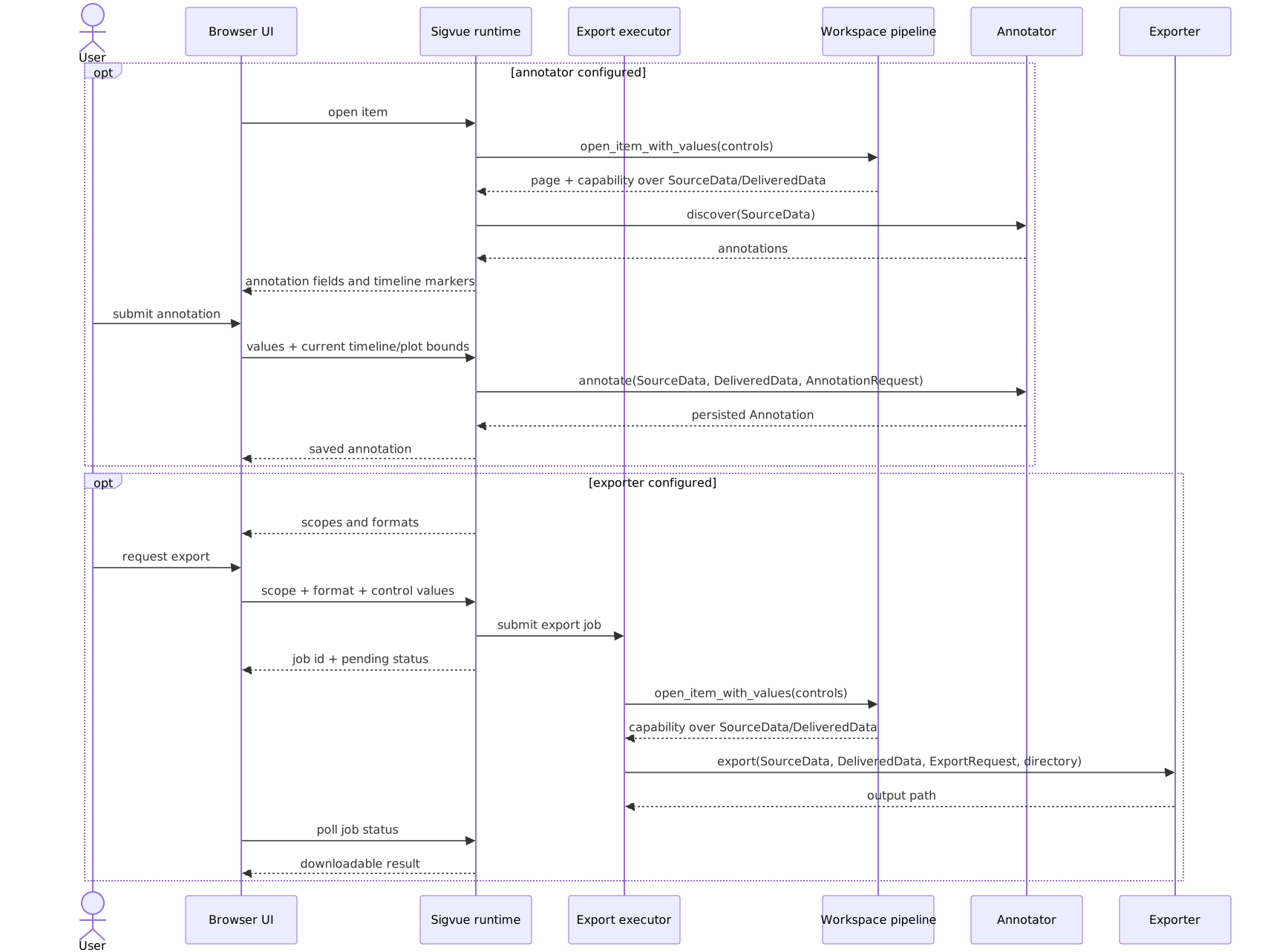
Subclass Annotator to discover timeline annotations and add one from the current
delivered value. Subclass Exporter to advertise scope and format choices and write
one result file into the supplied directory. CapabilityChoice, AnnotationField,
AnnotationPlotBinding, Annotation, AnnotationRequest, and ExportRequest are
available from sigvue.plugin.
This keeps formats such as SigMF annotations, MAT, JSON, or a domain-specific archive out
of the framework.
Plot-oriented plugins can attach an AnnotationPlotBinding to a numeric
AnnotationField. When the annotation menu opens, Sigvue fills that input from the
currently visible lower or upper edge of the named axis. A pipeline can set
selection_policy="box_preferred" on the binding to prefer the latest compatible Plotly
box-selection bounds; deselecting or double-clicking clears the captured box. The plugin
declares the unit transform and may add the current playback position for buffer-relative
plot axes; the resulting editable value is still persisted entirely by the plugin.
When view names a view-switcher key instead of one concrete plot, Sigvue resolves the
binding against that switcher's active plot. The same selection is supplied to the
annotator as AnnotationRequest.view_selections, allowing a collection workspace to
persist into the selected member without turning that member choice into a processing
parameter. A discovered Annotation may carry the corresponding view_selections
mapping; Sigvue then shows its timeline marker only while those local view choices are
active.
HTTP API
The browser UI uses the same local JSON API available to integrations:
| Method and path | Result |
|---|---|
GET /health |
Service health. |
GET /workspaces |
Registered workspaces. |
GET /workspaces/{workspace_id}/items |
Discovered items. |
GET /workspaces/{workspace_id}/items/{item_id} |
Page definition and rendered views. Query parameters carry controls and timeline state. |
POST /workspaces/{workspace_id}/items/{item_id}/exports |
Start a plugin-owned background export with scope, format, and control_values. |
GET /exports/{job_id} |
Poll export status. |
GET /exports/{job_id}/{filename} |
Download a completed export. |
POST /workspaces/{workspace_id}/items/{item_id}/annotations |
Add an annotation through the plugin contract. |
POST /workspaces/{workspace_id}/batch |
Start a plugin-owned workspace batch action. |
POST /workspaces/{workspace_id}/items/{item_id}/batch |
Start a plugin-owned item batch action. |
GET /batches/{job_id} |
Poll batch status and discover result files. |
GET /batches/{job_id}/{filename} |
Download a completed batch artifact. |
PyPI and standalone distribution
The PyPI wheel contains:
- The browser server and typed plugin contracts.
- Dependency metadata that installs Plotly and Matplotlib.
- The PyInstaller spec under
sigvue._packaging. - The
sigvue-buildcommand.
To build a platform-specific, one-file executable:
python -m pip install "sigvue[build]"
sigvue-build
The result is dist/sigvue or dist/sigvue.exe. Build separately on Windows, Linux, and macOS.
Workspace packages, browser.toml, and data remain external to the executable.
Development
python -m pip install -e ".[build,examples,test,release]"
python -m pytest -q tests
python -m pytest -q example_pipelines/tests
The publish workflow runs the framework and bundled-pipeline suites as separate required steps before versioning or building a distribution.
Neutral, runnable workspace packages are maintained separately so the framework distribution stays format-independent: Sigvue Examples.
1 maintainer

Download files
Download the file for your platform. If you're not sure which to choose, learn more about installing packages.
Source Distribution
Built Distribution
Filter files by name, interpreter, ABI, and platform.
If you're not sure about the file name format, learn more about wheel file names.
Copy a direct link to the current filters
File details
Details for the file sigvue-2026.38.tar.gz.
File metadata
- Download URL: sigvue-2026.38.tar.gz
- Upload date:
- Size: 153.6 kB
- Tags: Source
- Uploaded using Trusted Publishing? No
- Uploaded via:
twine/6.1.0 CPython/3.13.14
File hashes
| Algorithm | Hash digest | |
|---|---|---|
| SHA256 |
86855af2964cfaec85f889b7b4bd36b6fbfff9be39ed46d004038085b4336e1e
|
|
| MD5 |
66c87f7c8dc5aec2d20b748f1871697e
|
|
| BLAKE2b-256 |
6edf94f544af4c5ff2e4ed194715e3a738a52c749e2107c3a185ff0099cd9423
|
File details
Details for the file sigvue-2026.38-py3-none-any.whl.
File metadata
- Download URL: sigvue-2026.38-py3-none-any.whl
- Upload date:
- Size: 96.3 kB
- Tags: Python 3
- Uploaded using Trusted Publishing? No
- Uploaded via:
twine/6.1.0 CPython/3.13.14
File hashes
| Algorithm | Hash digest | |
|---|---|---|
| SHA256 |
bc30fd43f60da87c4241a77871454bb1a01c6d754a121dfe6d7882e1327a033b
|
|
| MD5 |
ecd63fefafe8448feb645baa7aa63e6c
|
|
| BLAKE2b-256 |
6a3c944849f4b474fb19cc63f83c2440ca95e55f007e08655280a64710d96653
|














