

Retrieval tools for coding agents. No model in the loop.



Point Silica at a folder of markdown, code, PDFs or office files. The harness you already use — Claude Code, Cursor, Zed, a bare shell, and every other one below — gets five tools that return located evidence: a path, a section, a line, a window of text, and the numbers to judge it by. Silica never answers, summarises, plans or remembers for you. The harness owns the loop.
| Tool | Returns |
|---|---|
silica_files |
the inventory and what the index did with each file: indexed, changed, excluded, failed, unconverted |
silica_search |
ranked passages: path, section, line, raw BM25, matched terms, coverage, and the query terms absent from the corpus |
silica_read |
a slice by lines or by heading (a page, in a PDF), the outline, and a version to carry forward |
silica_code_pack |
an AST context pack for one source file inside a character budget |
silica_write_note |
one atomic write, linted for structure and unresolved wikilinks |
silica_search indexes markdown and the PDFs that carry a text layer.
Source files are not in the index: silica_files lists a .py as
excluded, silica_read serves it by line and silica_code_pack by file.
To find a symbol in a repository, grep wins.
The contract, the reply shapes and the acceptance checks are in TOOLS.md. Nothing on that page needs an API key, a model or a network.
Install
uv tool install 'silica-core[mcp]'   # the command and the server
silica setup claude                  # register it — see Harnesses
npx skills add kiycoh/silica-core    # optional: the skill
pipx install 'silica-core[mcp]' works for the first line just as well. The
second registers the server at user scope, so every session serves the folder
the client was opened in; to serve another root, pass --vault DIR in the
server entry or export SILICA_VAULT in the client's env block, since a
.env file is not enough on purpose.
The package is silica-core, the command is silica, the tools are
silica_*: the distribution carries the name, the code keeps the namespace.
Harnesses
silica setup <client> writes the registration into the client's own config.
It backs the file up first, leaves an existing silica-core entry alone, and
refuses a file that does not parse rather than overwriting it. --dry-run
prints the block without writing, --config PATH writes somewhere else,
--from SPEC swaps the release for a checkout.
silica setup … |
Harness | Writes |
|---|---|---|
claude |
Claude Code | delegates to claude mcp add --scope user |
codex |
Codex CLI | ~/.codex/config.toml, and the skill into ~/.codex/skills |
opencode |
opencode | ~/.config/opencode/opencode.json |
dsh |
DeepSeek Harness | ~/.dsh/cordis.patch.yml, and the skill into ~/.agents/skills |
goose |
Goose | ~/.config/goose/config.yaml |
openhands |
OpenHands | config.toml, in the folder OpenHands runs from |
gemini |
Gemini CLI | ~/.gemini/settings.json |
cursor |
Cursor | ~/.cursor/mcp.json |
windsurf |
Windsurf | ~/.codeium/windsurf/mcp_config.json |
cline |
Cline | cline_mcp_settings.json in the extension's storage |
roo |
Roo Code | mcp_settings.json in the extension's storage |
continue |
Continue.dev | ~/.continue/config.yaml |
zed |
Zed | ~/.config/zed/settings.json |
claude-desktop |
Claude Desktop | claude_desktop_config.json |
lmstudio |
LM Studio | ~/.lmstudio/mcp.json |
anythingllm |
AnythingLLM | anythingllm_mcp_servers.json |
librechat |
LibreChat | librechat.yaml, in the current folder |
Desktop paths follow the OS convention: ~/.config on Linux, ~/Library/Application Support on macOS, %APPDATA% on Windows. silica setup --list prints this table
with every path resolved on your machine.
The rest install by instruction rather than by file, so setup prints the recipe
instead of failing:
silica setup … |
Covers |
|---|---|
shell |
Aider, SWE-agent, Plandex, Devin, SWE-bench — anything with a bash tool |
python |
LangGraph, smolagents, CrewAI, AutoGen, Inspect, METR |
generic |
Void, Jan, Factory Droid, Antigravity, Hermes — the MCP block to paste |
Cursor and Windsurf also read a project rule file (.cursor/rules/silica.mdc,
.windsurfrules). Those are yours, not your home's, so setup names them
rather than writing them; the content is silica/skills/silica/SKILL.md.
The skill
SKILL.md is the wording that tells an agent when to reach for the tools.
setup installs it for the two harnesses whose skill root it knows (codex,
dsh). For every other one, npx skills
knows 79 of them:
npx skills add kiycoh/silica-core
It installs the skill and nothing else — no package, no server. So it is the third line of the install, not a shortcut past the first two: on its own it leaves an agent holding instructions for tools that are not there.
Docker
No image is published. The Dockerfile builds one, and CI builds and smoke-tests
it on every push, so it stays runnable:
docker build -t silica-core .
docker run --rm -i -v /path/to/vault:/vault silica-core                 # the MCP server over stdio
docker run --rm -v /path/to/vault:/vault silica-core search "compaction" -k 5
The container serves /vault and keeps everything it derives — index, ledger,
checkpoints — under /data, which is $HOME inside the image: mount a volume
there or the index is rebuilt on every run. The lanes that need a system binary
(MinerU, ffmpeg, soffice) are deliberately not in the image; docker run --rm silica-core doctor reports them missing, and the comments in the Dockerfile
say where to add the ones you use.
From the shell
Every subcommand prints the same JSON the MCP tool returns, so a harness with a shell needs no MCP at all.
silica index                                   # build or refresh the index (searches do it on first use)
silica search "incremental index updates" -k 5
silica read papers/lsm-trees.md --section "3 Compaction"
silica files --status unconverted              # what the index could not read
silica import papers/lsm-trees.pdf             # writes papers/lsm-trees.md beside the PDF (which then wins over the text layer)
silica write-note notes/decision.md --body-file - < decision.md
silica code-pack src/search/index.py --budget 12000
silica mcp --extended                          # also serve the wikilink tools
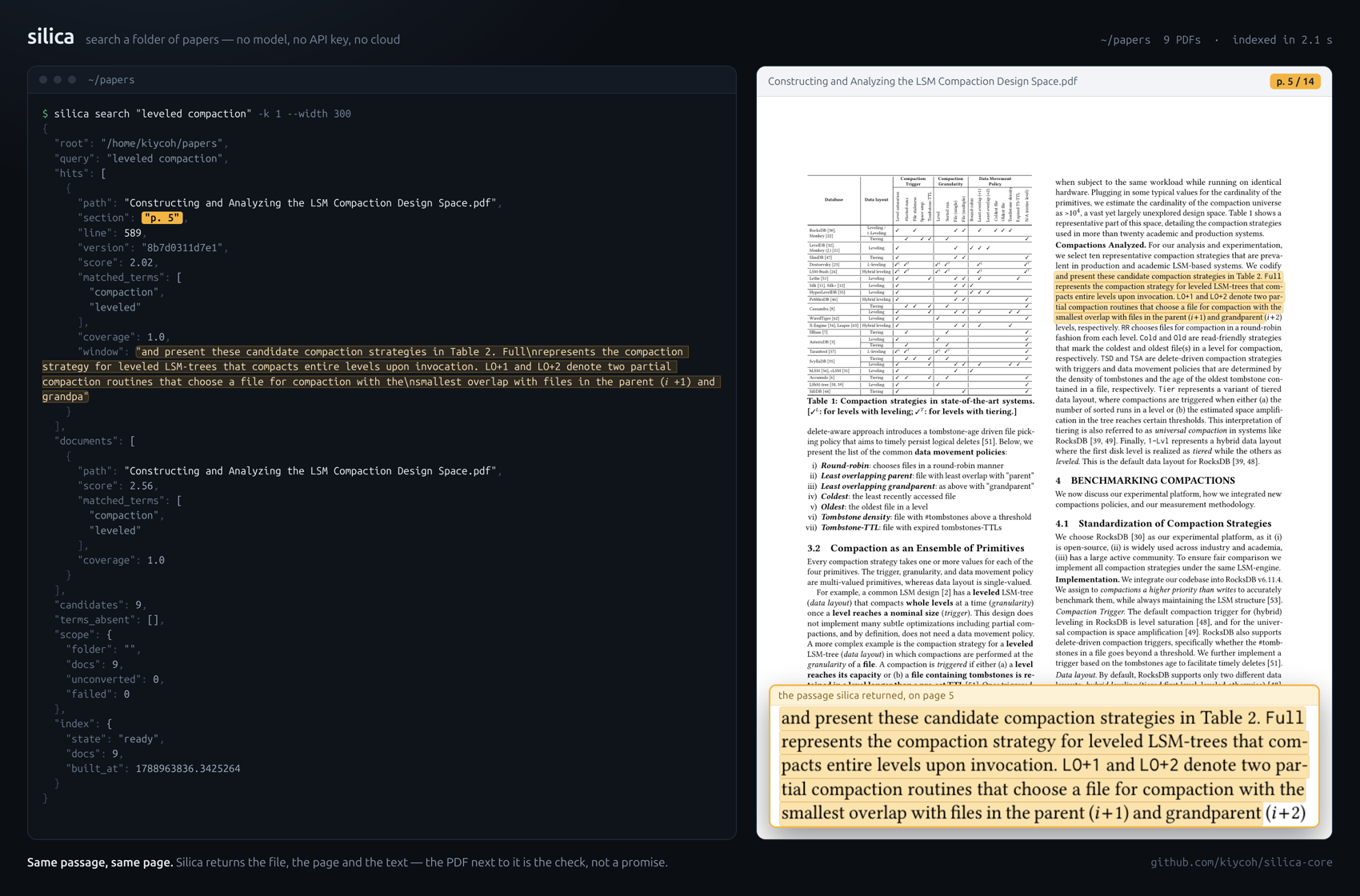
Nine arXiv papers in a folder, indexed in 2.1 s. The hit names the file, the page and the passage — and the page beside it is the check, not a promise.
What it reads
A PDF with a text layer is searched as it is: the index reads the layer
itself, one section per page, so a hit reads p. 7 and silica_read serves
that page alone. No conversion, no .md written beside it. The reply also
carries extract_path, the extracted text on disk, for grep and the
harness's own reader — the line numbers there are the ones silica_read
serves. A scan has no text layer and reads as unconverted until you
convert it. silica import writes that conversion beside the original,
refuses to replace a .md it did not write, and records the original's
SHA-256 and the extracting tool's version in the frontmatter; silica_read
and silica_files then report source_state: stale on either path when
the PDF changed under a .md that did not.
Extras: [connect] adds the Obsidian bridge, [all] both. The converters
for PDF (headings, figures), DOCX, EPUB, FB2, RTF, XLS and ODF need no extra.
Scanned PDFs, images, PPTX and XLSX go through MinerU
when it is on your PATH; audio and video need ffmpeg and a speech-to-text
endpoint (SILICA_STT_BASE_URL). silica doctor says which lanes you have.
How search says no
A search returns hits even when the corpus does not answer, because a ranked list always has a top. What tells the two apart:
coverage: the share of the query's idf mass the hit's matched terms carry. Near 1, every rare term matched; near 0, only the common words did. A term absent from the whole corpus still weighs in, at the idf of a term found nowhere, so absence pulls coverage down instead of vanishing from it.terms_absent: query terms that occur nowhere in the corpus.matched_terms: which words this hit actually contains.
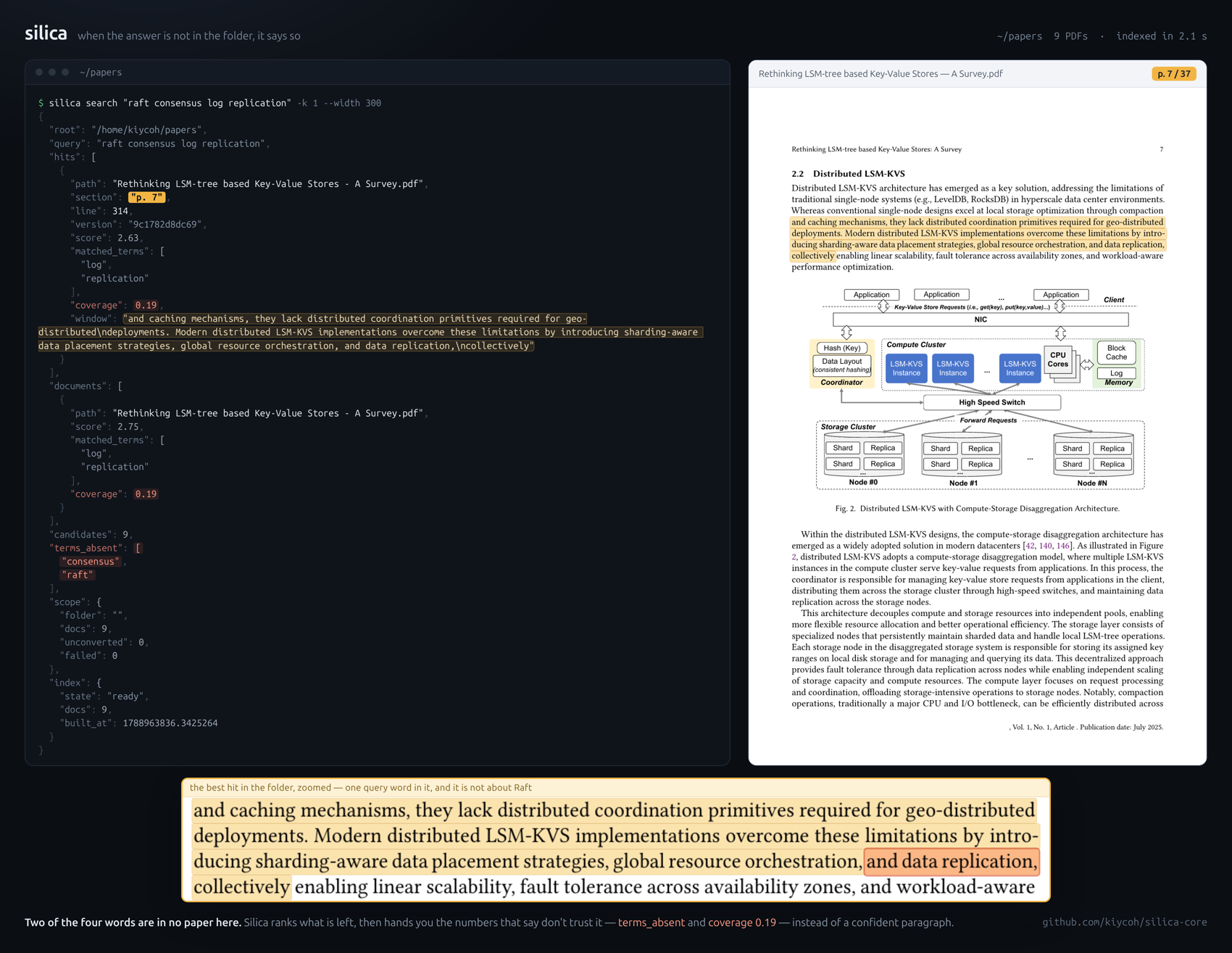
raft consensus log replication over the same nine papers: raft and
consensus occur in none of them, coverage falls to 0.19, and the top hit
matched log and replication — a passage about replicating data, not about
Raft. The ranking still has a top; the numbers beside it say what it is worth.
Measured on 254 converted papers (22 MB): the answered questions scored 0.69 to 1.00 on their top hit, a question the corpus does not cover scored 0.44. No boolean is derivable from lexical signals alone, so Silica exposes the numbers and the harness decides to stop, read, or rephrase.
The same column, read down the hits, says whether one document or several
are in contention. Best section per document on that corpus: 0.99 · 0.67 · 0.60 is one paper, 0.97 · 0.94 · 0.67 is two, 0.79 · 0.73 · 0.72 is
spread, 0.44 · 0.29 · 0.28 is nothing. Only the absolute level tells the
first shape from the last, so Silica reports the column and no ratio between
its neighbours: a ratio scores the first and the last shape alike.
Ranking is BM25 over documents, then over the heading sections of the top
documents, at most two sections per document, with each hit's densest
window. The index is one JSON file per root under ~/.silica/index, built
in seconds and refreshed by mtime.
What the measurements say
Leave the choice to the harness. Measured with Opus on 2026-09-09, 144 runs,
every run correct: no arm of any experiment separated on the answer, so what
moves is the work spent reaching it. Twelve questions over a 5.5M-token
corpus of papers, Silica reached for spontaneously, against the same harness
without the plugin: 3.9 turns instead of 5.0, 2.9 tool calls instead of 4.0,
$0.20 instead of $0.22 a task at a warm cache. The same answers for a
quarter fewer calls. On code the model never reaches for silica_search,
because the questions name identifiers and the descriptions say grep wins
there: the two resident schemas cost 13% on those tasks and return nothing.
Told to use the tools instead of grep it is worse everywhere: 49% over
spontaneous use on the papers, 1.7 times a plain grep on code, 3.2 times at
the worst task.
Put the pair in front of the model instead: silica mcp marks
silica_search and silica_read anthropic/alwaysLoad, so a client that
defers MCP tools behind its own tool search keeps those two in the list and
the other three ride behind them. On the same twelve document tasks the model
reached for a deferred search once, and a resident one twelve times. The
marker is declared, never inferred, and it has to reach the wire as _meta:
a wrapper that rebuilds the tool list carries it over itself.
The optional REPL
silica repl is the reference harness: a plain agent loop over the same
tools, for a folder where no coding agent is running. It is the only
surface that needs a model, and the model is any OpenAI-compatible chat
endpoint:
export SILICA_MODEL=openrouter/deepseek/deepseek-chat OPENROUTER_API_KEY=…   # hosted
export SILICA_MODEL=lmstudio/qwen3-14b                                      # or local: lmstudio/…, ollama/…
silica repl
SILICA_PROVIDER_BASE_URL and SILICA_PROVIDER_API_KEY point a bare model
id at any other endpoint. silica mcp never needs any of this.
Extended tools
silica mcp --extended adds the wikilink tools (silica_links,
silica_backlinks, silica_orphans, silica_unresolved) over the same
root.
There is no SQL tool and no data-file converter. A .csv stays a file:
silica_files lists it as excluded with the reason, and silica_read
serves its lines by number. Search does not index it. Anything past that is
a query engine, which is a different product from located evidence.
Obsidian
silica connect hosts the bridge the Obsidian plugin dials into, so
writes can land through Obsidian's own vault API while the app is open.
The five core tools do not need it: they read and write the folder
directly.
Not included, on purpose
No LLM client, no memory lane, no session capture, no hook that injects text into a prompt, no summaries, no undo journal, no SQL over your data files. Undo is git. The private product this core is cut from keeps those lanes.
Development
git clone https://github.com/kiycoh/silica-core.git && cd silica-core
uv sync --extra dev --extra mcp
uv run pytest -q
SILICA_BENCH_CORPUS=/path/to/markdown uv run pytest tests/test_retrieval_check.py -s   # the acceptance check
uv run lint-imports && uv run mypy silica && uv run ruff check silica tests
License
MIT. See LICENSE.
1 maintainer

Download files
Download the file for your platform. If you're not sure which to choose, learn more about installing packages.
Source Distribution
Built Distribution
Filter files by name, interpreter, ABI, and platform.
If you're not sure about the file name format, learn more about wheel file names.
Copy a direct link to the current filters
File details
Details for the file silica_core-0.7.4.tar.gz.
File metadata
- Download URL: silica_core-0.7.4.tar.gz
- Upload date:
- Size: 2.2 MB
- Tags: Source
- Uploaded using Trusted Publishing? Yes
- Uploaded via:
twine/7.0.0 CPython/3.13.14
File hashes
| Algorithm | Hash digest | |
|---|---|---|
| SHA256 |
c121f44b46682b5990567ae1afead67e4a02b13d79f237f77549d3b48a656c9f
|
|
| MD5 |
131b1848928d82211cb5c93ebdb9078e
|
|
| BLAKE2b-256 |
7f0aa28f493fecc2179c03bd8e23c3d0fefc6e470c5494974f6fe53fc0595150
|
Provenance
The following attestation bundles were made for silica_core-0.7.4.tar.gz:
Publisher:
release.yml on kiycoh/silica-core
-
Statement:
-
Statement type:
https://in-toto.io/Statement/v1 -
Predicate type:
https://docs.pypi.org/attestations/publish/v1 -
Subject name:
silica_core-0.7.4.tar.gz -
Subject digest:
c121f44b46682b5990567ae1afead67e4a02b13d79f237f77549d3b48a656c9f - Sigstore transparency entry: 2771049393
- Sigstore integration time:
-
Permalink:
kiycoh/silica-core@6c9364f3de40d0e2a7ab0964f853e71e93feb00e -
Branch / Tag:
refs/tags/v0.7.4 - Owner: https://github.com/kiycoh
-
Access:
public
-
Token Issuer:
https://token.actions.githubusercontent.com -
Runner Environment:
github-hosted -
Publication workflow:
release.yml@6c9364f3de40d0e2a7ab0964f853e71e93feb00e -
Trigger Event:
push
-
Statement type:
File details
Details for the file silica_core-0.7.4-py3-none-any.whl.
File metadata
- Download URL: silica_core-0.7.4-py3-none-any.whl
- Upload date:
- Size: 223.9 kB
- Tags: Python 3
- Uploaded using Trusted Publishing? Yes
- Uploaded via:
twine/7.0.0 CPython/3.13.14
File hashes
| Algorithm | Hash digest | |
|---|---|---|
| SHA256 |
bd79b4467bdaba985ca29c713e1afc84922ed7cf1a9725301df79efaae9ef608
|
|
| MD5 |
16acdd5be19913a83a0ea50383641b51
|
|
| BLAKE2b-256 |
4bce3f37e3d0147e4c1f2467f5e1808bd1c347f1b52d1c272cbedd7c3079b243
|
Provenance
The following attestation bundles were made for silica_core-0.7.4-py3-none-any.whl:
Publisher:
release.yml on kiycoh/silica-core
-
Statement:
-
Statement type:
https://in-toto.io/Statement/v1 -
Predicate type:
https://docs.pypi.org/attestations/publish/v1 -
Subject name:
silica_core-0.7.4-py3-none-any.whl -
Subject digest:
bd79b4467bdaba985ca29c713e1afc84922ed7cf1a9725301df79efaae9ef608 - Sigstore transparency entry: 2771049448
- Sigstore integration time:
-
Permalink:
kiycoh/silica-core@6c9364f3de40d0e2a7ab0964f853e71e93feb00e -
Branch / Tag:
refs/tags/v0.7.4 - Owner: https://github.com/kiycoh
-
Access:
public
-
Token Issuer:
https://token.actions.githubusercontent.com -
Runner Environment:
github-hosted -
Publication workflow:
release.yml@6c9364f3de40d0e2a7ab0964f853e71e93feb00e -
Trigger Event:
push
-
Statement type:














