
Retrieval tools for coding agents. No model in the loop.
Point it at a folder and the agent you already use gets five tools that return located evidence, never answers.


Silica works over the markdown, code, PDFs and office files under one root and serves them to Claude Code, Cursor, Zed, Codex and every other harness it knows, as MCP tools or as shell commands that print the same JSON. A hit is a path, a section, a line, a window of text and the numbers to judge it by. Silica never answers, summarises, plans or remembers for you: the harness owns the loop.
Install
uv tool install 'silica-core[mcp]'
pipx install 'silica-core[mcp]' works the same. The package is silica-core,
the command is silica, the tools are silica_*: the distribution carries the
name, the code keeps the namespace.
Quickstart
In any folder of markdown, code, PDFs or office files:
silica init                               # adopt the folder and build the first index
silica search "leveled compaction" -k 5  # return the best located passages
silica setup claude                      # register the MCP server, write the guidance block into ~/.claude/CLAUDE.md
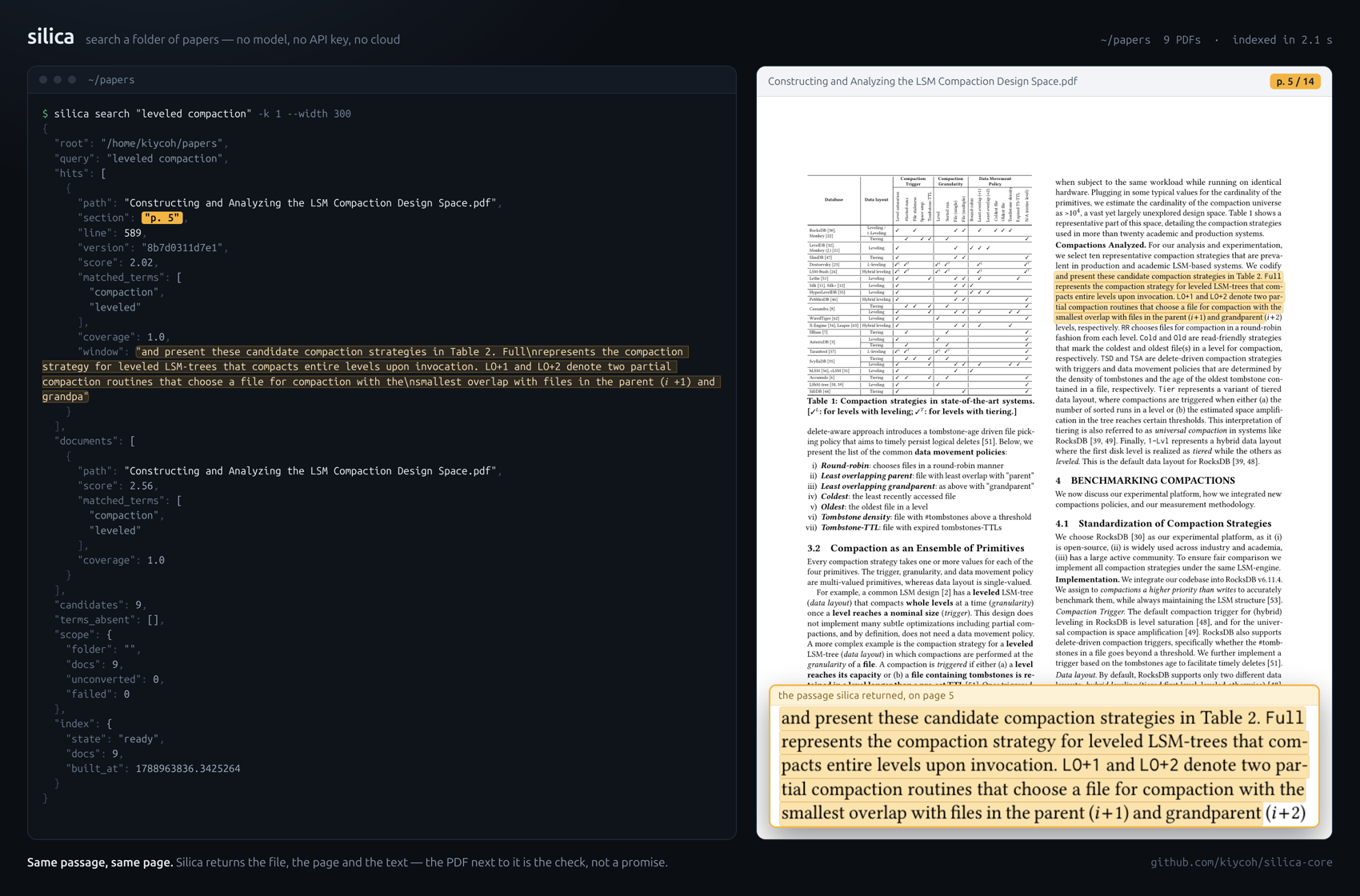
Nine arXiv papers in a folder, indexed in 2.1 s. The hit names the file, the page and the passage, and the page beside it is the check, not a promise.
Benchmarks
Silica's closest comparisons are zvec-grep and ck: local retrieval tools over files. Each arm received the same BEIR SciFact and NFCorpus documents and queries. Scores are nDCG@10 (higher is better), shown as SciFact · NFCorpus.
| Mode | Silica | zvec-grep 0.2.2 | ck 0.7.11 |
|---|---|---|---|
| Lexical | 0.662 · 0.311 | 0.649 · 0.297 | 0.630 · 0.289 |
Hybrid, same potion-retrieval-32M embedder |
0.675 · 0.328 | 0.672 · 0.330 | — |
Silica's lexical index needs no model; the competitors serve lexical search from an index that also includes embeddings. BEIR's published BM25 baselines are 0.665 · 0.325. On the hybrid row Silica and zvec-grep tie at the 95% interval: the same vectors rank the same, with no daemon, no vector store and no bundled model. See benchmarks for corpora, methods, intervals and commands.
On code, grep then silica_code_pack as the only reader was measured against
grep and file reads: twelve repository questions with Haiku 4.5, the four
hardest again with Sonnet 5, and no task separated the two arms on the answer,
as none did with Opus 5 the day before. Where the answer is one symbol's body
in a file not worth reading whole the pack halves the cost, two constants in
two files at $0.067 against $0.034 and a twelve-line label function at $0.054
against $0.033, and on the local task Sonnet pays a third less with it
($0.200 against $0.134) because it finds the symbol inside the pack. Numbers
per model and per task in
benchmarks.
Searching code, not only reading it: with the code index on
(SILICA_INDEX_CODE, one unit per function, method, class or constant),
Silica ranks the answering file ahead of zvec-grep on zvec-grep's own twenty
SWE-QA questions with the same embedder, file MRR 0.68 against 0.54, the
interval clear of zero, and ties on twelve local ones. Asked for the way the
plugin now asks (an imperative description, a prompt hook, a CLAUDE.md block),
Sonnet ran the search in 17 of 20 runs and closed the question in 4.7 turns
instead of 6.5, at the same cost, the judge up nine points inside its
interval. Numbers in
benchmarks.
Tools
| Tool | Shell | Returns |
|---|---|---|
silica_files |
silica files |
the inventory and what the index did with each file: indexed, changed, excluded, failed, unconverted |
silica_search |
silica search |
ranked passages: path, section, line, raw BM25, matched terms, coverage, and the query terms absent from the corpus |
silica_read |
silica read |
a slice by lines or by heading (a page, in a PDF), the outline, and a version to carry forward |
silica_code_pack |
silica code-pack |
an AST context pack for one source file inside a character budget |
silica_write_note |
silica write-note |
one atomic write, linted for structure and unresolved wikilinks |
Search indexes markdown and the PDFs that carry a text layer, and, with
SILICA_INDEX_CODE set, source files one unit per function, method, class or
constant: a hit's section is the symbol, span its lines, and
silica_read(path, section=…) serves the body. Without the switch a .py is
excluded in silica_files and served by silica_read by line. For a symbol
whose name is known, grep wins; for a question that names none, the search
comes first, and the plugin's prompt hook asks the model to say so before it
greps (measured 2026-09-10: with the ask in place the search ran in 17 of 20
runs). The contract, the reply shapes and the acceptance checks are in
TOOLS.md; nothing there needs an API key, a model or a network.
How search says no
A ranked list always has a top, even when the corpus does not answer. Three fields show how much the result is worth:
coverage: the share of the query's idf mass the hit's matched terms carry. Near 1, every rare term matched; near 0, only common words did.terms_absent: query terms that occur nowhere in the corpus.matched_terms: which words this hit actually contains.
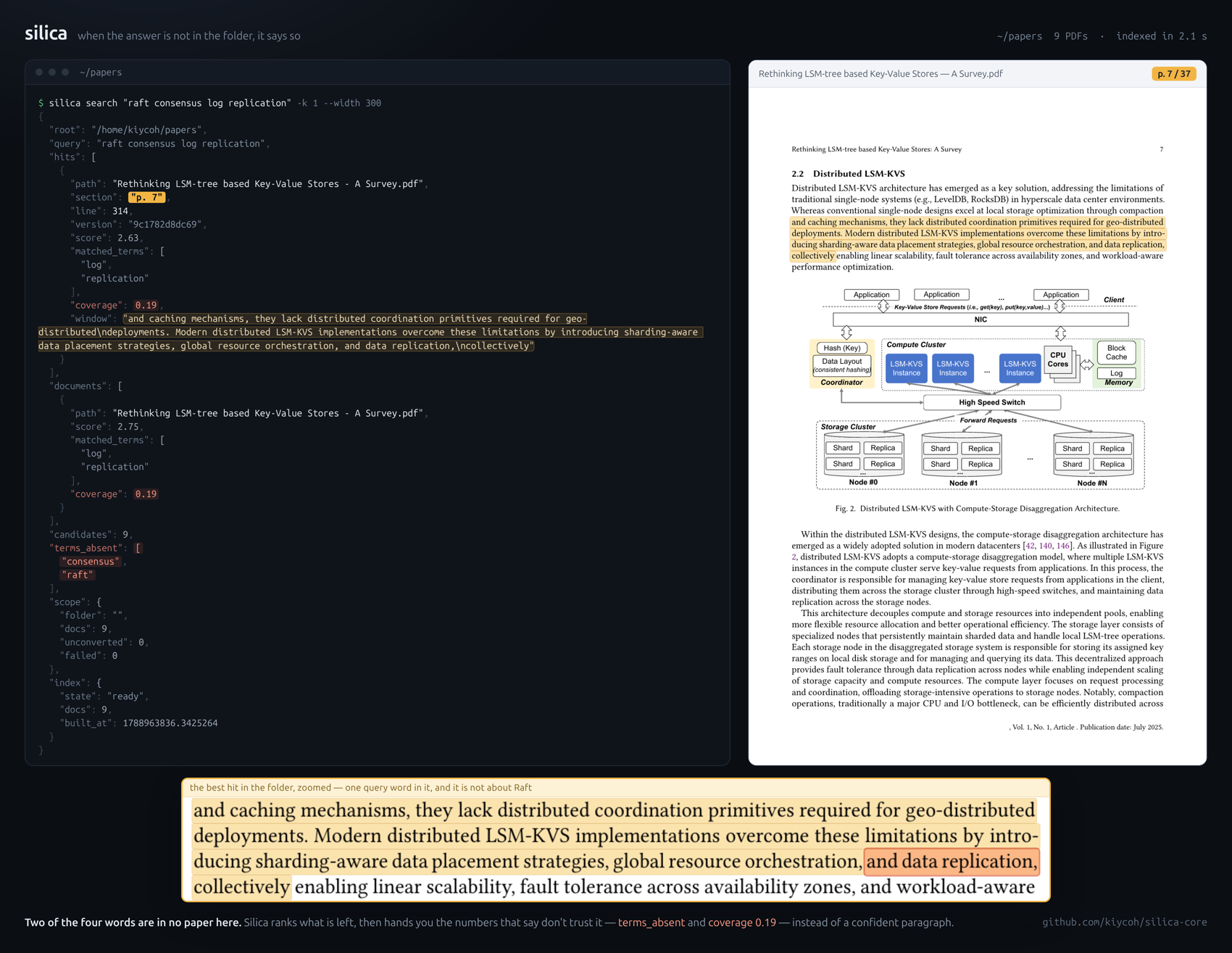
raft consensus log replication over the same nine papers: raft and
consensus occur in none of them, coverage falls to 0.19, and the top hit
is about data replication, not Raft. Silica exposes the signals and lets the
harness decide whether to stop, read or rephrase.
Ranking is BM25 over documents, then over the heading sections of the top
documents, returning each hit's densest window. --also QUERY ranks another
query group separately and fuses the results, useful for searching a concept
and its exact identifiers together. Searches refresh small changes inline;
larger ones return stale with pending until silica index catches up, and
interrupted builds resume. Use <root>/.silicaignore to exclude content.
The dense leg
Optional section embeddings catch paraphrases that share no rare words with
the answer. After they are built, every search fuses them with BM25. Use any
OpenAI-compatible /v1/embeddings endpoint:
ollama pull nomic-embed-text
export SILICA_EMBEDDING_BASE_URL=http://localhost:11434/v1 SILICA_EMBEDDING_MODEL=nomic-embed-text
export SILICA_EMBEDDING_DOC_PREFIX='search_document: ' SILICA_EMBEDDING_QUERY_PREFIX='search_query: '  # what nomic's card asks for
silica index --embed
Or use a local static model, with no server:
uv tool install 'silica-core[mcp,dense]'
export SILICA_EMBEDDING_MODEL=model2vec/minishlab/potion-retrieval-32M
silica index --embed
Text leaves the machine only for an endpoint that is not on it, and only after
silica index --embed --allow-remote grants that host once. Until then search
stays lexical. The reply always says whether the dense leg ran.
What it reads
- PDF with a text layer: searched directly, one section per page; no conversion or sidecar.
- Scanned PDF, image, PPTX, XLSX:
silica importuses MinerU to create a guarded.mdsidecar. Silica reports it as stale if the source changes. - DOCX, EPUB, FB2, RTF, XLS, ODF: converted with no extra.
- Audio and video:
ffmpegplusSILICA_STT_BASE_URL. - CSV and other data files: readable by line but excluded from search.
silica doctor says which lanes this machine has. Extras: [connect] adds the
Obsidian bridge, [dense] the local embedder, [all] everything.
Harnesses
silica setup <client> writes the registration into the client's own config.
It backs up existing config and refuses malformed files; for claude it also
puts a guidance block between markers into ~/.claude/CLAUDE.md, when to
search before grep, replaced on a second run and nothing else touched. silica setup --list
shows paths for claude, codex, cursor, windsurf, zed, cline, roo,
continue, goose, opencode, openhands, gemini, dsh, hermes,
openclaw, agent-zero, claude-desktop, lmstudio, anythingllm and
librechat; shell, python and generic print recipes for anything else. By default the server serves the
folder the client opens in; use --vault DIR or SILICA_VAULT for a fixed root.
npx skills add kiycoh/silica-core installs the skill that tells an agent
when to reach for the tools. It installs nothing else: on its own it leaves an
agent holding instructions for tools that are not there. Setup details, shell
recipes, Docker and the optional REPL are in docs/harnesses.md.
Other surfaces
- Extended tools:
silica mcp --extendedadds the wikilink tools,silica_links,silica_backlinks,silica_orphansandsilica_unresolved, over the same root. - Obsidian:
silica connecthosts the bridge the Obsidian plugin dials into, so writes land through the vault API while the app is open. The five core tools do not need it. - REPL:
silica replruns a small reference agent over the same tools. It is the only surface that needs a model (SILICA_MODEL).
The core keeps no memory lane, prompt injection, summaries or undo journal. Undo is git.
License
MIT. See LICENSE.
1 maintainer

Download files
Download the file for your platform. If you're not sure which to choose, learn more about installing packages.
Source Distribution
Built Distribution
Filter files by name, interpreter, ABI, and platform.
If you're not sure about the file name format, learn more about wheel file names.
Copy a direct link to the current filters
File details
Details for the file silica_core-0.8.1.tar.gz.
File metadata
- Download URL: silica_core-0.8.1.tar.gz
- Upload date:
- Size: 2.2 MB
- Tags: Source
- Uploaded using Trusted Publishing? Yes
- Uploaded via:
twine/7.0.0 CPython/3.13.14
File hashes
| Algorithm | Hash digest | |
|---|---|---|
| SHA256 |
129d4a047505742199caace8401223de6987b128d06c99c43f70b9d4a0445a26
|
|
| MD5 |
83729dacd32a57246c590401d8e8692d
|
|
| BLAKE2b-256 |
9fc064787afe1c1a351d81043e5ca42ae6f2f26b37271a2a9e04ed58d6d39a34
|
Provenance
The following attestation bundles were made for silica_core-0.8.1.tar.gz:
Publisher:
release.yml on kiycoh/silica-core
-
Statement:
-
Statement type:
https://in-toto.io/Statement/v1 -
Predicate type:
https://docs.pypi.org/attestations/publish/v1 -
Subject name:
silica_core-0.8.1.tar.gz -
Subject digest:
129d4a047505742199caace8401223de6987b128d06c99c43f70b9d4a0445a26 - Sigstore transparency entry: 2788099200
- Sigstore integration time:
-
Permalink:
kiycoh/silica-core@6650aaaa4ee745fa223115d8e9144b117ad603b3 -
Branch / Tag:
refs/tags/v0.8.1 - Owner: https://github.com/kiycoh
-
Access:
public
-
Token Issuer:
https://token.actions.githubusercontent.com -
Runner Environment:
github-hosted -
Publication workflow:
release.yml@6650aaaa4ee745fa223115d8e9144b117ad603b3 -
Trigger Event:
push
-
Statement type:
File details
Details for the file silica_core-0.8.1-py3-none-any.whl.
File metadata
- Download URL: silica_core-0.8.1-py3-none-any.whl
- Upload date:
- Size: 236.3 kB
- Tags: Python 3
- Uploaded using Trusted Publishing? Yes
- Uploaded via:
twine/7.0.0 CPython/3.13.14
File hashes
| Algorithm | Hash digest | |
|---|---|---|
| SHA256 |
11bb9c3d55181e3fc8f83e6f8dea5b9719204db0f2e55d92b8dd6a48801c56da
|
|
| MD5 |
bdc8cab1f0032b185ce6e8cd76b72537
|
|
| BLAKE2b-256 |
6924b9bb71d06ca4111eaf28a3bb567c595c5371e37ce9ba879fa536a3d9e8a1
|
Provenance
The following attestation bundles were made for silica_core-0.8.1-py3-none-any.whl:
Publisher:
release.yml on kiycoh/silica-core
-
Statement:
-
Statement type:
https://in-toto.io/Statement/v1 -
Predicate type:
https://docs.pypi.org/attestations/publish/v1 -
Subject name:
silica_core-0.8.1-py3-none-any.whl -
Subject digest:
11bb9c3d55181e3fc8f83e6f8dea5b9719204db0f2e55d92b8dd6a48801c56da - Sigstore transparency entry: 2788099237
- Sigstore integration time:
-
Permalink:
kiycoh/silica-core@6650aaaa4ee745fa223115d8e9144b117ad603b3 -
Branch / Tag:
refs/tags/v0.8.1 - Owner: https://github.com/kiycoh
-
Access:
public
-
Token Issuer:
https://token.actions.githubusercontent.com -
Runner Environment:
github-hosted -
Publication workflow:
release.yml@6650aaaa4ee745fa223115d8e9144b117ad603b3 -
Trigger Event:
push
-
Statement type:














