
A configurable linter for agent skills, plugins, and AI coding assistant context
Verified details
These details have been verified by PyPIProject links
GitHub Statistics
Maintainers

Project description
 |
skillsawKeep your skills sharp. 40+ rules catch weak language, contradictions, attention dead zones, and structural issues — then auto-fix them.
|






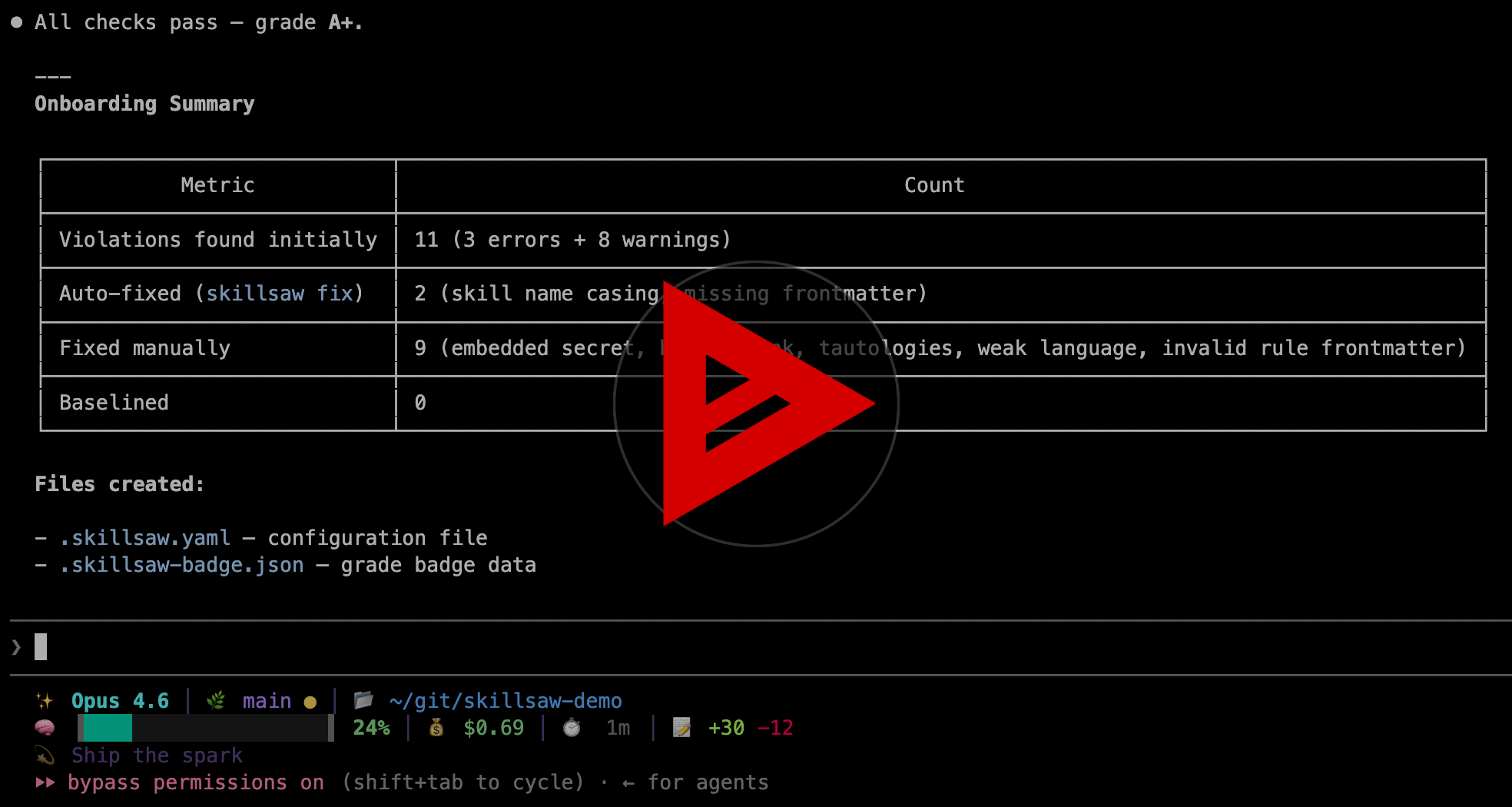
▶️ Easy onboarding with AI! — watch an AI agent grade, fix, and configure a repo from scratch.
Full documentation at skillsaw.org — supports Claude Code plugins, agentskills.io, CLAUDE.md, AGENTS.md, Cursor, Copilot, Gemini, Kiro, CodeRabbit, and more.
Table of Contents
- Quick Start
- Installation
- Repository Types
- Configuration
- Baseline
- Quality Grade & Badge
- Supply Chain Protection
- Builtin Rules
- Autofixing
- Custom Rules
- Rule Plugins
- Scaffolding
- Lint Tree
- Documentation Generation
- Exit Codes
- Example Output
- Migrating from claudelint
- Development
- Contributing
- License
- See Also
- Support
Quick Start
No install required — run with uvx skillsaw (or install
it for repeated use).
# 1. See what skillsaw detects in your repo
skillsaw tree

# 2. Lint it (current directory by default — also accepts multiple
#    directories and/or SKILL.md files: skillsaw lint dir1/ dir2/SKILL.md)
skillsaw

# 3. Fix what you can automatically
skillsaw fix

# 4. Accept remaining violations as the baseline
skillsaw baseline

# Done — only new violations will fail from here on
skillsaw   # exit 0

# Curious why a rule fired (or didn't)?
skillsaw explain content-weak-language
For all commands and flags, see the CLI Reference.
[!TIP] :sparkles: Onboard with AI — let your coding agent handle the entire setup in one shot.
Claude Code:
claude plugin marketplace add stbenjam/skillsaw
claude plugin install skillsaw@skillsaw-marketplace
Then type
/skillsaw-onboard— it installs skillsaw, lints your repo, autofixes what it can, walks you through manual fixes, sets up CI, and creates a baseline.Other agents — see the Getting Started guide.
Installation
Via uvx (easiest, no install required)
uvx skillsaw
uvx skillsaw /path/to/skills
Via pip
pip install skillsaw
From source
git clone https://github.com/stbenjam/skillsaw.git
cd skillsaw
pip install -e .
Using Docker
docker pull ghcr.io/stbenjam/skillsaw:latest
docker run -v $(pwd):/workspace ghcr.io/stbenjam/skillsaw
CI Integration
# GitHub Actions
- uses: stbenjam/skillsaw@v0
  with:
    strict: true

# With plugins
- uses: stbenjam/skillsaw@v0
  with:
    strict: true
    plugins: |
      skillsaw-runbooks==0.1.0

# Allow custom rules (disabled by default for security — see THREAT_MODEL.md T1)
- uses: stbenjam/skillsaw@v0
  with:
    no-custom-rules: false
# GitLab CI — outputs Code Quality JSON for MR widgets
skillsaw:
  script:
    - pip install skillsaw==0.15.0
    - skillsaw lint --output gitlab:gl-code-quality-report.json .
  artifacts:
    reports:
      codequality: gl-code-quality-report.json
Output formats for --format / --output: text, json, sarif, html,
code-climate, and gitlab.
For PR review comments, the secure two-workflow pattern, and full configuration options, see the CI Integration guide.
Pre-commit
skillsaw ships a Pre-commit hook. Add this to your
repository's .pre-commit-config.yaml:
repos:
  - repo: https://github.com/stbenjam/skillsaw
    rev: v0.15.0  # or pin a full commit SHA
    hooks:
      - id: skillsaw
See the Pre-commit guide for details.
Repository Types
skillsaw automatically detects your repository structure. A repository can match multiple types simultaneously (e.g. an agentskills repo that also has .coderabbit.yaml).
agentskills.io Skills
Standalone skill repositories following the agentskills.io specification:
my-skill/
├── SKILL.md              # Required: metadata + instructions
├── scripts/              # Optional: executable code
├── references/           # Optional: documentation
├── assets/               # Optional: templates, resources
├── evals/                # Optional: evaluation tests
│   └── evals.json
└── <any-dir>/            # Arbitrary directories allowed per spec
Skill collections (multiple skills in subdirectories) are also supported:
skills-repo/
├── skill-one/
│   └── SKILL.md
└── skill-two/
    └── SKILL.md
Standard discovery paths (.claude/skills/, .github/skills/, .agents/skills/) are checked automatically.
Single Plugin
my-plugin/
├── .claude-plugin/
│   └── plugin.json
├── commands/
│   └── my-command.md
├── skills/
│   └── my-skill/
│       └── SKILL.md
└── README.md
Marketplace (Multiple Plugins)
skillsaw supports multiple marketplace structures per the Claude Code specification:
Traditional Structure (plugins/ directory)
marketplace/
├── .claude-plugin/
│   └── marketplace.json
└── plugins/
    ├── plugin-one/
    │   ├── .claude-plugin/
    │   └── commands/
    └── plugin-two/
        ├── .claude-plugin/
        └── commands/
Flat Structure (root-level plugin)
marketplace/
├── .claude-plugin/
│   └── marketplace.json    # source: "./"
├── commands/
│   └── my-command.md
└── skills/
    └── my-skill/
Custom Paths and Mixed Structures
Plugins from plugins/, custom paths, and remote sources can coexist in one marketplace. Only local sources are validated.
When marketplace.json sets metadata.pluginRoot (e.g. "./plugins"), it is prepended to relative plugin sources, so entries can use bare names like "source": "formatter" per the spec.
.claude/ Directory
Repositories with a .claude/ directory containing commands, skills, hooks, agents, or rules. When APM is present, .claude/ is treated as compiled output and this type is not detected.
CodeRabbit
Repositories with a .coderabbit.yaml file. skillsaw validates the instruction fragments within the config.
Promptfoo
Repositories with promptfoo eval configs (promptfooconfig*.yaml or YAML files in evals/ directories). Prompt strings in the config are treated as content blocks, so all content-* rules apply to them automatically. Dedicated promptfoo-* rules validate config structure, assertion coverage, and metadata.
APM (Agent Package Manager)
Repositories with an .apm/ directory or apm.yml file. APM manages dependencies and compiles instruction files for all supported agents (.claude/, .cursor/rules/, .github/instructions/, etc.). When APM is present it is the authoritative source — .claude/ is treated as compiled output.
Configuration
Generate a default .skillsaw.yaml in your repository root:
skillsaw init
This creates a config file with all builtin rules, their defaults, and
descriptions. Edit it to enable, disable, or customize rules for your project.
See .skillsaw.yaml.example for a complete example.
Version Pinning
The config file includes a version field set to the skillsaw version that
created it. New rules introduced after that version are automatically skipped
unless you bump the version or explicitly enable them. Repos without a
.skillsaw.yaml run all rules at the latest version — you get new rules
automatically but may occasionally fail after a skillsaw upgrade.
A hand-written config that omits version defaults to an early version (so
newer rules are skipped) and prints a warning on each run — set version
explicitly to silence it and control which rules apply.
Exclude Patterns
Skip files and directories using glob patterns:
exclude:
  - "vendor/**"
  - "generated/**"
  - "node_modules/**"
Patterns match against the file path relative to the lint root using
Python fnmatch syntax, where * also crosses /. A leading **/
additionally matches at the root of the repository, so **/templates/**
excludes both a top-level templates/ directory and any nested
a/templates/.
By default, skillsaw excludes **/template/**, **/templates/**, and
**/_template/** directories. These defaults are replaced when you specify
your own exclude list.
Exclude patterns apply to all rules, including custom rules loaded via
custom-rules. Any violation whose file path matches an exclude pattern is
filtered out before results are reported.
Per-Rule Excludes
Exclude specific files from a single rule using the exclude key in the
rule's config:
rules:
  content-weak-language:
    enabled: true
    exclude:
      - "docs/legacy/**"
      - "CHANGELOG.md"
This is useful when a rule produces false positives on specific files but
you still want it enabled globally. Per-rule excludes use the same glob
syntax as global exclude patterns.
Inline Suppression
Suppress specific rules on specific lines using comment directives directly in your files. Both HTML comments (for markdown) and hash comments (for YAML) are supported.
Markdown (HTML comments)
<!-- skillsaw-disable content-weak-language -->
This section intentionally uses informal language.
<!-- skillsaw-enable content-weak-language -->
Suppress a single line:
<!-- skillsaw-disable-next-line content-tautological -->
Follow best practices for error handling.
Omitting the rule IDs suppresses all rules on the next line:
<!-- skillsaw-disable-next-line -->
This line is exempt from every rule.
Suppress multiple rules at once:
<!-- skillsaw-disable content-weak-language, content-tautological -->
Re-enable all suppressed rules:
<!-- skillsaw-enable -->
Multi-line HTML comments are also supported:
<!--
    skillsaw-disable content-weak-language
-->
YAML (hash comments)
For YAML files (.coderabbit.yaml, promptfooconfig.yaml, etc.), use # comments:
# skillsaw-disable promptfoo-valid
prompts:
  - "{{prompt}}"
# skillsaw-enable promptfoo-valid
# skillsaw-disable-next-line coderabbit-yaml-valid
instructions: missing-value
Only full-line # comments are recognized — inline comments like
key: value # skillsaw-disable are ignored.
Notes
Inline suppression only affects rules that are already enabled. It cannot be used to enable a normally disabled rule.
In markdown files, directives are located through the markdown parser: a directive shown inside a fenced or indented code block is treated as documentation and is not honored.
Content Paths
By default, content intelligence rules only analyze recognized instruction
files (CLAUDE.md, AGENTS.md, .cursor/rules/, .apm/instructions/, etc.).
Use content-paths to extend coverage to any text files that contain
instructions for humans or AI agents — markdown, .mdc, .txt, or any
other format:
content-paths:
  - "src/**/instructions/**/*.md"
  - ".cursor/rules/*.mdc"
  - "docs/runbooks/*.txt"
Matched files are analyzed by all content-* rules.
Baseline
When adopting skillsaw on an existing project, you may have many
pre-existing violations. The baseline feature lets you snapshot
current violations so that skillsaw lint only reports new ones —
existing violations are accepted and won't cause failures.
Creating a baseline
# Generate .skillsaw-baseline.json from current violations
skillsaw baseline
How it works
Once a .skillsaw-baseline.json file exists (next to .skillsaw.yaml or
in the repo root), skillsaw lint automatically loads it and subtracts
matching violations from the output. Only new violations are reported.
Violations are matched by a content hash — a fingerprint built from the rule ID, file path, and the content of the source line (not the line number). This means the baseline survives line drift: if you add lines above a baselined violation, the fingerprint still matches because the content hasn't changed.
If you reformat or rewrite a line, the fingerprint changes and the violation resurfaces for a fresh look — which is the correct behavior.
Rules that measure a numeric value (context-budget, content-instruction-budget,
content-actionability-score) use ratchet behavior instead: the baseline
records the value and only suppresses violations that are equal to or better.
Regressions (e.g., file grew past the baselined token count) are always reported.
Ignoring the baseline
# Run lint without baseline filtering
skillsaw lint --no-baseline
Stale entries
When you fix a baselined violation, its baseline entry becomes stale. Skillsaw reports stale entries so you know the baseline can be refreshed:
Baseline: 3 stale entries (violations resolved since baseline was set)
  Run `skillsaw baseline` to update.
Run skillsaw baseline again to regenerate the file without the
resolved violations.
Baseline and fix
The skillsaw fix command operates on all violations regardless of the
baseline. The baseline only affects lint reporting and exit codes — if
you explicitly ask to fix, everything is eligible.
Quality Grade & Badge
Every lint run computes a letter grade (A+ through F) summarizing
repository quality, shown in the text summary and in the JSON report
under summary.grade.
How it's calculated: weighted violation density sets your letter; errors additionally knock letters off.
- Density sets the letter. Errors (weight 1.0), warnings (weight 0.75), and info-level violations (weight 0.1) are counted per 10,000 estimated content tokens, so a large marketplace isn't penalized for having more surface area than a single skill. A+ requires density below 1.0; after that every 2.0 density units cost one notch (A < 3, A- < 5, B+ < 7, … F ≥ 21 — calibrated against real-world community marketplaces). Repositories smaller than 10K tokens are graded as one unit.
- Errors also knock off whole letters regardless of repository size: one error costs a letter, five or more cost two, twenty-five or more cost three. A broken manifest can't be diluted by prose volume.
- Zero violations is an A+.
The weights and bands are deliberately not configurable — a skillsaw badge means the same thing on every repository, so a repo can't grade itself on a friendlier curve.
README badge
skillsaw badge grades the repository, writes .skillsaw-badge.json
(a shields.io compatible payload), and prints the
markdown to embed the badge:
skillsaw badge
Commit .skillsaw-badge.json and add the printed markdown to your
README. The file works with both shields.io styles:
- Endpoint badge
(recommended — color tracks the grade automatically):
https://img.shields.io/endpoint?url=<raw-url-to-.skillsaw-badge.json> - Dynamic JSON badge
(query
$.messagefrom the same file):https://img.shields.io/badge/dynamic/json?url=<raw-url>&query=%24.message&label=skillsaw
When the repository has a GitHub remote, the printed markdown already
contains the correct raw.githubusercontent.com URL. Regenerate the
badge file in CI (or a pre-push hook) so it stays current.
Unlike lint, the badge ignores any baseline — the published grade
reflects every violation, so a baselined repository can't advertise a
clean bill of health it doesn't have.
Supply Chain Protection
skillsaw includes security rules that detect supply chain attacks targeting AI coding assistants — malicious hooks, MCP servers, and settings injected into repositories. Inspired by the Shai-Hulud attack that compromised 317 npm packages.
We recommend enabling hooks-prohibited, mcp-prohibited, and
settings-dangerous with explicit allowlists so any new hook, server, or
command-execution setting fails CI until reviewed.
See the Supply Chain Protection guide for full configuration, pattern details, and incremental adoption with baselining.
Builtin Rules
Every rule has a documentation page at skillsaw.org/rules with rationale, examples, and configuration options. The same content is available offline in your terminal:
skillsaw explain <rule-id>
explain also shows the rule's effective configuration in the current
repository — whether it's enabled and why (user override, repo-type
auto-detection, or version gate) — which makes it the quickest way to
debug "why didn't this rule fire?"
agentskills.io
These rules validate skills against the agentskills.io specification. They auto-enable for agentskills repos, single plugins, and marketplaces whenever skills are detected.
| Rule ID | Description | Default Severity | Autofix |
|---|---|---|---|
agentskill-valid |
SKILL.md must have valid frontmatter with name and description | error (auto) | auto |
agentskill-name |
Skill name must be lowercase letters, numbers, and hyphens and match directory name | error (auto) | auto |
agentskill-rename-refs |
Update stale skill name references after a rename | warning (auto) | auto |
agentskill-description |
Skill description should be meaningful and within length limits | warning (auto) | - |
agentskill-structure |
Skill directories should only contain recognized subdirectories (stricter than spec) | warning (disabled) | - |
agentskill-evals |
Validate evals/evals.json format when present | warning (auto) | - |
agentskill-evals-required |
Require evals/evals.json for each skill (opt-in) | warning (disabled) | - |
agentskill-unreferenced-files |
Every bundled skill file should be referenced from SKILL.md, directly or transitively | warning (auto) | - |
agentskill-valid parameters:
| Parameter | Description | Default |
|---|---|---|
required-fields |
Additional frontmatter fields to require (name and description are always required) | [] |
required-metadata |
Keys that must be present inside the metadata mapping | [] |
agentskill-rename-refs parameters:
| Parameter | Description | Default |
|---|---|---|
autofix-min-segments |
Minimum hyphen-separated segments in the old name for autofix to apply (single-word names are too ambiguous to fix safely) | 2 |
agentskill-description parameters:
| Parameter | Description | Default |
|---|---|---|
max_length |
Maximum description length in characters (spec limit 1024; consider 256 to keep routing context lean) | 1024 |
agentskill-structure parameters:
| Parameter | Description | Default |
|---|---|---|
allowed_dirs |
Directory names allowed in the skill root | ["assets", "evals", "references", "scripts"] |
agentskill-unreferenced-files parameters:
| Parameter | Description | Default |
|---|---|---|
directory_mention_covers |
Treat a mention of a directory (e.g. references/, ./canvas-fonts, or assets/fonts when the directory exists) as referencing every file under it |
true |
exclude |
Additional glob patterns (matched against skill-relative paths and bare file names; a leading **/ also matches at the skill root) exempt from dead-file detection; extends the built-in exclusions (SKILL.md, README.md, CHANGELOG.md, LICENSE*, NOTICE*, evals/, tests/, test_*.py, testdata/, hidden files) |
[] |
Plugin Structure
| Rule ID | Description | Default Severity | Autofix |
|---|---|---|---|
plugin-json-required |
Plugin must have .claude-plugin/plugin.json | error (auto) | - |
plugin-json-valid |
plugin.json must be valid JSON with required fields | error (auto) | - |
plugin-naming |
Plugin names should use kebab-case | warning (auto) | - |
plugin-readme |
Plugin should have a README.md file | warning (auto) | - |
plugin-json-valid parameters:
| Parameter | Description | Default |
|---|---|---|
recommended-fields |
Fields that trigger a warning if missing from plugin.json | ["description", "version", "author"] |
Command Format
| Rule ID | Description | Default Severity | Autofix |
|---|---|---|---|
command-naming |
Command files should use kebab-case naming | warning | auto |
command-frontmatter |
Command files must have valid frontmatter with description | error | auto |
command-sections |
Command files should have Name, Synopsis, Description, and Implementation sections | warning (disabled) | - |
command-name-format |
Command Name section should be 'plugin-name:command-name' | warning (disabled) | - |
Marketplace
| Rule ID | Description | Default Severity | Autofix |
|---|---|---|---|
marketplace-json-valid |
Marketplace.json must be valid JSON with required fields | error (auto) | - |
marketplace-registration |
Plugins must be registered in marketplace.json | error (auto) | auto |
Skills, Agents, Hooks
Validates skill/agent frontmatter and hook configuration. The security rules scan hooks in hooks.json, .claude/settings*.json, and skill/agent frontmatter (hooks: key) for supply-chain attack patterns (inspired by the Shai-Hulud attack).
| Rule ID | Description | Default Severity | Autofix |
|---|---|---|---|
skill-frontmatter |
SKILL.md files should have frontmatter with name and description | warning | auto |
agent-frontmatter |
Agent files must have valid frontmatter with name and description | error | auto |
hooks-json-valid |
hooks.json must be valid JSON with proper hook configuration structure | error | - |
hooks-dangerous |
Flags hook commands that execute scripts from dotfile directories, download-and-execute chains (curl|sh), obfuscation (eval/base64), or perform network requests | error (auto) | - |
hooks-prohibited |
All hook commands are prohibited unless explicitly allowlisted; catches new or unexpected hooks added to a project | error (disabled) | - |
hooks-dangerous parameters:
| Parameter | Description | Default |
|---|---|---|
allowlist |
Hook commands to permit (exact match) | [] |
hooks-prohibited parameters:
| Parameter | Description | Default |
|---|---|---|
allowlist |
Hook commands to permit (exact match) | [] |
MCP (Model Context Protocol)
| Rule ID | Description | Default Severity | Autofix |
|---|---|---|---|
mcp-valid-json |
MCP configuration must be valid JSON with proper mcpServers structure | error | - |
mcp-prohibited |
Repository should not enable non-allowlisted MCP servers | error (disabled) | - |
mcp-prohibited parameters:
| Parameter | Description | Default |
|---|---|---|
allowlist |
MCP server names that are permitted | [] |
Settings
Security rules for .claude/settings.json. Project-scoped settings can set keys that execute arbitrary shell commands or environment variables that hijack process behaviour — these rules flag them.
| Rule ID | Description | Default Severity | Autofix |
|---|---|---|---|
settings-dangerous |
Flags settings keys that execute arbitrary commands (apiKeyHelper, awsAuthRefresh, awsCredentialExport, gcpAuthRefresh, otelHeadersHelper) and dangerous env vars (LD_PRELOAD, NODE_OPTIONS, proxy settings, GIT_SSH_COMMAND, etc.) | error (auto) | - |
settings-dangerous parameters:
| Parameter | Description | Default |
|---|---|---|
allow_command_exec_keys |
Command-execution keys to permit (e.g. apiKeyHelper) | [] |
allow_env_vars |
Dangerous env var names to permit | [] |
Rules Directory
| Rule ID | Description | Default Severity | Autofix |
|---|---|---|---|
rules-valid |
.claude/rules/ files must be markdown with valid optional paths frontmatter | error (auto) | - |
Openclaw
Validates metadata.openclaw in SKILL.md frontmatter against the openclaw spec. Only fires when metadata.openclaw is present.
| Rule ID | Description | Default Severity | Autofix |
|---|---|---|---|
openclaw-metadata |
Validate metadata.openclaw fields against the openclaw spec | warning (auto) | - |
Instruction Files
Validates AI coding assistant instruction files (AGENTS.md, CLAUDE.md, GEMINI.md) at the repository root. Checks encoding, non-emptiness, and that @import references resolve to existing files. Disabled by default.
| Rule ID | Description | Default Severity | Autofix |
|---|---|---|---|
instruction-file-valid |
Instruction files (AGENTS.md, CLAUDE.md, GEMINI.md) must be valid and non-empty | warning (auto) | - |
instruction-imports-valid |
Import references (@path) in AGENTS.md, CLAUDE.md, and GEMINI.md must point to existing files | warning (auto) | - |
Context Budget
Warns when instruction and configuration files exceed recommended token limits. Uses a len(text) / 4 approximation for token counting. Supports per-category warn and error thresholds. Disabled by default.
| Rule ID | Description | Default Severity | Autofix |
|---|---|---|---|
context-budget |
Warn when instruction or config files exceed recommended token limits | warning (auto) | - |
context-budget parameters:
| Parameter | Description | Default |
|---|---|---|
limits |
Token limits per file category (int for warn-only, or {warn, error} dict) | {"agents-md": {"warn": 6000, "error": 12000}, "claude-md": {"warn": 6000, "error": 12000}, "gemini-md": {"warn": 6000, "error": 12000}, "instruction": {"warn": 4000, "error": 8000}, "skill": {"warn": 3000, "error": 6000}, "command": {"warn": 2000, "error": 4000}, "agent": {"warn": 2000, "error": 4000}, "rule": {"warn": 2000, "error": 4000}, "skill-description": {"warn": 200, "error": 500}, "command-description": {"warn": 200, "error": 500}} |
Content Intelligence
Rules that go beyond structural validation to analyze the quality of instruction files. Built on attention research (lost-in-the-middle, instruction-following limits) and prompt engineering best practices. See docs/designs/content-rules-research.md for the full research basis behind each rule.
| Rule ID | Description | Default Severity | Autofix |
|---|---|---|---|
content-weak-language |
Detect hedging, vague, and non-actionable language in instruction files | warning (auto) | - |
content-tautological |
Detect tautological instructions that the model already follows by default | warning (auto) | - |
content-critical-position |
Detect critical instructions in the middle of files where LLM attention is lowest | warning (auto) | - |
content-redundant-with-tooling |
Detect instructions that duplicate .editorconfig, ESLint, Prettier, or tsconfig settings | warning (auto) | - |
content-instruction-budget |
Check if instruction count in a file exceeds LLM instruction budget (~150) | warning (auto) | - |
content-negative-only |
Detect prohibitions without a positive alternative (agent has no path forward) | warning (auto) | - |
content-section-length |
Warn about markdown sections longer than ~500 tokens | info (auto) | - |
content-contradiction |
Detect likely contradictions within instruction files using keyword-pair heuristics | warning (auto) | - |
content-hook-candidate |
Detect instructions that should be automated as hooks instead of prose instructions | info (auto) | - |
content-actionability-score |
Score instruction files on actionability (verb density, commands, file references) | info (auto) | - |
content-cognitive-chunks |
Check that instruction files are organized into cognitive chunks with headings | info (auto) | - |
content-embedded-secrets |
Detect potential API keys, tokens, and passwords in instruction files | error (auto) | - |
content-banned-references |
Detect banned or deprecated model names, APIs, and custom patterns | warning (auto) | - |
content-inconsistent-terminology |
Detect inconsistent terminology across instruction files (e.g., mixing 'directory' and 'folder') | info (auto) | - |
content-broken-internal-reference |
Detect markdown links where the target file does not exist | warning (auto) | auto |
content-unlinked-internal-reference |
Detect bare path-like strings not wrapped in markdown link syntax | info (auto) | auto |
content-placeholder-text |
Detect TODO markers, bracket placeholders, and unfilled template text | warning (auto) | - |
content-critical-position parameters:
| Parameter | Description | Default |
|---|---|---|
min-lines |
Minimum file length (in lines) before the rule activates | 50 |
content-section-length parameters:
| Parameter | Description | Default |
|---|---|---|
max-tokens |
Maximum estimated tokens per section before triggering a warning | 500 |
content-embedded-secrets parameters:
| Parameter | Description | Default |
|---|---|---|
entropy-threshold |
Minimum Shannon entropy (bits/char) a generic key = "value" match must reach to be reported; structured tokens (AKIA…, ghp_…, private keys) are always reported | 3.5 |
additional-placeholders |
Extra case-insensitive substrings that mark a generic credential value as a placeholder (suppressing the violation) | [] |
content-banned-references parameters:
| Parameter | Description | Default |
|---|---|---|
banned |
Additional banned patterns as list of {pattern, message} dicts | [] |
skip-builtins |
Disable built-in deprecated model/API checks | false |
regex-timeout |
Per-pattern wall-clock budget (seconds) for custom banned patterns; guards against catastrophic-backtracking regexes (clamped to 10s max) | 2.0 |
content-unlinked-internal-reference parameters:
| Parameter | Description | Default |
|---|---|---|
patterns |
Glob patterns for path-like strings to flag when unlinked | ["./**/*.*", "references/**/*.md"] |
CodeRabbit
Validates .coderabbit.yaml config files for YAML syntax. Instruction text fields (reviews.instructions, per-path instructions, per-tool instructions, chat.instructions) are automatically checked by the content-* rules above. Auto-enabled when .coderabbit.yaml is detected.
| Rule ID | Description | Default Severity | Autofix |
|---|---|---|---|
coderabbit-yaml-valid |
.coderabbit.yaml must be valid YAML | error (auto) | - |
Promptfoo Evals
Validates promptfoo eval YAML configs found in evals/ directories of plugins and skills. promptfoo-valid auto-enables when eval files are detected; promptfoo-assertions and promptfoo-metadata are opt-in policy rules.
| Rule ID | Description | Default Severity | Autofix |
|---|---|---|---|
promptfoo-valid |
Validate promptfoo eval YAML config structure and file references | error (auto) | - |
promptfoo-assertions |
Require specific assertion types in all promptfoo eval tests | warning (disabled) | - |
promptfoo-metadata |
Require specific metadata keys on all promptfoo eval tests | warning (disabled) | - |
promptfoo-assertions parameters:
| Parameter | Description | Default |
|---|---|---|
required-types |
Assertion types that every test must include (via test-level or defaultTest assertions) | [] |
threshold-constraints |
Per-assertion-type threshold bounds, e.g. {cost: {max: 2.0}, latency: {max: 30000}} | {} |
promptfoo-metadata parameters:
| Parameter | Description | Default |
|---|---|---|
required-keys |
Metadata keys required on every test case | [] |
APM (Agent Package Manager)
Validates repositories using the APM directory layout (.apm/). Auto-enables when .apm/ is detected.
| Rule ID | Description | Default Severity | Autofix |
|---|---|---|---|
apm-yaml-valid |
apm.yml must exist with valid YAML and required fields (name, version, description) | error (auto) | - |
apm-structure-valid |
.apm/ directory must contain skills/ or instructions/ with valid structure | warning (auto) | - |
Autofixing
skillsaw applies deterministic fixes for structural issues. Content-quality violations that need judgment are fixed by coding agents (Claude Code, Cursor, etc.) — the lint interface is familiar, and every violation points to skillsaw explain which includes how-to-fix guidance. Rules declare whether they support deterministic autofix (see the Autofix column in the rules tables above).
Deterministic Fixes
Safe, pattern-based fixes that run instantly without any external dependencies:
skillsaw fix                     # Apply safe structural fixes
skillsaw fix --suggest           # Also apply suggested fixes (e.g. stale references)
skillsaw fix --dry-run           # Preview safe fixes as colored diffs without writing
skillsaw fix --suggest --dry-run # Preview safe + suggested fixes
Examples: adding missing frontmatter, renaming files to kebab-case, registering unregistered plugins in marketplace.json, fixing skill names to match directory names. These are marked SAFE confidence and applied automatically.
Some fixes produce cascading changes — for example, renaming a skill name creates stale references in other files. These secondary fixes are marked SUGGEST confidence because simple name matching may replace occurrences that aren't actually skill name references. Use --suggest --dry-run to review these changes before applying them.
Working with Coding Agents
If you're already working in a coding agent (Claude Code, Cursor, etc.), you don't need any extra setup — the agent can read skillsaw's lint output and fix violations directly. skillsaw is a standard linter, so agents treat it the same way they treat ESLint or ruff: run it, read the output, fix what it flags. Every violation points to skillsaw explain <rule-id>, which provides detailed how-to-fix guidance that agents invoke automatically.
The onboarding skill uses this approach end-to-end — it lints, applies deterministic fixes, then has your agent resolve the remaining violations interactively.
For an agent workflow focused purely on fixing, use the skillsaw-fix skill: it runs skillsaw fix for the deterministic fixes, then walks the remaining violations one by one, consulting skillsaw explain <rule-id> for the how-to-fix guidance on each rule and re-linting after every change.
Check skillsaw list-rules to see which rules support deterministic autofix.
Breaking changes (0.15):
- The built-in LLM fix path (
skillsaw fix --llm, thellmconfig section, and theskillsaw[llm]extras) was removed. Non-deterministic fixes are now the job of coding agents — use theskillsaw-fixskill above.- The deprecated
skillsaw lint --fixflag was removed.skillsaw fixis the single entry point for autofixes.
Custom Rules
Create custom validation rules by extending the Rule base class:
from pathlib import Path
from typing import List
from skillsaw import Rule, RuleViolation, Severity, RepositoryContext

class NoTodoCommentsRule(Rule):
    @property
    def rule_id(self) -> str:
        return "no-todo-comments"

    @property
    def description(self) -> str:
        return "Command files should not contain TODO comments"

    def default_severity(self) -> Severity:
        return Severity.WARNING

    def check(self, context: RepositoryContext) -> List[RuleViolation]:
        violations = []
        for plugin_path in context.plugins:
            commands_dir = plugin_path / "commands"
            if not commands_dir.exists():
                continue
            for cmd_file in commands_dir.glob("*.md"):
                content = cmd_file.read_text()
                if "TODO" in content:
                    violations.append(
                        self.violation("Found TODO comment", file_path=cmd_file)
                    )
        return violations
Then reference it in .skillsaw.yaml:
custom-rules:
  - ./my_custom_rules.py

rules:
  no-todo-comments:
    enabled: true
    severity: warning
For a more complete example — including config schemas, promptfoo eval validation, and test fixtures — see the examples/custom-rules/ directory.
Rule Plugins
To share rules across repositories, package them as a rule plugin — a
pip-installable package that registers rules through the skillsaw.plugins
entry point group. Installing the package is all it takes:
pip install skillsaw-example-plugin   # rules run automatically on the next lint
skillsaw plugins                      # list installed plugins and their rules
Plugin rules behave exactly like builtin rules: configure them per rule ID
under rules: in .skillsaw.yaml, select them with --rule, and see their
origin in the violation source field (plugin:<name>). Disable a plugin
with plugins: {disable: [<name>]} in config, or skip all plugins for one
run with --no-plugins.
Publishing a plugin takes a pyproject.toml entry point plus a
SKILLSAW_RULES list:
[project.entry-points."skillsaw.plugins"]
example = "skillsaw_example_plugin"
# skillsaw_example_plugin/__init__.py
from .rules import NoTodoInstructionsRule

SKILLSAW_RULES = [NoTodoInstructionsRule]
Plugins can also ship a CLI: a console script named skillsaw-<name> in the
same package becomes reachable as skillsaw <name> [args...], git-style —
but only for registered plugins, never for arbitrary skillsaw-*
executables on PATH.
Beyond rules, plugins can extend skillsaw itself: declare custom
repository types (SKILLSAW_REPO_TYPES) with their own detection and
content paths, and contribute nodes to the lint tree
(SKILLSAW_TREE_CONTRIBUTORS) — prose content blocks, structured config
blocks, or any other lint-tree nodes — so plugin rules can lint things
skillsaw doesn't know about.
See the plugin documentation, the complete
examples/plugins/skillsaw-example-plugin/
package, and the skillsaw-create-plugin skill in skills/ that
walks an AI coding assistant through building one.
Scaffolding
skillsaw add scaffolds marketplaces, plugins, and components with best-practice structure, CI, and branding out of the box.
Initialize a Marketplace
# Interactive (prompts for name, owner, colors)
skillsaw add marketplace

# Non-interactive
skillsaw add marketplace --name my-plugins --owner myuser --color-scheme ocean-blue
This creates the full marketplace structure: marketplace.json, settings.json, GitHub Pages site, GitHub Actions CI, Makefile, and an example plugin.
Add Components
# Add a plugin to a marketplace
skillsaw add plugin my-plugin

# Add a skill, command, agent, or hook
skillsaw add skill my-skill
skillsaw add command greet
skillsaw add agent helper
skillsaw add hook PreToolUse
Context Detection
skillsaw automatically detects your repo type and places files in the right location:
- Marketplace — components go under
plugins/<name>/, or undermetadata.pluginRootwhen marketplace.json sets one - Single-plugin repo — components go in the repo root
.claude/repo — components go under.claude/
In a marketplace with multiple plugins, specify --plugin <name> or skillsaw will prompt interactively.
Lint Tree
skillsaw tree visualizes the typed lint tree — the internal data structure that all rules operate on. Every lintable entity (plugins, skills, commands, agents, instruction files, config files) is a typed node in the tree.
# View the lint tree
skillsaw tree

# View a specific path
skillsaw tree /path/to/repo
Example output:
my-marketplace/
    ├── AGENTS.md (agents-md)
    ├── marketplace.json
    ├── plugins/ [marketplace]
    │   └── my-plugin/ [plugin]
    │       ├── hello.md (command)
    │       └── my-skill/ [skill]
    │           └── SKILL.md (skill)
    └── .coderabbit.yaml
        └── reviews.instructions (coderabbit)
Documentation Generation
skillsaw can generate documentation for your plugins, skills, and marketplaces:
# Generate HTML docs (default)
skillsaw docs

# Generate Markdown
skillsaw docs --format markdown

# Write to a specific file
skillsaw docs --format markdown -o docs/README.md

# Write to a directory
skillsaw docs -o my-docs/

# Custom title
skillsaw docs --title "My Plugin Docs"
The generated documentation includes plugin metadata, command descriptions, skill summaries, and configuration details extracted from your repository.
Exit Codes
0- Success (no errors, or warnings only in non-strict mode)1- Failure (errors found, or warnings in strict mode)
Example Output
Linting: /path/to/skills-repo

Errors:
  ✗ ERROR [skills/my-skill/SKILL.md]: Name 'My Skill' must contain only lowercase letters, numbers, and hyphens
  ✗ ERROR [plugins/git/.claude-plugin/plugin.json]: Missing plugin.json

Warnings:
  ⚠ WARNING [skills/helper/SKILL.md]: Description exceeds 1024 characters (1087)
  ⚠ WARNING [plugins/utils]: Missing README.md (recommended)

Summary:
  Errors:   2
  Warnings: 2
Migrating from claudelint
This project was renamed from claudelint to skillsaw. To migrate:
- Update your package:
pip install skillsaw(instead ofpip install claudelint) - Rename
.claudelint.yamlto.skillsaw.yaml(the old name is still discovered as a fallback) - Update CLI usage:
skillsaw(instead ofclaudelint) - Update imports in custom rules:
from skillsaw import ...(the oldfrom claudelint import ...still works)
The claudelint command still works as a shim but prints a deprecation warning.
Removed rules
The following rules from claudelint have been removed in skillsaw:
| Rule ID | Reason |
|---|---|
commands-dir-required |
Claude Code now treats skills/ and commands/ as the same mechanism; requiring a commands/ directory is no longer meaningful |
commands-exist |
Same as above — plugins don't need to have commands |
If your .skillsaw.yaml references these rule IDs, skillsaw will emit a warning about the unknown rule.
Development
# Run tests
pytest tests/ -v

# Format code
black src/ tests/

# Build Docker image
docker build -t skillsaw .
Contributing
Contributions welcome! See CONTRIBUTING.md for guidelines and DEVELOPMENT.md for setup instructions.
License
Apache 2.0 - See LICENSE for details.
See Also
- agentskills.io Specification
- Claude Code Documentation
- Claude Code Plugins Reference
- AI Helpers Marketplace - Example marketplace using skillsaw
Support
Project details
Verified details
These details have been verified by PyPIProject links
GitHub Statistics
Maintainers
Release history Release notifications | RSS feed


Download files
Download the file for your platform. If you're not sure which to choose, learn more about installing packages.
Source Distribution
Built Distribution
Filter files by name, interpreter, ABI, and platform.
If you're not sure about the file name format, learn more about wheel file names.
Copy a direct link to the current filters
File details
Details for the file skillsaw-0.15.0.tar.gz.
File metadata
- Download URL: skillsaw-0.15.0.tar.gz
- Upload date:
- Size: 460.3 kB
- Tags: Source
- Uploaded using Trusted Publishing? Yes
- Uploaded via: twine/6.1.0 CPython/3.13.12
File hashes
| Algorithm | Hash digest | |
|---|---|---|
| SHA256 |
9a66dc24404e26f2dfa4a6072290724dab0634cce9a16ddf06bd91f8a5e2648a
|
|
| MD5 |
8c0c2310f743d7f28e602b81c3d188ed
|
|
| BLAKE2b-256 |
b7a936623c6a013ae62b73b34e75006aa168e0acaf87fb9b8c038db9856db55c
|
Provenance
The following attestation bundles were made for skillsaw-0.15.0.tar.gz:
Publisher:
release.yml on stbenjam/skillsaw
-
Statement:
-
Statement type:
https://in-toto.io/Statement/v1 -
Predicate type:
https://docs.pypi.org/attestations/publish/v1 -
Subject name:
skillsaw-0.15.0.tar.gz -
Subject digest:
9a66dc24404e26f2dfa4a6072290724dab0634cce9a16ddf06bd91f8a5e2648a - Sigstore transparency entry: 2051478482
- Sigstore integration time:
-
Permalink:
stbenjam/skillsaw@a1d7340ef19cd0949f884a5381155843589dbad8 -
Branch / Tag:
refs/tags/v0.15.0 - Owner: https://github.com/stbenjam
-
Access:
public
-
Token Issuer:
https://token.actions.githubusercontent.com -
Runner Environment:
github-hosted -
Publication workflow:
release.yml@a1d7340ef19cd0949f884a5381155843589dbad8 -
Trigger Event:
release
-
Statement type:
File details
Details for the file skillsaw-0.15.0-py3-none-any.whl.
File metadata
- Download URL: skillsaw-0.15.0-py3-none-any.whl
- Upload date:
- Size: 328.6 kB
- Tags: Python 3
- Uploaded using Trusted Publishing? Yes
- Uploaded via: twine/6.1.0 CPython/3.13.12
File hashes
| Algorithm | Hash digest | |
|---|---|---|
| SHA256 |
6878c10ae1d5d5fe6b35c56c2d00b159dbeaae63d79fbbf59af72f8080b3b6c7
|
|
| MD5 |
fe323751ee46e287e9fd49d808752866
|
|
| BLAKE2b-256 |
24eaf3f60d877ee824fd62d70a9150e00bc382744cbca1d9e44d87b685643150
|
Provenance
The following attestation bundles were made for skillsaw-0.15.0-py3-none-any.whl:
Publisher:
release.yml on stbenjam/skillsaw
-
Statement:
-
Statement type:
https://in-toto.io/Statement/v1 -
Predicate type:
https://docs.pypi.org/attestations/publish/v1 -
Subject name:
skillsaw-0.15.0-py3-none-any.whl -
Subject digest:
6878c10ae1d5d5fe6b35c56c2d00b159dbeaae63d79fbbf59af72f8080b3b6c7 - Sigstore transparency entry: 2051478855
- Sigstore integration time:
-
Permalink:
stbenjam/skillsaw@a1d7340ef19cd0949f884a5381155843589dbad8 -
Branch / Tag:
refs/tags/v0.15.0 - Owner: https://github.com/stbenjam
-
Access:
public
-
Token Issuer:
https://token.actions.githubusercontent.com -
Runner Environment:
github-hosted -
Publication workflow:
release.yml@a1d7340ef19cd0949f884a5381155843589dbad8 -
Trigger Event:
release
-
Statement type:






