
smartdownsample
Embedding-based diverse downsampling for large image datasets
smartdownsample selects representative subsets from large image collections while preserving visual diversity. It uses DINOv2 embeddings and agglomerative clustering to group visually similar images, then samples across clusters to maximize variety.
Built for image collections that:
- Contain more images than you need for training, and
- Have a high level of redundancy (e.g., many near-duplicate or visually similar frames)
In many ML workflows, majority classes can have hundreds of thousands of images. These often need to be reduced for efficiency or class balance, without discarding too much valuable variation. smartdownsample offers a practical solution: fast downsampling that keeps diversity, cutting processing time from hours (or days) to minutes.
This approach builds on work by Dante Wasmuht and Peter Bermant at Conservation X Labs.
Installation
pip install smartdownsample
Requires Python >= 3.8. GPU recommended but not required (falls back to CPU).
Note: pip install smartdownsample installs CPU-only PyTorch. For GPU support, install the CUDA version of PyTorch first (pytorch.org).
Usage
from smartdownsample import sample_diverse

selected = sample_diverse(
    image_paths=my_image_list,
    target_count=50000
)
Parameters
| Parameter | Default | Description |
|---|---|---|
image_paths |
Required | List of image file paths (str or Path objects) |
target_count |
Required | Exact number of images to select |
distance_threshold |
0.5 |
Cosine distance threshold for clustering. Lower = more clusters (stricter). Higher = fewer clusters (more lenient). |
n_workers |
4 |
Number of parallel workers for image loading |
show_progress |
True |
Display progress bars during processing |
show_summary |
True |
Print cluster statistics and distribution summary |
save_distribution |
None |
Path to save distribution chart as PNG (creates directories if needed) |
save_thumbnails |
None |
Path to save thumbnail grids as PNG (creates directories if needed) |
image_loading_errors |
"raise" |
How to handle image loading errors: "raise" (fail immediately) or "skip" (continue with remaining images) |
return_indices |
False |
Return 0-based indices instead of paths (refers to original input list order) |
How it works
The algorithm has four steps:
-
Embedding extraction Each image is passed through DINOv2 ViT-S/14 to produce a 384-dimensional embedding vector that captures semantic visual features (subjects, backgrounds, composition, lighting). Embeddings are L2-normalized. The model is loaded once and cached for subsequent calls.
-
Clustering Images are grouped using agglomerative clustering (cosine distance, average linkage) with a fixed distance threshold. The number of clusters reflects the natural visual structure of the data, not the selection budget. This means larger clusters (common visual patterns) get proportionally more images in the selection, while small clusters (rare/unique images) are still guaranteed representation.
-
Divide-and-conquer scaling (for large datasets)
Clustering all images at once requires comparing every pair. For 10,000 images that's 100 million comparisons. Instead, for datasets larger than 2,000 images,
smartdownsampleclusters in stages:- Shuffle the images randomly and split them into groups of ~2,000.
- Cluster each group independently (much smaller distance matrices).
- From each cluster within each group, pick the 5 most central images as representatives.
- Re-cluster all the representatives together. This merges clusters that were separated by the random split, e.g., visually similar images that ended up in different groups now get reunited.
- Every image inherits the final cluster ID of its representative.
The random shuffle ensures each group is a representative mix. The re-clustering stitches it back together. The result is roughly the same as clustering everything at once, but at a fraction of the cost.
If the representative set is still too large after several rounds (very large datasets, 500K+), the final merging step uses MiniBatchKMeans instead of agglomerative clustering. KMeans scales linearly because it doesn't build a pairwise distance matrix. The earlier rounds still use full agglomerative clustering where the real grouping happens, so the impact on quality is minimal.
-
Cluster-aware sampling
- Budget allocation: every cluster gets at least 1 image, then the remaining budget is distributed proportionally to cluster size using largest-remainder allocation. A cluster with twice as many images gets twice as many selections.
- Within-cluster selection: uses farthest-point sampling to maximize spread. Starts with the most central image, then iteratively picks the image farthest from all already-selected images. This ensures maximum visual diversity within each cluster's allocation.
-
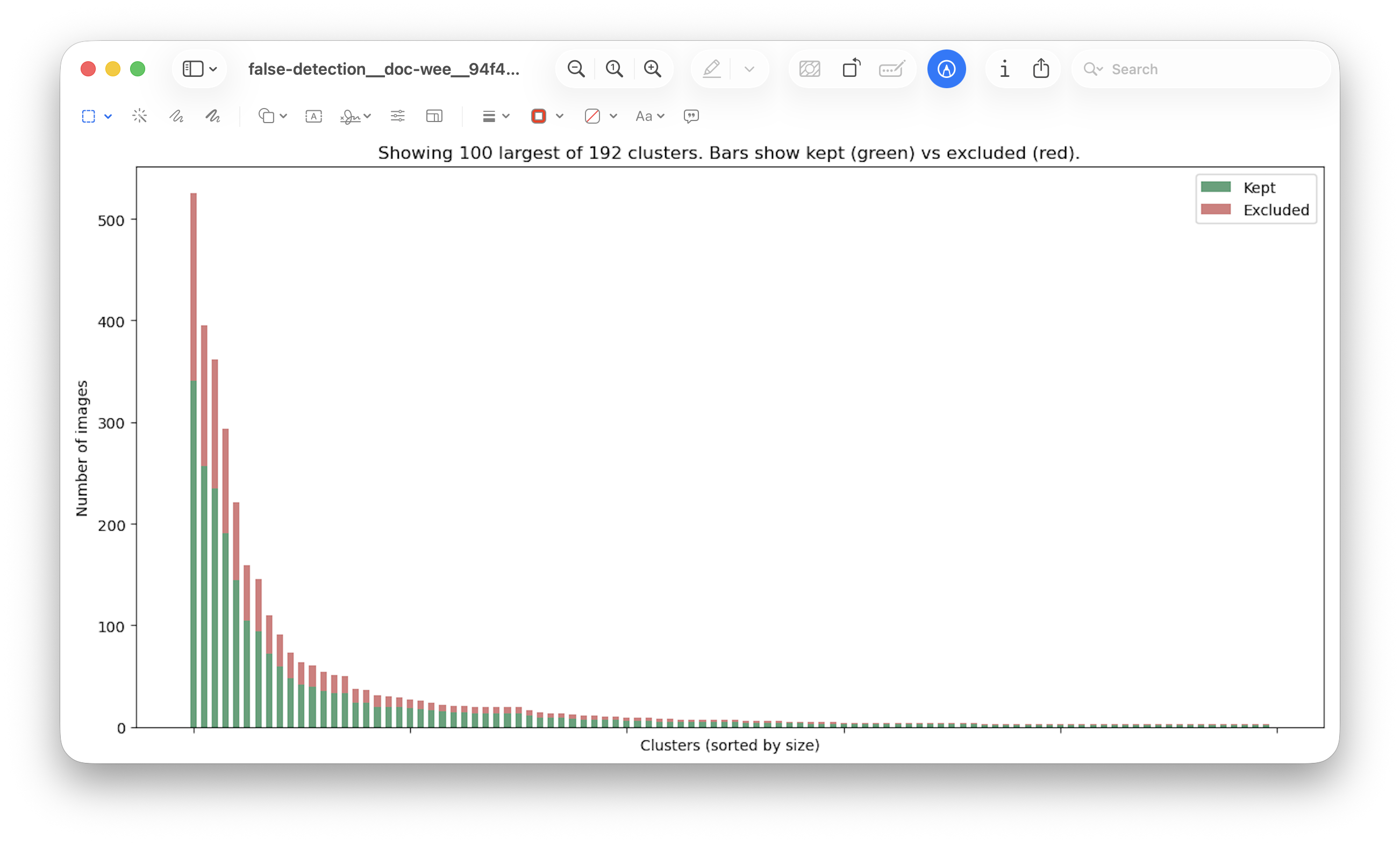
Save distribution chart (optional)
- Vertical bar chart of kept vs. excluded images per cluster
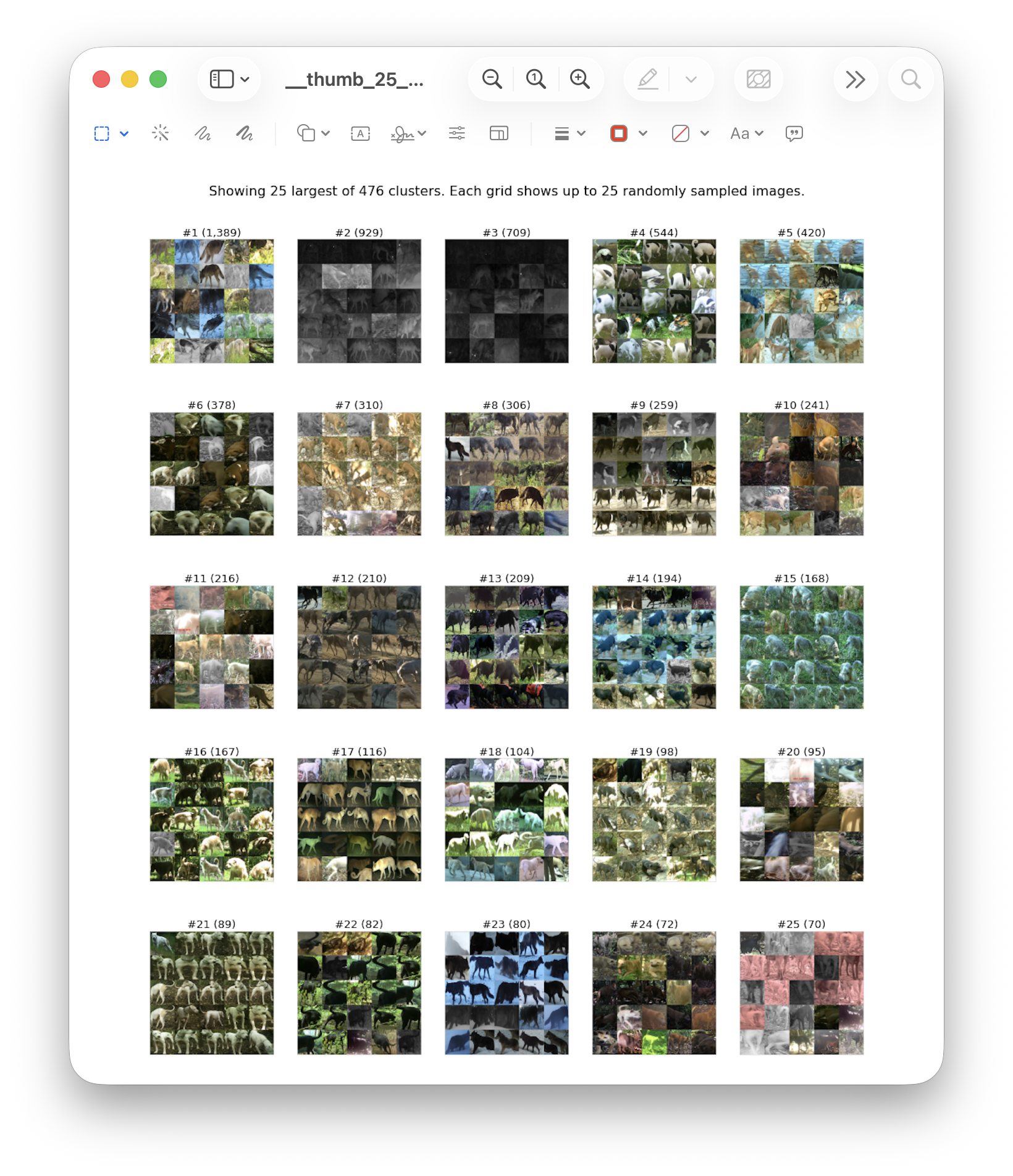
- Save thumbnail grids (optional)
- 5x5 grids from each cluster, for quick visual review
Performance
Approximate times on an NVIDIA RTX 3080 Ti.
| Dataset size | Embedding time (GPU) | Clustering | Total |
|---|---|---|---|
| 1,000 images | ~1s | instant | ~2s |
| 10,000 images | ~15s | ~1s | ~20s |
| 100,000 images | ~2.5 min | ~10s | ~3 min |
| 1,000,000 images | ~25 min | ~2 min | ~30 min |
License
MIT License, see LICENSE file.
1 maintainer

Release files for smartdownsample 2.0.6
For a detailed explanation of source distributions (sdists) and built distributions (wheels), please see the package formats documentation.
Source distribution (sdist)
| File | Size | Uploaded | |
|---|---|---|---|
| smartdownsample-2.0.6.tar.gz | 21.6 kB | Details |
Built distribution (wheel)
| File | Interpreter | ABI | Platform | Reset |
|---|---|---|---|---|
| smartdownsample-2.0.6-py3-none-any.whl | Python 3 | none | any | Details |
Total release size: 36.8 kB
Release files / smartdownsample-2.0.6.tar.gz
| Download URL | smartdownsample-2.0.6.tar.gz |
|---|---|
| Size | 21.6 kB |
| Tags | Source |
|
SHA-256 checksum How to use checksums |
517c03f7bec2dab0ec981a57519edb77beea32b0c8af7af033ee4a4537cfc8a2
|
|
BLAKE2b-256 checksum How to use checksums |
758337de49da9a3237bfdd89e76bd0ff546f94e4a21f1e010820922dee2537cc
|
| Upload date | |
|
Uploaded using Trusted Publishing? What is trusted publishing? |
No |
| Uploaded via |
twine/6.1.0 CPython/3.8.15
|
Release files / smartdownsample-2.0.6-py3-none-any.whl
| Download URL | smartdownsample-2.0.6-py3-none-any.whl |
|---|---|
| Size | 15.2 kB |
| Tags | Python 3 |
|
SHA-256 checksum How to use checksums |
79780e0b720638e51ab22e049a84035969a912012240e893808b593d008158af
|
|
BLAKE2b-256 checksum How to use checksums |
13d9ee36bc8b564f349e1b695a25d087961681ee15a87824283a9280385bcc16
|
| Upload date | |
|
Uploaded using Trusted Publishing? What is trusted publishing? |
No |
| Uploaded via |
twine/6.1.0 CPython/3.8.15
|














