
soma-shades




Control Soma Smart Shades over Bluetooth LE, without the SOMA Connect hub: a Python library, a command line tool, and an MQTT bridge to Home Assistant.
The SOMA Smart Shades 2 and the SOMA Tilt 2 are supported, they use the same protocol. The Smart Shades 3 use a different protocol and are planned for a next version. This project is not affiliated with Soma.
What do you need?
| You want to | Use |
|---|---|
| Use the shades in Home Assistant, and it is in range of them | The Home Assistant integration |
| Use the shades in Home Assistant, but it is out of range | The MQTT bridge on a device close to the shades |
| Control the shades from a terminal or a script | The command line tool |
| Build your own application | The Python library |
The integration is the simplest: it needs no broker and no separate device.
MQTT bridge
The bridge runs on a device close to the shades, and connects them to Home Assistant over your network.
┌──────────────┐               ┌──────────────────────┐          ┌───────────┐          ┌────────────────┐
│ Soma Smart   │ Bluetooth LE  │ Soma Bridge          │   MQTT   │ Mosquitto │   MQTT   │ Home Assistant │
│ Shades       │◄─────────────►│ connection per shade │◄────────►│ broker    │◄────────►│                │
│              │               │ keepalive, reconnect │          │           │          │                │
└──────────────┘               └──────────────────────┘          └───────────┘          └────────────────┘
Requirements: a Linux device with a Bluetooth LE adapter within range of the shades, and an MQTT broker.
Docker Compose
The docker-compose.yml runs Mosquitto
and the bridge, which uses the Bluetooth of the host through D-Bus:
curl -LO https://raw.githubusercontent.com/vanderkley/soma-shades/main/docker-compose.yml
mkdir -p deploy/mosquitto
curl -Lo deploy/mosquitto/mosquitto.conf \
    https://raw.githubusercontent.com/vanderkley/soma-shades/main/deploy/mosquitto/mosquitto.conf
docker compose up -d
docker compose logs -f soma-bridge
Raspberry Pi with systemd
The systemd unit runs the bridge as your user:
sudo apt-get install bluetooth pi-bluetooth pipx
sudo usermod -aG bluetooth $USER
pipx install 'soma-shades[bridge]'

sudo curl -Lo /etc/systemd/system/soma-bridge@.service \
    https://raw.githubusercontent.com/vanderkley/soma-shades/main/deploy/systemd/soma-bridge@.service
sudo systemctl daemon-reload
sudo systemctl enable --now soma-bridge@$USER
journalctl -u soma-bridge@$USER -f
Set the broker with Environment=SOMA_BROKER=... in sudo systemctl edit soma-bridge@$USER.
Home Assistant
- Install an MQTT broker: the Docker Compose file above includes one, on Home Assistant OS use the Mosquitto add-on.
- Add the MQTT integration with the address of the broker.
- Start the bridge. Every shade appears as a device through MQTT discovery, and beeps once on its first connection.
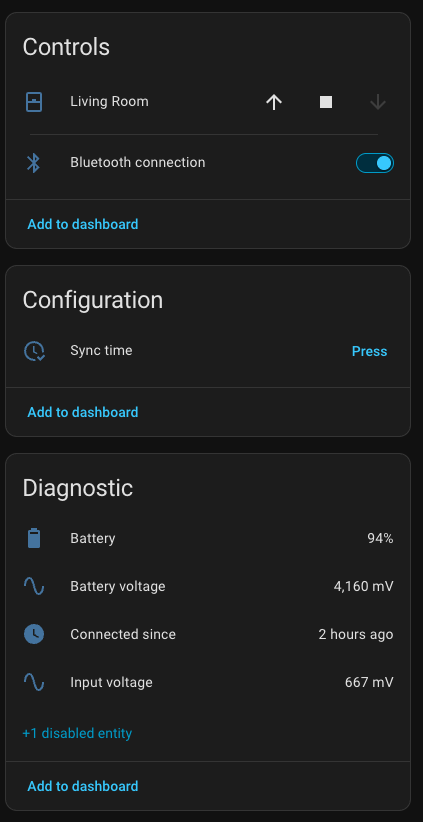
- Sync time sets the clock of the shade, for the schedules of the Soma app.
- Bluetooth connection leaves the shade free for the Soma app, also after a restart. Meanwhile it is unavailable in Home Assistant.
- New shades are found when the bridge starts, or with
mosquitto_pub -h <broker> -t homeassistant/cover/discover -m 20. - To remove a shade, remove it from the cache file and delete the device in Home Assistant.
MQTT topics
| Topic | Direction | Payload |
|---|---|---|
homeassistant/cover/smartshade/<shade>/config |
publish | discovery message |
homeassistant/cover/smartshade/<shade>/availability |
publish | online, offline |
homeassistant/cover/smartshade/<shade>/state |
publish | open, closed, opening, ... |
homeassistant/cover/smartshade/<shade>/position |
publish | 0 (open) to 100 (closed) |
homeassistant/cover/smartshade/<shade>/battery |
publish | battery level, 0 to 100 |
homeassistant/cover/smartshade/<shade>/battery_voltage |
publish | battery voltage in mV |
homeassistant/cover/smartshade/<shade>/input_voltage |
publish | charging input voltage in mV |
homeassistant/cover/smartshade/<shade>/charging_current |
publish | charging current, probably in mA |
homeassistant/cover/smartshade/<shade>/connected_since |
publish | start of the connection |
homeassistant/cover/smartshade/<shade>/bluetooth_connection |
publish | ON, OFF |
homeassistant/switch/smartshade/<shade>_bluetooth_connection/config |
publish | discovery message of the switch |
homeassistant/sensor/smartshade/<shade>_<sensor>/config |
publish | discovery messages of the sensors |
homeassistant/button/smartshade/<shade>_sync_time/config |
publish | discovery message of the button |
homeassistant/cover/smartshade/bridge/availability |
publish | online, offline (last will) |
homeassistant/cover/smartshade/<shade>/set |
subscribe | open, close, stop |
homeassistant/cover/smartshade/<shade>/set_position |
subscribe | 0 to 100 |
homeassistant/cover/smartshade/<shade>/sync_time |
subscribe | any payload sets the clock |
homeassistant/cover/smartshade/<shade>/bluetooth_connection_set |
subscribe | ON, OFF |
homeassistant/cover/discover |
subscribe | scan duration in seconds (max 30) |
homeassistant/status |
subscribe | online republishes all messages |
All published messages are retained, so Home Assistant also gets the covers when it starts after the bridge.
Command line
pip install 'soma-shades[bridge]'

soma discover                               # finds the shades
soma control living_room down
soma control living_room set_position 50    # 0 is open, 100 is closed
soma control living_room beep               # probe sound
A shade accepts a single Bluetooth connection: first close the Soma app, and stop the bridge or the Home Assistant integration.
Actions of soma control:
- Move:
up,down,stop,set_position VALUE(0 is open, 100 is closed) - Read:
position,battery,battery_voltage,charging,motor_speed,info - Other:
set_motor_speed VALUE(0 to 100),sync_time,beep
The other commands are soma bridge and soma probe-sounds SHADE. Run soma COMMAND --help for the options and soma -v COMMAND for debug logging. The options can also be set with
the environment variables SOMA_CACHE_FILE, SOMA_BROKER, SOMA_PORT, SOMA_USERNAME, SOMA_PASSWORD and
SOMA_DISCOVER.
Python library
pip install soma-shades
Use ShadeClient for a single shade, ShadeFleet to discover shades, and ShadeConnection to keep a connection open.
Example: read the state of a shade and move it
import asyncio

from soma_shades import ShadeFleet


async def main() -> None:
    fleet = ShadeFleet()  # the shades from the cache
    if not fleet.shades:
        await fleet.discover(scan_for=20)

    shade = fleet.get("living_room")
    await shade.connect(timeout=15)
    try:
        print(await shade.get_position(), await shade.get_battery_level())
        await shade.set_position(50)
    finally:
        await shade.disconnect()


asyncio.run(main())
Bluetooth adapter
A connection to every shade stays open, so the adapter has to hold several connections at the same time. Use an adapter
from the list of Home Assistant,
e.g. a branded CSR8510A10 or a Realtek RTL8761BU like the ASUS USB-BT500. Avoid an Actions ATS2851 chip (USB ID
10d7:b012), often sold as "Bluetooth 5.3", and unbranded CSR clones (0a12:0001). On Linux, check the chip with
lsusb and sudo btmgmt info.
Tip: do connections still drop with Unacceptable Connection Parameters (0x3b)? A shade asks for other connection
parameters after connecting, and drops the connection after 105 seconds when the adapter cannot provide them. Let
BlueZ use these parameters right away: add them to /etc/bluetooth/main.conf, and run
sudo systemctl restart bluetooth.
BlueZ settings for /etc/bluetooth/main.conf
[LE]
# shortest time between two connection events, in units of 1.25 ms: 16 × 1.25 = 20 ms (default 24: 30 ms)
# the shades ask for 16 (20 ms)
MinConnectionInterval=16
# longest time between two connection events, in units of 1.25 ms: 32 × 1.25 = 40 ms (default 40: 50 ms)
# the shades ask for 32 (40 ms), with a longer interval they ask for an update and drop the connection when it fails
MaxConnectionInterval=32
# connection events the shade may skip to save power: none (default 0)
# the shades ask for 0, they answer every event, so a command arrives within one interval
ConnectionLatency=0
# time without an answer before the connection is lost, in units of 10 ms: 80 × 10 = 800 ms (default 42: 420 ms)
# the shades ask for 80 (800 ms), a weak connection then survives short interference
ConnectionSupervisionTimeout=80
Troubleshooting
Check the Bluetooth access on Linux:
ls -l /run/dbus/system_bus_socket     # the D-Bus socket exists
systemctl status bluetooth            # active (running)
bluetoothctl show                     # Powered: yes
| Error | Cause |
|---|---|
FileNotFoundError |
no D-Bus socket; in Docker, /run/dbus is not mounted |
AccessDenied, PermissionError |
D-Bus or AppArmor denies the access to BlueZ, or the user is not in bluetooth |
No Bluetooth adapters found |
bluetoothd runs without an adapter, check bluetoothctl show and rfkill list |
- A shade stays unavailable: run
soma -v bridgeand look forCannot connect. Check the range withsoma control <shade> batterywhile the bridge is stopped. - The bridge and Home Assistant on the same device compete for the same adapter. Give the bridge a separate adapter, or disable the Bluetooth integration of Home Assistant.
- All shades fail with
TimeoutErrorordevice disappeared: BlueZ can get stuck after many failed connections. Restart it withsudo systemctl restart bluetooth. - Connections drop at a fixed interval: show the reason with
sudo btmon | grep -A4 "Disconnect Complete".Unacceptable Connection Parameters (0x3b)every 105 seconds is the adapter, see Bluetooth adapter.Connection Timeout (0x08)is the range.
Development
See CONTRIBUTING.md for the development setup, the checks and the release steps.
Credits
Thanks to rzuppur/smart-shades-documentation for the protocol documentation, and andersonshatch/soma-ctrl for the original Node.js implementation. Licensed under MIT.
1 maintainer

Metadata
1 maintainer
Release files for soma-shades 2.1.0
For a detailed explanation of source distributions (sdists) and built distributions (wheels), please see the package formats documentation.
Source distribution (sdist)
| File | Size | Uploaded | Provenance | Actions |
|---|---|---|---|---|
| soma_shades-2.1.0.tar.gz | 41.3 kB | With provenance | Details for soma_shades-2.1.0.tar.gz |
Built distribution (wheel)
| File | Interpreter | ABI | Platform | Actions Reset |
|---|---|---|---|---|
| soma_shades-2.1.0-py3-none-any.whl | Python 3 | none | any | Details for soma_shades-2.1.0-py3-none-any.whl |
Total release size: 75.0 kB
Release files / soma_shades-2.1.0.tar.gz
| Download URL | soma_shades-2.1.0.tar.gz |
|---|---|
| Size | 41.3 kB |
| Tags | Source |
|
SHA-256 checksum How to use checksums |
38d279996524cbcfcc8863810f7501671f74e2603e7018314a9226c99e6f30ec
|
|
BLAKE2b-256 checksum How to use checksums |
c16554bfb644fe23576328807a002ab21c0aa8a24004e96af58db3e8055173f8
|
| Upload date | |
|
Uploaded using Trusted Publishing? What is trusted publishing? |
Yes |
| Uploaded via |
twine/7.0.0 CPython/3.13.16
|
Provenance
Provenance describes where a file came from. On PyPI, provenance is shared via attestations, which provide a verifiable record of the build or publishing details. View details, limitations and caveats.


PyPI Publish Attestation
PyPI verified that this artifact, at this checksum, originated from the publisher listed below.
Signed by GitHub Actions, verified by PyPI on Nov 4, 2026.
Transparency logRelease files / soma_shades-2.1.0-py3-none-any.whl
| Download URL | soma_shades-2.1.0-py3-none-any.whl |
|---|---|
| Size | 33.7 kB |
| Tags | Python 3 |
|
SHA-256 checksum How to use checksums |
352c7640aa51aca097e3ca7f6d036ff0fbc55aa245a96955c42b6437caf3b6af
|
|
BLAKE2b-256 checksum How to use checksums |
2c38e6a3caa7bcba7e98d5f591161bbd77588e583a5d1baf38dfd70e2addc4f8
|
| Upload date | |
|
Uploaded using Trusted Publishing? What is trusted publishing? |
Yes |
| Uploaded via |
twine/7.0.0 CPython/3.13.16
|
Provenance
Provenance describes where a file came from. On PyPI, provenance is shared via attestations, which provide a verifiable record of the build or publishing details. View details, limitations and caveats.
PyPI Publish Attestation
PyPI verified that this artifact, at this checksum, originated from the publisher listed below.
Signed by GitHub Actions, verified by PyPI on Nov 4, 2026.
Transparency logSecurity for soma-shades 2.1.0
Provenance
Provenance describes where a file came from. On PyPI, provenance is shared via attestations, which provide a verifiable record of the build or publishing details. View details, limitations and caveats.
Full provenance
Both files in this release have been uploaded with provenance metadata.
Attestation for soma_shades-2.1.0.tar.gz
PyPI Publish Attestation
PyPI verified that this artifact, at this checksum, originated from the publisher listed below.
Signed by GitHub Actions, verified by PyPI on Nov 4, 2026.
Transparency logA note on package security
PyPI is a repository for distributing packages, not a service for auditing them. While third-party security researchers and our staff do their best to detect and remove malicious packages, PyPI cannot guarantee the quality, security or suitability of any given package.
To learn more about protecting yourself from malicious actors, visit our package security documentation.














