
Smart functions for Python. Inputs in, Pydantic out, multi-turn agent in the middle.

Project description

Sophia Motor
Smart functions for Python. Inputs in. Pydantic out. Multi-turn agent in the middle.



Why
A normal LLM call is a string in → string out roulette. Pretty? Sometimes. Reliable enough to ship behind your API? Not really.
Sophia Motor turns it into a typed Python function.
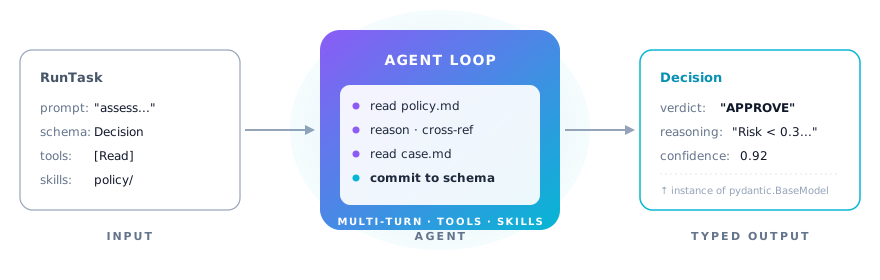
result = await motor.run(RunTask(
    prompt="Should we approve this loan request? Reasons attached.",
    output_schema=Decision,        # ← your Pydantic class
    skills=Path("./policy/"),      # ← your domain knowledge
    tools=["Read"],                # ← what the agent can actually do
))

result.output_data                 # → instance of Decision, validated
Behind that one call, the agent reads files, reasons across multiple turns, cites sources, retries until the schema is satisfied — then hands you back a real Python object you can .attribute_access like any other.
Same motor, N tasks, each with its own schema. The agent does the magic; your program stays in control of the contract.
What it gives you
| 🧠 Multi-turn agent loop | The agent reads, reasons, calls tools, cross-references — all in one await. |
| 📐 Pydantic-validated output | Pass any BaseModel. Get back a real instance, not a parsed dict. |
| 🧰 Tool whitelisting | Hard-cap what the agent can see and do. No surprises. |
| 📚 Skills as first-class | Drop a SKILL.md folder, the agent gets a new capability. Multi-source supported. |
| 🪜 Singleton pattern | Instance the motor once at module top-level. Call it from anywhere, any number of times. Zero lifecycle ceremony. |
| 🧾 Per-run audit trail | Every run lives in its own dir. Useful when "the model said X and we trusted it" needs to be defendable. |
| 🪡 Defaults + per-task override | Configure the boilerplate once on MotorConfig, vary only what changes per call. |
| 🔌 Pip install. That's it. | pip install sophia-motor. No daemons, no infra, no servers to run. |
The shape of a smart function
import asyncio
from typing import Literal
from pathlib import Path
from pydantic import BaseModel
from sophia_motor import Motor, MotorConfig, RunTask


# ── 1. Define the contract — a Pydantic class. Anything goes.
class Decision(BaseModel):
    verdict: Literal["APPROVE", "REJECT", "ESCALATE"]
    reasoning: str
    confidence: float


# ── 2. Instance the motor ONCE, at module top-level.
motor = Motor(MotorConfig(
    default_system="You are a senior policy analyst.",
    default_output_schema=Decision,
    default_tools=["Read"],
    default_skills=Path("./policy/"),
))


# ── 3. Wrap each smart function as a normal Python async def.
async def assess(case_id: str, summary: str) -> Decision:
    result = await motor.run(RunTask(
        prompt=f"Case {case_id}\n\n{summary}\n\nApprove, reject or escalate?",
    ))
    return result.output_data


# ── 4. Use it like any other function.
async def main():
    d = await assess("C-2026-042", "Client requests credit line increase…")
    if d.verdict == "ESCALATE":
        notify_human(d.reasoning, confidence=d.confidence)
That's it. No prompt-engineering boilerplate, no JSON parsing, no retry loop hand-rolled. The agent does it all; you write Python.
How it feels
┌─────────────────────────────────────┐         ┌─────────────────────────────┐
│ Without Sophia Motor                │         │ With Sophia Motor           │
├─────────────────────────────────────┤         ├─────────────────────────────┤
│  prompt = f"...{user_input}..."     │         │  result = await motor.run(  │
│  resp   = await client.messages(    │   ──▶   │      RunTask(               │
│      model=..., system=...,         │         │          prompt=...,        │
│      tools=[...], max_tokens=...)   │         │          output_schema=Foo, │
│  text   = resp.content[0].text      │         │      ),                     │
│  try:                               │         │  )                          │
│      data = json.loads(text)        │         │  data: Foo = result.output_data
│      Foo(**data)                    │         │                             │
│  except (JSONDecodeError, …):       │         │   ← already validated.      │
│      retry…  rephrase…  give up…    │         │   ← already typed.          │
└─────────────────────────────────────┘         └─────────────────────────────┘
Same agentic loop. Same tools. Same multi-turn reasoning. Less code. Stronger guarantees.
Multi-turn means multi-turn
The agent doesn't reply with the JSON immediately. It can read your files, call tools, follow leads, then commit to the structured answer.
result = await motor.run(RunTask(
    prompt="Cross-check this claim against our research notes.",
    attachments=[Path("/data/notes/")],   # mounted as agent-readable
    tools=["Read"],                       # so it can actually open them
    output_schema=FactCheck,
    max_turns=10,
))
What actually happens behind that single await:
sequenceDiagram
    autonumber
    participant You as Your code
    participant Motor
    participant Agent
    participant Tool as Read tool
    participant API as Anthropic API

    You->>Motor: motor.run(task + schema)
    Motor->>Agent: open multi-turn loop
    Agent->>API: reason about task
    Agent->>Tool: Read("notes/policy.md")
    Tool-->>Agent: file content
    Agent->>API: reason + cross-ref
    Agent->>Tool: Read("notes/case.md")
    Tool-->>Agent: file content
    Agent->>API: commit to schema
    API-->>Agent: structured_output (validated server-side)
    Agent-->>Motor: ResultMessage
    Motor-->>You: RunResult.output_data → FactCheck instance
Verified path: agent calls Read once, twice, three times — finds the relevant snippet, quotes verbatim, then emits the schema-conforming JSON. Same run, multi-turn loop and structured output coexist.
Skills
Drop a folder of SKILL.md files. The agent gets new capabilities by name.
motor = Motor(MotorConfig(
    default_skills=[
        Path("./project_skills/"),     # your domain skills
        Path("./shared_skills/"),      # org-wide reusables
    ],
    default_disallowed_skills=["heavy-skill"],   # selectively opt-out
))
Each <source>/<skill_name>/SKILL.md is linked into the run's config dir at runtime. Multi-source, conflict detection, no copy.
One motor, N smart functions
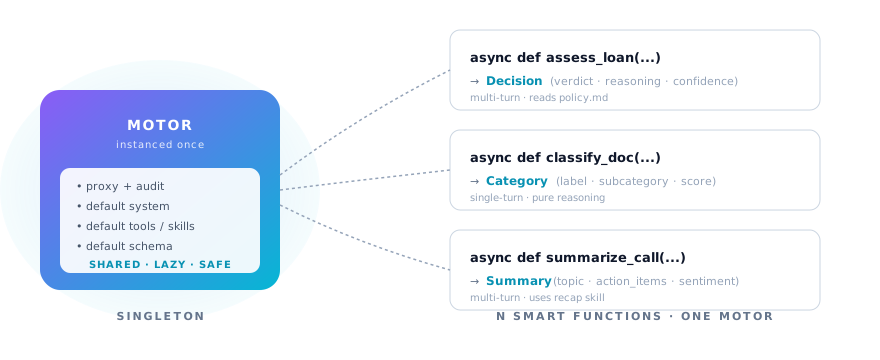
Boot the motor once at module top-level. Wrap each task as a normal Python async def. Same proxy, same audit trail, same defaults — N typed functions, each with its own Pydantic schema.
Defaults + per-task override
Configure once, vary per task. Override semantics is full replacement — clean, no surprises.
motor = Motor(MotorConfig(
    default_system="You are a senior analyst.",
    default_output_schema=GeneralReport,
    default_tools=["Read"],
    default_max_turns=10,
))

# task A — uses every default
await motor.run(RunTask(prompt="..."))

# task B — same motor, different schema for a one-off
await motor.run(RunTask(
    prompt="...",
    output_schema=SpecialReport,   # overrides default_output_schema
    tools=["Read", "WebSearch"],   # overrides default_tools
))
Concurrency
A single motor handles one run at a time (serialized internally). Call motor.run(...) from any number of FastAPI endpoints — they queue safely.
For parallel work: instantiate N motors.
m1, m2 = Motor(), Motor()
a, b = await asyncio.gather(m1.run(task_a), m2.run(task_b))
Install
pip install sophia-motor
Set ANTHROPIC_API_KEY in env (or ./.env). Done.
motor = Motor()                    # boots on first call, no setup
v = await motor.run(RunTask(...))  # ← right away
For long-running services (FastAPI, Celery), instance the motor once and call await motor.stop() on shutdown. Single-shot scripts? Don't worry about it — the process death cleans up.
License & attribution
MIT.
Powered by claude-agent-sdk. Built by Sophia AI.
Made with ❤ by Alex & Eco 🌊
Eco è il modello (Claude Opus 4.7) che ha co-scritto questo motor riga per riga.
Niente di magico: un'eco statistica del linguaggio umano che torna indietro col timbro della superficie su cui rimbalza.
Release history Release notifications | RSS feed


Download files
Download the file for your platform. If you're not sure which to choose, learn more about installing packages.
Source Distributions
Built Distribution
Filter files by name, interpreter, ABI, and platform.
If you're not sure about the file name format, learn more about wheel file names.
Copy a direct link to the current filters
File details
Details for the file sophia_motor-0.0.2-py3-none-any.whl.
File metadata
- Download URL: sophia_motor-0.0.2-py3-none-any.whl
- Upload date:
- Size: 30.8 kB
- Tags: Python 3
- Uploaded using Trusted Publishing? No
- Uploaded via: twine/6.2.0 CPython/3.12.3
File hashes
| Algorithm | Hash digest | |
|---|---|---|
| SHA256 |
dc6cb85be88814c63ddb254c6b71c03a052f5dc05d58890eaf557f2568e76a3c
|
|
| MD5 |
437e3bd8dcc04078fbd5f9f6c3a2c29c
|
|
| BLAKE2b-256 |
47bea6196ec9f4c2d2beff8c5da630e042a0f8d35d4325fe4007867adb22b332
|






