

Typed Vaadin web components and browser assets for spaday.




Overview
from spaday import SetField, element, serve
from spaday_vaadin import VaadinButton, VaadinGrid, VaadinGridColumn, VaadinTextField

page = element("div").child(
    VaadinButton(theme="primary").text("Approve").on("click", SetField("state", "approved")),
    VaadinTextField(label="State", readonly=True).bind("value", "state"),
    VaadinGrid(items=[{"name": "Ada"}, {"name": "Grace"}]).child(VaadinGridColumn(path="name")),
)
serve(page, packages=["vaadin"], store={"state": "pending"})
A curated core of Vaadin's free components — button, checkbox, combo box, date picker, dialog, grid
and its columns, notification, select, tabs and text field, 20 elements in all — has typed classes
generated from their Custom Elements Manifests, so props, events and slots are checked when you
author the tree. Array properties such as a grid's items are keyword arguments too, set on the
element as properties. Installing the package does not inject assets; select it with
packages=["vaadin"] or pass the exported package descriptor.
Generic controls
Selecting the vaadin package also selects its design, rendering spaday's generic button, text
input, date input, checkbox, select, and dialog as Vaadin elements:
from spaday import Button, Column, TextInput
from spaday.backends.starlette import serve

page = Column(
    TextInput(label="Name").bind("value", "name", mode="two-way"),
    Button(label="Save", intent="primary"),
)
app = serve(page, packages=["vaadin"], design="vaadin", store={"name": ""})
The other seven generic controls use spaday's marked native fallback because they are outside this
package's curated Vaadin subset or require a rendering contract the generic API cannot preserve.
Text inputs with a non-text type, such as password or email, also use the native fallback
because this package's curated subset contains vaadin-text-field only.
Browser examples
- Fulfillment desk — complete interactive example, with Python running in Pyodide.
- Component gallery — the current curated 20-wrapper subset and its Python source.
Run the local example
python -m pip install -e ".[examples]"
python -m spaday_vaadin.example
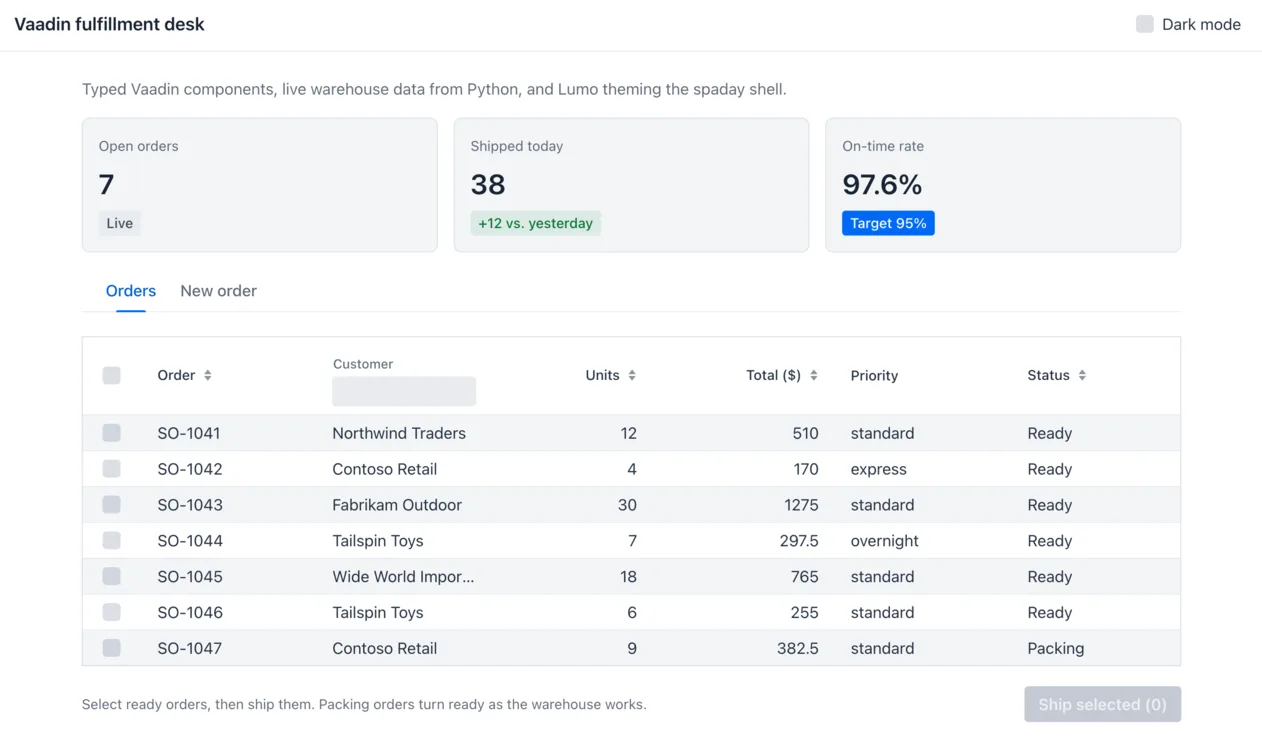
Open http://127.0.0.1:8027 for the fulfillment desk: a grid of orders
streamed live from Python with selection, sorting and filtering, shipping the selected orders through a
Python endpoint, an order form of combo box, text field, select, date picker and checkbox two-way bound
to spaday state, a dialog confirming what the server created, tabs, Lumo badges, and a dark mode that
re-themes Lumo and the spaday shell together.
Run python -m spaday_vaadin.gallery and open http://127.0.0.1:8028 for the curated local component gallery.
Theming
The elements are styled with Vaadin's Lumo theme, and the stylesheet maps spaday's --spa-* shell
palette onto Lumo's properties, so restyling Lumo restyles the shell and every other spaday component
package with it. TOKENS lists the properties wired to the palette:
App().css(lumo_primary_color="#0C4253")
The theme follows spaday's page mode: a wa-dark class (for example
App(...).bind_root_class("wa-dark", "dark")) switches Lumo to dark, and a wa-light island inside
a dark page stays light.
Sharing Vaadin with your own library
Vaadin registers global custom element names, so a page can hold only one copy. The package serves
Vaadin's modules under their own bare specifiers — @vaadin/button, @vaadin/grid/…,
@vaadin/component-base/… and the other packages these elements are built from — through the page's
import map. A library that imports or extends them and leaves those imports out of its bundle
(external: ["@vaadin/*"] with esbuild) gets this copy.
The served copy carries the opt-out of Vaadin's development-time usage statistics, which its package
normally installs at npm install time.
1 maintainer

Metadata
1 maintainer
Release files for spaday-vaadin 0.3.0
For a detailed explanation of source distributions (sdists) and built distributions (wheels), please see the package formats documentation.
Source distribution (sdist)
| File | Size | Uploaded | Provenance | Actions |
|---|---|---|---|---|
| spaday_vaadin-0.3.0.tar.gz | 370.6 kB | Without provenance | Details for spaday_vaadin-0.3.0.tar.gz |
Built distribution (wheel)
| File | Interpreter | ABI | Platform | Actions Reset |
|---|---|---|---|---|
| spaday_vaadin-0.3.0-py3-none-any.whl | Python 3 | none | any | Details for spaday_vaadin-0.3.0-py3-none-any.whl |
Total release size: 931.3 kB
Release files / spaday_vaadin-0.3.0.tar.gz
| Download URL | spaday_vaadin-0.3.0.tar.gz |
|---|---|
| Size | 370.6 kB |
| Tags | Source |
|
SHA-256 checksum How to use checksums |
0289aead868b4910536b208dafecf3f71f952f8ad06df76e03596d52fdbe664b
|
|
BLAKE2b-256 checksum How to use checksums |
dbaaea338f32a3ff0a7fe691a80dc8d6f475dda20f374c560ab46ed1da4908c4
|
| Upload date | |
|
Uploaded using Trusted Publishing? What is trusted publishing? |
No |
| Uploaded via |
twine/7.0.0 CPython/3.12.14
|
Release files / spaday_vaadin-0.3.0-py3-none-any.whl
| Download URL | spaday_vaadin-0.3.0-py3-none-any.whl |
|---|---|
| Size | 560.7 kB |
| Tags | Python 3 |
|
SHA-256 checksum How to use checksums |
91c559fee838d2ea59512eaaf8692e7ceeeb2bdd53464016d6c8cef337905f5e
|
|
BLAKE2b-256 checksum How to use checksums |
4eb57bf813c3f480a747023204302fe701251ecb36d80c18ba9571c97585c3bc
|
| Upload date | |
|
Uploaded using Trusted Publishing? What is trusted publishing? |
No |
| Uploaded via |
twine/7.0.0 CPython/3.12.14
|
Security for spaday-vaadin 0.3.0
Provenance
Provenance describes where a file came from. On PyPI, provenance is shared via attestations, which provide a verifiable record of the build or publishing details. View details, limitations and caveats.
No provenance found
None of the files in this release were uploaded with provenance metadata.
A note on package security
PyPI is a repository for distributing packages, not a service for auditing them. While third-party security researchers and our staff do their best to detect and remove malicious packages, PyPI cannot guarantee the quality, security or suitability of any given package.
To learn more about protecting yourself from malicious actors, visit our package security documentation.














