
Estimate Cn2 from Speckle patterns using machine learning
Verified details
These details have been verified by PyPIProject links
GitHub Statistics
Maintainers

Project description











SpeckleCn2Profiler:
Improving Satellite Communications with SCIDAR and Machine Learning
Overview
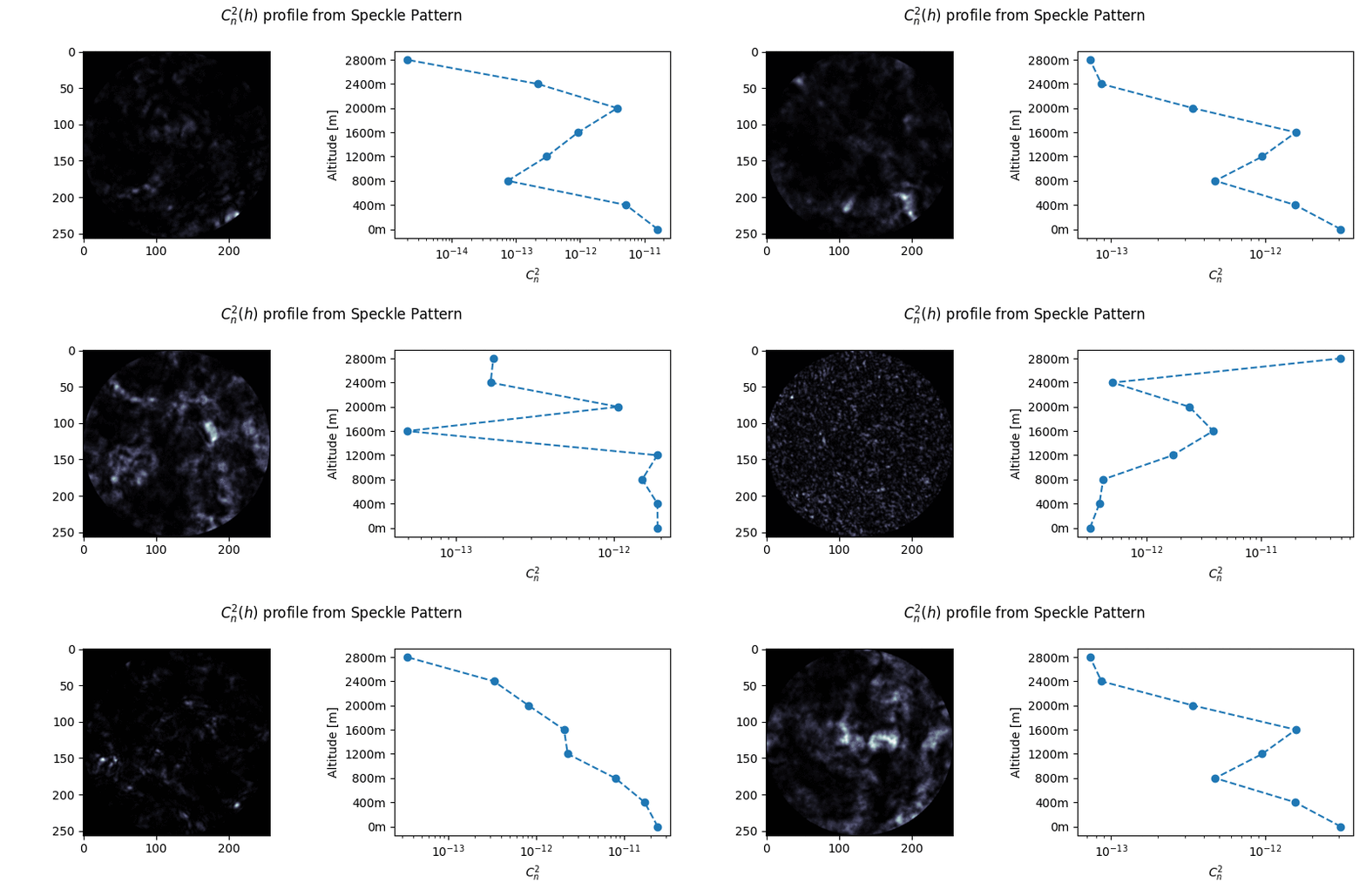
Optical satellite communications is a growing research field with bright commercial perspectives. One of the challenges for optical links through the atmosphere is turbulence, which is also apparent by the twinkling of stars. The reduction of the quality can be calculated, but it needs the turbulence strength over the path the optical beam is running. Estimation of the turbulence strength is done at astronomic sites, but not at rural or urban sites. To be able to do this, a simple instrument is required. We want to propose to use a single star Scintillation Detection and Ranging (SCIDAR), which is an instrument that can estimate the turbulence strength, based on the observation of a single star. In this setting, reliable signal processing of the received images of the star is most challenging. We propose to solve this by Machine Learning.
Statement of Need
SpeckleCn2Profiler addresses the challenge of atmospheric turbulence profiling for optical satellite communications using machine learning-based analysis of SCIDAR data. The primary target users include:
- Aerospace engineers working on free-space optical communication systems
- Atmospheric scientists studying turbulence profiles and optical propagation
- Astronomers characterizing atmospheric seeing conditions
- Researchers in adaptive optics and atmospheric characterization
While traditional SCIDAR instruments require complex signal processing, SpeckleCn2Profiler provides a machine learning-based approach that enables simpler, more accessible turbulence profiling. Unlike classical methods that rely on analytical inversion techniques, our ML-based approach can handle noisy data more robustly and provides uncertainty quantification through ensemble predictions.
Repository Contents
This repository contains the workflow to implement and train machine learning models for turbulence strength estimation from SCIDAR data. Extensive Documentation is available to explain the methodology, algorithms used, and guidelines for using the code.
Getting Started
To get started with the project, follow these steps:
Prerequisites
To correctly install speckcn2, you need Python 3.9 or higher. If you don't have it installed, you can download it from the official website.
You will also need header files required to compile Python extensions (contained in python3-dev):
Ubuntu/Debian:
sudo apt-get install python3-dev
Other systems:
# Fedora/RHEL
sudo dnf install python3-devel

# macOS
xcode-select --install

# Windows: Headers are included with the official Python installer
Installation
Option 1: Install from PyPI (Recommended)
python -m pip install speckcn2
We strongly recommend using a virtual environment:
# Create virtual environment
python -m venv speckcn2-env

# Activate virtual environment
# On Linux/macOS:
source speckcn2-env/bin/activate
# On Windows:
# speckcn2-env\Scripts\activate

# Install the package
python -m pip install speckcn2
Verify installation:
python -c "import speckcn2; print('Installation successful!')"
Option 2: Development Installation
For advanced users and developers who want to modify the code:
git clone https://github.com/MALES-project/SpeckleCn2Profiler.git
cd SpeckleCn2Profiler
git submodule init
git submodule update
pip install -e .
Usage
To use the package, you run the commands such as:
python <mycode.py> <path_to_config.yml>
where <mycode.py> is the name of the script that trains/uses the speckcn2 model and <path_to_config.yml> is the path to the configuration file.
Here you can find a typical example run and an explanation of all the main configuration parameter. In the example submodule you can find multiple examples and multiple configuration to take inspiration from.
Quick Example
Here's a minimal working example to train a model on sample data:
import speckcn2 as sp2
import torch

# Load configuration
config = sp2.load_config('path/to/config.yaml')

# Prepare data
all_images, all_tags, all_ensemble_ids = sp2.prepare_data(config)

# Normalize tags
nz = sp2.Normalizer(config)

# Split data
train_set, test_set = sp2.train_test_split(all_images, all_tags,
                                            all_ensemble_ids, nz)

# Setup model
device = torch.device('cuda' if torch.cuda.is_available() else 'cpu')
model, last_model_state = sp2.setup_model(config)
model = model.to(device)

# Define loss and optimizer
criterion = sp2.ComposableLoss(config, nz, device)
optimizer = sp2.setup_optimizer(config, model)

# Train
model, avg_loss = sp2.train(model, last_model_state, config,
                            train_set, test_set, device,
                            optimizer, criterion, criterion)
print(f'Training complete. Final loss: {avg_loss:.5f}')
Sample data and configuration files are available in the examples/ directory.
What can we predict?
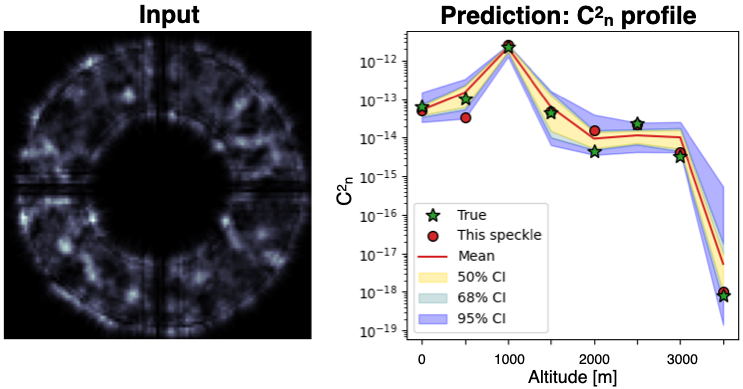
A machine learning model trained using speckcn2 can predict:
1. Instantaneous turbulence strength
2. Parameters estimation
The model can also estimate important parameters that are useful for the analysis of the speckle pattern. At the moment we support:
- Fried parameter
r0 - Isoplanatic angle
θ0 - Rytov Index
σ
We also provide histograms of the estimated parameters and the error of the estimation.
Running Tests
To verify your installation and ensure everything works correctly, you can run the test suite using pytest:
pytest
Note: Some tests may fail on first run because test data needs to be set up. If this happens, run:
python ./scripts/setup_test.py
pytest
For more details on testing and development, see our Contributing Guidelines.
Contribution Guidelines
We welcome contributions to improve and expand the capabilities of this project. If you have ideas, bug fixes, or enhancements, please submit a pull request. Check out our Contributing Guidelines to get started with development.
Generative-AI Disclaimer
Parts of the code have been generated and/or refined using GitHub Copilot. All AI-output has been verified for correctness, accuracy and completeness, revised where needed, and approved by the author(s).
How to cite
Please consider citing this software that is published in Zenodo under the DOI 10.5281/zenodo.11447920.
License
This project is licensed under the Apache 2.0 License - see the LICENSE file for details.
Project details
Verified details
These details have been verified by PyPIProject links
GitHub Statistics
Maintainers
Release history Release notifications | RSS feed


Download files
Download the file for your platform. If you're not sure which to choose, learn more about installing packages.
Source Distribution
Built Distribution
Filter files by name, interpreter, ABI, and platform.
If you're not sure about the file name format, learn more about wheel file names.
Copy a direct link to the current filters
File details
Details for the file speckcn2-2.0.0.tar.gz.
File metadata
- Download URL: speckcn2-2.0.0.tar.gz
- Upload date:
- Size: 41.6 kB
- Tags: Source
- Uploaded using Trusted Publishing? Yes
- Uploaded via: twine/6.1.0 CPython/3.13.7
File hashes
| Algorithm | Hash digest | |
|---|---|---|
| SHA256 |
f1330874fcada52586b3a052f0a334065af19fce2560a45931433d6957a59147
|
|
| MD5 |
2eb764c22a5ca12d186cbe376f8a4339
|
|
| BLAKE2b-256 |
229de5ce896f49cd0c1dcb02fc5db0184136cfffd324f83ef01682706d97db89
|
Provenance
The following attestation bundles were made for speckcn2-2.0.0.tar.gz:
Publisher:
publish.yaml on MALES-project/SpeckleCn2Profiler
-
Statement:
-
Statement type:
https://in-toto.io/Statement/v1 -
Predicate type:
https://docs.pypi.org/attestations/publish/v1 -
Subject name:
speckcn2-2.0.0.tar.gz -
Subject digest:
f1330874fcada52586b3a052f0a334065af19fce2560a45931433d6957a59147 - Sigstore transparency entry: 607820496
- Sigstore integration time:
-
Permalink:
MALES-project/SpeckleCn2Profiler@b2d089297078bab8ffff9e05f517d0f9c922b6c7 -
Branch / Tag:
refs/tags/2.0.0 - Owner: https://github.com/MALES-project
-
Access:
public
-
Token Issuer:
https://token.actions.githubusercontent.com -
Runner Environment:
github-hosted -
Publication workflow:
publish.yaml@b2d089297078bab8ffff9e05f517d0f9c922b6c7 -
Trigger Event:
release
-
Statement type:
File details
Details for the file speckcn2-2.0.0-py3-none-any.whl.
File metadata
- Download URL: speckcn2-2.0.0-py3-none-any.whl
- Upload date:
- Size: 47.5 kB
- Tags: Python 3
- Uploaded using Trusted Publishing? Yes
- Uploaded via: twine/6.1.0 CPython/3.13.7
File hashes
| Algorithm | Hash digest | |
|---|---|---|
| SHA256 |
0b76bab1b7b08931ca56899c8a63f7089a6b44afb0e0be311ef088d56afa77d2
|
|
| MD5 |
69c06aa6b87e1d20670552b8983a52f9
|
|
| BLAKE2b-256 |
31b27ad7fca22ac6629fb172d512af918a7937d8131fb6f6142f14f0db8c6442
|
Provenance
The following attestation bundles were made for speckcn2-2.0.0-py3-none-any.whl:
Publisher:
publish.yaml on MALES-project/SpeckleCn2Profiler
-
Statement:
-
Statement type:
https://in-toto.io/Statement/v1 -
Predicate type:
https://docs.pypi.org/attestations/publish/v1 -
Subject name:
speckcn2-2.0.0-py3-none-any.whl -
Subject digest:
0b76bab1b7b08931ca56899c8a63f7089a6b44afb0e0be311ef088d56afa77d2 - Sigstore transparency entry: 607820499
- Sigstore integration time:
-
Permalink:
MALES-project/SpeckleCn2Profiler@b2d089297078bab8ffff9e05f517d0f9c922b6c7 -
Branch / Tag:
refs/tags/2.0.0 - Owner: https://github.com/MALES-project
-
Access:
public
-
Token Issuer:
https://token.actions.githubusercontent.com -
Runner Environment:
github-hosted -
Publication workflow:
publish.yaml@b2d089297078bab8ffff9e05f517d0f9c922b6c7 -
Trigger Event:
release
-
Statement type:






