
spectrl





Put a mass spectrum directly in a URL.
Encodes one spectrum's peak arrays and modeled mzML metadata into a compact, URL-safe token. The encoded payload lives in the string. No backend is required.
spectrl.v1.<base64url(CBOR document)>.<checksum>
Try the browser demo · Read the format specification · See the changelog
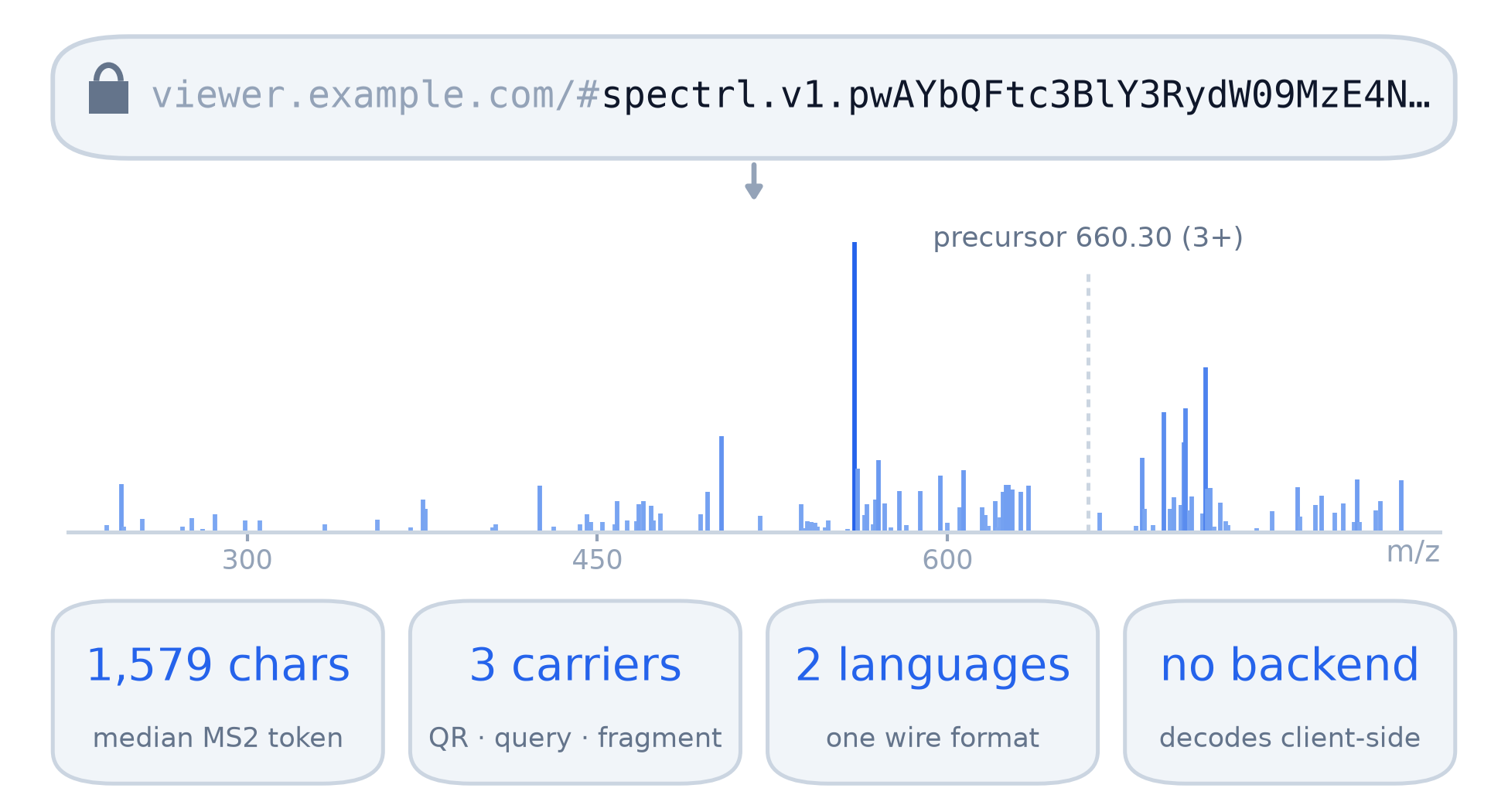
A spectrum travels as ordinary URL-safe text and decodes entirely client-side.
Why
Use spectrl to share a spectrum in a URL, QR code, notebook, paper, or
application handoff. The token contains the spectrum itself, so decoding does
not depend on an external service or file. A Universal Spectrum Identifier
(USI) points to a spectrum in a repository. Spectrl embeds the spectrum. Use a
USI when long-term repository lookup is the goal, and spectrl when a compact,
self-contained handoff is more useful.
What's included
| Component | Purpose |
|---|---|
spectrl Python package |
Reference encoder/decoder, mzML bridge, URL helpers, and CLI |
js/ |
Independent TypeScript implementation for browsers and Node |
SPECIFICATION.md |
Normative spectrl.v1 wire-format specification |
test-vectors/ |
Shared positive, negative, and cross-language conformance vectors |
Install
pip install spectrl
Requires Python 3.12+. Pure Python out of the box: the MS-Numpress codecs ship with a dependency-free backend (this is what lets spectrl run in Pyodide / the browser). For the C-extension backend (byte-identical, faster on large arrays):
pip install "spectrl[speed]"
To install the unreleased development version:
pip install "spectrl @ git+https://github.com/pgarrett-scripps/spectrl.git"
The TypeScript implementation is tested and built from js/, but is
not yet published to npm because the final package scope has not been claimed.
Quick start
Encode from mzmlpy
The mzML bridge is optional. Install it with pip install "spectrl[mzml]".
Applications such as Spectacular that already depend on mzmlpy do not need
the extra.
from mzmlpy.run import Mzml
from spectrl import encode_spectrum, from_mzmlpy

with Mzml("data.mzML") as mzml:
    spec = mzml.spectra[0]
    token = encode_spectrum(from_mzmlpy(spec))

print(token)
# spectrl.v1.hQ...
Encode manually
import numpy as np
from spectrl import encode_spectrum
from spectrl.model import InlineSpectrum, SpectrlCvParam

spec = InlineSpectrum(
    default_array_length=3,
    mz=np.array([147.0, 175.1, 246.2]),
    intensity=np.array([1e5, 8e4, 3e4]),
    id="scan=42",
    params=[
        SpectrlCvParam(accession="MS:1000511", value=2),   # ms level
        SpectrlCvParam(accession="MS:1000130"),             # positive scan
        SpectrlCvParam(accession="MS:1000127"),             # centroid
    ],
)

token = encode_spectrum(spec)
Decode
from spectrl import decode_token

decoded = decode_token(token)
print(decoded.mz)        # numpy array
print(decoded.intensity) # numpy array
print(decoded.id)        # "scan=42"
URL bindings
from spectrl import to_fragment, to_query, to_data_uri, extract_token

# Embed in a URL fragment. This is recommended because it is never sent to the server.
url = to_fragment(token, "https://viewer.example.com/spectrum")
# https://viewer.example.com/spectrum#spectrl.v1.hQ...

# Or as a query parameter
url = to_query(token, "https://viewer.example.com/spectrum")
# https://viewer.example.com/spectrum?d=spectrl.v1.hQ...

# Or as a data URI
uri = to_data_uri(token)
# data:application/vnd.spectrl;v=1,spectrl.v1.hQ...

# Extract token back from any of the above
token = extract_token(url)
Additional arrays
Beyond the dedicated m/z, intensity, and charge fields, attach any per-peak
array by PSI-MS accession (a standard mzML binary array) or by a free-text name
(a non-standard MS:1000786 array). Every ion-mobility variant lives here, so
multiple distinct mobility arrays are preserved. int32/float32 dtypes are
preserved. ArrayAccession provides readable string-valued enum keys while
still allowing future PSI-MS accessions as plain strings.
import numpy as np
from spectrl import ArrayAccession, UnitAccession, encode_spectrum, decode_token
from spectrl.model import InlineSpectrum

spec = InlineSpectrum(
    default_array_length=3,
    mz=np.array([147.0, 175.1, 246.2]),
    intensity=np.array([1e5, 8e4, 3e4]),
    extra_arrays={
        ArrayAccession.RAW_INVERSE_REDUCED_ION_MOBILITY: np.array([0.82, 0.91, 1.05]),
        "MS:1000517": np.array([120.0, 80.0, 45.0]),         # signal-to-noise array (named CV)
        "iso_score": np.array([0.98, 0.91, 0.74], np.float32),  # non-standard (MS:1000786)
    },
    array_units={
        ArrayAccession.RAW_INVERSE_REDUCED_ION_MOBILITY:
            UnitAccession.VOLT_SECOND_PER_SQUARE_CENTIMETER,
    },
)
decoded = decode_token(encode_spectrum(spec))
decoded.extra_arrays["iso_score"]  # float32 array, round-tripped
decoded.mobility_arrays["MS:1003008"]  # accession-keyed filtered view
Known PSI-MS auxiliary arrays receive semantic defaults. Coordinate arrays use
Numpress linear, positive magnitude arrays such as signal-to-noise use Numpress
slof, and integer index arrays use Numpress pic. Unknown and non-standard arrays
remain lossless raw + zlib. The JavaScript implementation exposes the same via
extraArrays and preserves Int32Array and Float32Array types for raw codecs.
Override any array independently when needed:
token = encode_spectrum(
    spec,
    array_encodings={
        ArrayAccession.MZ: "numlin-zstd",  # "mz" is an equivalent alias
        ArrayAccession.RAW_INVERSE_REDUCED_ION_MOBILITY: "numlin-zstd",
        "MS:1000517": {"codec": "numslof-zstd", "fixed_point": 3600},
        "iso_score": "byte-shuffled-zstd",
    },
)
Supported names are zlib, zstd, byte-shuffled-zstd, and each Numpress
transform followed by either zlib or zstd. Passing lossless=True keeps every
array exact and rejects an explicitly lossy override.
Unknown arrays remain lossless unless an expert explicitly passes
allow_unsafe_lossy_custom=True together with a lossy codec override. Known
incompatible array/codec combinations are rejected even with that option.
In JavaScript, call installZstd() from @spectrl-ms/spectrl/zstd before encoding
or decoding zstd arrays. The explicit setup cannot be removed by tree-shaking.
User params (free-text metadata)
For values with no CV term, attach mzML userParams at the spectrum or scan
level. They're omitted entirely when empty, so a spectrum without any is
byte-identical to one produced before the feature existed.
from spectrl.model import InlineSpectrum, SpectrlUserParam

spec = InlineSpectrum(
    default_array_length=3, mz=mz, intensity=intensity,
    user_params=[
        SpectrlUserParam(name="Mascot score", value=42.7, type="xsd:float"),
        SpectrlUserParam(name="reanalysis note", value="rerun semitryptic"),
    ],
)
from_mzmlpy reads spectrum- and scan-level userParams automatically. The JS
implementation exposes the same via userParams. Prefer a CV term whenever one
exists. UserParams are heavier (no accession to compress) and uncontrolled.
Trim large spectra
from spectrl import top_n

# Keep the 50 most intense peaks before encoding
trimmed = top_n(spec, 50)
token = encode_spectrum(trimmed)
Lossless encoding
# Default is lossy MS-Numpress
# Use lossless=True for bit-exact IEEE-754 doubles
token = encode_spectrum(spec, lossless=True)
Token format
spectrl.v1.<base64url(CBOR document)>.<checksum>
spectrl.v1: stablespectrlidentifier + explicitv1format version. The prefix is the version's only carrier.- The payload is a single CBOR document (RFC 8949), base64url-encoded without padding (RFC 4648 §5).
- The required trailing checksum is CRC-32/ISO-HDLC over everything before the last
., encoded as eight lowercase hexadecimal characters. It detects accidental corruption without decoding the CBOR payload. - Header: a CBOR map with integer keys mirroring mzML structure: ms level, polarity, scan times, precursor isolation window, activation method, collision energy, and ProForma interpretation.
- Array blobs: one per array type (m/z, intensity, charge, and accession-keyed additional arrays, including every ion-mobility variant), each encoded through an official PSI-MS Numpress, zlib, or zstd pipeline and embedded inline in the CBOR document as a byte string.
Validation
The shared conformance vectors test field-level Python/TypeScript interoperability in both directions. The test suites also cover malformed and adversarial inputs, canonicalization, URL bindings, mzML conversion, and both Numpress backends.
# Python: lint, formatting check, and tests
just check

# TypeScript: install, typecheck, test, and build
cd js
npm ci
npm run typecheck
npm test
npm run build
Run just release-check from the repository root for the full Python,
TypeScript, distribution, and demo release gate.
CLI
# Encode from JSON
echo '{"mz":[147.0,175.1],"intensity":[1e5,8e4]}' | spectrl encode

# Decode a token
echo "spectrl.v1.hQ..." | spectrl decode

# Inspect the header as readable JSON
echo "spectrl.v1.hQ..." | spectrl inspect
Demo
A browser demo encodes example spectra live, shows the shareable URL + QR, and decodes + plots them entirely client-side (no server). Use the hosted demo or launch it locally:
just demo # → http://127.0.0.1:8000
See demo/ for details.
Design
- mzML-aligned: modeled metadata uses mzML
cvParamsemantics and existing ontology accessions. A token is not an arbitrary mzML<spectrum>XML round-trip: run-level references, processing provenance, source-file links, and unmodeled XML structure are outside its scope. - CV binding: accession constants are generated into spectrl from its shared registry and validated against mzmlpy's StrEnum enums during development. Core encoding and decoding do not import an mzML parser.
- Deterministic (within an implementation): canonical form (m/z-ascending, fixed numpress scale factors, RFC 8949 §4.2 CBOR) yields a stable token from a given implementation. A required CRC-32 checksum covers the received token text and is verified before decoding. Token bytes are not guaranteed identical across implementations (DEFLATE output is not canonical). See SPECIFICATION.md.
- ProForma: carries an optional ProForma 2.0 peptide interpretation string (key 7).
Scope and security
- URL lengths vary by browser and receiving system. Encoding warns above 8 KiB.
Use
top_n()or a repository identifier for spectra that are too large. - Lossy MS-Numpress is the default. Pass
lossless=Truewhen bit-exact arrays are required. - The trailing checksum detects accidental corruption. It does not authenticate the sender or make untrusted content safe.
- spectrl preserves modeled spectrum-level metadata, not an entire mzML file or its run-level provenance. See the specification for the exact data model and decoder limits.
Specification
The normative token format is specified in SPECIFICATION.md (an open specification governed in this repository). This README is a tutorial. The specification is the contract. A machine-readable CV/codec/key registry lives in schema/registry.json.
spectrl.v1 is the frozen format described here. It intentionally uses a new
magic because its wire layout is not compatible with the development
spectrl1 tokens emitted by earlier package releases.
Contributing
See CONTRIBUTING.md and the Code of Conduct. Changes to the on-the-wire token format are governed more strictly. See the Format changes section of the contributing guide.
Bug reports and focused pull requests are welcome. Please report security problems privately as described in SECURITY.md.
Citation
If spectrl supports published work, cite the archived software release rather
than the moving main branch. GitHub exposes the current metadata through
CITATION.cff.
The archived v0.4.0 release is available at
doi:10.5281/zenodo.21960545.
License
Licensed under the Apache License 2.0. If you use spectrl in research, please cite it via CITATION.cff. Third-party test-data attribution is recorded in NOTICE.
Related
- mzmlpy: the mzML parser this library bridges from
- ProForma 2.0: peptidoform notation carried in the token
1 maintainer

Download files
Download the file for your platform. If you're not sure which to choose, learn more about installing packages.
Source Distribution
Built Distribution
Filter files by name, interpreter, ABI, and platform.
If you're not sure about the file name format, learn more about wheel file names.
Copy a direct link to the current filters
File details
Details for the file spectrl-1.0.0.tar.gz.
File metadata
- Download URL: spectrl-1.0.0.tar.gz
- Upload date:
- Size: 242.4 kB
- Tags: Source
- Uploaded using Trusted Publishing? Yes
- Uploaded via:
twine/7.0.0 CPython/3.13.14
File hashes
| Algorithm | Hash digest | |
|---|---|---|
| SHA256 |
95f442284886c9f12964cfa0445869528a096161b8c729d77dcd5f63770697b7
|
|
| MD5 |
45268bc1f4011e2f528933ef9a0e50e6
|
|
| BLAKE2b-256 |
2180b20048be843be2312c9914b154d5a0aa830cd22f3fad5d78f4d134c566e9
|
Provenance
The following attestation bundles were made for spectrl-1.0.0.tar.gz:
Publisher:
publish.yml on pgarrett-scripps/spectrl
-
Statement:
-
Statement type:
https://in-toto.io/Statement/v1 -
Predicate type:
https://docs.pypi.org/attestations/publish/v1 -
Subject name:
spectrl-1.0.0.tar.gz -
Subject digest:
95f442284886c9f12964cfa0445869528a096161b8c729d77dcd5f63770697b7 - Sigstore transparency entry: 2499533047
- Sigstore integration time:
-
Permalink:
pgarrett-scripps/spectrl@aaba408435eac0f63395169a712121a4c21ac2a7 -
Branch / Tag:
refs/tags/v1.0.0 - Owner: https://github.com/pgarrett-scripps
-
Access:
public
-
Token Issuer:
https://token.actions.githubusercontent.com -
Runner Environment:
github-hosted -
Publication workflow:
publish.yml@aaba408435eac0f63395169a712121a4c21ac2a7 -
Trigger Event:
release
-
Statement type:
File details
Details for the file spectrl-1.0.0-py3-none-any.whl.
File metadata
- Download URL: spectrl-1.0.0-py3-none-any.whl
- Upload date:
- Size: 52.9 kB
- Tags: Python 3
- Uploaded using Trusted Publishing? Yes
- Uploaded via:
twine/7.0.0 CPython/3.13.14
File hashes
| Algorithm | Hash digest | |
|---|---|---|
| SHA256 |
55214b4b0381e85c7f36f23a117f7ae8fe82188b474b472f01de2cfecc84f0b4
|
|
| MD5 |
fad1019badfa9286a68c4fb73050b62a
|
|
| BLAKE2b-256 |
00db080eadfd5a7b55b145767a6cc7537a0053ac1d80ec025b226869eb3db1f0
|
Provenance
The following attestation bundles were made for spectrl-1.0.0-py3-none-any.whl:
Publisher:
publish.yml on pgarrett-scripps/spectrl
-
Statement:
-
Statement type:
https://in-toto.io/Statement/v1 -
Predicate type:
https://docs.pypi.org/attestations/publish/v1 -
Subject name:
spectrl-1.0.0-py3-none-any.whl -
Subject digest:
55214b4b0381e85c7f36f23a117f7ae8fe82188b474b472f01de2cfecc84f0b4 - Sigstore transparency entry: 2499533058
- Sigstore integration time:
-
Permalink:
pgarrett-scripps/spectrl@aaba408435eac0f63395169a712121a4c21ac2a7 -
Branch / Tag:
refs/tags/v1.0.0 - Owner: https://github.com/pgarrett-scripps
-
Access:
public
-
Token Issuer:
https://token.actions.githubusercontent.com -
Runner Environment:
github-hosted -
Publication workflow:
publish.yml@aaba408435eac0f63395169a712121a4c21ac2a7 -
Trigger Event:
release
-
Statement type:














