
Spiritboard
Your agents. One board.
Open it and immediately know which agents need your attention, what they're doing, and where to continue.
Spiritboard is a local dashboard for every coding agent you run. Claude Code, Codex, opencode, Pi, Hermes and DeepSeek Harness sessions, and the agents of the Grok Bot desktop app, from your terminals, your desktop apps and each of your accounts appear side by side, with what each one is working on, whether it is running, waiting for you or gone, and a button that takes you straight to it.
It only reads what the agents already write to disk. It never starts, steers or stops an agent, and nothing leaves your machine unless you turn on summaries.
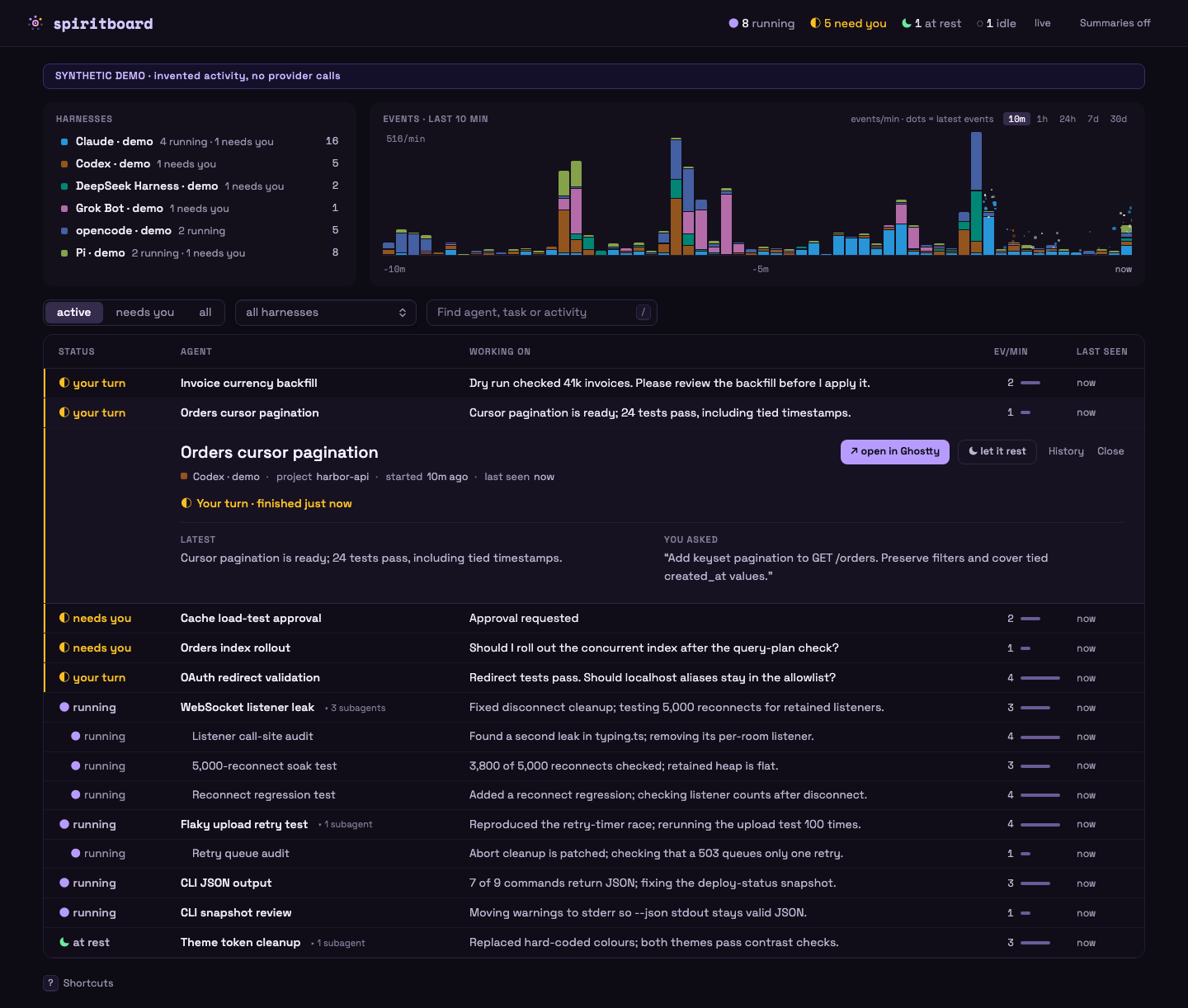
Synthetic data: invented software engineering sessions, projects, activity and app targets.
Quick start
Install uv, then run:
uvx spiritboard
This runs the published PyPI package and opens your local dashboard in the browser. No repo checkout or API key is needed. Supported Codex, Claude, opencode, Pi, Hermes, DeepSeek Harness and Grok Bot storage is discovered automatically, without opening authentication files or tables.
Mac users can also use a standalone app with its own window and Dock icon. Signed Apple Silicon
and Intel DMGs will be attached to GitHub Releases
starting with the first release made after Mac signing is configured. No Mac download has been
published yet; the macOS app guide
also explains how to install one locally from a checkout with bash src/app/install.sh.
The app includes the dashboard code present when it is built; rebuild it to include later web UI
changes. If it connects to an already running dashboard, it shows that server's web UI instead.
Leave the terminal running. Ctrl-C stops only Spiritboard, never an agent. Running the same command again reopens the existing board instead of starting a second collector. The terminal prints the local URL; if port 8766 is busy, a free port is chosen.
Want to look around before reading your own sessions? Use the synthetic demo:
uvx spiritboard --demo
The demo has separate local history and never discovers real profiles or calls a
model. Add --no-open to either command to print the URL without launching a browser.
AI summaries are optional and stay off unless you enable them.
Watch a 10-second tour: 48 agents across eight profiles
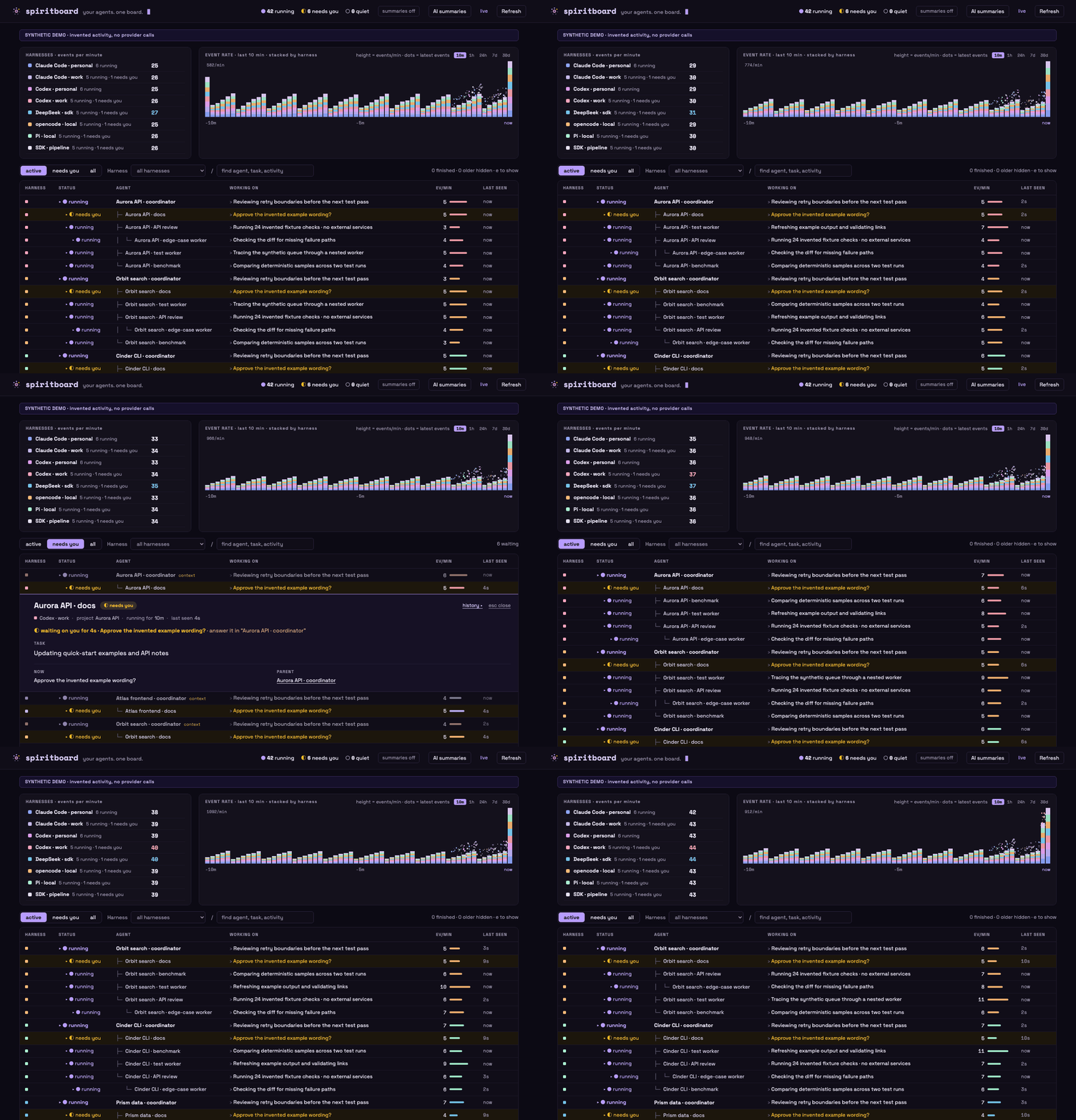
Watch or download the MP4 video
48 invented agents across eight simulated profiles: two Codex profiles, two Claude profiles, opencode, Pi, DeepSeek and an SDK pipeline, including nested subagents. Harness labels, accounts, tasks and activity are simulated through validated local events. No real harnesses, credentials or model calls are involved. This is an interaction demo, not a performance measurement.
For a permanent command:
uv tool install spiritboard
spiritboard
Python 3.12+ is required; uv manages the isolated environment and installs the needed
dependencies. Pin a release with uvx spiritboard@0.1.0. Each release has a matching
GitHub tag and release.
For a permanent installation of a local checkout, run
uv tool install --force --managed-python --python 3.13 . there,
then launch spiritboard. Keep data and private config outside checkouts and worktrees;
see the checkout relocation guide
before moving an existing setup.
GitHub development preview
To try unreleased changes instead of the PyPI release:
uvx --from git+https://github.com/topppg/spiritboard.git@main spiritboard
The moving main branch is a development channel, not a fixed release. See the
distribution guide
for upgrades, removal and publishing.
Supported harnesses
| Harness | Reads | Live or closed | Open | Resume |
|---|---|---|---|---|
| Claude Code (CLI) | ~/.claude*/projects, CLAUDE_CONFIG_DIR |
sessions/<pid>.json + process start time |
its terminal tab or app window | claude --resume <id> |
| Claude desktop app | the same folders, marked "Claude desktop", enriched from the app's session records | as Claude Code | the exact session (claude://code/continue) |
in a terminal with the CLI |
| Codex (CLI and ChatGPT app) | ~/.codex*, ~/.codex-switch/profiles/*, CODEX_HOME |
the thread locks a codex process holds | its terminal tab, or the ChatGPT window | codex resume <id> |
| opencode | opencode.db, read-only |
an opencode process in the session's directory |
its terminal | opencode -s <id> |
| Pi | ~/.pi/agent/sessions, PI_CODING_AGENT_DIR |
a pi process in the session's directory |
its terminal | pi --session <file> |
| Hermes | ~/.hermes/state.db, named profiles, HERMES_HOME, read-only |
runtime registry + process start time; unmatched live leases leave ownership unknown | a directly matched CLI terminal | hermes --resume <id> when verified closed |
| DeepSeek Harness | ~/.dsh (zstd-compressed), DSH_HOME |
the session.lock the app holds |
the app window | not yet |
| Grok Bot (macOS app) | the app's local cache, GROK_BOT_HOME |
unknown: its agents run in the cloud | the exact agent in the app | — |
| Your own agents | the Python SDK below | heartbeats | — | — |
Claude Code, Codex and opencode are checked against real sessions, and Pi against a real Pi 0.73 session (reading, liveness and resume). The Claude desktop marker and DeepSeek Harness are built from each app's own code and documentation and covered by tests, but have seen little or no real data yet. Hermes 0.22.5 reading, liveness and resume were checked with the real CLI and a local deterministic model endpoint. Fresh CLI leases can use an ID different from the stored session, leaving ownership unknown; native question/approval detection is unknown too. Grok Bot is read from the app's local cache, whose undocumented format was observed on one machine and may change; unrecognized versions are skipped with a warning. New harnesses plug in as one module each (see the source guide).
What you see
-
Every harness at once. Each storage profile (personal and work accounts, the default CLI folders, the desktop apps) is a harness with its own colour, live events per minute, and a 10-minute activity chart stacked by harness, with dots for the latest events. The harness list shows the harnesses with something running or drawn in the chart; idle ones stay available in the harness filter.
-
Where to put your attention. Main agents show one status; subagent rows and details leave it out:
Status Meaning ◐ needs you An unanswered question or approval was reported. It stays actionable until resolved. ◐ your turn Finished its turn and is waiting for your next direction: for 12 hours while the session is still open, otherwise for 30 minutes. ☾ at rest A turn you checked with let it rest (or r) in its detail view; nothing needed now. It goes back to your turn as soon as the agent does anything. Kept in this browser only.● running Working, including while it waits on a tool or a subagent. A running descendant also keeps its main agent running, even if the main agent's own transcript is idle or quiet. Explicit approvals, finished runs and closed sessions keep their own status. ◌ open · idle Still open in a terminal or app, idle for longer. It stays in the active view however long it idles, dimmed, grouped under one folded ▸ N open · idle line at the bottom of the list (unless one of its subagents is running or needs you). Its summary and title are not refreshed while it idles. ? status unknown No recent activity evidence. The agent may be working or waiting for an unrecorded reply. ■ closed No running process owns the session any more. ✓ done An SDK run reported that it finished. -
Spot the next reply. A small NEW flag beside the agent's name marks a newly finished turn or input request you have not checked. Opening its row or successfully opening its terminal or app window clears the flag without marking the turn at rest. A later turn can flag it again. Unanswered questions and approvals keep their needs you status until resolved, even after you check them. New flags and checked turns are remembered in this browser across reloads. On the first visit, turns already waiting form the baseline and do not all appear new. A new reply stays actionable until checked, even beyond the normal your-turn time window.
-
Keep an agent close. Use Pin to top in its details to keep it above the normal ordering, with a small pin beside its name; Unpin restores its usual position. Pins stay in this browser across reloads and new turns, scoped to this board's journal. Filters still apply. A pinned idle agent stays visible instead of joining the folded idle group. Pinning a subagent keeps it under its parent and brings that family to the top without opening its subagent list.
-
What each one is doing. The session's own title (your
/rename, the Claude desktop app's title, Claude's generated title, the Codex thread name, the opencode session title, a Pi/name, the Hermes session title, the DeepSeek Harness title or the Grok Bot agent's name), retitled by the summary model once the goal moves on, its goal, your latest request and the agent's latest reply or commentary. Open a session and click its name to rename it in Spiritboard only; clear it to go back to the automatic title. Subagents sit under their parent, named by the task the parent gave them. Each subagent list starts collapsed, including running agents and search results. Click ▸ N subagents (ors) to open or close that list; nested lists have their own toggles. Your choice lasts until you toggle it again or reload. Opening or closing agent details leaves the lists as you chose them. Collapsing a list keeps its parent's details open and closes any hidden subagent's details. Sessions the Claude desktop app runs are tagged Claude desktop; ones archived there never count as active. -
Jump in. Open a session in the terminal or app that runs it (cmux, tmux, iTerm2, Terminal, VS Code, the ChatGPT, Claude or DeepSeek Harness app), or copy a resume command when it is closed.
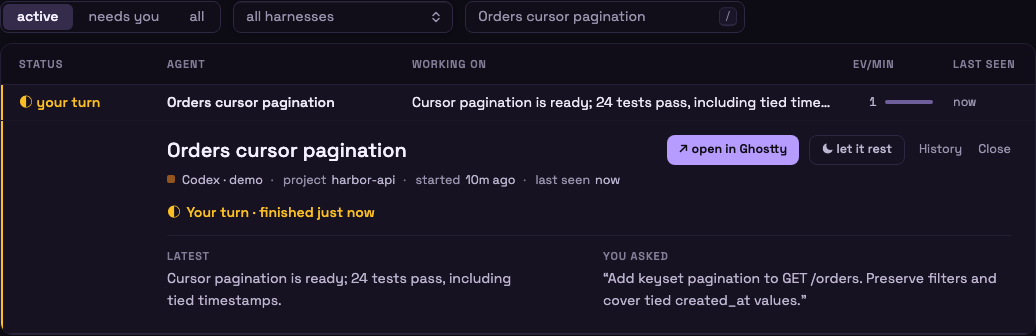
Synthetic session and app target. This turn has finished and has no running subagents.
Click a row to open it in place; / finds, j/k move between top-level agents, Esc closes, a / w
/ e switch between active, needs-you and all, r lets the open session's
turn rest, and o brings the focused session's window forward. Click a table heading to sort by
that column, click again to reverse it, and a third time to restore the default
attention order: new turns and unanswered input requests first, running work next,
then older your-turn sessions you have checked. Sessions stay in the main list.
Except for STATUS, sorting orders within groups: busy and needs-you agents
stay above ones at rest, and those above history. Unpinned open idle sessions stay at the bottom.
Pins take priority over default and column ordering within the current view;
subagents stay under their parent while sorting.
Drag the edge of the STATUS or AGENT heading to widen it (arrow keys work when the
edge is focused); the width is remembered and a double-click resets it.
Zoom the event-rate chart out to the last hour, day, week or 30 days. Click a
bar to see the board as it was at that moment, rebuilt from the recorded
events; L, "back to live" or the newest bar returns to now. Liveness was
never recorded, so the past board never calls a session closed, and its open
and resume buttons are off.
How it works
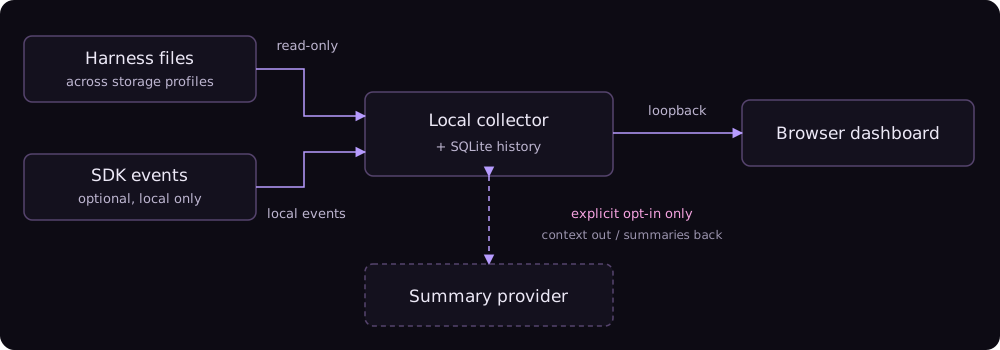
The collector reads supported harness files without changing them and keeps its own local history. Your browser connects to that collector on your machine. Summary providers receive selected context only after you connect and enable them; the dashboard and synthetic demo work without one.
Measured local baseline
Spiritboard 0.1.0, Apple M4 Pro, Python 3.13.11; seven fresh collector launches with the built-in five-run demo and native discovery disabled, measured October 21, 2026:
| Collector-only metric | Median across seven launches |
|---|---|
| Process start to healthy local endpoint | ~76 ms |
| Observed resident memory (RAM) after startup | ~34 MiB |
These figures exclude first-time installation/downloads, browser memory and rendering,
native-profile scanning, and model calls. System file caches were not cleared; RAM is
observed usage, not peak memory or a long-running guarantee. Real workloads will differ.
See the method, ranges and individual samples
and rerun uv run python scripts/benchmark_startup.py --samples 7 from a checkout.
Sources and privacy
-
Input status across interfaces. Native lifecycle events can report questions before they reach transcripts. Run
spiritboard inputs installto add local Claude/Codex hooks and OpenCode/Pi extensions, independently of the terminal. Codex requires reviewing the installed hooks with/hooks; existing prompts are not replayed. DeepSeek and Grok Bot also use their recorded input states. Setup is explicit and reversible; coverage, setup and limitations explain what each source can report. -
Discovery. The standard
~/.claude,~/.codex,~/.pi/agent,~/.hermesand~/.dshfolders, named variants such as~/.claude-workor~/.codex-switch/profiles/*,CLAUDE_CONFIG_DIR/CODEX_HOME/PI_CODING_AGENT_DIR/PI_CODING_AGENT_SESSION_DIR/HERMES_HOME/DSH_HOME, Grok Bot's cache in~/Library/Application Support/Grok Bot(macOS) orGROK_BOT_HOME, and opencode'sopencode.db(and release-channel databases) in$XDG_DATA_HOME/opencodeor~/.local/share/opencode, orOPENCODE_DB. The opencode database is opened read-only, as is Hermes'sstate.db; Hermes named profiles under~/.hermes/profiles/<name>are discovered too. DeepSeek Harness logs are zstd-compressed: their text needs Python 3.14+ or thezstdcommand; without either, its sessions are listed with liveness but no text. To choose sources yourself, write a private config and pass it:spiritboard discover --write-config ~/.config/spiritboard/profiles.json spiritboard --config ~/.config/spiritboard/profiles.json
An explicit config replaces automatic discovery, so list every folder you want. Equal session IDs or names never merge across profiles, and a profile label is not proof of which account is signed in.
-
Text. Task and reply excerpts are shown by default. Set
"include_text": falseon a profile to hide them. Excerpts can contain private information and stay in local history, so review the board before recording or sharing it. -
History window. Transcripts not modified in the last 7 days are skipped without being read; change it with
--max-age-days N(0reads everything). -
Liveness. Every few seconds Spiritboard checks which sessions a live local process still owns, from Claude's
sessions/<pid>.json, the Codex thread locks and the DeepSeek Harnesssession.lockfiles. Hermes uses itsruntime/active_sessions.jsonregistry matched against process start times. opencode and Pi record no per-session owner. With N liveopencodeprocesses in a directory, its N most recently updated top-level sessions and their children count as open. A livepiprocess marks that directory's most recent session open. A session is only marked closed when the relevant check can run. Grok Bot agents run in the cloud, so their liveness is unknown. A missing or unreadable Hermes registry also leaves ownership unknown. An unmatched live Hermes lease blocks resume; gateway routes can establish liveness but cannot select a terminal to focus.
What is read, and the bounds on it, are in the source guide.
Open a session in its app
Opening a row looks up which local process owns the session and how to show it:
a cmux panel, a tmux pane, an iTerm2 session, an Apple Terminal tab, or the
owning app's window (VS Code, Ghostty, ChatGPT, Claude desktop, DeepSeek Harness).
A live Claude desktop session opens directly in the app with
claude://code/continue; when the app's record of it is unknown, the app is just
brought forward. A Grok Bot agent runs in the cloud, so it has no local process;
it opens directly in the Grok Bot app with the app's own agent link. On Linux,
tmux panes and wmctrl windows are supported.
Pointing at a row whose session is still open shows a small ↗ just before its
name: click it, or press o on the focused row, to bring the window forward
without opening the row. Spiritboard looks the window up the first time you
point at or focus a row, so rows you never touch cost nothing; only the ↗'s
tooltip names the app. Narrow windows leave the ↗ out; o and the opened row's
button still work.
The ↗ and the button only bring a window forward. They never type into, signal
or control an agent. The first iTerm2 or Terminal use can trigger a macOS
automation prompt. For a closed session the button offers a resume command, such as
claude --resume <id> with the profile's CLAUDE_CONFIG_DIR, for you to copy
and run; Spiritboard never runs it, and never offers it while the session might
still be running elsewhere. DeepSeek Harness sessions offer no resume command. A
closed Claude desktop session resumes in a terminal with the CLI, and its button
says so.
Optional goal summaries
Open AI settings in the dashboard header, including on smaller screens. The panel opens automatically on your first visit if no provider is connected; choose Maybe later to skip setup. This choice is remembered in this browser for the dashboard address when browser storage is available. Demo mode and existing connections do not trigger setup. Read the excerpt-sharing notice, choose a provider, then sign in or add a key. OpenRouter supports sign-in or an API key; Anthropic and OpenAI support API keys. Continue with ChatGPT uses an eligible Plus or Pro account; Enterprise workspaces are not supported by that sign-in route. No existing agent-account credentials are borrowed. These connections and your summary setting survive restarts. Saved keys and ChatGPT tokens use macOS Keychain, Windows Credential Manager, or Linux Secret Service—not plaintext files. If secure storage is unavailable, Spiritboard asks you to set it up or unlock it; it never falls back to a file.
Each eligible session gets one line describing its overall goal. Claude's own
recaps are used as they are, at no cost. Other sessions use your preferred
provider first: deepseek/deepseek-v4-flash on OpenRouter, gpt-6-luna with
medium reasoning through ChatGPT or OpenAI API, or claude-haiku-5-5 through
Anthropic API. If needed, another explicitly connected provider can be tried.
Pause summaries or disconnect at any time.
API-key connections use separate API billing; ChatGPT sign-in uses your plan allowance and its limits. The AI settings tooltip separates known API charges, API calls with unknown cost, and ChatGPT plan calls rather than treating usage as free. Excerpts are redacted on a best-effort basis, not guaranteed safe for confidential work. Read the summary guide.
For a terminal-only setup, spiritboard --summaries accepts
OPENROUTER_API_KEY or --openrouter-key-file /absolute/path/to/private.env.
Launch-provided keys stay in memory and are never served to the browser.
Stop an existing board before changing its launch settings. A second command with different options refuses to reuse it, rather than silently ignoring your privacy or source choices, including edits to an explicit source config.
Report from your own agents
A small SDK lets any Python agent report runs, subagents, activity and tool calls to the same board:
from spiritboard.launcher import default_data_dir, running_url
from spiritboard.sdk import Client

data = default_data_dir()
token = (data / "token").read_text().strip()
with Client(running_url(data), token, account="example") as client:
    with client.run("Coordinator", "Inspect an invented change") as root:
        with root.child("Reviewer", "Check the example") as child:
            child.activity("Checking the invented test fixture")
            with child.operation("tool", "Read synthetic fixture"):
                pass  # Put your actual operation here; no automatic interception.
        root.activity("Review complete")
    delivered = client.flush(timeout=2)
    print("Delivered:", delivered, client.diagnostics)
Start spiritboard first; running_url finds it on whichever port it bound. With
another --data-dir, pass that directory instead. spiritboard demo uses the same
lookup to send its synthetic scenario to the running board. Use heartbeat() during
long quiet work. Failed delivery never changes your application's result; check
flush() and diagnostics to detect loss.
Local storage and cleanup
History stays in a stable per-user directory, independent of your terminal's working folder:
| Platform | Default directory |
|---|---|
| macOS | ~/Library/Application Support/spiritboard |
| Linux | $XDG_DATA_HOME/spiritboard, or ~/.local/share/spiritboard |
| Windows | %LOCALAPPDATA%/spiritboard |
--demo uses its demo subdirectory. --data-dir /your/chosen/directory
overrides either default. Existing checkout-local history is never moved or
deleted; pass its old directory explicitly to keep using it.
On macOS/Linux, existing data directories must be private to your user; unsafe permissions cause a clear error instead of being changed automatically.
This directory holds events.sqlite3, a private ingestion token, an instance
lock and, with summaries on, summaries.sqlite3. Keep it and any custom source
config out of version control. The running dashboard deletes history older
than 30 days at startup and then hourly; --retention-days N changes that and
--retention-days 0 keeps everything. To prune by hand:
spiritboard prune --older-than-days 7
Either way this deletes only old observer records, never your agents' transcripts,
and keeps active runs. Stop the dashboard before a manual prune; it refuses while
that data directory is in use. You can
run separate boards with separate --data-dir values and ports.
Development
Contributors still use a checkout:
uv sync --frozen
uv run spiritboard --demo --no-open
uv run ruff check . && uv run ruff format --check .
uv run pytest
node --check src/spiritboard/static/app.js
Node is optional for the Python tests but runs the browser DOM test; check for skips before relying on that coverage. Contribution rules, including worktrees and one change per PR, are in AGENTS.md.
More detail: sources,
summaries,
historical validation record,
archived functional plan
and reference projects. The references/ folder holds
shallow research checkouts of other projects, excluded from Git history and never
installed, executed or copied.
Direction
Spiritboard stays a small local observer: one board for every agent harness you use, which tells you at a glance what each agent is working on and which one needs you. It is not a cost or process monitor, and it does not launch, steer or approve agents.
The look is ghostly rather than spooky: dark amethyst surfaces, Space Grotesk for reading with Space Mono for numbers and times, violet for activity, amber for attention, green for rest, pink for summaries, and motion only when something actually changes. Labels stay literal (needs you, your turn, closed, open in cmux), with one nod to the board: a turn you checked is at rest.
Next: more harnesses and framework adapters, exact tab focus for Ghostty once a released version exposes it, and a longer scripted demo scenario for recording.
Boundaries
Spiritboard is an independent, unofficial project. It is not affiliated with or endorsed by Anthropic (Claude), OpenAI (Codex), or the makers of the other tools it reads.
This is an observer, not an agent framework, task scheduler or remote control. It never kills, steers or approves actions; opening a session's app only brings an existing window forward. A clear board must never hide lost events or claim that an unresponsive agent has failed.
License
MIT. The bundled Space Grotesk and Space Mono fonts are under the
SIL Open Font License 1.1; their licences ship next to them in
src/spiritboard/static/fonts/.
1 maintainer

Metadata
1 maintainer
Release files for spiritboard 0.4.0
For a detailed explanation of source distributions (sdists) and built distributions (wheels), please see the package formats documentation.
Source distribution (sdist)
| File | Size | Uploaded | Provenance | Actions |
|---|---|---|---|---|
| spiritboard-0.4.0.tar.gz | 5.4 MB | Without provenance | Details for spiritboard-0.4.0.tar.gz |
Built distribution (wheel)
| File | Interpreter | ABI | Platform | Actions Reset |
|---|---|---|---|---|
| spiritboard-0.4.0-py3-none-any.whl | Python 3 | none | any | Details for spiritboard-0.4.0-py3-none-any.whl |
Total release size: 5.7 MB
Release files / spiritboard-0.4.0.tar.gz
| Download URL | spiritboard-0.4.0.tar.gz |
|---|---|
| Size | 5.4 MB |
| Tags | Source |
|
SHA-256 checksum How to use checksums |
ba4ae74d8cccead13bac5e4e096b0fa4037700440e20fd4f3c1c1a0795a80963
|
|
BLAKE2b-256 checksum How to use checksums |
691ee2445d95eeaede91ea61f60751f7199056c0a7492afbd8ba0af08932f02a
|
| Upload date | |
|
Uploaded using Trusted Publishing? What is trusted publishing? |
Yes |
| Uploaded via |
uv/0.13.7 {"installer":{"name":"uv","version":"0.13.7","subcommand":["publish"]},"python":null,"implementation":{"name":null,"version":null},"distro":{"name":"Ubuntu","version":"24.04","id":"noble","libc":null},"system":{"name":null,"release":null},"cpu":null,"openssl_version":null,"setuptools_version":null,"rustc_version":null,"ci":true}
|
Release files / spiritboard-0.4.0-py3-none-any.whl
| Download URL | spiritboard-0.4.0-py3-none-any.whl |
|---|---|
| Size | 246.3 kB |
| Tags | Python 3 |
|
SHA-256 checksum How to use checksums |
b4729d5bec03c88b3a21d8211068575f6c334747fde5c0d5ce394bf70462cd2e
|
|
BLAKE2b-256 checksum How to use checksums |
d2af499b4423078f22304b14217e05bfd52479632a3cb45e2d13f0c6a7b857c2
|
| Upload date | |
|
Uploaded using Trusted Publishing? What is trusted publishing? |
Yes |
| Uploaded via |
uv/0.13.7 {"installer":{"name":"uv","version":"0.13.7","subcommand":["publish"]},"python":null,"implementation":{"name":null,"version":null},"distro":{"name":"Ubuntu","version":"24.04","id":"noble","libc":null},"system":{"name":null,"release":null},"cpu":null,"openssl_version":null,"setuptools_version":null,"rustc_version":null,"ci":true}
|
Security for spiritboard 0.4.0
Provenance
Provenance describes where a file came from. On PyPI, provenance is shared via attestations, which provide a verifiable record of the build or publishing details. View details, limitations and caveats.
No provenance found
None of the files in this release were uploaded with provenance metadata.
A note on package security
PyPI is a repository for distributing packages, not a service for auditing them. While third-party security researchers and our staff do their best to detect and remove malicious packages, PyPI cannot guarantee the quality, security or suitability of any given package.
To learn more about protecting yourself from malicious actors, visit our package security documentation.














